Maintaining compliance with industry standards is critical in today’s security-conscious climate. The Cybersecurity Maturity Model Certification (CMMC) framework aims to secure sensitive information from threats. Organizations must be prepared for audits to ensure compliance. This is where software solutions can help.
Understanding CMMC Compliance
Cybersecurity Maturity Model Certification (CMMC) is a model for evaluating cybersecurity capabilities. The CMMC compliance software solution provides a systematic process for protecting critical information.
For some government contracts, government agencies only allow organizations that have reached certain compliance levels to bid. Successfully managing compliance is a key requirement for obtaining such contracts.
Governments focus on different levels, from basic cybersecurity hygiene to advanced security. Hence, compliance consists of creating processes and practices that match these levels. Preparing paperwork for upcoming audits means staying aware of guidelines 24/7. Such expectations demand an impressive set of tools for organizations trying to stay ahead of these requirements.
The Role of Software Solutions
Where compliance is necessary, software solutions can help immensely. These solutions provide centralized platforms for managing and tracking compliance activities. Such tools offer automated checks, lowering the chance of human errors. With such solutions, organizations can track progress and understand areas that still need work.
Automation makes documentation easier by ensuring all required records are current. This is crucial during the audit process, as it allows auditors to immediately access the information they require.
Features to Look For
Here are some key characteristics of compliance solutions you should look for when choosing one:
- Integration: First, the software should be integrated seamlessly. It should be implemented appropriately with minimal disruptions.
- Real-time Monitoring: Another key feature is real-time monitoring. With regular tracking, you can identify problems instantly. These problems can be mitigated quickly to reduce risk and improve security.
- Reporting: Reporting capabilities are crucial. The detailed report generation capability helps determine compliance levels. These reports allow for learning to inform decision-making and practice.
User-friendly interfaces are equally important. They ensure that team members can exploit these tools effectively without laborious training. A well-designed, intuitive interface ensures that the software will be used efficiently for maximum benefit.
Advantages of Employing a Compliance Software
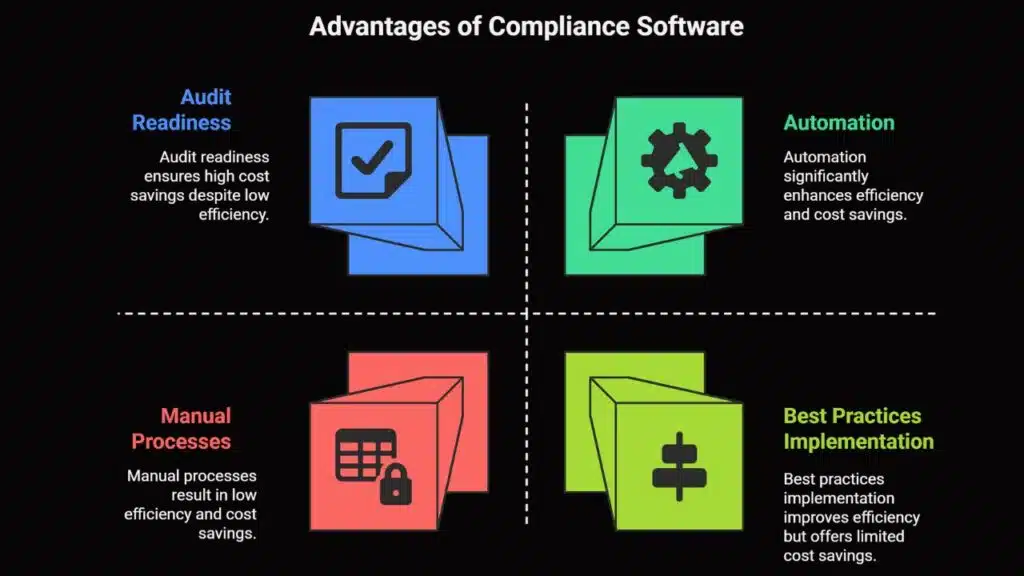
Compliance software offers numerous advantages. It minimizes the time spent on manual processes and leaves room for other tasks, so resources are well-utilized in different areas. Automation helps improve accuracy by reducing the possibility of errors.
Another strong advantage is cost savings. Although the software requires an upfront investment, the labor-related savings recorded over time are significant, as are the savings associated with avoiding penalties. Furthermore, these tools help ensure best practices are applied equally, thus enabling security.
In addition, the software makes it much easier to remain audit-ready. With everything organized and documentation ready and easily accessible, audits become much less painful. This allows organizations to handle audits well and ensure all requirements are met.
Implementing a Compliance Solution
Successful implementation requires careful planning. From here, evaluate and identify gaps in current systems. Knowledge of existing practices aids in configuring the software for the organization. Training is essential. To maximize the system’s effectiveness, everybody on the team must be on board with it. Staying compliant requires regular updates and learning to keep everyone aligned.
Interdepartmental collaboration is equally important. A singular approach can eliminate any potential missing pieces in compliance. Transparency facilitates implementation and continuous improvement.
Continuous Improvement and Adaptation
Remaining audit-ready is always a work in progress. Reviewing or updating practices regularly helps ensure effective compliance. Organizations can stay adaptable and respond to changes in standards and regulations. With software solutions, organizations can easily adapt.
Software solutions improve with user feedback. Team members must be motivated to share their observations and recommendations, which is valuable for streamlining processes and increasing the software’s efficiency.
Compliance requires adapting to fresh challenges. Keeping up with industry trends and updates is a must. This awareness assists organizations in staying ahead of the compliance curve.
Conclusion
For organizations dealing with sensitive data, such as that coming from the Department of Defense, compliance with CMMC is a must. Software solutions help simplify the compliance process and provide better monitoring, reporting, and security functionalities.
These processes can keep organizations audit-ready at all times. These advantages go beyond compliance, including cost savings and security improvements. Continuous improvement and consistent adaptation align organizations with ever-changing needs.