For decades, the story of gaming was simple. You bought a console or a powerful PC, you bought discs or downloads, and you played locally. Today, that story is changing fast. Cloud gaming services and game streaming platforms are turning devices we already own – phones, laptops, smart TVs – into full gaming machines.
The game runs on remote servers. The player simply streams the video, sends back inputs, and keeps playing from almost anywhere. Market forecasts now expect cloud gaming to grow at a very high compound annual rate toward 2030, reaching tens of billions of dollars in value. For many publishers, cloud gaming is no longer a side project. It is part of the core strategy for subscriptions, access, and engagement.
Cloud gaming, the new standard, does not mean that consoles disappear overnight. It means the way people access games is shifting. For a growing number of players, the first step is not buying hardware. It is opening an app and tapping “Play.”
What Cloud Gaming Really Is – and What It Isn’t
Cloud gaming is often described as “Netflix for games,” but the comparison is only half right.
From Downloads to Streams
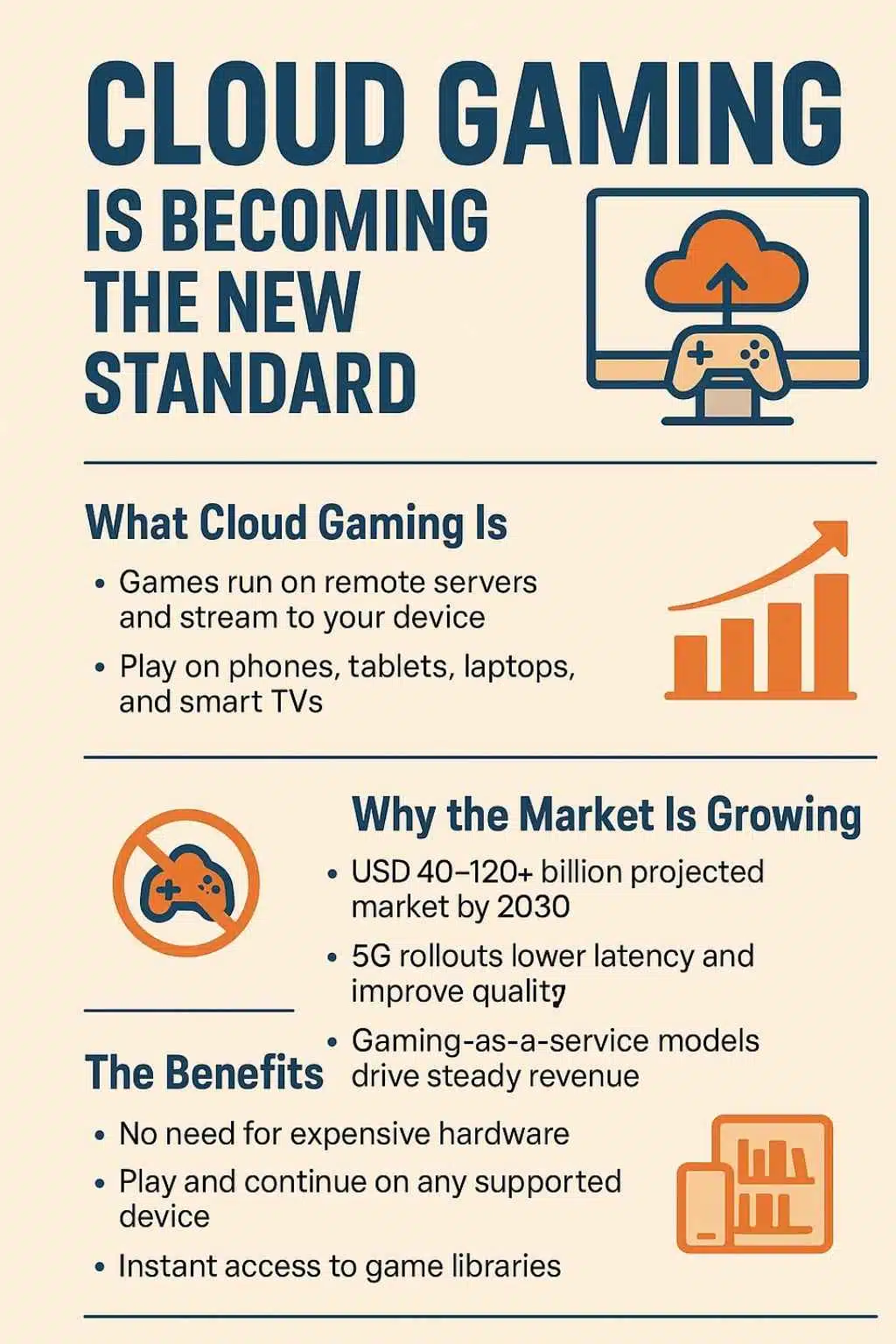
In a traditional setup, you download a game to a console or PC. The device handles all the processing. In cloud gaming, the heavy lifting happens in a data center. High-end servers render the game, compress the video, and stream it to you over the internet.
You send commands with a controller, mouse, or touchscreen. The system sends frames back in real time. The goal is simple: make the player forget that the game actually runs hundreds of kilometers away.
This is different from remote play, where you stream from your own console or PC at home. Cloud gaming services run on shared infrastructure. You are effectively renting a slice of a powerful gaming rig on demand.
The Current Cloud Gaming Ecosystem
Several cloud gaming services now compete in this space:
- Xbox Cloud Gaming inside the Game Pass ecosystem
- Nvidia GeForce Now Ultimate, which offers RTX 4080-class or newer GPU performance in the cloud
- PlayStation Plus cloud streaming on supported titles
- Amazon Luna and regional platforms backed by telecom operators or local clouds
Some focus on subscription catalogs. Others focus on high-end performance or “bring your own library.” Together, they are normalizing game streaming as a mainstream option, even after the shutdown of Google Stadia, which once raised doubts about the model.
Follow the Money: Why the Market Is Moving to the Cloud
The strongest signal that cloud gaming is becoming the new standard comes from the numbers and incentives behind it.
Explosive Growth Projections
Different research firms disagree on exact figures, but the direction is clear. Many now estimate the cloud gaming market at under USD 20 billion in the mid-2020s, with potential to reach between USD 40–120+ billion by 2030, depending on methodology and scenario.
What drives this curve?
- Cheaper and faster broadband
- Global 5G rollouts and 5G cloud gaming tests
- Growing catalogs of streaming-ready games
- Integration into subscriptions like Xbox Game Pass and PlayStation Plus
Asia-Pacific, in particular, already represents a large share of the cloud gaming market thanks to strong mobile networks and a smartphone-first gaming culture.
Gaming-as-a-Service Changes the Business Model
Cloud gaming fits neatly into gaming-as-a-service (GaaS) and subscription strategies. Instead of one-time box sales, publishers and platform holders push.
- Monthly or yearly subscriptions
- Seasonal passes and live services
- Microtransactions and cosmetic items
Cloud streaming makes it easier to drop players into new content immediately. No long downloads, no big patches, no waiting.
For companies, this means:
- More consistent recurring revenue
- Better data on how players engage
- Stronger leverage over distribution and pricing
When you combine high growth projections with recurring revenue, cloud gaming becomes hard for big players to ignore.
The Tech That Makes Cloud Gaming Work
Cloud gaming existed as an idea long before it reached mainstream attention. The difference today is that the technology has caught up.
Lower Latency Through 5G and Edge Computing
Latency – the delay between pressing a button and seeing the result – is the main enemy of cloud gaming. High ping, jitter, and packet loss can ruin the experience, especially in fast-paced games.
Now, several trends are working in cloud gaming’s favour:
- Wider fiber broadband coverage
- Mass deployment of 4G+ and 5G networks, especially in urban areas
- Edge computing, where data centers move closer to players to reduce distance
Telecom providers and hyperscale cloud firms are actively testing 5G cloud gaming services and edge nodes. The goal is to keep latency low enough that most players cannot tell the difference between local and remote play in many genres.
Cloud GPUs and High-End Performance
Hardware advances matter as much as networks. Cloud gaming services now deploy GPU clusters with serious power.
- Nvidia’s GeForce Now Ultimate tier uses RTX 4080 or newer-class GPUs, offering high frame rates and ray tracing at up to 4K.
- Newer upgrades like RTX 5080 in the cloud promise resolutions up to 5K and very high fps ceilings at 1080p and 1440p.
For players on low-spec devices, the result is dramatic. A basic laptop or tablet can suddenly run games that would normally demand a high-end desktop GPU.
Smarter Codecs and AI-Assisted Streaming
Cloud gaming also benefits from advances in video compression and AI. New codecs, network optimizations, and AI-driven encoding help.
- Maintain image quality at lower bitrates
- Smooth out temporary drops in connection quality
- Predict input and frames to reduce perceived latency
The result is a more stable, low-latency game streaming even on connections that would have struggled a few years ago.
Why Players Are Embracing Cloud Gaming
Technology and business models explain why companies push cloud gaming. But why are players willing to follow?
No Console, No Gaming PC, No Problem
The biggest advantage is simple: access.
For a new gamer, buying a console or a gaming PC can cost several hundred dollars, sometimes more.
A cloud gaming service often only requires:
- A compatible device (phone, tablet, TV, browser)
- A decent internet connection
- A subscription or pay-per-use access
This lowers the barrier to entry for:
- Students and younger players
- Gamers in emerging markets
- People who play casually and don’t want to invest in hardware
Cloud gaming services turn a smart TV and a cheap controller into a full gaming machine. For many households, this is enough.
Play Anywhere, Continue Anywhere
Cloud gaming services treat the game as a service tied to your account, not your device.
That lets you:
- Start a game on a smart TV
- Continue on a laptop at a café
- Pick up a phone while commuting
Save synchronization and cross-platform continuity are now core features, especially in ecosystems like Xbox Cloud Gaming. Microsoft’s recent updates even highlight exact save sync timestamps to reassure players that their progress is safe when they move between devices.
Instant Access to Backlogs and New Releases
In the age of digital stores, many players already own more games than they can finish.
Cloud gaming makes it easier to:
- Test large games without downloading tens of gigabytes
- Jump into new releases instantly if they are included in a catalog
- Reduce friction when trying games outside your usual genre
This “instant access” mindset aligns perfectly with subscription-based game streaming platforms. Choice is abundant. Friction is the enemy. Cloud gaming minimizes that friction.
Why Platforms and Publishers Want Cloud Gaming as the Default
From a strategic viewpoint, cloud gaming gives platforms and publishers several advantages.
Subscriptions and Deep Player Data
When a player streams games from a central service, the platform sees almost everything.
- Which games do people try
- How long do they play
- Where do they drop off
This level of telemetry supports:
- Better tuning of live service games
- More targeted marketing and recommendations
- Smarter curation for subscription catalogs
For subscription providers, cloud gaming is a natural extension of the “all-you-can-play” model. It keeps players inside the ecosystem, and it makes churn less likely.
Reaching Markets Without Shipping Hardware
In many regions, console penetration is low, but smartphone and smart TV usage is high.
A cloud gaming service can reach these players without:
- Building a local console distribution network
- Handling customs and logistics for hardware
- Managing complex retail relationships
In these markets, cloud gaming and game streaming platforms often arrive bundled with telecom plans, TV apps, or set-top boxes. That makes them feel like a standard part of digital life, much like video streaming.
Successes, Setbacks, and the New Cloud Playbook
Cloud gaming’s path has not been linear. Early failures shaped today’s strategies.
Xbox Cloud Gaming: From Experiment to Pillar
Xbox Cloud Gaming started as a beta perk inside Game Pass. Over time, it gained:
- Wider device coverage (browsers, Smart TVs, handhelds)
- Higher streaming quality, including 1440p options for Ultimate-tier subscribers
- UX improvements, such as clearer save sync indicators and better controller support
Microsoft is now experimenting with ad-supported or lower-cost streaming models, aiming to use cloud access as a funnel into its wider subscription ecosystem.
Nvidia GeForce Now Ultimate: High-End PC in the Cloud
Nvidia’s GeForce Now Ultimate tier positions cloud gaming as a performance upgrade, not just a budget alternative.
It offers:
- RTX 4080- and 5080-class cloud GPUs
- High frame rates (up to very high fps at 1080p and 1440p)
- Support for ray tracing and advanced upscaling
This appeals to players who want high-end PC quality but don’t want the upfront cost of a new GPU.
Google Stadia: A Cautionary Tale
Google Stadia launched with big promises and strong technology, but it shut down in 2023.
Analysts and former partners have pointed to:
- Limited exclusive content
- Confusing business models
- Gaps in marketing and community building
Stadia proved that cloud gaming can work technically. It also proved that technology alone is not enough. Content, pricing, and ecosystem matter just as much.
Where Cloud Gaming Is the “New Standard” – and Where It Isn’t
Cloud gaming, the new standard, doesn’t mean a single model dominates everyone, everywhere. It means that for certain use cases, streaming is becoming the default expectation.
When Cloud Is Already the Default
Cloud gaming is fast becoming the standard choice for:
- New or casual players who do not own consoles or gaming PCs
- Households where a smart TV is the main entertainment hub
- Travelers and commuters who want to continue their savings on a mobile or a laptop
- “Try before download” sessions for large or experimental titles
In these contexts, many players now assume that a game streaming option should exist.
Why Consoles and PCs Are Not Going Away
At the same time, dedicated hardware keeps clear advantages:
- Competitive esports and latency-sensitive genres still favour local play
- PC gaming offers modding, open ecosystems, and deep customization
- Many players still prefer owning games locally and playing offline
For these segments, cloud gaming is more of a backup or complement than a full replacement.
The likely outcome is hybrid: consoles and PCs remain strong, while cloud gaming becomes the normal way to access and sample games for millions of users.
The Friction Points Slowing Total Takeover
Cloud gaming faces real constraints that will shape its growth curve.
Infrastructure, Data Caps, and the Digital Divide
Not every region enjoys fast, affordable broadband. In many countries:
- Rural areas lag behind urban centers
- Data caps make high-bitrate streaming expensive
- Peak-time congestion can hurt quality
For players dealing with these issues, cloud gaming may feel unreliable or too costly compared with offline play.
Latency-Sensitive Genres Still Struggle
Turn-based RPGs, strategy games, and slower-paced adventures can work well over the cloud. High-level competitive shooters, fighting games, and rhythm titles are less forgiving.
Even small amounts of extra latency can break the experience for players at the highest skill levels. Until routing and edge deployments improve further, local hardware will remain the preferred choice for serious competitors.
Ownership and Platform Risk
Finally, cloud gaming raises questions about ownership:
- What happens if a cloud gaming service loses a license?
- What if a game leaves a catalog or a platform shuts down?
- Can players transfer saves and purchases to other ecosystems?
The Stadia shutdown is still a reference point. Many players watched a major platform disappear and took note. Trust will shape how quickly players accept cloud gaming as their main way to play.
2026–2030: How Far Can Cloud Gaming Go?
Looking ahead, several trends will drive cloud gaming’s next phase.
Market Growth Scenarios
If current projections hold, cloud gaming could become a substantial slice of the global games market by 2030, potentially worth tens of billions of dollars annually.
Even in conservative scenarios, game streaming will sit alongside consoles, PCs, and mobile as one of the standard ways to access games, not a niche experiment.
AI-Enhanced, Server-Side Gaming
Cloud gaming also pairs naturally with AI and heavy computing.
Because games run in powerful data centers, developers can:
- Use AI to generate or adapt worlds in real time
- Personalize difficulty and NPC behaviour
- Run large-scale simulations that would overwhelm local hardware
As generative AI tools mature, we can expect new genres and experiences that assume a server-side environment from day one.
The Battle for the Living Room and the Smartphone
Finally, the race is on to own the “entry point” for cloud gaming:
- Smart TVs with built-in game streaming apps
- Streaming sticks and set-top boxes bundled with subscriptions
- Mobile apps that turn phones into primary gaming devices
Whoever controls these entry points – console makers, cloud providers, telcos, or media companies – will shape how players experience cloud gaming.
Key Questions Gamers Still Ask
Before cloud gaming truly becomes the new standard, players want clear answers.
Will cloud gaming completely replace consoles and PCs?
Not in the near term. Instead, it will sit beside them. For many use cases, streaming will be the default. For others, local hardware will remain best.
How fast does my internet need to be?
Requirements vary by service, but a stable connection with decent bandwidth and low latency is essential. Many platforms now recommend at least 15–25 Mbps for 1080p streaming and more for higher resolutions.
Do I really own cloud-streamed games?
Often, you own access rather than a permanent copy. This depends on each platform’s terms, but in most cases, if a title leaves the service, your access ends.
Is cloud gaming eco-friendlier?
Data centers can be efficient, especially when powered by renewable energy. However, energy use shifts from personal devices to shared infrastructure. The net effect depends on the specific setup and region.
Who benefits most right now?
New players, casual gamers, and people with good connections but limited hardware benefit immediately. Core and competitive players benefit more selectively, often using cloud gaming as a complement.
Bottom Line: The New Access Standard
Cloud gaming is not a distant promise. It is already embedded in daily habits, subscription bundles, and device ecosystems. For a growing number of people, the first way they experience an AAA game is through a stream, not a download.
That is what “the new standard” really means. Not the end of consoles or PCs, but a new default for access – fast, device-independent, and deeply integrated into broader digital ecosystems.
Over the next five to ten years, the most likely future is hybrid:
- Consoles and PCs for ownership, performance, and offline resilience
- Cloud gaming services for instant access, discovery, and everyday play
For gamers, developers, and investors, the key will be simple: treat cloud gaming not as a side experiment, but as a central pillar of how the industry reaches and serves its next billion players.