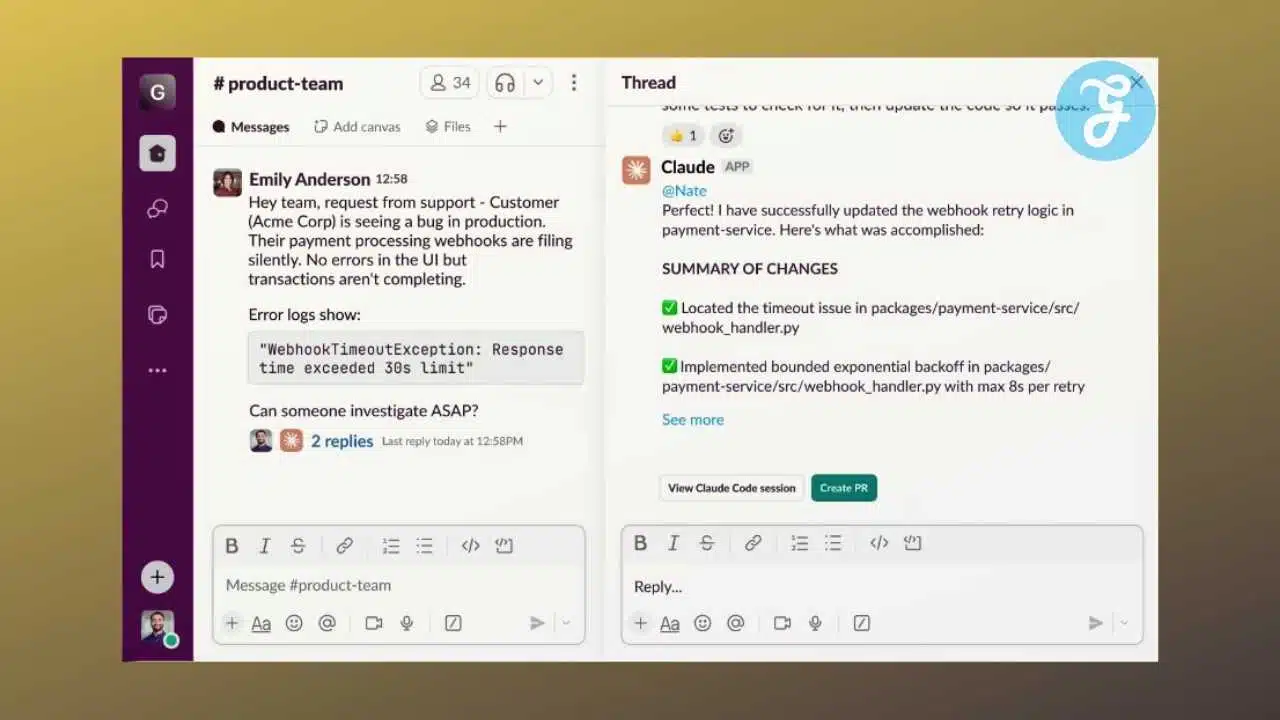
Anthropic recently unveiled a beta integration that seamlessly brings its advanced Claude Code AI assistant directly into Slack, the popular workplace messaging platform. Launched on Monday, this feature allows developers to invoke Claude Code effortlessly by simply tagging @Claude within any ongoing Slack conversation or thread. This strategic move underscores Anthropic’s commitment to embedding sophisticated AI coding capabilities into everyday collaboration tools, where engineering teams naturally discuss project updates, troubleshoot issues, and brainstorm solutions.
The integration works by intelligently pulling contextual details from the surrounding Slack discussion, enabling Claude Code to perform complex tasks such as debugging intricate bugs, refactoring legacy codebases, generating comprehensive pull requests, and even suggesting optimizations tailored to the team’s specific needs. As the AI processes these requests in the background, it provides real-time status updates right in the Slack thread, ensuring transparency and keeping all team members informed without disrupting their workflow. Users can then click through to detailed session logs for a deeper review, making the process collaborative and efficient.
This beta release is positioned as a research preview, meaning it’s available for early adopters to test and provide feedback. To get started, developers must first configure Claude Code on the web interface and authenticate their relevant repositories, ensuring secure access to codebases. This builds directly on Slack’s pre-existing Claude app, which previously offered lighter-weight coding assistance through simple chat interactions, but now elevates it to handle full-fledged development sessions.
Explosive Revenue Growth Signals Claude Code’s Market Dominance
Claude Code has achieved remarkable commercial success, reaching $1 billion in annualized run-rate revenue merely six months after its initial public launch in May 2025. Anthropic’s Chief Product Officer, Mike Krieger—formerly a key figure at Instagram—publicly celebrated this milestone, attributing it to the tool’s ability to deliver tangible value in enterprise environments. High-profile clients including Netflix for streaming optimizations, Spotify for music platform enhancements, Salesforce for CRM customizations, KPMG for audit automation, and L’Oreal for supply chain scripting now depend on it daily.
Originally conceived as an internal experiment within Anthropic’s own engineering teams, Claude Code rapidly evolved into a powerhouse solution for handling real-world software engineering challenges. Its revenue trajectory highlights a surging demand among development organizations for AI agents that go beyond basic code completion, tackling end-to-end tasks like code generation, testing, and deployment with high accuracy and context awareness. This financial achievement not only validates Anthropic’s technical prowess but also positions the company as a frontrunner in the competitive AI-for-coding landscape.
Broader Industry Trend: AI Coding Assistants Invade Collaboration Platforms
This Slack integration exemplifies a significant shift in the software development world, where AI coding assistants are migrating from traditional integrated development environments (IDEs) like VS Code or IntelliJ into dynamic collaboration hubs such as Slack, Microsoft Teams, and Discord. The rationale is straightforward: much of the critical context for engineering work—detailed bug reports, feature specifications, stakeholder feedback, and architectural debates—resides in these chat platforms rather than isolated code files.
For instance, GitHub Copilot introduced its own Slack functionality in late October 2025, empowering users to summon coding agents directly from conversations, generate pull requests linked to GitHub repos, and iterate on code suggestions collaboratively, provided they grant appropriate repository permissions. Similarly, Cursor—an innovative AI-first coding platform—pioneered Slack capabilities back in June 2025, deploying autonomous background agents that scan entire threads, interact with multiple repositories simultaneously, draft PRs with commit messages, and deliver threaded updates for seamless team review.
Anthropic’s announcement emphasizes how this approach eliminates the tedious friction of context-switching: no more manually copying error logs, screenshots, or spec documents from Slack into an IDE. Developers stay immersed in their team’s natural communication flow, accelerating resolution times and fostering more inclusive problem-solving across roles like product managers, designers, and QA engineers.
Anthropic’s String of Technical and Strategic Victories
Anthropic has been on a hot streak with product advancements. Just in late November 2025, the company rolled out Claude Opus 4.5, its latest flagship model, which set a new industry benchmark by scoring an impressive 80.9% on the rigorous SWE-Bench Verified leaderboard. This evaluation tests AI models on authentic software engineering problems sourced from real GitHub issues, spanning diverse programming languages, frameworks, and repositories—areas where Opus 4.5 outperformed competitors like OpenAI’s offerings and Google’s Gemini in metrics for issue resolution, code editing, and test passing.
That same month saw Claude Code extend its reach to Anthropic’s dedicated Mac desktop application, allowing power users to harness its capabilities offline or in hybrid setups. Capping off this momentum, Anthropic announced its very first acquisition: Bun, the high-performance JavaScript and TypeScript runtime known for its lightning-fast package installation, bundling, and scripting speeds. Bun powers key elements of Claude Code’s own installer and deployment pipelines, and the deal ties its future innovations directly to AI-driven coding workflows.
Post-acquisition, Bun remains fully open-source under the permissive MIT license, with its core team continuing independent development while benefiting from Anthropic’s resources. This synergy promises enhancements in JavaScript ecosystem tools, potentially accelerating AI model training, inference, and agentic applications that rely on Node.js-compatible environments.
Slack Emerges as the Ultimate AI Agentic Workspace
With projections estimating around 47 million daily active users by late 2025, Slack stands as a massive canvas for AI innovation, transforming from a mere messaging tool into what industry analysts describe as an “agentic hub.” Here, autonomous AI agents can ingest rich workplace context—timestamps, mentions, file attachments, and threaded replies—to execute actions like code commits, ticket triages, or data queries without users lifting a finger beyond a simple tag.
For Anthropic’s integration, this means Claude Code can now operate as a virtual team member, invisible yet omnipresent in engineering channels. It expands Slack’s prior Claude chatbot, which handled quick snippets, into a robust backend powerhouse. However, this evolution prompts important considerations around data security: authenticated repos must balance accessibility with safeguards against unintended code exposure or intellectual property leaks across distributed teams.
Early feedback from developer communities highlights the potential for hybrid workflows, where Slack becomes the command center orchestrating IDEs, GitHub, Jira, and beyond. As more AI tools follow suit, expect Slack to evolve further with native governance features, like granular permissions and audit trails, to support enterprise-scale adoption.