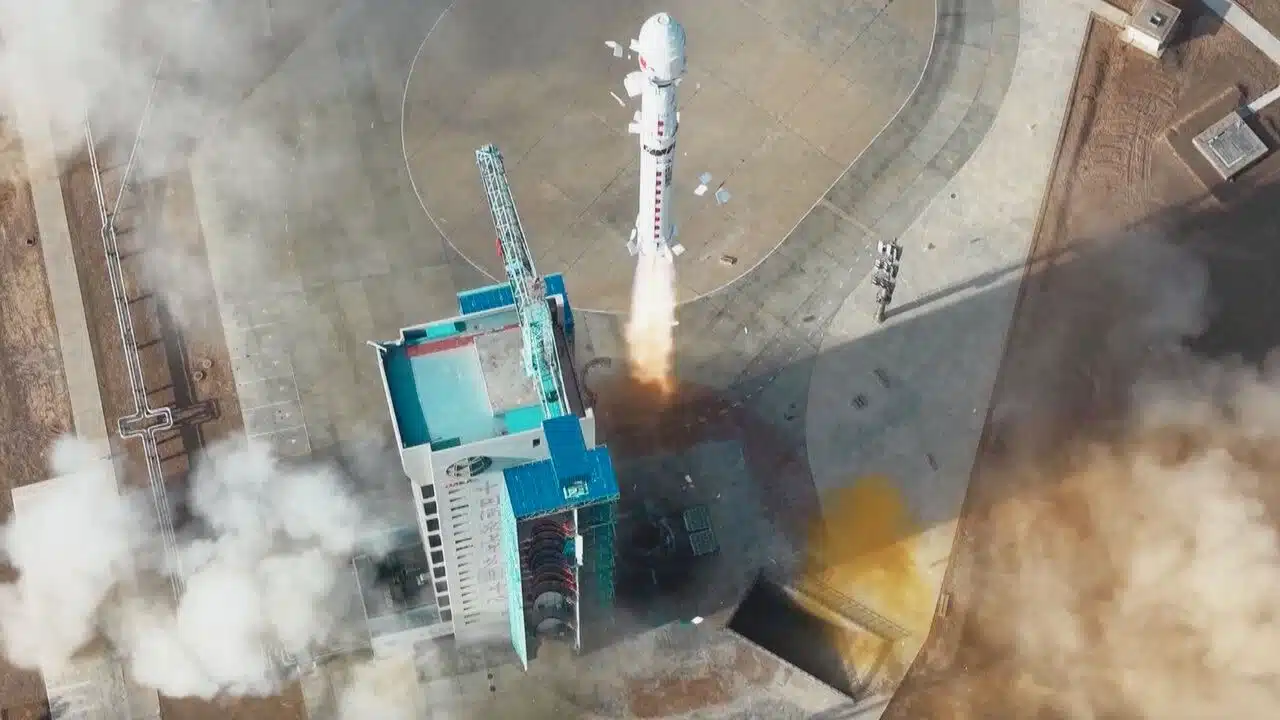
China has set a new national milestone in spaceflight, reaching 83 orbital missions in 2025 after a rapid series of three Long March rocket launches completed within 19 hours in early December. The new benchmark surpasses the country’s previous annual record of 68 orbital launches in 2024 and underscores Beijing’s push to expand its presence in low Earth orbit, deep space exploration, and strategic satellite infrastructure.
While the United States still leads the world in total orbital launches this year, China’s rising cadence confirms its status as the second most active launch nation and a central player in the evolving space race.
How China reached 83 launches
The latest record was sealed between 8 and 9 December 2025, when three Long March rockets lifted off from three different launch centers, each deploying a distinct class of satellite. A Long March 6A from Taiyuan carried a batch of broadband spacecraft for China’s Guowang (“national network”) megaconstellation, followed by a Long March 4B from Jiuquan that placed the Yaogan 47 remote-sensing satellite—widely seen as having military applications—into orbit. The sequence concluded with a Long March 3B from Xichang, delivering the classified TJSW-22 satellite and pushing China’s cumulative 2025 orbital launch count to 83, all within a Beijing-local 24‑hour period that set a new national record for launch frequency.
Behind the headline triple-launch lies a broader expansion of China’s launch activity throughout 2025, with government-backed and commercial missions both contributing to the higher tempo. Analysts note that China’s cadence has grown by roughly a third compared with 2024, helped by the deployment of large satellite constellations for communications and remote sensing as well as continued support for national defense payloads. State-owned giant China Aerospace Science and Technology Corporation (CASC) remains the backbone of this effort, operating the Long March family across a range of orbits and payload classes from small satellites to heavy-lift missions.
Global context and implications
Although China’s 83 orbital missions mark a national record, the figure still trails the United States, which has logged 164 orbital launches to orbit in 2025—an all-time annual high for a single country, driven largely by SpaceX. SpaceX alone has conducted around 159 orbital missions this year, underscoring how private-sector launch providers in the US currently outpace state-led programs elsewhere, even as China narrows the gap through state-guided commercialization. Global launch statistics compiled by independent tracking show 2025 as the busiest year on record, with 282 launches reaching orbit worldwide, highlighting how satellite megaconstellations and national security needs are reshaping the space economy.
Selected 2025 launch statistics
| Metric | China | United States | Notes |
| Orbital launches to orbit in 2025 | 83 | 164 | China sets a national record; US reaches historic global high. |
| China’s previous annual orbital record | 68 (2024) | Not specified; 2025 is the peak at 164 | Shows China’s year‑on‑year increase in launch cadence. |
| Notable same‑day launch feat in 2025 | 3 Long March launches in <19 hours | Multiple same‑day Falcon 9 missions | Global record for most launches in 24 hours remains six, set in April 2025 by multiple providers. |
China’s surge in launch activity has several strategic implications, from accelerating the rollout of broadband constellations such as Guowang to enhancing Earth‑observation and signals‑intelligence coverage through satellites like Yaogan 47. At the same time, the Long March fleet supports high-profile exploration projects and future heavy‑lift ambitions—such as the reusability features planned for newer models—which feed directly into Beijing’s long-term goals for lunar missions and deeper space operations.
Outlook for China’s launch program
The December triple-launch showcases a maturing industrial and operational base that can coordinate multiple missions from Taiyuan, Jiuquan, and Xichang within a single day, a capability China is expected to leverage for even denser launch schedules in the coming years. Industry observers anticipate that sustained demand from national broadband and reconnaissance constellations, coupled with a growing ecosystem of state-guided commercial launch firms, will keep China near or above the 80‑launch threshold annually, even as competition from US and emerging space powers intensifies.