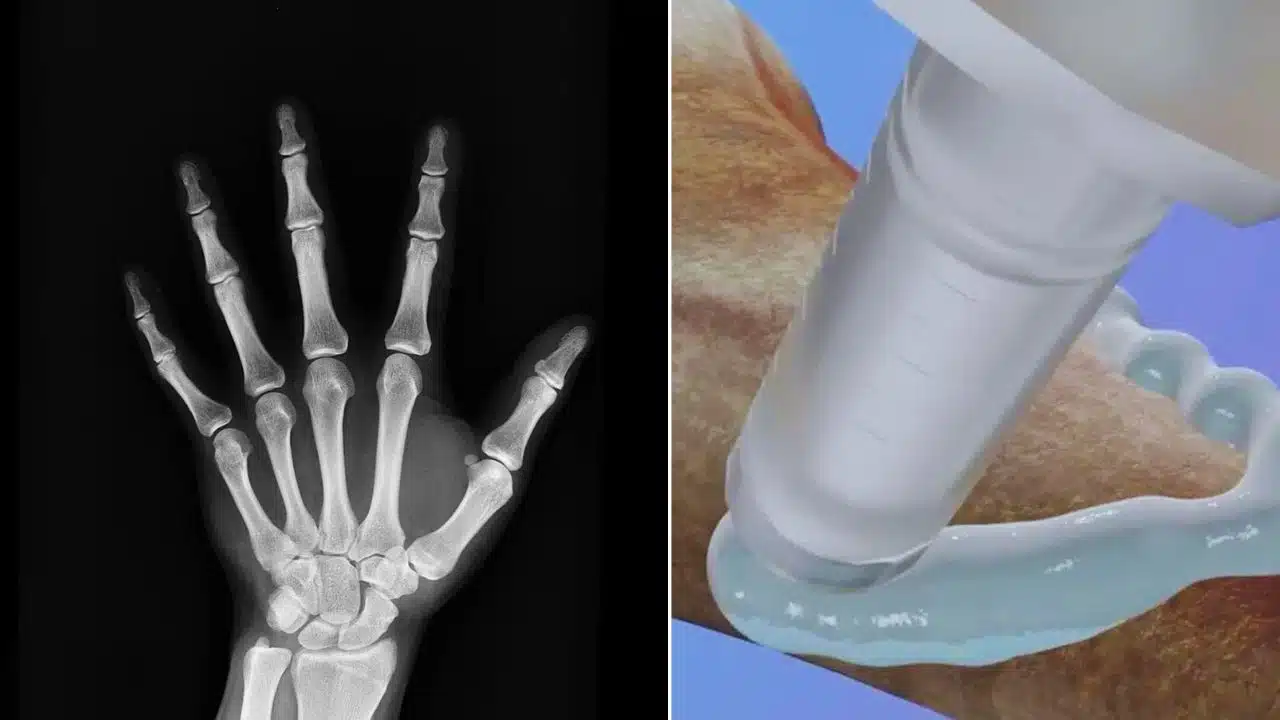
Chinese researchers in Zhejiang Province have announced the development of a revolutionary medical adhesive named Bone-02, a substance designed to repair broken bones within minutes. The innovation is considered a major step forward in orthopaedic medicine, addressing one of the most persistent challenges in trauma care: how to rapidly fix fractures and shattered bone fragments without resorting to traditional metal implants.
The project was led by orthopaedic specialists at Sir Run Run Shaw Hospital, affiliated with Zhejiang University. Inspired by how oysters firmly attach themselves to underwater surfaces, the research team developed an adhesive capable of bonding fractured bones in environments rich with blood—conditions where ordinary glues fail.
How Bone-02 Works
Bone-02 is formulated to provide fast, strong, and biocompatible fixation. It can be applied directly to broken bone fragments, creating a bond within two to three minutes. This rapid action dramatically reduces surgical time and the risks associated with prolonged operations.
- Application time: Once applied to fractured bone surfaces, it forms a strong bond within two to three minutes.
- Biodegradability: Unlike bone cements or metallic implants, Bone-02 is biodegradable. As natural healing progresses, the adhesive is gradually absorbed by the body, eliminating the need for additional surgery.
- Moisture resistance: The glue is effective in blood-soaked surgical fields, which makes it ideal for trauma and emergency operations.
This combination of speed, safety, and natural absorption makes Bone-02 a potential alternative to traditional fracture repair.
Safety and Biocompatibility
Ensuring safety was one of the most critical aspects of Bone-02’s development. Traditional bone adhesives first introduced in the 1940s—based on materials like gelatin, epoxy resins, and acrylates—were eventually discarded because they caused immune reactions, inflammation, or toxicity.
Bone-02 has undergone multiple layers of testing to confirm its biocompatibility:
-
Animal trials demonstrated that the adhesive did not trigger harmful immune responses or toxic effects.
-
Human clinical trials, involving more than 150 patients, showed that Bone-02 bonded effectively without complications such as severe inflammation, allergic reaction, or rejection.
-
Researchers also monitored how the material degraded inside the body, confirming that it breaks down naturally without producing harmful byproducts.
These findings suggest Bone-02 is significantly safer than earlier adhesive prototypes and may be suited for routine clinical use in the near future.
Efficiency and Performance Metrics
In laboratory and clinical settings, Bone-02 has consistently shown high strength and reliability:
-
Bonding force exceeded 400 pounds, meaning repaired bones could withstand substantial physical stress.
-
Shear strength measured at about 0.5 MPa, ensuring stability against forces that push bone fragments sideways.
-
Compressive strength reached around 10 MPa, indicating durability against downward or crushing pressure.
These figures suggest Bone-02 may be capable of replacing metal implants in certain fracture treatments. Where conventional methods require long incisions and the insertion of plates or screws, Bone-02 offers a minimally invasive alternative with equal or greater stability.
Advantages Over Conventional Treatments
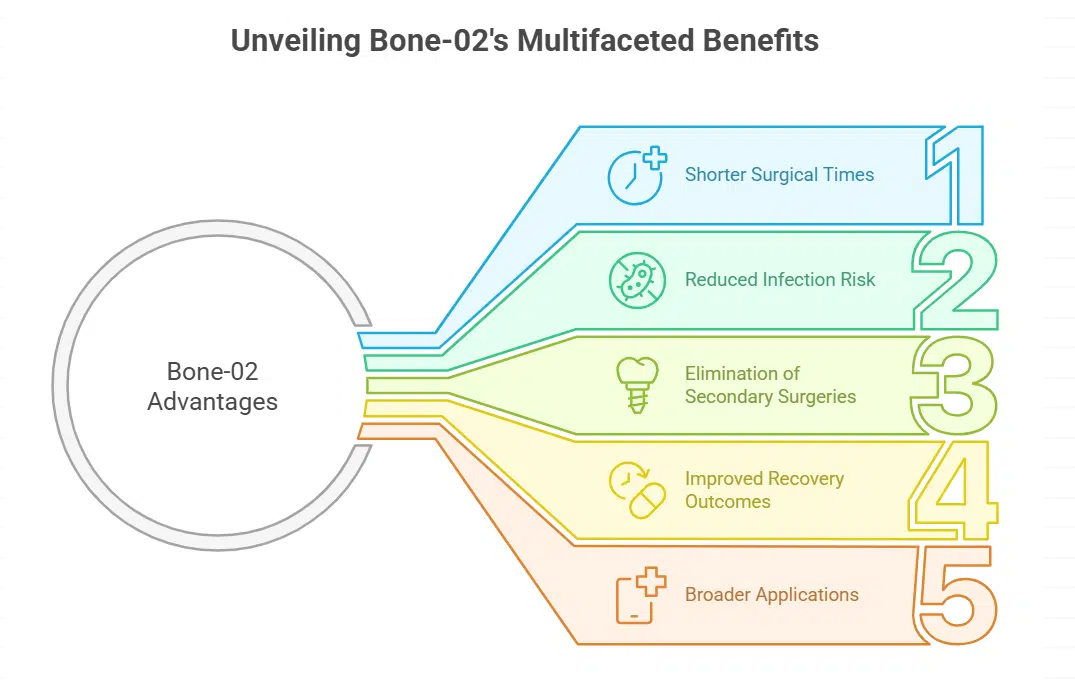
The introduction of Bone-02 could reshape how fractures are managed worldwide. Its potential advantages include:
-
Shorter surgical times – Procedures can be completed in under three minutes in some cases, compared with hours for traditional implant surgeries.
-
Reduced infection risk – Smaller incisions mean fewer open wounds and less exposure to bacteria.
-
Elimination of secondary surgeries – Since the glue dissolves naturally, patients avoid additional procedures to remove implants.
-
Improved recovery outcomes – Reduced tissue damage and quicker stabilization may lead to faster rehabilitation.
-
Potential for broader applications – Beyond orthopaedics, Bone-02 could be used in dental surgery, spinal procedures, and emergency trauma care, including battlefield or disaster settings.
Next Steps for Research and Approval
While early results are promising, Bone-02 is still in its developmental phase. Researchers have identified several key next steps:
-
Expanded Clinical Trials – The product has already been tested in more than 150 patients, but larger multi-center trials will be required to confirm safety and effectiveness across diverse patient populations.
-
Long-Term Monitoring – Scientists need to assess how the adhesive performs over months and years, particularly in elderly patients with fragile bones or those with osteoporosis.
-
Regulatory Approval – Before global adoption, Bone-02 must pass strict safety and efficacy evaluations by China’s National Medical Products Administration (NMPA), followed by approvals in international markets such as the U.S. FDA and Europe’s EMA.
-
Specialized Training – Surgeons will need training to use Bone-02 properly, as techniques for adhesive application differ from traditional hardware fixation.
-
Commercial Production – Scaling up manufacturing while ensuring quality, sterility, and affordability will be crucial for widespread adoption.
Challenges and Considerations
Despite the excitement, experts caution that Bone-02 will not immediately replace all metal implants. Large load-bearing bones, such as the femur or hip, may still require plates or rods to guarantee structural integrity under heavy strain. Additionally, the long-term durability of the adhesive must be confirmed in larger studies.
Cost will also be an important factor. Metal implants, though invasive, are relatively affordable and widely available. To be competitive, Bone-02 must demonstrate not only medical benefits but also cost-effectiveness for hospitals and healthcare systems.
A Step Toward the Future of Fracture Care
Bone-02 represents a potential game-changer in orthopaedics, combining speed, strength, and safety in ways that traditional methods cannot match. If ongoing trials continue to deliver positive results, this Chinese innovation could revolutionize fracture treatment, offering millions of patients worldwide a less invasive, faster, and safer recovery option.
The coming years will determine whether Bone-02 transitions from a promising laboratory breakthrough into a global medical standard for treating broken bones.