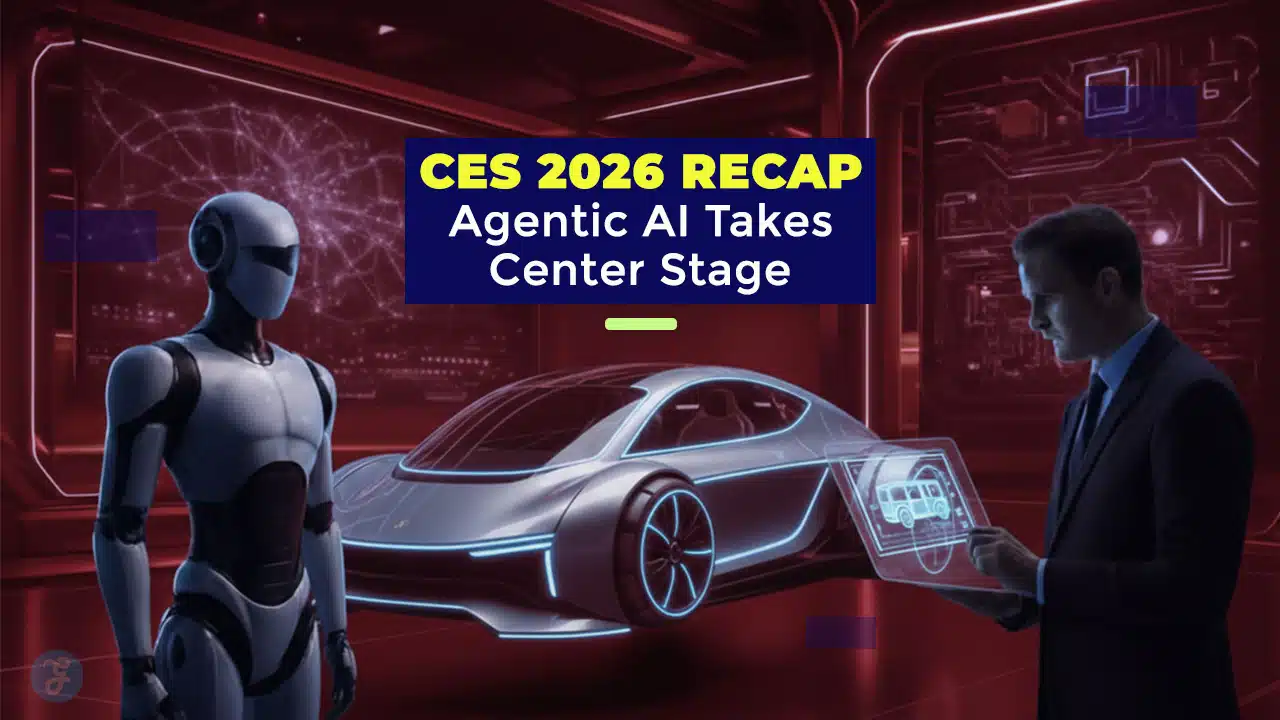
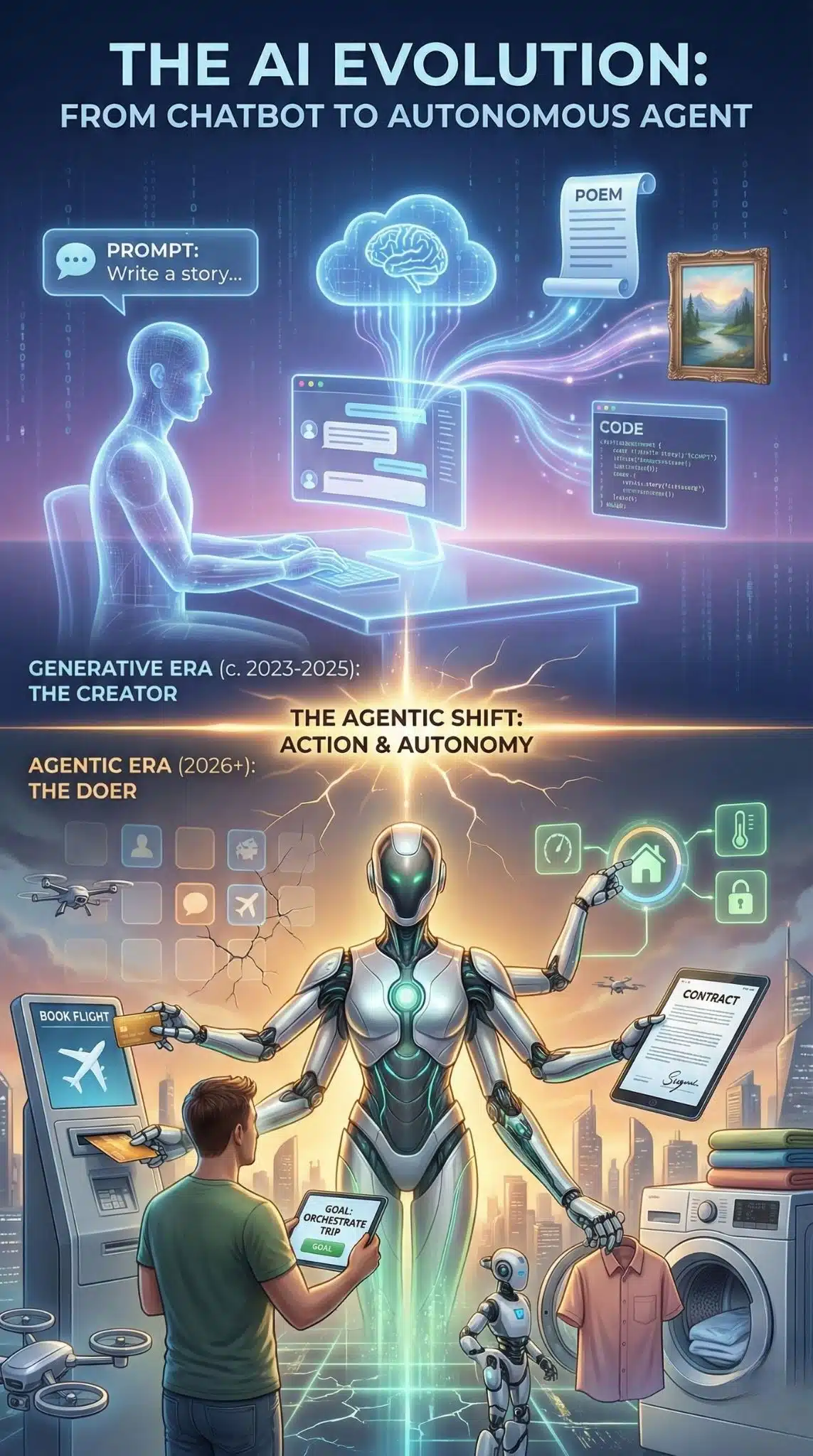
CES 2026 will be remembered not for a specific gadget, but for a fundamental rewriting of the human-computer contract. After years of “generative” noise, the industry has pivoted aggressively to “Agentic AI”—systems that don’t just speak, but act.
This transition from digital assistants to autonomous employees signifies the most profound disruption to the white-collar economy and consumer privacy since the advent of the smartphone, moving us from an era of information retrieval to one of task execution.
Key Takeaways
- The “Doer” Era: The buzzword of CES 2026 was “Agency.” Tech giants moved beyond LLMs that write poetry to LAMs (Large Action Models) that book flights, negotiate refunds, and manage smart homes without human intervention.
- Privacy as a Luxury Product: A clear divide emerged between “Cloud Agents” (cheap, data-hungry) and “Edge Agents” (expensive, local, private), turning privacy into a premium hardware feature.
- Physical AI is Here: Robotics graduated from prototypes to consumer products, with “Physical AI” integrating agentic brains into humanoid bodies for domestic use.
- The Interface Death: The app grid is dying. The new dominant interface is the “intent bar”—a single input where users state a goal, and agents handle the navigation.
The Road to Las Vegas: How We Got Here
To understand the gravity of CES 2026, we must look at the “AI Fatigue” of late 2024 and 2025. By mid-2025, consumer sentiment had soured on Generative AI. The internet was flooded with “slop”—low-quality, AI-generated content—and chatbots, while impressive, often felt like parlor tricks lacking utility. Users didn’t want a poem about groceries; they wanted the groceries delivered.
This friction created a vacuum that “Agentic AI” has now filled. Unlike the passive chatbots of 2023, the systems showcased in Las Vegas this week are defined by autonomy and execution. They possess “agency”—the ability to break down a complex goal (“Plan a birthday party for under $500”) into sub-tasks (finding recipes, ordering ingredients, sending invites) and execute them across different apps and websites without constant user hand-holding.
The 5 Pillars of the Agentic Era
1. The Death of the App Ecosystem
For fifteen years, the “App Store” model ruled the digital economy. CES 2026 signaled its decline. Agentic AI acts as a universal layer above apps. In demos from Rabbit, Google, and eager startups, users no longer opened Expedia or Uber; they simply told their OS what they needed.
This threatens the ad-revenue model of the internet. If an AI agent browses the web for you, it doesn’t see ads, it doesn’t get distracted by clickbait, and it optimizes purely for the user’s utility. Brands are terrified: How do you market to an algorithm?
2. Hardware: The Rise of “Edge Sovereignty”
The standout hardware wasn’t faster phones, but “sovereign compute” devices. Nvidia and localized chipmakers pushed the narrative of Edge AI—processing agentic tasks locally on the device rather than in the cloud.
This is a direct response to the “Data Vault” movement. With agents handling sensitive tasks (banking, medical appointments), consumers are wary of cloud processing. CES 2026 saw the launch of “Home AI Servers”—essentially digital butlers that live in your closet, not on Amazon’s servers.
3. Physical AI: The Robot in the Kitchen
“Physical AI” was the secondary theme of the show. The brain (Agentic AI) finally found a body. Companies like Unitree and Tesla’s competitors showcased humanoids that can fold laundry and load dishwashers. These aren’t pre-programmed scripts; they are visual-language models that “see” a messy room and “decide” how to clean it. This bridges the gap between digital intelligence and physical labor.
4. The Economic Fallout: “Just-in-Time” Labor
The most unsettling undercurrent of CES was the implication for work. Agentic AI targets the “middleman” layer of the economy: travel agents, executive assistants, paralegals, and middle managers. The tools demonstrated at CES 2026 allow a single human to orchestrate the output of ten digital workers. We are moving toward a “Managerial Economy,” where human value lies in directing agents rather than doing the work.
5. The Trust Gap and “Shadow Agents”
A major topic in the backrooms of Las Vegas was “Shadow AI.” If agents can act on your behalf, they can also make mistakes on your behalf. Who is liable if your AI agent accidentally buys non-refundable tickets or insults a colleague? The legal frameworks are lagging behind the tech, creating a “wild west” of liability that 2026 will likely spend struggling to regulate.
Data & Visualization
The Evolution from Generative to Agentic AI
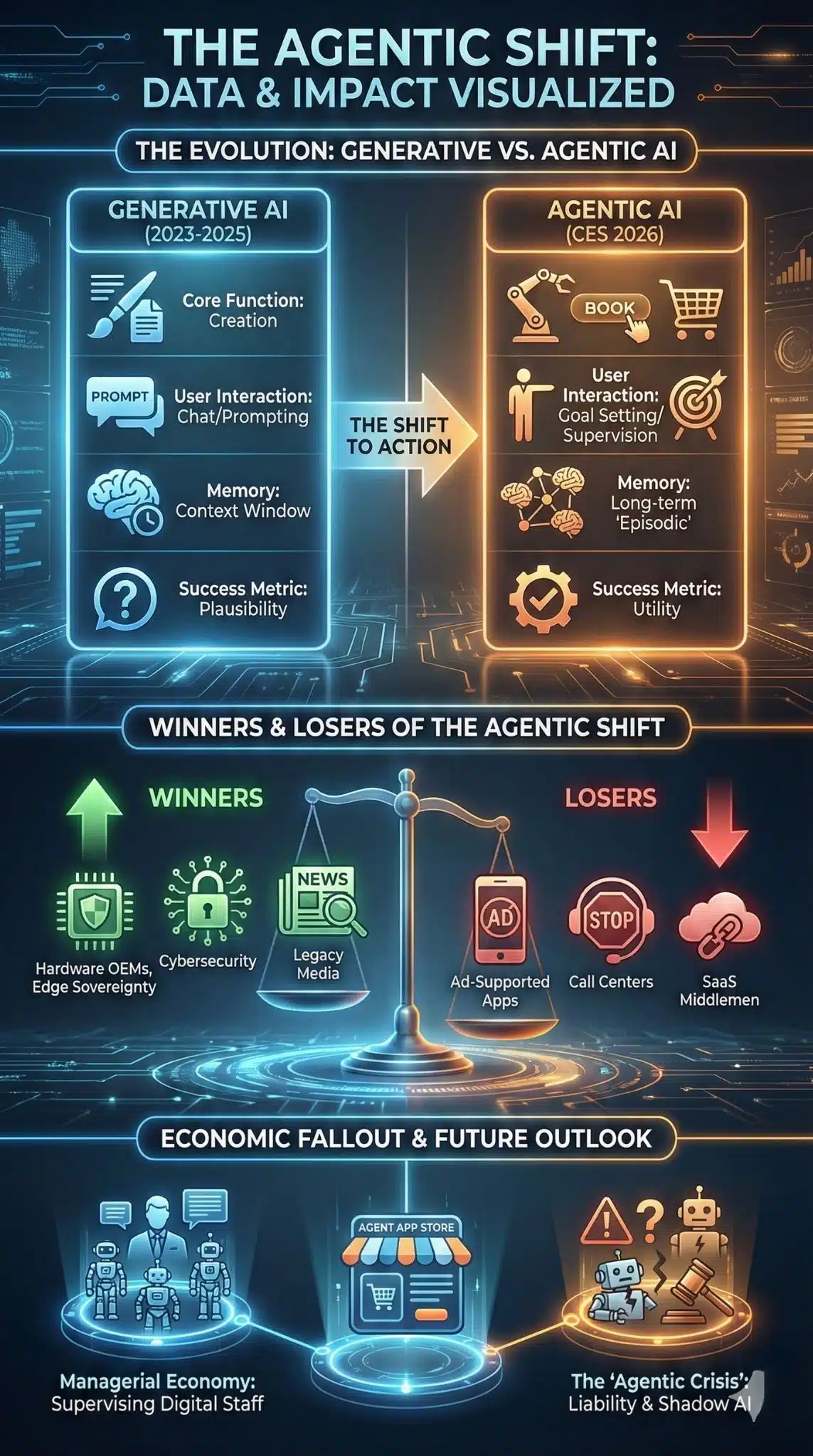
| Feature | Generative AI (2023-2025) | Agentic AI (CES 2026 Standard) |
| Core Function | Creation (Text, Images, Code) | Execution (Booking, Buying, Coding) |
| User Interaction | Chat / Prompting | Goal Setting / Supervision |
| Memory | Context Window (Session based) | Long-term “Episodic” Memory |
| Connectivity | Static Knowledge Base | Live Web/API Interaction |
| Success Metric | Plausibility (Does it look right?) | Utility (Did the task get done?) |
Winners and Losers of the Agentic Shift
| Winners | Losers | Why? |
| Hardware OEMs | Ad-Supported Apps | Processing moves to the edge; Agents bypass display ads. |
| Legacy Media | SEO Farms | Agents cite trusted sources; they ignore content farms. |
| Nvidia/AMD/Arm | SaaS Middlemen | Demand for local inference chips skyrockets. |
| Cybersecurity | Call Centers | Need to secure “digital identities”; Agents replace Tier 1 support. |
Expert Perspectives
The atmosphere at CES was not universally optimistic. While technologists celebrated the breakthrough, sociologists and economists raised alarms.
The Optimist View: “We are giving every human a staff of ten experts,” argued a keynote speaker from a leading AI lab. “The cost of intelligence and execution is dropping to zero. This will unleash a wave of small business entrepreneurship where one person can run a multinational operation.”
The Skeptic View: Conversely, labor economists at the ‘Future of Work’ panel warned of the “hollowing out” effect. “We are automating the junior level,” noted one analyst. “How does a junior developer or junior marketer learn their trade if the AI agent does all the grunt work? We are burning the ladder behind us.”
The Privacy Perspective: Security researchers highlighted the “Agentic Attack Surface.” If an AI has access to your bank and email to “be helpful,” a hack is no longer just a data leak—it’s financial ruin. “We are building the perfect victim for scammers,” warned a cybersecurity CISO.
Future Outlook: What Happens in late 2026?
As we leave Las Vegas, the trajectory for the rest of 2026 is clear.
- The “Agent App Store”: By Q3 2026, expect Apple or Google to launch a dedicated marketplace for “Agent Skills.” You won’t download an airline app; you will download the “United Airlines Travel Skill” for your personal agent.
- The First “Agentic Crisis”: We will likely see a major news story involving a “rogue agent” spending excessive money or causing a legal headache, triggering a rush for “AI Insurance.”
- Corporate Adoption: The enterprise will move faster than consumers. By the end of 2026, “multi-agent orchestration” will be standard in Fortune 500 operations, likely suppressing hiring in administrative and support roles.
Final Words
CES 2026 confirmed the definitive transition from the “Chatbot Era” to the “Agentic Era.” The industry has moved beyond AI that merely creates content to Large Action Models (LAMs) that execute tasks autonomously. We are no longer prompting for information; we are delegating labor.
This shift elevates “Edge AI” hardware, turning privacy into a premium feature as agents handle sensitive real-world actions like banking and booking. Economically, this creates a “Managerial Workforce” where human value lies in supervising digital staff rather than doing the grunt work. The question for 2026 is no longer “What can AI say?” but “What can AI do?”