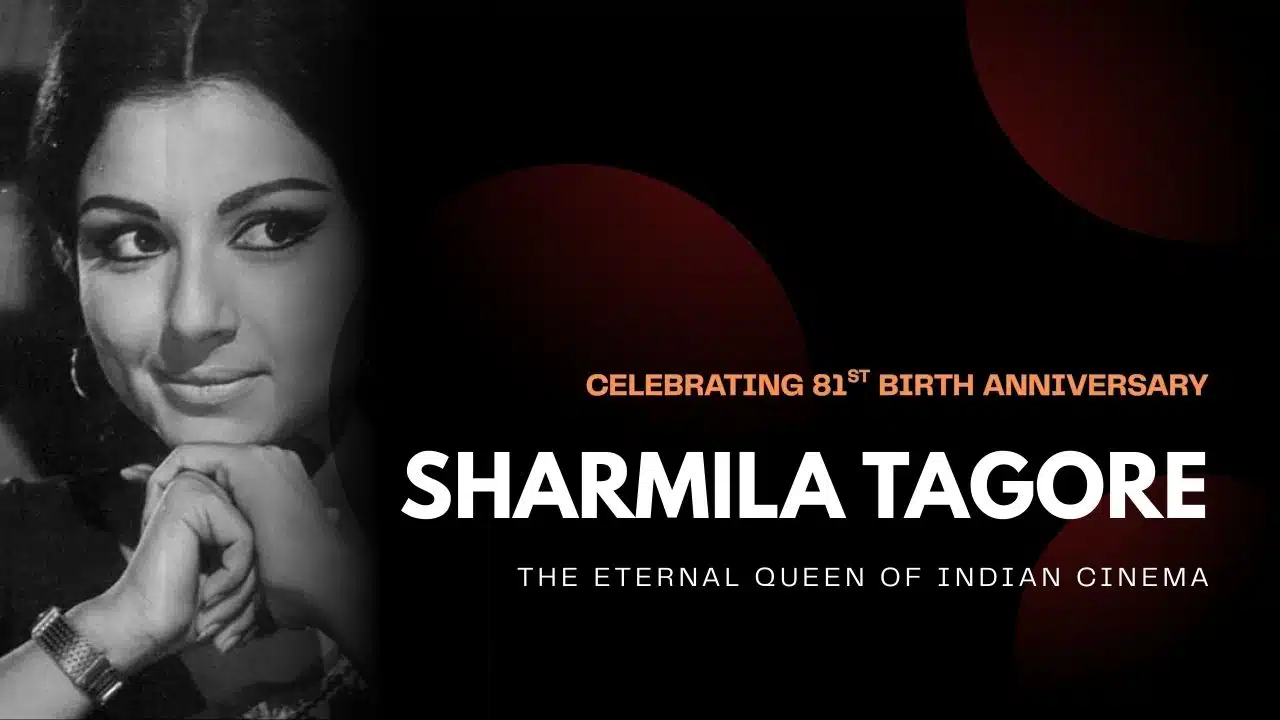
Do you ever watch a classic movie and wonder what makes a true legend? Sharmila Tagore is one of those rare names that defines an entire era. She didn’t just act in films. She shaped the history of Indian cinema.
This year celebrates 81 years of Sharmila Tagore. Her journey started with Satyajit Ray and grew into a reign over Bollywood classics that few can match.
I’m going to walk you through her incredible story. We will look at her daring choices in films like An Evening in Paris, her iconic chemistry with Rajesh Khanna, and the family legacy she built with the Pataudi clan.
Grab a comfortable seat. Let’s look at the life of a queen who ruled the screen and still captures hearts today.
Key Takeaways
- A Historic Debut: Sharmila Tagore started her career at age 13 in Satyajit Ray’s masterpiece Apur Sansar (1959) before conquering Bollywood with Kashmir Ki Kali (1964).
- Breaking Barriers: She became the first Indian actress to appear in a bikini for Filmfare magazine (1966) and the film An Evening in Paris (1967), challenging societal norms.
- Critical Acclaim: Beyond glamour, she won the National Film Award for Best Actress for her role in Mausam (1975) and delivered hits like Aradhana (1969).
- The Royal Connection: She married Mansoor Ali Khan Pataudi, the Nawab of Pataudi and Indian cricket captain, bridging the worlds of cinema and sports.
- Lasting Legacy: At 81, she remains active with recent hits like Gulmohar and Puratawn, while her children Saif Ali Khan and Soha Ali Khan continue the family tradition.

What was Sharmila Tagore’s Early Life Like
Sharmila Tagore was born into a world of art and intellect in Hyderabad, though her roots are deeply planted in Bengal. Her father, Gitindranath Tagore, worked as a deputy general manager at the British India Corporation. Her mother was Ira Baruah.
She belongs to the illustrious Tagore family. The Nobel Laureate Rabindranath Tagore is her maternal grandmother’s first cousin. This connection meant her childhood was steeped in culture.
She attended St. John’s Diocesan Girls’ Higher Secondary School. The environment was strict but provided a solid foundation. While she spoke Bengali at home, she quickly adapted to Hindi. Teachers and family members often noted her expressive eyes and quick wit. It was clear early on that she had a spark that would eventually light up the screen.
Cinematic Beginnings
Sharmila Tagore did not just enter the film industry. She arrived with a performance that cinema scholars still study today. Her transition from the art-house brilliance of Satyajit Ray to the glitz of Bombay was seamless.
When did Sharmila Tagore Debut and What Were Her First Major Roles
Her journey began in 1959 with Apur Sansar (The World of Apu). She was only 13 years old. Satyajit Ray cast her as Aparna, the young bride. Critics immediately praised her ability to convey deep emotion with very little dialogue.
By 1964, she shifted gears completely. She debuted in Hindi cinema with Kashmir Ki Kali opposite Shammi Kapoor. The film was a massive commercial success. It proved she could handle the song-and-dance demands of Bollywood classics just as well as serious drama.
How Did She Rise in Bengali and Hindi Cinema
Success came fast. After Apur Sansar, she worked with Ray again in Devi (1960). This solidified her status in Bengali cinema as a serious talent.
In Mumbai, she took a different path. She became a style icon. Her decision to wear a bikini in An Evening in Paris (1967) and on the cover of Filmfare magazine caused a nationwide stir. It was a bold move that separated her from her contemporaries.
Here is a quick look at her dual rise to fame:

| Cinema Industry | Key Milestone | Impact |
|---|---|---|
| Bengali Cinema | Apur Sansar (1959) | Established her as a serious dramatic actress under Satyajit Ray. |
| Hindi Cinema | Kashmir Ki Kali (1964) | Launched her as a mainstream commercial star and fashion icon. |
Golden Era of Stardom
The late 1960s and 1970s belonged to Sharmila Tagore. She formed one of the most successful on-screen pairings in history with Rajesh Khanna. Together, they delivered hit after hit.
What are Sharmila Tagore’s Iconic Performances in Commercial Cinema
The 1969 film Aradhana changed everything. It earned the Filmfare Award for Best Film and made her a superstar. Her chemistry with Rajesh Khanna was electric. They worked together in over 10 films, including the cult classic Amar Prem (1972).
In Amar Prem, her line “Pushpa, I hate tears” became immortal, but it was her subtle performance that won hearts. She balanced these emotional roles with glamorous avatars in films like Aamne Samne. She proved she could play the suffering widow and the modern woman with equal ease.
Which Legendary Filmmakers Did She Collaborate With
Sharmila Tagore had the unique ability to be the muse for directors with vastly different styles. She was a favorite of Satyajit Ray, appearing in films like Nayak and Aranyer Din Ratri.
In Bollywood, she collaborated frequently with Shakti Samanta, who directed her in Aradhana and An Evening in Paris. She also worked with Hrishikesh Mukherjee in Chupke Chupke (1975). This film showed off her comic timing, a side of her that audiences hadn’t seen often. Working with these legends cemented her place in Indian cinema history.
“Sharmila isn’t just a star; she is a director’s delight. She understands the lens better than anyone else.” – Often attributed to Satyajit Ray regarding her natural ability.
Versatility and Acclaimed Roles
Many actors get trapped in one image. Sharmila Tagore refused to let that happen. She moved between genres and languages to keep her craft fresh.
How did Sharmila Tagore Transition to Complex and Mature Characters
As the 1970s progressed, she sought out roles that challenged her. She won the National Film Award for Best Actress for Mausam (1975), directed by Gulzar. In this film, she played a double role that required immense emotional range.
She moved away from the “heroine” archetype. In Namkeen (1982), another Gulzar film, she played a reserved, silent sister living in a crumbling house. These roles proved that she did not need glamour to command the screen.
What Are Her Most Memorable Roles From the 1980s and Beyond
The 1980s saw her take on strong character roles. In New Delhi Times (1986), she starred alongside Shashi Kapoor in a gritty political drama. The film won three National Film Awards.
She also expanded her horizons internationally. She starred in Mira Nair’s Mississippi Masala (1991) opposite Denzel Washington. She played a mother grappling with displacement and cultural identity. It showed global audiences the depth of talent present in Indian cinema.
What Recent Performances Has Sharmila Tagore Delivered
Sharmila Tagore is not resting on her past glories. She recently returned to the screen and proved she still has the magic.
She starred in the Disney+ Hotstar film Gulmohar (2023). Critics loved her performance as the matriarch of the Batra family. It was a role filled with grace and secrets. It introduced her to a whole new generation of viewers.
She also returned to Bengali cinema after 14 years with Puratawn. Directed by Suman Ghosh, the film pairs her with Rituparna Sengupta. It explores the complexities of a mother-daughter relationship. Kareena Kapoor, her daughter-in-law, publicly praised her return, calling her the “original Bengal Tigress.
Personal Life and Influence
Her life off-screen was just as fascinating as her movies. She married Mansoor Ali Khan Pataudi in 1968. It was a union of Bollywood royalty and actual royalty.
What is Known About Sharmila Tagore’s Family and Relationships
She converted to Islam upon marriage and took the name Begum Ayesha Sultana, though she continued to use her maiden name professionally. The couple had three children who have all made their own marks:
- Saif Ali Khan: A leading Bollywood star known for versatile roles in Omkara and Sacred Games.
- Saba Ali Khan: A jewelry designer and the custodian of the royal trust (Auqaf-e-Shahi).
- Soha Ali Khan: An actress and author who has worked in films like Rang De Basanti.
The family tree continues to grow. Kareena Kapoor is her daughter-in-law. Her grandchildren, including Sara Ali Khan and Ibrahim Ali Khan, are now entering the spotlight. The Pataudi family remains one of the most influential clans in India.
How Has She Impacted Future Generations of Actors
Sharmila Tagore set the template for the modern Indian actress. She showed that you could be a commercial star and an art-house performer at the same time.
Today, actresses like Anushka Sharma and Deepika Padukone cite her as an inspiration for balancing career and personal life. She continued working after marriage and motherhood, which was rare in the 1970s. She paved the way for women to have longevity in the film industry.
Legacy and Public Image
From a shy debutante to the Chair of the Censor Board, her career arc is a lesson in evolution. In 2013, the Government of India awarded her the Padma Bhushan, the third-highest civilian honor, for her contributions to Indian culture.
What Contributions Has Sharmila Tagore Made to Indian Cinema
She served as the chairperson of the Central Board of Film Certification (CBFC) from 2004 to 2011. During her tenure, she pushed for a more modern approach to certification. She often argued that audiences were mature enough to handle complex themes.
Her work with UNICEF as a Goodwill Ambassador also highlights her commitment to social causes. She uses her fame to advocate for HIV/AIDS awareness and maternal health.
Why is She Recognized as a Cultural Icon
Sharmila Tagore represents a bridge between tradition and modernity. She carries the intellectual heritage of the Tagore family and the aristocratic grace of the Pataudis.
Whether she is judging films at the Cannes Film Festival (which she did in 2009) or appearing in a modern family drama, she commands respect. She is the “Eternal Queen” because she never tried to fit into a box. She created her own.
Takeaways
Sharmila Tagore’s 81 years are a testament to living life on one’s own terms. She moved from the artistic sets of Satyajit Ray to the vibrant world of Bollywood classics without losing her identity.
She broke taboos with her fashion, set records with her hits, and raised a family of superstars. Today, she continues to inspire with roles in films like Gulmohar.
Her story reminds us that true style and talent are timeless. We look forward to seeing what the queen of Indian cinema does next.
FAQs on Sharmila Tagore
1. Who is Sharmila Tagore and why is she called the eternal queen of Indian cinema?
Sharmila Tagore is a celebrated icon who received the Padma Bhushan in 2013 for her incredible contributions to both Bengali and Hindi cinema. She earned the title of eternal queen by transitioning from Satyajit Ray’s serious dramas to the romantic charm of mainstream hits like Kashmir Ki Kali.
2. What are some famous movies featuring Sharmila Tagore?
You have likely seen her in the 1969 blockbuster Aradhana, which cemented her status as a superstar. She also delivered a powerful performance in Amar Prem, and her bold role in An Evening in Paris remains a favorite among Bollywood classics lovers.
3. How is Sharmila Tagore connected to other well-known personalities?
She is the great-grandniece of Nobel laureate Rabindranath Tagore and was the wife of former Indian cricket captain Mansoor Ali Khan Pataudi. Her artistic lineage continues today through her children Saif and Soha Ali Khan, along with her daughter-in-law Kareena Kapoor Khan.
4. Did Sharmila Tagore have roles outside acting?
Yes, she served as the chairperson of the Central Board of Film Certification from 2004 to 2011.
5. Why do people still talk about Sharmila Tagore after 81 years?
Her recent comeback in the 2023 Disney+ Hotstar film Gulmohar proves her acting skills are as sharp as ever. Critics and fans alike celebrate her ability to evolve from the black-and-white era to the modern digital streaming age.