The Indian automotive market has matured rapidly, moving beyond the simple “Petrol vs. Diesel” debate. In 2026, the real question isn’t just about the car brand, but the energy that moves it. For the smart buyer, the ultimate flexibility comes from finding a vehicle platform so versatile that it offers cars with petrol CNG and electric options all under one roof. This “power of choice” allows you to pick a design you love and then simply select the heart engine or battery that fits your budget and driving habits.
Why is this important? Because historically, if you wanted an EV, you had to buy a specific, often expensive, standalone model. If you wanted CNG, you were restricted to budget hatchbacks with zero trunk space. Today, that has changed. Manufacturers like Tata Motors and Citroën have democratized technology, offering a single model, like the Nexon or Punch, in every flavor imaginable. Whether you are a highway cruiser (Petrol), a city taxi operator or budget commuter (CNG), or an eco-conscious tech lover (EV), you don’t have to compromise on the car’s looks or safety.
In this comprehensive guide for 2026, we explore the top 5 vehicles that offer this rare “tri-fuel” versatility. We will break down their specs, driving dynamics, and most importantly, the math behind which version will save you the most money.
Key Takeaways
-
The Rare Club: Only 5 cars in India currently offer Petrol, CNG, and Electric powertrains under a single model name for 2026.
-
Tata’s Dominance: Four out of the five cars belong to Tata Motors, leveraging their multi-powertrain strategy.
-
Citroën’s Unique Approach: The Citroën C3 joins the list with a distinct “dealer-authorized” CNG kit strategy alongside its factory EV and petrol models.
-
Cost Efficiency: Electric variants offer the lowest running cost (₹1/km), while CNG bridges the gap (₹3-4/km) for high-mileage users who can’t charge at home.
-
No Compromise: New tech like Tata’s Twin-Cylinder CNG has solved the “no boot space” issue, making tri-fuel cars practical for families.
The Rise of “Multi-Energy” Platforms: Why It Matters to You
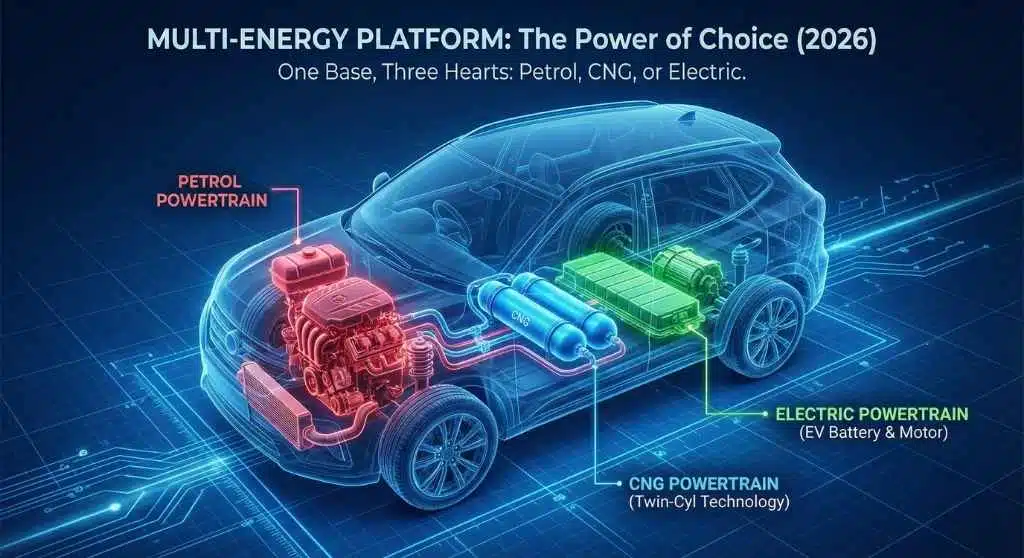
Before we dive into the specific models, it is important to understand why this shift is happening. In the past, if you wanted an electric car, you often had to buy a quirky, expensive standalone model that looked like a science experiment. If you wanted CNG, you were usually restricted to budget trims with zero safety features. In 2026, that era is over. Manufacturers, led by Tata Motors, have perfected “Multi-Energy Platforms.”
This means they engineer a single, robust vehicle architecture capable of hosting a Petrol engine, a CNG cylinder setup, or a heavy Battery pack without compromising the car’s balance or safety. For you, the buyer, this offers three massive advantages:
-
Zero Compromise on Safety: Whether you buy the Nexon EV or the Nexon Petrol, you get the same 5-star safety rating. The reinforced chassis protects the battery just as well as it protects the fuel tank.
-
Easy & Cheap Repairs: Since 90% of the body panels, lights, and interiors are shared across all three versions, spare parts are abundant and affordable. You don’t pay a “luxury premium” for EV repairs.
-
Resale Value Security: Buying a popular multi-fuel model ensures that your car remains in demand in the second-hand market, regardless of which fuel type becomes dominant in the future.
So, which of these versatile machines actually delivers on the promise? Let’s look at the 5 contenders leading the pack.
The “Tri-Fuel” Titans: 5 Cars With Petrol CNG and Electric Options
As of 2026, finding a car that lets you choose between Petrol, CNG, and Electric is a luxury provided primarily by one Indian giant and one French challenger. Here is the definitive list.
1. Tata Tiago (The City Hatchback Champion)
The Tata Tiago was the pioneer. It proved that a safe (4-star GNCAP-rated), good-looking hatchback could be a jack-of-all-trades. In 2026, it remains the entry point for the multi-powertrain universe.
-
The Petrol Avatar: Powered by the 1.2L Revotron engine, the petrol Tiago is peppy and reliable. It’s the baseline choice for those with low monthly running (under 800 km). It offers a balance of initial affordability and decent highway manners.
-
The CNG Avatar (iCNG): This is where Tata changed the game. The Tiago iCNG features Twin-Cylinder Technology, where two smaller CNG tanks sit under the boot floor rather than one giant cylinder taking up the luggage space. You actually get a usable boot, making it a practical family car.
-
The Electric Avatar (Tiago.ev): As one of India’s most affordable EVs, the Tiago.ev is perfect for city runabouts. With a real-world range of ~200-230 km (depending on the battery pack), it offers a silent, vibration-free drive that the petrol/CNG versions simply cannot match.
Who is it for: First-time car buyers, students, or small families living in congested cities.
2. Tata Tigor (The Only Sedan in the Club)
If you prefer the elegance of a sedan over a hatchback, the Tata Tigor is currently your only option in India that offers Petrol, CNG, and Electric variants.
-
The Petrol Avatar: Identical to the Tiago, the Tigor petrol offers a smooth ride with added boot capacity (419 liters). It’s a favorite for ride-sharing drivers due to its low maintenance.
-
The CNG Avatar: The Tigor iCNG is a masterstroke. Since sedans inherently have larger trunks, the twin-cylinder tech leaves a massive amount of luggage space even with the CNG kit installed. It feels like a normal petrol car but runs at half the cost.
-
The Electric Avatar (Tigor.ev): Often seen as a fleet favorite (BluSmart, Uber Green), the Tigor.ev is incredibly robust. It offers the same ~315 km (MIDC) range as the Tiago but with better rear-seat comfort and suspension tuning suited for carrying passengers.
Who is it for: Those who need a “big car” feel and dedicated luggage space on a budget.
3. Tata Punch (The Micro-SUV Phenomenon)
The Tata Punch is often India’s best-selling car, and its versatility is the main reason. It combines the rugged appeal of an SUV with the compact footprint of a hatchback.
-
The Petrol Avatar: The high stance and visibility make the petrol Punch a confidence-inspiring drive for new drivers. It handles bad roads effortlessly.
-
The CNG Avatar: Unlike low-slung hatchbacks that scrape speed breakers when loaded with heavy CNG tanks, the Punch’s high ground clearance ensures it stays practical even with a full load of passengers and gas.
-
The Electric Avatar (Punch.ev): The Punch.ev is significantly different from its petrol sibling. It is built on the acti.ev architecture, meaning it has a “Frunk” (front trunk), a completely different interior with dual screens, and superior range (up to 421 km claimed). It is a tech-heavy, premium experience compared to the utilitarian petrol version.
Who is it for: Urban dwellers who want SUV styling, high ground clearance, and safety (5-star rating) without the bulk of a full-size SUV.
4. Tata Nexon (The Premium All-Rounder)
The Tata Nexon is the heavyweight of this list. It is the only car in India to offer four fuel options (Petrol, Diesel, CNG, EV), but for this list, we focus on the core three.
-
The Petrol Avatar: The Turbo-Petrol engine in the Nexon is powerful and highway-ready. It’s for the enthusiast who wants performance.
-
The CNG Avatar: Launched late in the previous cycle, the Nexon iCNG is India’s first Turbo-CNG. While most CNG cars feel underpowered, the Nexon CNG uses a turbocharger to deliver punchy performance, making it the only CNG car genuinely capable of effortless highway overtaking.
-
The Electric Avatar (Nexon.ev): The benchmark for Indian EVs. With a range of 465 km (claimed), Vehicle-to-Load (V2L) capabilities (you can power your camping gear with your car), and luxury features like ventilated seats, it competes with cars in a segment above.
Who is it for: Families who want a primary car that can do everything: road trips, office commutes, and luxury travel.
5. Citroën C3 (The Comfort King)
The French automaker Citroën enters the list with the quirky C3 hatchback. Their approach is slightly different but equally effective.
-
The Petrol Avatar: Known for its “Magic Carpet” ride, the C3 petrol offers the best suspension comfort in its class. It smooths out potholes better than SUVs twice its price.
-
The Electric Avatar (eC3): A straightforward, no-nonsense EV. It doesn’t have the high-tech bells and whistles of the Tata EVs (no regeneration modes, simple dash), but it offers a very comfortable, silent, and spacious cabin with a decent 320 km range.
-
The CNG Avatar: Here lies the difference. Unlike Tata’s factory-fitted line, Citroën introduced a fully authorized, dealer-fitted CNG kit. This means you buy the car, the dealer installs a high-quality kit approved by Citroën, and you retain your factory warranty. It’s a retrofit, but an official one, giving you the CNG savings with French comfort.
Who is it for: Buyers who prioritize ride comfort and cabin space over touchscreens and features.
Detailed Comparison: Price & Specs (2026 Estimates)
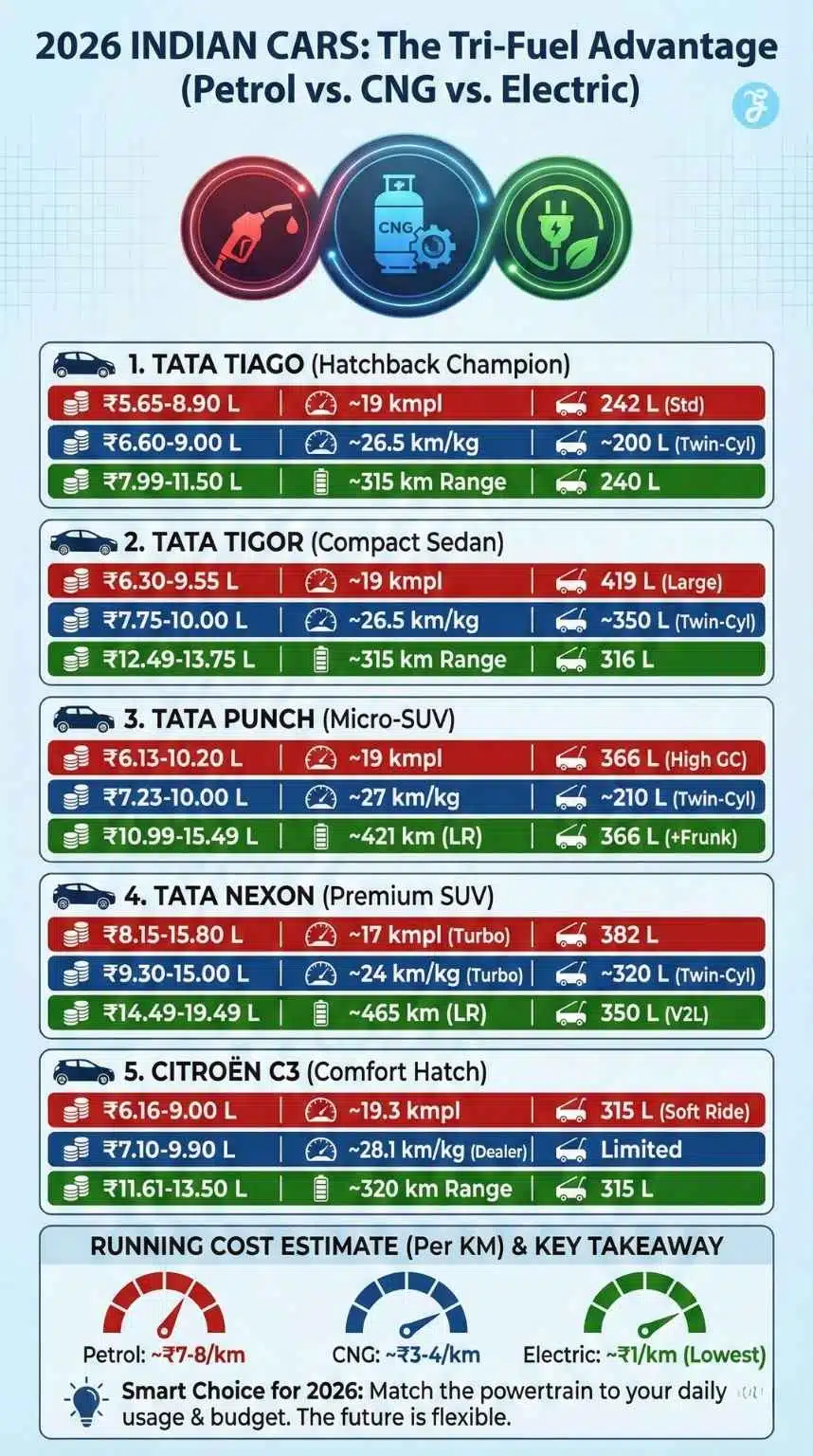
To help you make a quick decision, here is a snapshot of how these cars stack up against each other in terms of pricing and capability.
| Car Model | Powertrain | Approx. Price (Ex-Showroom) | Range / Mileage (Claimed) | 0-100 km/h (Approx) | Boot Space |
| Tata Tiago | Petrol | ₹5.65 – ₹8.90 L | 19 kmpl | 14 sec | 242 L |
| CNG | ₹6.60 – ₹9.00 L | 26.49 km/kg | 16 sec | ~200 L (Twin Cyl) | |
| Electric | ₹7.99 – ₹11.50 L | 315 km (LR) | 12 sec | 240 L | |
| Tata Tigor | Petrol | ₹6.30 – ₹9.55 L | 19 kmpl | 14 sec | 419 L |
| CNG | ₹7.75 – ₹10.00 L | 26.49 km/kg | 16.5 sec | ~350 L (Twin Cyl) | |
| Electric | ₹12.49 – ₹13.75 L | 315 km | 12.5 sec | 316 L | |
| Tata Punch | Petrol | ₹6.13 – ₹10.20 L | 19 kmpl | 15 sec | 366 L |
| CNG | ₹7.23 – ₹10.00 L | 26.99 km/kg | 17 sec | ~210 L (Twin Cyl) | |
| Electric | ₹10.99 – ₹15.49 L | 421 km (LR) | 9.5 sec | 366 L (Frunk extra) | |
| Tata Nexon | Petrol | ₹8.15 – ₹15.80 L | 17 kmpl | 11 sec | 382 L |
| CNG | ₹9.30 – ₹15.00 L | 24.00 km/kg | 13 sec | ~320 L (Twin Cyl) | |
| Electric | ₹14.49 – ₹19.49 L | 465 km (LR) | 8.9 sec | 350 L | |
| Citroën C3 | Petrol | ₹6.16 – ₹9.00 L | 19.3 kmpl | 13 sec | 315 L |
| CNG | ₹7.10 – ₹9.90 L | 28.10 km/kg | 15 sec | Limited (Cylinder) | |
| Electric | ₹11.61 – ₹13.50 L | 320 km | 13 sec | 315 L |
Note: Prices and specs are indicative of the 2026 market landscape. “LR” refers to Long Range battery packs.
Running Cost Analysis: Where the Real Savings Are
This is the most critical section for your wallet. A car might be cheaper to buy (Petrol) but expensive to run, or expensive to buy (EV) but almost free to run. Let’s break down the math for a typical Indian user driving 1,200 km per month.
1. The Petrol Equation
-
Average Mileage: 14 kmpl (City + Highway mix)
-
Fuel Price: ₹100/liter (Average)
-
Cost Per KM: ₹7.14
-
Monthly Fuel Bill: ₹8,568
2. The CNG Equation
-
Average Mileage: 22 km/kg
-
CNG Price: ₹78/kg
-
Cost Per KM: ₹3.54
-
Monthly Fuel Bill: ₹4,248
-
Savings vs Petrol: ₹4,320/month (₹51,840/year)
3. The Electric Equation
-
Range per Charge: 250 km (Real world)
-
Battery Size: 30 kWh (Average of Tiago/Punch)
-
Electricity Cost: ₹8/unit (Domestic rate)
-
Cost for Full Charge: ₹240 (30 units x ₹8)
-
Cost Per KM: ₹0.96 (Less than ₹1!)
-
Monthly Fuel Bill: ₹1,152
-
Savings vs Petrol: ₹7,416/month (₹88,992/year)
The Verdict
-
If you choose CNG, you save about ₹50,000 a year. It takes roughly 2 years to recover the extra ₹1 Lakh you paid for the CNG kit over the petrol model.
-
If you choose Electric, you save nearly ₹90,000 a year. Even if the EV costs ₹3-4 Lakhs more than the petrol version, you break even in about 3.5 to 4 years. After that, you are essentially driving for free compared to petrol users.
Buying Guide: Which Powertrain Fits Your Lifestyle?
Don’t just buy based on the calculator. Your lifestyle dictates the right choice.
Scenario A: The “High-Miler” (Sales executive, taxi, long commuter)
-
Profile: Drives 50+ km daily, often inter-city.
-
Recommendation: CNG.
-
Why? You need the low running costs immediately. EV charging on highways can still be tricky if you are in a rush. CNG stations are now ubiquitous. The Tata Nexon iCNG is perfect here because its Turbo engine handles highway speeds easily.
Scenario B: The “City Slicker” (Office goer, school runs)
-
Profile: Drives 30-40 km daily, fixed route, has own parking spot.
-
Recommendation: Electric.
-
Why? The silence and ease of an automatic drive (EVs have no gears) in traffic is a blessing. You charge at night like a phone. The Tata Punch.ev is the ideal pick for its compact size and tech features.
Scenario C: The “Weekend Warrior” (Low usage, occasional road trips)
-
Profile: Drives under 20 km daily, mostly uses the car for weekend outings.
-
Recommendation: Petrol.
-
Why? If you drive less, you won’t save enough on fuel to justify the higher upfront cost of EV or CNG. Petrol engines are also lighter and offer the peppiest drive for those spirited weekend sprints. The Citroën C3 Turbo (if available) or Tiago Petrol makes sense here.
Frequently Asked Questions (FAQs)
1. Is CNG safe in 2026? I’ve heard horror stories about leaks.
Absolutely. Modern factory-fitted CNG cars (like Tata’s iCNG) use advanced stainless steel pipes and have leak detection software. If a leak is detected, the car automatically switches to petrol and shuts off the gas supply. They also feature a “micro-switch” that prevents the car from starting if the fuel lid is open. They are as safe as petrol cars.
2. Does the Tata Punch CNG feel underpowered on hills?
The Tata Punch CNG is tuned remarkably well. While CNG naturally has slightly less power than petrol, Tata’s ECU tuning ensures there is enough low-end torque. You might need to downshift one gear lower than you would in a petrol car on very steep inclines, but it climbs the Shimla or Ooty hills without struggle.
3. What is the real lifespan of an EV battery?
Most modern EVs come with an 8-year/160,000 km warranty on the battery. In 2026, data suggests these LFP (Lithium Iron Phosphate) batteries can last well over 2,00,000 km with only minor degradation (loss of range). Your car’s body might age faster than the battery!
4. Why is the Citroën C3 CNG a “dealer fitment”? Is it worse?
It’s not “worse,” but it’s different. A factory-fit (Tata) is integrated into the chassis during manufacturing. A dealer-fit (Citroën) is installed after the car is built. However, since Citroën authorizes it, you get the warranty. The main downside is usually the boot space; dealer kits often use a standard large cylinder, whereas Tata’s factory kit uses the clever twin-cylinder tech to save space.
5. Can I switch between fuels while driving?
Yes! All these cars allow you to switch between Petrol and CNG with the press of a button, even while moving. For EVs, obviously, you cannot switch to petrol, but you can switch between “Regeneration Modes” to recover energy while braking.
Final Thoughts: The Future is Flexible
In 2026, the car market is no longer “one size fits all.” The existence of cars like the Nexon, Punch, and C3, offering Petrol, CNG, and Electric options, proves that manufacturers are listening to the diverse needs of Indian drivers.
If you are still on the fence, visit a showroom and test drive all three versions of the same car. Feel the vibration of the petrol, the economy of the CNG, and the silent surge of the Electric. Your perfect match isn’t just about the car; it’s about the heartbeat you choose for it.
Ready to find your perfect ride? Start by calculating your monthly usage. If it’s over 1,000 km, ditch the petrol and look at the CNG or EV options today. The savings are real, and the technology has never been better.