In July 2025, Elon Musk, renowned for his groundbreaking work in technology and space, shocked the U.S. political landscape by announcing the formation of the America Party. Musk claims this new party will offer a true alternative to the Republican and Democratic “uniparty,” representing a voice for millions who feel disenfranchised by the existing system.
But amid skepticism, institutional barriers, and fierce criticism from former ally Donald Trump, the big question remains: Can Musk’s America Party actually disrupt American politics, or is it destined to become another footnote among failed third-party attempts?
The Birth of the America Party
Elon Musk didn’t decide to launch the America Party on a whim. His dramatic fallout with President Trump, primarily over fiscal excesses in the “One Big Beautiful Bill,” left him disillusioned with current party leadership.
After polling millions on X (formerly Twitter), Musk cited a “mandate” to carry forward this political departure. This self-proclaimed revolution aims to challenge what Musk terms a “one-party system,” promising more choice and accountability for U.S. voters.
Musk’s decision to focus on a select handful of Senate and House races, rather than aiming for the presidency or blanket national presence, marks the America Party as a pointed disruptor rather than a broad-based opposition. The message: shift balance in tightly contested votes, using influence instead of sheer numbers.
The Fallout: Musk vs. Trump—and the Political Establishment
The split between Musk and Trump is as personal as it is political. Once close, sharing both campaign funds and advisory roles, their rift over government spending has become public and heated. Trump branded Musk’s third-party ambitions as “ridiculous,” warning of chaos and vowing to cut off federal ties with Musk’s enterprises.
Within the Republican establishment, concern is mounting that Musk’s party could fracture conservative support and alter close races, indirectly favoring Democrats in 2026. Democrats, sensing opportunity, have largely restrained their response, watching to see if Musk’s threat will materialize or simply fizzle out.
The America Party’s Strategy and Challenges
The America Party’s approach is surgical: focus influence on 2–3 Senate seats and 8–10 House districts where margins are narrowest. This strategy aims to make Musk’s faction the swing vote, leveraging power to alter or block partisanship on key legislation.
However, the reality of American electoral law complicates such ambitions. As of mid-July 2025, the party was still not registered with the Federal Election Commission, and gaining ballot access in major states requires cutting through legal red tape and extensive organizational work.
There’s also skepticism that Musk’s business priorities and polarizing style will allow him to maintain the party’s momentum or credibility over time.
| Aspect | Details |
|---|---|
| Target Races | 2–3 Senate, 8–10 House districts |
| Strategy | Swing votes on narrow legislation |
| Key Priorities | Fiscal restraint, anti-corruption, voter accountability |
| Financial Backing | Musk’s fortune, tech, and business allies |
| Ballot Status | Not yet FEC-registered (as of July 21, 2025) |
Public Reception and Poll Data
While Musk’s polls on X received enthusiastic responses, established public surveys tell a more sobering story. Around 45% of Americans like the idea of a viable third party, but just 11% say they would support Musk’s America Party. Most backing comes from Republican-leaning voters, raising concerns that the party could mainly split the conservative base and inadvertently boost Democrats in competitive districts.
Professional pollsters also note that Americans’ appetite for major political change often fails to translate into actual votes for unfamiliar third-party candidates. The America Party’s current numbers suggest it may be a force in only a handful of districts, with lasting national impact remaining highly uncertain.
| Poll/Source | Key Finding |
|---|---|
| YouGov | 11% support for Musk’s America Party |
| Echelon Insights | 5% would vote for the party; pulls GOP votes |
| Quinnipiac/CNN | 74–77% would not join; 17% open to joining |
The Bigger Picture: Third Parties in US Politics
From the Bull Moose Party to Ross Perot’s Reform Party, American third-party dreams almost never translate to long-term viability. Winner-take-all elections, the Electoral College, and ballot-access technicalities have rendered two-party politics nearly bulletproof.
Will Musk Succeed?
Musk’s technological reach and personal wealth are unprecedented. Strategy—focusing on legislative leverage instead of a sweeping national campaign—may improve his odds. Still, even tech titans must confront entrenched electoral barriers and voter skepticism.
The Feud’s Fallout: Disrupted Alliances and Risky Gambits
The Musk-Trump split has had cascading consequences:
-
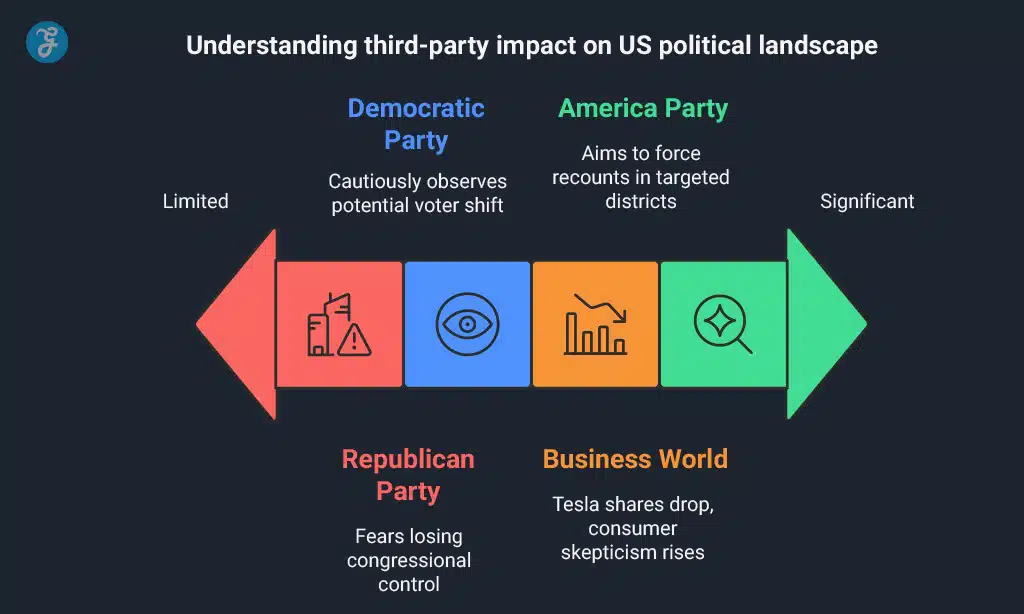
Republican Alarm: Fears of losing control in Congress as right-leaning votes splinter.
-
Democratic Caution: A wait-and-see approach, aware that America Party voters might shift swing districts in their favor.
-
Business Impact: Tesla shares have dropped , some liberal-minded consumers have soured on Musk’s ventures, and activist circles question his priorities.
Possible Scenarios:
-
If Musk steers enough votes in targeted districts, the America Party could force close races into recount territory, amplifying its influence even without widespread wins.
-
Conversely, lack of legal recognition or candidate recruitment could stall the party before the 2026 midterms.
Digital Engagement: How Musk’s Playbook Differs
Elon Musk’s strategy spotlights a trend reshaping modern U.S. politics:
-
Social Media as a Megaphone: Polls, debates, and party messages are launched directly to millions on X, bypassing traditional party machinery.
-
Influencer Capital: Musk leverages his identity as an entrepreneur and “disruptor-in-chief,” using his personal brand to fuel digital engagement and drive online debates.
-
Populist Language: Calls for “restoring your freedom” and painting both major parties as a “uniparty” tap into anti-establishment sentiment, especially among younger, more digital-native voters.
Branding, Vision, and Long-Term Prospects
The America Party’s branding is as ambitious as its founder: freedom, innovation, and independence. Yet, voter turnout and grassroots support—not digital virality alone—will determine its legacy.
| Branding Element | Description |
|---|---|
| Slogan | “Give back your freedom.” |
| Visual Identity | U.S. flag themes, digital first; appeals to independent voters |
| Core Demographics | Disaffected conservatives, tech enthusiasts, anti-establishment seekers |
| Long-Term Challenge | Sustain excitement against “spoiler effect” accusations and institutional inertia |
Takeaways: Disruption or Distraction?
Elon Musk’s launch of the America Party injects energy, drama, and uncertainty into an already turbulent U.S. political arena. By focusing on strategic districts and legislative influence, Musk sidesteps the traditional pitfalls that have sunk other third-party bids. Yet, the daunting path to registration, ballot access, and voter trust remains.
With public support tepid and legal hurdles looming, the America Party’s fate hangs in the balance. Musk may not overturn the two-party system overnight, but his foray is certain to test the limits of political disruption in the digital age. The months leading to the 2026 midterms will reveal whether Musk’s vision is revolutionary—or simply another experiment in American electoral history.