
You know how it goes. You start with a promising idea, build something people want, and then suddenly find yourself at a crossroads. Revenue is climbing, but so are costs. Your team is stretched thin. What worked at 10 customers doesn’t work at 100, and you’re not sure if your systems can handle 1,000. This is where most small businesses hit a wall.
According to a 2026 report from the US Small Business Administration, roughly 50% of new businesses fail within the first five years. The culprit is often not a lack of demand. It’s the inability to scale operations profitably. Building business models that scale requires more than ambition. It demands a deliberate framework that aligns revenue growth with controlled cost expansion.
Here’s the opportunity. With the right infrastructure, strategic automation, and a clear customer acquisition plan, we can design a business model that grows without breaking. This guide walks through the proven principles that separate companies that plateau from those that compound.
From leveraging technology to structuring your finances for rapid growth, we’ll show you the practical steps that turn startups into sustainable enterprises.
What Makes a Business Model Scalable?
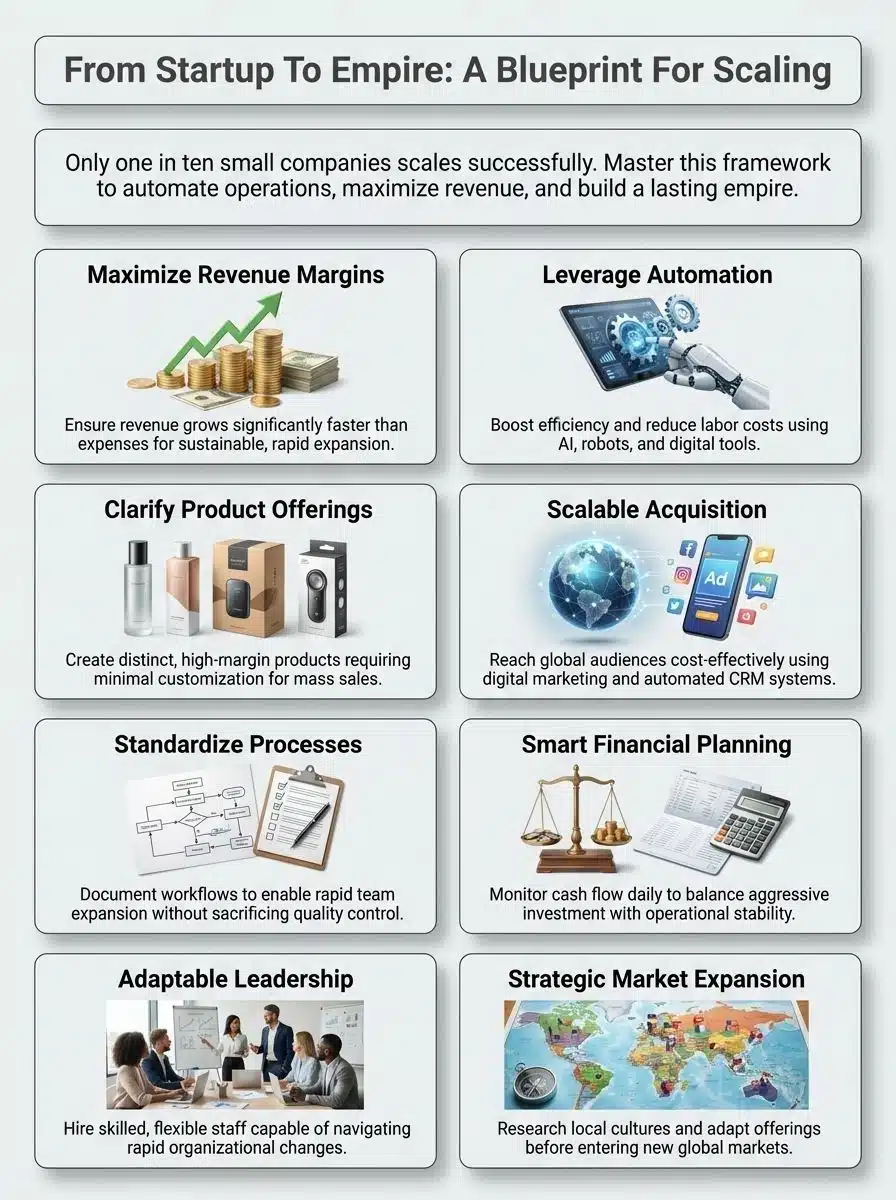
A scalable business model is one where revenue can grow significantly faster than costs. The magic happens when we can serve 10 times more customers without needing 10 times more resources.
Companies like Amazon and Netflix prove this works. They invest heavily upfront in technology and infrastructure, then spread those fixed costs across millions of users.
Revenue Growth vs. Cost Growth
The core test of scalability is simple. Can we double revenue without doubling expenses? In scalable models, revenue climbs while costs inch up slowly. A software company might spend $1 million building a product, but selling the 10,000th license costs nearly nothing. A subscription box service, once the logistics are automated, can add new subscribers at a fraction of the original setup cost.
Traditional businesses struggle here. A bakery can’t serve twice as many customers without buying more ovens, hiring more staff, and leasing more space. Costs and revenue move in lockstep. That’s why economies of scale matter so much. They let us lower the per-unit cost as volume grows, turning what once felt expensive into something highly profitable.
Flexibility and Adaptability
Markets shift. Customer needs evolve. A scalable business doesn’t just grow. It pivots. Flexibility shows up in how we respond to demand spikes, integrate new revenue streams, or enter adjacent markets. Strategic partnerships amplify this. When we team up with the right distributors or technology providers, we gain access to resources we’d never build in-house.
Some platform models take this further. They invite competitors as customers, which demonstrates serious adaptability. Think of Shopify. It powers stores for brands that could theoretically compete with each other, yet Shopify grows because it’s the underlying infrastructure.
This kind of model thrives because it stays open to change. We test new features, collect feedback fast, and adjust before the market moves on.
Efficiency Through Automation
Automation isn’t optional anymore. It’s the baseline for any business that wants to scale without chaos. According to a 2025 report, Amazon now operates over 1 million robots across its fulfillment centers globally. These machines sort packages, move inventory, and reduce human error. The result is faster delivery and lower labor costs per unit shipped.
The same principle applies across industries. Automated chatbots handle customer inquiries 24/7. Digital invoicing tools like Stripe or QuickBooks eliminate manual billing errors. Predictive analytics platforms help us forecast demand and stock inventory more accurately.
Tools like Zapier and Microsoft Power Automate connect systems so tasks flow automatically. An order placed on your website can trigger inventory updates, send a confirmation email, and notify your warehouse, all without a single manual step.
In 2026, the most common business automation platforms include Salesforce for customer relationship management, HubSpot for marketing workflows, and ClickUp for project management. Each one reduces the need for repetitive manual work, freeing teams to focus on strategy and growth.
Core Elements of a Scalable Business Model

Building a scalable model starts with clarity. We need to know exactly what we’re selling, who’s buying it, and how we’ll deliver it profitably at volume.
Clear Product or Service Offerings
Simplicity sells. When customers immediately understand what we offer, conversion rates climb. Look at Google’s search engine or Apple’s iPhone. There’s no ambiguity. People know the value instantly, and that clarity drives adoption at scale.
Scalable businesses often focus on products or services that require minimal ongoing support. Digital tools, streaming platforms like Netflix, and SaaS applications thrive here. Once built, they serve millions without a proportional increase in support staff.
Intellectual property adds another layer. Patents, trademarks, and proprietary designs create competitive barriers. A competitor can’t simply copy what makes our product unique, which protects market share as we grow.
Defined Customer Acquisition Strategy
Growth depends on a repeatable system for attracting the right customers. We start by defining our target market clearly. Who are they? What problems do they face? A strong value proposition answers why they should choose us over alternatives.
Digital tools accelerate acquisition. Search engine optimization brings organic traffic. Content marketing educates potential buyers. Social media ads target specific demographics. Email campaigns nurture leads until they’re ready to purchase.
According to a 2026 digital marketing study, email marketing delivers an average return of $36 for every $1 spent, while SEO generates approximately $22 per $1 invested. These channels compound over time, making them essential for sustainable growth.
A customer relationship management platform like Salesforce or HubSpot tracks every interaction. We know who’s interested, where they came from, and what content resonated. This data lets us refine our approach continuously.
Subscription models and affiliate programs further streamline acquisition. Subscriptions create recurring revenue, improving cash flow predictability. Affiliates expand our reach without upfront marketing spend.
Streamlined Operational Processes
Standardization is the backbone of scalability. When we document exactly how tasks should be done, training new team members becomes faster. Quality stays consistent even as volume increases. There’s no guessing, no reinventing the wheel.
Automation tools handle repetitive work. In an e-commerce business, order processing, shipping notifications, and inventory updates can all run automatically. This reduces errors and frees up time for higher-value activities.
Outsourcing non-core functions helps too. Many growing companies outsource PR, fulfillment, or customer support. This keeps operations lean while allowing us to focus on product development and strategy.
Strong Financial Planning and Management
Cash flow makes or breaks scaling efforts. We track daily sales, monitor expenses, and project cash needs months ahead. The goal is to avoid surprises. Businesses often fail not because they lack revenue, but because they run out of cash during a growth phase.
Tools like Shopify Capital offer quick access to funding based on actual sales. Payments come out as a percentage of each transaction, so there are no surprise fees or compounding interest. This type of flexible financing supports inventory purchases and marketing campaigns without the rigidity of traditional loans.
According to a 2026 report on US small business trends, poor cash flow management affects 82% of small business failures. The most successful companies build reserves equal to six to 12 months of operating expenses. That buffer allows them to weather slow periods and seize growth opportunities when they arise.
Key Strategies for Scaling a Business

Execution separates ideas from outcomes. These strategies provide the practical steps we need to scale effectively.
Technology and Automation
Technology is the engine of modern scalability. AI-powered tools now handle tasks that once required entire teams. Zendesk AI and Drift manage customer support inquiries around the clock. Salesforce Einstein and HubSpot AI analyze data to predict which leads are most likely to convert. Klaviyo automates email campaigns based on customer behavior.
Social media management platforms like Hootsuite and Buffer schedule posts across multiple channels, maintaining consistent brand presence without daily manual effort.
Amazon’s use of over 1 million robots demonstrates automation at scale. These machines speed up fulfillment, reduce errors, and lower labor costs. While most businesses won’t need robots, the principle applies everywhere. Automate what’s repetitive so teams can focus on strategy and innovation.
Automated invoicing software like QuickBooks or FreshBooks handles billing, sends payment reminders, and tracks overdue accounts. Project management tools such as Monday.com or Asana keep teams aligned without constant check-ins.
Adoption requires investment. Training takes time. Systems may need updates or integration work. But businesses that embrace automation gain speed and consistency that manual processes can’t match.
Building a Talented and Adaptable Team
People drive growth. Hiring the right talent means looking beyond skills to mindset. We need team members who can adapt, solve problems, and take ownership. Contractors and freelancers work well for testing new ideas or handling specialized projects early on. Once revenue stabilizes, bringing on full-time staff ensures commitment and continuity.
Leadership matters even more as we scale. Clear roles prevent overlap and confusion. Strong leaders keep teams aligned, manage change effectively, and maintain culture even as headcount grows.
Diversity brings new perspectives. Different backgrounds and experiences lead to better problem-solving and innovation. Investing in ongoing training keeps skills sharp. Fair compensation and career development opportunities help retain top performers.
Standardizing and Documenting Processes
Documentation turns chaos into clarity. The “Six S Framework” from Harvard Business School guides this work. The framework emphasizes standardizing, simplifying, and systematizing operations so that growth doesn’t outpace our ability to execute.
We write down every critical process. How do we onboard new customers? What’s the step-by-step for fulfilling orders? How do we handle support tickets? These documents become the playbook that keeps everyone moving in the same direction.
Standardization also protects quality. As we scale, new hires can follow established procedures instead of improvising. This reduces mistakes and maintains consistency across the business.
Expanding into New Markets
New markets unlock new revenue streams. Research comes first. According to research from the University of Chicago, cultural differences significantly impact how business ideas transfer across borders. What works in the US might not resonate in Europe or Asia. We study local preferences, regulations, and competitive landscapes before committing resources.
Strategic partnerships smooth market entry. The REACH model emphasizes building relationships with local distributors, suppliers, and advisors. These partners understand the terrain and help us adapt quickly.
Walmart’s global expansion starting in 1991 offers a useful lesson. The company entered Mexico City first, then moved into Canada and South Korea. Each market required adjustments to product selection, pricing, and distribution. Some markets worked. Others didn’t. The key was starting with one market, learning fast, and applying those lessons to the next.
Diversifying revenue streams through geographic expansion reduces dependence on any single market. If one region slows down, others can sustain growth.
Common Challenges When Scaling
Growth brings complexity. Anticipating common pitfalls helps us navigate them more effectively.
Operational Complexity
More customers mean more moving parts. We add employees, open new locations, and expand distribution channels. Each addition introduces new layers of coordination. Managing company culture becomes harder as teams grow and work across different locations or time zones.
Hiring and retaining great people requires deliberate effort. Building a strong management team ensures that decisions get made efficiently and problems get solved before they escalate.
According to a 2026 study on business scaling, the most common challenges include cash flow constraints, talent shortages, and maintaining quality as volume increases. Addressing these early prevents them from stalling growth later.
Maintaining Quality Control
Speed and quality often pull in opposite directions. As we rush to meet demand, errors creep in. Products ship with defects. Customer service suffers. Brand reputation takes a hit.
We prevent this by building quality checks into every process. Standardized procedures ensure consistency. Customer feedback loops help us catch issues early. Regular audits identify weak points before they become crises.
Strong branding reinforces quality expectations. When our brand identity aligns with the actual customer experience, trust builds. In 2026, startups with strong, consistent branding see higher customer retention and better word-of-mouth growth compared to competitors with unclear messaging.
Managing Cash Flow Effectively
Cash flow crunches are the most common cause of scaling failures. Growth demands upfront investment. We need inventory, equipment, and staff before revenue from new customers arrives. This creates a gap where expenses outpace income.
According to a 2026 financial management report, businesses should create monthly cash flow projections for the next 12 to 18 months. Scenario planning helps. What happens if sales drop 10%? What if a major customer delays payment?
Tools like CashFlow Complete from Commerce Bank provide unified views of all accounts, receivables, and payables. Automated reminders reduce late payments. Setting clear payment terms and following up quickly on overdue invoices shortens the cash conversion cycle.
Financing options like factoring, lines of credit, or short-term loans provide flexibility. Avoiding common mistakes in seeking funding ensures we don’t overextend or saddle the business with unsustainable debt.
Preserving Brand Identity
Growth can dilute what made us special in the first place. Startups with limited resources often struggle to maintain brand consistency as they scale. New team members may not fully understand the brand’s core values. Marketing messages become inconsistent. Customer experience varies across touchpoints.
We counter this by embedding our values into every process and decision. Regular feedback from our core audience keeps us aligned. Strong internal communication ensures everyone knows what the brand stands for.
Investors watch how well growing companies maintain their identity. It signals discipline and long-term thinking, both of which matter for sustainable growth.
Real-Life Examples of Scalable Success
Case studies offer concrete proof that these principles work.
The Amazon Playbook
Jeff Bezos built Amazon on four principles: customer obsession, long-term thinking, bold invention, and operational excellence.
Amazon now operates over 1 million robots in its fulfillment network. Automation keeps costs low even as order volume skyrockets. Economies of scale kick in. The more Amazon ships, the lower the cost per package.
Amazon Prime demonstrates the power of customer focus. By offering fast, free shipping and exclusive content, Prime creates loyalty that translates into repeat purchases. The subscription model provides predictable revenue, which funds further innovation.
AWS started as a massive upfront investment. Amazon built data centers, developed cloud infrastructure, and learned from internal use before opening it to other businesses. Today, AWS generates billions in high-margin revenue, proving that long-term bets on infrastructure can pay off at scale.
The Netflix Transformation
Netflix began by mailing DVDs. Growth was slow and expensive. Postage, inventory management, and physical logistics limited scalability.
In 2007, Netflix shifted to digital streaming with a subscription model. This change eliminated most variable costs. Serving the millionth subscriber costs about the same as serving the thousandth. Fixed infrastructure costs spread across a growing user base, lowering the average cost per customer.
According to 2026 data, Netflix now has approximately 325 million global subscribers. The company uses predictive analytics to recommend content, keeping users engaged and reducing churn. Licensing deals and original content give Netflix control over both costs and quality.
Network effects amplify value. The more people use Netflix, the more data the company collects. Better data leads to better recommendations, which keeps subscribers happy and attracts new ones.
Final Words
Scalable business models aren’t built by accident. They’re designed with intention, supported by automation, and guided by clear financial planning.
The path from startup to empire requires more than hard work. It demands systems that grow revenue faster than costs, technology that eliminates manual bottlenecks, and teams that adapt as markets shift.
Whether you’re launching a digital product or expanding a service business, the principles remain the same. Focus on customer acquisition strategies that compound. Build infrastructure before you need it. Track cash flow relentlessly. And never stop testing, learning, and refining.
The tools and frameworks exist. Companies like Amazon and Netflix prove the model works. Now it’s about execution.