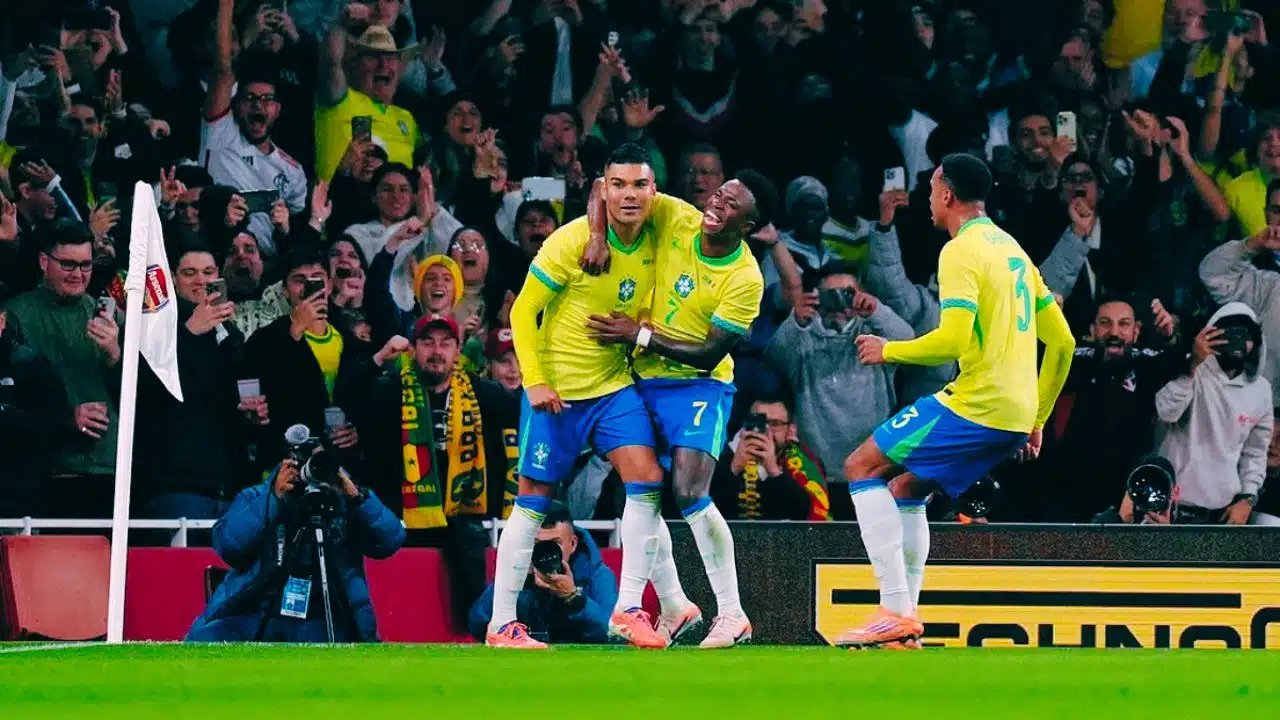
Brazil continued their steady build-up to the 2026 World Cup with a composed 2-0 victory over African champions Senegal in an international friendly at the Emirates Stadium in London, powered by first-half goals from teenage prodigy Estêvão and captain Casemiro.
The match, staged at Arsenal’s Emirates Stadium, finished Brazil 2–0 Senegal, with both goals arriving before the interval to give the Seleção full control of the contest.
Estêvão opened the scoring with a cool finish before Casemiro doubled the advantage, ensuring a confidence-boosting result against one of Africa’s most dangerous sides.
Lineups and tactical setup
Brazil set up in a 4-2-3-1 system, with Ederson in goal behind a back four of Éder Militão, Marquinhos, Gabriel Magalhães and Alex Sandro, offering a blend of physicality and ball-playing ability.
In midfield, Bruno Guimarães partnered Casemiro in the double pivot, while an attacking trio of Estêvão, Matheus Cunha and Rodrygo operated behind Vinícius Júnior as the lone striker, giving Carlo Ancelotti plenty of movement and creativity between the lines.
Senegal mirrored Brazil’s shape with their own 4-2-3-1, led by star forward Sadio Mané at the tip of the attack.
Behind him, Ismaïla Sarr and Iliman Ndiaye provided width and dribbling threat, while Idrissa Gana Gueye and Pape Gueye formed a combative central pairing in front of a defence marshalled by Kalidou Koulibaly and Moussa Niakhaté with Edouard Mendy in goal.
Bright Brazilian start
From the opening whistle Brazil imposed themselves, pressing high and using quick combinations to stretch Senegal’s defensive block.
Within the first 15 minutes, the Seleção had already registered multiple shots on goal, signalling a clear intent to dictate the tempo and test Mendy early.
Senegal initially struggled to progress the ball cleanly under Brazil’s pressure but still threatened sporadically on the break, looking to release Mané and Sarr into space behind the Brazilian full-backs.
However, Marquinhos and Gabriel read the transitions well, cutting out several counterattacking moves before they could develop into clear chances.
Estêvão’s breakthrough moment
The deadlock was broken by Estêvão, whose rising star within the national setup gained further momentum with a composed opener.
The young winger drifted into a pocket of space, linked neatly with the attacking midfield line and produced a tidy finish that left Mendy with little chance, underlining why he is being tipped as one of Brazil’s next great attacking talents.
That goal shifted the rhythm decisively in Brazil’s favour, allowing them to play with more patience and confidence in possession.
Senegal responded by pushing their wide players higher, but doing so left additional gaps between the lines that Brazil’s creative players, particularly Rodrygo and Estêvão, were quick to exploit.
Casemiro doubles the lead
Brazil’s second goal arrived before half-time, when Casemiro marked a rare scoring appearance at international level.
A Rodrygo set piece was delivered to the far post, where Casemiro timed his run perfectly to meet the ball and guide it home, giving Brazil a 2-0 cushion and further rewarding their dominance in the first period.
For Casemiro, the goal ended a long drought for the national team and showcased the additional threat he can offer on attacking dead-ball situations.
It also reflected the set-piece work Ancelotti has clearly prioritised, using Brazil’s aerial strength in the box against a physically strong Senegalese side.
Second-half control and key battles
The second half evolved into a more tactical contest, with Brazil managing the tempo and Senegal pushing for a way back without leaving themselves completely exposed.
Senegal enjoyed better spells of possession after the break and forced Brazil to defend deeper phases, but struggled to turn approach play into high-quality shots on Ederson’s goal.
In midfield, Casemiro and Bruno Guimarães continued to dictate rhythm, breaking up Senegal’s transitions and recycling the ball intelligently.
For Senegal, Gana Gueye tried to drive the team forward with his usual energy, yet Brazil’s compact shape between the lines limited the effectiveness of Mané and Sarr in the final third.
Notable incidents and fitness concerns
One concern for Brazil came with an injury scare surrounding Arsenal defender Gabriel Magalhães, who appeared to be in discomfort and was eventually withdrawn.
Given the match took place at his club’s home ground, his early exit will be monitored closely by both the national team staff and Arsenal, with further assessments expected in the coming days.
Beyond that, the contest remained largely free of major flashpoints, with the referee keeping control in a match that was competitive but generally fair.
Both managers used their benches in the second half, handing minutes to squad players and younger options as part of broader World Cup preparation plans.
What the result means for Brazil
For Brazil, this win offers a timely injection of belief following what has been a mixed run of results in competitive fixtures.
Victory over a well-regarded Senegal side reinforces the sense that Ancelotti is beginning to impose a clearer structure and identity on the team, particularly in terms of defensive stability and attacking balance.
It also underlined the growing influence of emerging talents like Estêvão alongside established stars such as Vinícius Júnior, Rodrygo and Casemiro.
With the 2026 World Cup on the horizon, Brazil will take encouragement from a performance that combined solidity at the back with sparks of attacking flair and more coherent collective play.
Senegal’s takeaways despite defeat
Despite the defeat, Senegal showed enough quality in spells to reaffirm their status as one of Africa’s most consistent and dangerous teams.
Their defensive shape held firm for long periods against elite opposition, and with Mané, Sarr and Ndiaye, they remain a constant threat in transition against any back line.
The main challenge for Senegal will be sharpening their end product against top-tier sides, as they struggled to convert pressure into clear chances here.
Even so, the experience of facing Brazil in a high-profile venue like the Emirates will serve as valuable preparation for upcoming continental and World Cup qualifying commitments.
Overall, Brazil’s 2-0 win over Senegal was a professional and convincing display that blended the excitement of new faces with the reliability of seasoned leaders.
Estêvão’s breakthrough and Casemiro’s set-piece header delivered the key moments, while a controlled second-half performance ensured a clean sheet and a statement result in London.