
Black Friday has grown from a single day of doorbuster chaos into an extended shopping season that stretches across many days of online and in-store offers. For shoppers, the result is a confusing mix of discount banners, flash sales, early access events, and so-called “once-a-year” deals. In that noise, it is no longer obvious what is genuinely good value and what is simply a loud price tag.
That is why a well-structured, practical Black Friday buying guide matters more than ever. Smart Black Friday shoppers do not simply react to the biggest percentage they see on a screen. They build a plan, set limits, compare prices, and move with intention. They understand that the goal is not to buy more but to buy better.
This guide takes you through Black Friday step by step. It explains how to prepare, what to prioritize, what to avoid, and how to protect yourself from scams and regret. Rather than focusing on hype, it focuses on behavior—because your decisions before, during, and after Black Friday determine whether it becomes an opportunity or an expensive mistake.
Why Black Friday Still Matters for Smart Shoppers
Despite constant talk of “sale fatigue,” Black Friday still plays an important role for many households. It can be a useful moment to:
-
Replace or upgrade essential electronics at lower prices
-
Buy planned gifts without paying full retail
-
Stock up on seasonal items and household basics
-
Take advantage of limited-time loyalty and cash-back offers
The problem is not Black Friday itself. The problem is how easy it is to drift through the season without a plan. Retailers invest heavily in tactics that encourage impulse buying: countdown timers, “only a few left” notices, emotional product stories, and carefully designed product bundles. When shoppers arrive unprepared, they become far more vulnerable to overspending and disappointment.
A Black Friday buying guide restores balance. It puts you back in charge by helping you define what you want from the day, long before the first promo email lands in your inbox.
Step-by-Step Black Friday Buying Guide for Smart Shoppers
This is the heart of the article: a practical, chronological Black Friday buying guide you can follow like a checklist. Think of it as a simple roadmap: plan, research, execute, then review.

Step 1: Clarify your goals and set a tight budget
Every smart decision starts with a clear purpose. Before you look at a single deal, ask yourself:
-
What do I need to buy before the end of the year?
-
What would be nice to buy if the price is right?
-
What can wait, even if the discount looks attractive?
Write down your answers and then define a total Black Friday budget—not just for one day but for the entire period that includes early sales, the main event, and Cyber Monday.
Break that overall budget into simple categories:
-
Gifts for others
-
Household or personal essentials
-
Upgrades (electronics, home office, etc.)
-
“Fun” or discretionary items
This is your financial guardrail. The job of every other part of this Black Friday buying guide is to help you stay within those boundaries.
Step 2: Build and prioritise a master wish list
Once you know your budget, turn vague ideas into a concrete list. This step is where many Black Friday shopping tips begin—and with good reason.
Create a list with columns for:
- Product name and model (as specific as possible)
- Category (gift, home, tech, etc.)
- Typical everyday price
- Target price for Black Friday
- Priority level (must-buy, planned upgrade, nice-to-have)
Prioritize your list in three tiers:
- Tier 1 – Non-negotiable essentials: Items you will buy at some point, regardless of Black Friday: replacing a failed appliance, buying a work or study device, or essential household needs.
- Tier 2 – Planned upgrades: Items that improve your quality of life but are not urgent. Here, a solid discount is important for the purchase to make sense.
- Tier 3 – Optional extras: Nice-to-have items that you will only buy if the price is exceptional and there is room left in your budget.
This master list becomes the anchor of your Black Friday buying guide. When the deals start, you check them against the list—not the other way around.
Step 3: Research prices and define “real deals”
The next task is to turn your wish list into a realistic expectations map. That means researching:
- The usual selling price in recent months
- The range of prices across major retailers
- Whether the item has already been discounted at similar levels earlier in the year
Use price-comparison sites, retailer apps, and shopping tools to get a sense of genuine value. Then set a target price for each item:
- For big-ticket electronics, a meaningful discount may be in the range of a solid mid-double-digit percentage off typical pricing.
- For apparel or accessories, a higher percentage discount is often realistic, as retailers build in more margin.
- For furniture and some appliances, moderate discounts may be more common, and it may be worth comparing other sale periods as well.
The key principle: define what counts as “good enough” before you see the promotion. This reduces the emotional impact of “today only” banners and keeps your decisions grounded in facts.
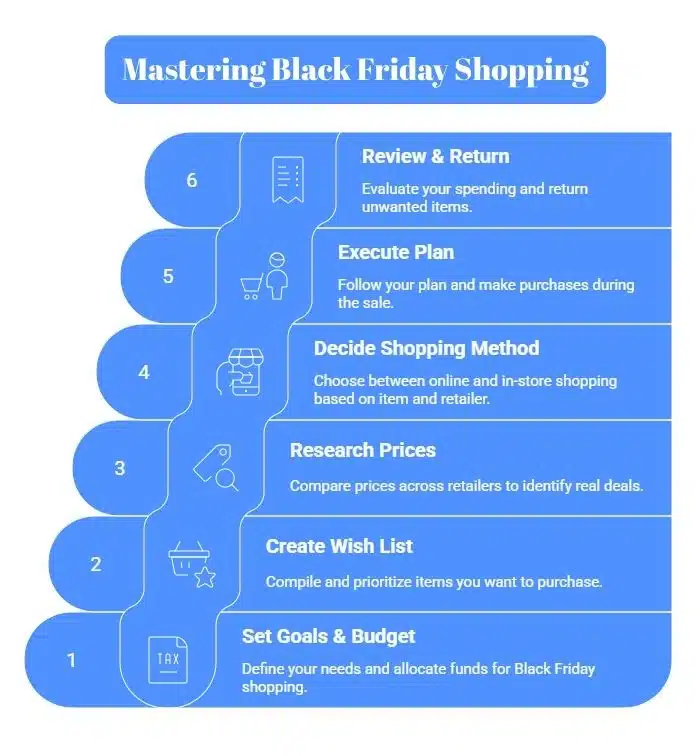
Step 4: Decide where and how you will shop
Black Friday is now a hybrid event: part online, part in-store, and often spread across several days.
Refine your Black Friday buying guide by deciding:
- Which items will you buy online (where price comparison is easier and delivery is convenient)
- Which items do you prefer to buy in-store (where you can see size, quality, and colour in person)
- Which retailers offer the best mix of price, return policy, delivery times, and loyalty benefits
Check:
- Store opening hours and crowd expectations if you plan to visit in person
- Delivery cut-off dates for items you need before specific occasions
- Whether click-and-collect is available to avoid shipping fees or long in-store queues
This is also a good moment to confirm your payment strategy. Will you use a particular card for extra cash back, rewards, or purchase protection? Planning that in advance is another small but powerful Black Friday shopping tip.
Step 5: Execute your plan on Black Friday (and the surrounding days)
When the sale finally starts, treat it like a short, focused project—not a day of aimless browsing.
Use this order of operations:
-
Start with Tier 1 essentials: Secure the items you genuinely need first, even if other discounts look more dramatic.
-
Check your target prices: Compare the live deals with the target prices from your research. If an offer meets or beats your target and fits your budget, it may be time to act.
-
Compare before you click: Even under time pressure, take a minute to compare prices across at least two retailers. Many products are available from several stores.
-
Watch the total, not the cart count: Track your running total of spending during the day. It is easy to lose perspective when each individual item feels affordable.
-
Use a “cooling-off” pause for non-essentials: For Tier 3 items, save them in your cart and step away for a short break. If they still feel worth it after that pause—and your budget allows—then buy.
A good Black Friday buying guide does not forbid impulse purchases entirely. It simply makes sure those purchases are conscious choices, not reactions to time pressure and marketing design.
Step 6: Review, return, and reset after the sale
The guide does not end when the discount banners disappear. Smart Black Friday shoppers use the post-sale period to protect their finances and correct mistakes.
After the event:
-
Review your spending: Compare your actual total with the budget you set. This reveals whether your plan was realistic and where discipline slipped.
-
Test what you bought: Unbox electronics, inspect clothing, and check measurements for home items as soon as they arrive. Do not leave them sealed until after the return windows close.
-
Organize receipts and confirmations: Save digital copies of receipts and order emails in one place, sorted by retailer. If anything fails or disappoints, you will have documentation ready.
-
Use return policies properly: If an item is not what you expected, act early. A central part of a modern Black Friday buying guide is the reminder that returns are there for a reason. There is no value in keeping something that does not suit your needs.
-
Reflect on next year: Note which tactics worked and which did not. Each season teaches you more about your own habits.
This final step turns Black Friday into a learning cycle rather than a one-off event.
Where the Best and Worst Black Friday Deals Usually Hide
A practical Black Friday buying guide does not stop at “how” to shop. It also addresses “what” you are likely to find.
Categories where smart shoppers often win
Certain categories regularly offer strong Black Friday value:
-
Toys and games: Retailers often use toys as attention-grabbing deals in the run-up to the holiday season, making this a sensible time to shop for children’s gifts.
-
Televisions and home entertainment: TV offers are a Black Friday staple. Good discounts appear on a wide range of models, not only budget sets.
-
Headphones, accessories, and small devices: Wireless earbuds, speakers, smart displays, streaming sticks, and gaming accessories often receive attractive price cuts as add-on purchases.
-
Apparel, shoes, and accessories: Fashion and footwear retailers typically offer large percentage discounts, which can be useful if you have a planned wardrobe update.
For many households, focusing Black Friday spending on these categories—and ignoring most of the rest—already leads to a more efficient outcome.
Categories that call for extra caution
Other areas deserve a slower, more critical approach:
- Furniture: While some discounts appear, similar or better offers may show up at end-of-season sales or clearance events. There is no guarantee Black Friday is the absolute best moment.
- Large home appliances: Washing machines, fridges, and similar items are often discounted, but wide price swings across the year mean you should compare other sale periods before committing.
- Extended warranties and add-on protection: These can be useful in specific cases but are often oversold. Read the terms carefully and compare the cost with realistic repair risks.
- Fast fashion and novelty gadgets: Deep discounts can hide short product lifespans. If something looks like it will be forgotten in a month, the best Black Friday price is still zero.
A balanced Black Friday buying guide encourages you to say “no” to entire categories when they do not align with your long-term interests.
Digital Tools, Loyalty Programs, and Timing Tactics
Modern Black Friday shopping tips almost always mention technology and loyalty schemes, and with good reason. Used properly, they extend your savings without increasing your risk.
Using price-tracking tools and alerts
Price-tracking services and browser extensions allow you to:
- View price history on selected items
- See whether a “deal” is genuinely lower than recent norms
- Set alerts when products reach your target price
- Compare prices across multiple retailers instantly
Integrate these tools into your Black Friday buying guide as early as possible. Add your Tier 1 and Tier 2 items in advance so your data is ready by the time the main promotions begin.
Stacking loyalty, rewards, and cash back
Loyalty and reward programs can quietly increase the value of each transaction:
- Store accounts may offer member-only pricing or early access to certain deals.
- Credit cards sometimes provide seasonal cash-back boosts for online shopping or specific categories.
- Cash-back platforms can add a small percentage rebate on top of advertised discounts.
- Digital coupon tools automatically test and apply promo codes at checkout.
The key rule is simple: stacking is a bonus, not a justification. A poor-value purchase does not become good just because you earn points on it.
Timing your Black Friday moves
Deals do not all peak at the same moment. Some retailers push their best offers earlier in the week. Others save them for the day itself or for Cyber Monday.
To handle this, refine your plan as follows:
- For products that historically sell out quickly, act earlier in the cycle.
- For less popular categories, you may wait to see whether Cyber Monday or later promotions improve the price.
- Keep an eye on shipping cut-offs if you need items before certain dates.
Treat timing as another lever you control—not something that retailers dictate entirely.
Scam-Proof and Safety Checklist for Smart Black Friday Shoppers
No Black Friday buying guide is complete without a clear safety and security section. As online shopping grows, so do scams, fake stores, and deceptive messages.
Use this simple checklist:
Online safety
- Type retailer addresses directly into your browser rather than clicking on unsolicited links.
- Be wary of deals that appear only via random ads or messages and seem far below typical prices.
- Check that the website address looks correct and professional, not a small variation on a well-known brand.
- Use secure payment methods that offer dispute or chargeback options.
- Avoid saving card details on multiple new sites; use a trusted payment service instead.
- Turn on two-factor authentication for email and key shopping accounts.
In-store safety
- Plan store visits and routes in advance; avoid wandering from deal to deal without a purpose.
- Keep wallets, phones, and shopping bags secure at all times, especially in crowded areas.
- For large purchases, store items out of sight in vehicles and move them quickly into a safe place at home.
Return and rights awareness
- Read return and exchange policies before buying, especially for electronics and sale items.
- Confirm whether “final sale” items can be returned at all.
- For online purchases, check whether return shipping is free, flat-rate, or paid by the customer.
- Keep receipts, order confirmations, and packaging until you are sure you will keep the product.
Security does not have to slow you down. When you build these habits into your Black Friday buying guide, they become routine.
Sustainable and Mindful Black Friday Shopping
Black Friday is often criticized for encouraging overconsumption, and the criticism is not entirely wrong. However, smart Black Friday shoppers can use the event in different ways.
Buying better instead of buying more
A thoughtful approach:
- Prioritises quality over quantity
- Favors durable products over disposable ones
- Avoids novelty purchases that will soon be unused clutter
That might mean choosing one well-made jacket instead of three fast-fashion alternatives or investing in a reliable appliance instead of a cheaper model that is likely to fail.
Supporting responsible brands and long-term value
In recent years, more brands have tried to align Black Friday with broader values, focusing on:
- Repairability and spare parts availability
- Transparent supply chains
- Fair labour and environmental standards
You do not need to be perfect. But even small shifts in what you choose to support can turn Black Friday into a more mindful experience.
Planning for returns and post-sale reality
Sustainable behavior also includes:
- Returning items you do not need rather than letting them gather dust
- Donating older but functional products when you replace them
- Reflecting on what genuinely improved your life versus what felt exciting only in the moment
A complete Black Friday buying guide helps you think about the full life cycle of your purchases, not just the moment they arrive at your door.
Verdict: How Smart Black Friday Shoppers Truly Win
Used well, Black Friday is not a chaos festival of random purchases—it is a planned opportunity to stretch your budget on things that matter. Used poorly, it becomes a source of debt, regret, and clutter.
The difference lies in how you approach it.
This Black Friday buying guide shows that the winning strategy is simple:
-
Define clear goals and a tight budget before you shop.
-
Build and prioritize a detailed wish list.
-
Research real prices and set target deals in advance.
-
Decide when, where, and how you will shop, including which tools and loyalty programs you will use.
-
Execute your plan calmly, starting with essentials and using pauses for non-essential buys.
-
Review, test, return, and reflect after the event to protect your finances and learn for next time.
Smart Black Friday shoppers know that every click and every purchase is a financial decision. When you combine discipline with solid Black Friday shopping tips, marketing loses its power over you. Black Friday no longer controls your wallet—you do.