Every year on 28 September, India marks Bhagat Singh Jayanti—the birth anniversary of a 23-year-old revolutionary who shaped the moral vocabulary of our freedom movement. Bhagat Singh was not only a symbol of courage. He was also a reader, a writer, and a sharp critic of injustice. He asked tough questions about power, privilege, and truth. Those questions still matter in today’s India.
This article explores how Bhagat Singh’s ideas apply to modern India. It connects his writings and actions to issues we face now—misinformation, divisive politics, social inequality, weak civic habits, and the need for youth leadership. The tone is simple and practical. Each section includes a quick table to help you scan and act.
A Quick Snapshot—Why Bhagat Singh Still Matters
Bhagat Singh matters because he changed how Indians imagined freedom. He argued that independence should also transform society, not only who governs it. He pushed people to think, read, and organize. He treated citizens as decision-makers, not spectators. This is a big deal in today’s world of instant reactions and short attention spans. His example cuts through the noise.
He taught that courage without clarity is dangerous, and clarity without courage is useless. Modern India lives online and offline at the same time; both spaces need integrity and discipline. That is why he still speaks to students, creators, and workers. He shows how to turn anger into action, and ideals into institutions. If you’re looking for a simple test for public life—“Does this reduce fear and increase dignity?”—his life gives you one.
Bhagat Singh stands out because he made freedom a moral project as much as a political one. He believed independence meant more than replacing rulers. It meant building a society that honors reason, equality, and human dignity. He studied widely, wrote with clarity, and used non-lethal protest in the Central Legislative Assembly to dramatize his ideas. He urged the youth to organize, read, debate, and act.
Bhagat Singh At a glance:
| Why He Matters | What It Means Today | Fast Action |
| Moral courage with discipline | Stand up for rights without hate or harm | Uphold civility in debates; say no to doxxing/trolling |
| Respect for reason and study | Think before you share; read before you react | Verify sources; read primary texts when possible |
| Organizing youth power | Move from lone rants to team action | Join or form campus clubs and community groups |
| Social and economic justice | Freedom should reduce inequality | Support local drives, legal aid, and fair work initiatives |
| Secular nationalism | Build unity across differences | Use inclusive language and shared civic rituals |
The Man Behind the Myth—Context You Need
It is easy to know Bhagat Singh’s name and miss his method. He was not a sudden hero. He was the product of steady learning and organized work. He grew up in a politically active family, yes, but he also built his mind like a craftsperson: reading newspapers, studying global ideas, and writing for the public. He used the courtroom and the jail as classrooms for society.
He treated history, economics, and philosophy as tools for citizens. When he chose symbolic protest, he also prepared leaflets, slogans, and arguments. This is crucial context. He did not romanticize chaos. He believed persuasion is stronger than noise, and that movements must teach as they act. Knowing this background helps us read his choices more fairly and apply his approach to our own time.
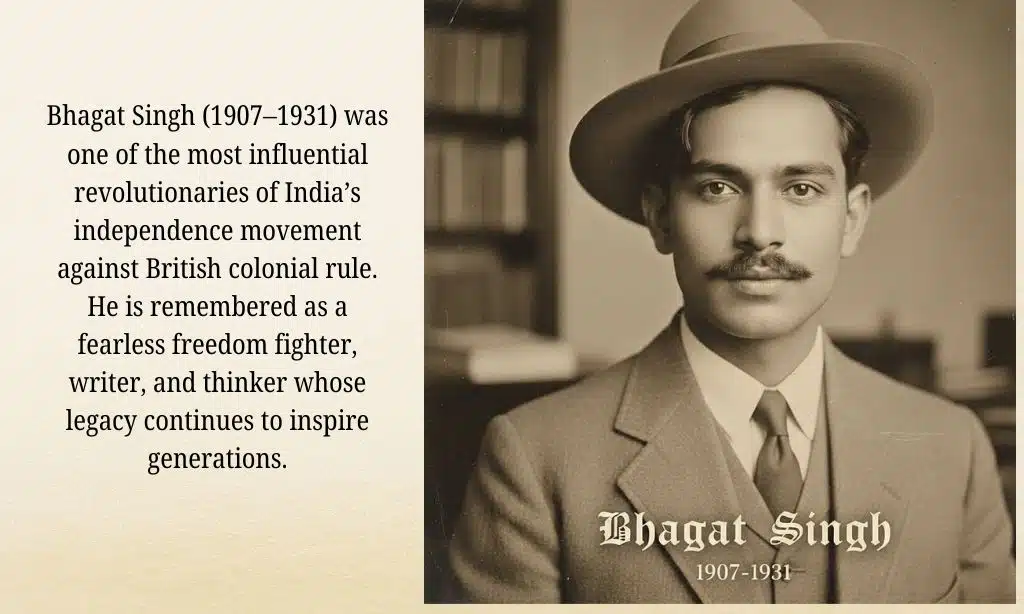
Bhagat Singh was born on 28 September 1907 in Banga (now in Pakistan). He grew up in a family involved in the freedom struggle. As a teenager he saw injustice first-hand. He read widely—Indian thinkers, European radical thought, and global anti-colonial literature. In the 1920s he helped organize Naujawan Bharat Sabha to mobilize youth. Later, as a member of the Hindustan Socialist Republican Association (HSRA), he pressed for a just and secular India.
He believed in symbolic protest that educates the public. The 8 April 1929 Assembly demonstration with B. K. Dutt was designed to avoid casualties and to carry leaflets that explained the cause. He also took part in a hunger strike in jail to demand rights for political prisoners.
His trial speeches and essays, including “Why I Am an Atheist,” show a mind committed to reason. He and his comrades were executed on 23 March 1931. His last words, and the calm with which he faced death, turned him into a lasting moral force.
Early Influences & Readings
| Influence | What He Took From It | Why It Matters Today |
| Family freedom tradition | Activist spirit and public duty | Families can seed civic values early |
| Lala Lajpat Rai & Punjab politics | Experience with protest and repression | Teaches resilience and strategic thinking |
| European political thought | Reason, rights, and critique of dogma | Encourages scientific temper and debate |
| Indian social reform movements | Dignity, caste critique, equality | Links freedom to social justice |
| Newspapers & pamphlets | Mass education and public persuasion | Reminds us to use media ethically |
The 5 Pillars of Bhagat Singh’s Vision
To use Bhagat Singh’s ideas today, we need a practical frame. The five pillars in this section turn values into habits. Each pillar pairs one risk of our era—outrage, division, tokenism, misinformation, apathy—with a response drawn from his method—purposeful dissent, secular citizenship, social fairness, intellectual discipline, youth leadership.
Think of them as “operating rules” for civic life. They do not demand perfection. They ask for steady effort. They remind us that impact comes from routines more than from one-day events. You will also find quick actions under each pillar. These are meant for classrooms, clubs, resident groups, and creators. Start small, show results, and keep improving. That is how big ideas survive beyond a news cycle.
Pillar 1: Courageous Dissent vs. Performative Outrage
Bhagat Singh practiced dissent with purpose. He rejected both silence and empty drama. He believed dissent should educate, persuade, and build. Outrage that wins likes but loses minds is not useful.
| Core Idea | Common Pitfall Today | Do This Instead | Time Needed |
| Dissent with purpose | Viral outrage without facts | Share only after you verify; add context | Minutes |
| Non-harm in protest | Abuse/doxxing in the name of “truth” | Keep protests civil; document peacefully | Ongoing |
| Educate while you protest | Noise without learning goals | Add reading lists and explainers to posts | 30–60 min |
| Build durable efforts | One-day trends | Link protests to petitions, RTI, meetings | Weeks |
Pillar 2: Secular Nationalism vs. Divisive Identity Politics
Bhagat Singh’s nationalism was inclusive. It focused on equal rights and common civic goals. He argued that social harmony was essential for a free India.
| Core Idea | What Divides Us | Civic Repair Action | Who Can Lead |
| Shared civic identity | Hate speech, stereotype chains | Community dialogues; code of conduct | Teachers, RWAs, student councils |
| Equal dignity | Social media echo chambers | Mixed-group activities in schools/colleges | Principals, cultural clubs |
| Common symbols | Weaponized symbols | Inclusive ceremonies, national days, service | Local leaders |
Pillar 3: Social & Economic Justice vs. Tokenism
For Bhagat Singh, freedom required fairness. He linked political liberty with economic dignity. He wanted workers and marginalized groups to see real change, not symbolic gestures.
| Core Idea | Token Gesture | Real Step | Expected Outcome |
| Dignity of labor | Occasional charity posts | Ongoing support for rights, safety, wages | Safer, fairer workplaces |
| Access to services | Photo-ops | Legal aid camps, literacy drives | Higher rights awareness |
| Equitable policy | Slogans | Budget tracking, public hearings | Better delivery and trust |
Pillar 4: Intellectual Rigor vs. Misinformation
Bhagat Singh asked people to read critically. He valued evidence over rumor. He wrote essays that challenged dogma and invited debate.
| Core Idea | Risk Today | What To Practice | Tool/Method |
| Evidence first | Forwarded myths | Cross-check with primary/credible sources | Archives, reputable books |
| Reasoned debate | Personal attacks | Attack ideas, not people | Debate rules, moderation |
| Media hygiene | Clickbait | Wait, verify, then share | Fact-check lists |
| Reading culture | Short attention span | Reading circles | Monthly meetups |
Pillar 5: Youth Agency vs. Apathy
Bhagat Singh trusted young people. He knew they could mix idealism with energy and organize for the common good. Our challenge now is to turn concern into consistent action.
| Core Idea | Typical Block | Simple Fix | Result |
| Campus clubs | Fear of starting | Use a small charter; start with 5 friends | Momentum |
| Community audits | Lack of guidance | Start with one park, school, clinic | Quick wins |
| Public speaking | Stage worry | Short lightning talks; supportive rules | Confidence |
| Mentorship | No role models | Invite local activists and lawyers | Networks |
What Would Bhagat Singh Urge India To Do Today?
If Bhagat Singh walked into a town hall today, he would likely ask: where are the tools that help citizens think, question, and build? He would push for schools that teach logic and debate, not just rote memory. He would ask why budgets are hard to read and why grievances get lost. He would stand with workers who lack contracts, safety, or fair pay.
He would also insist that women’s leadership is not a favor; it is a requirement for a better public sphere. This section converts those priorities into clear steps. Each idea has a purpose: make decisions transparent, make labor dignified, make classrooms curious, make leadership broad. Pick one area and own it for a year. The results will compound.
Education Reforms: Critical Thinking & Debate Culture
| Goal | Why It Matters | First Step | Who Acts |
| Teach logic & civics | Better voters, better citizens | Add weekly debate hour | Schools, colleges |
| Use primary sources | Learn history, not myths | Assign one primary text per term | Teachers |
| Media literacy | Stop misinformation | Fact-check workshops | Libraries, NGOs |
| Debate with respect | Keep disagreements civil | Written debate rules | Student unions |
Civic Tech: Transparency People Can Use
| Tool/Idea | What It Solves | Quick Start | Expected Benefit |
| RTI trackers | Hidden information | Learn RTI basics; template requests | Clearer decisions |
| Local budget dashboards | “Where did money go?” | Publish ward-level spends | Community oversight |
| Grievance mapping | Scattered complaints | Simple spreadsheet + map | Faster fixes |
| Open data clubs | Low awareness | Student clubs curate datasets | Data-driven debates |
Labour & Dignity: Rights for the Informal Sector
| Focus | Common Gap | What to Do | Partner |
| Safety & wages | No contracts | Model contracts; awareness drives | Bar associations, unions |
| Worker identity | No ID | Help with registration/IDs | NGOs, local govt |
| Redress | Slow cases | Legal aid days | Law colleges |
| Respect | Stereotypes | “Know your city’s workers” talks | RWAs, schools |
Women’s Leadership: Representation & Safety
| Aim | Why It Matters | Top Actions | Who Can Help |
| More women in councils | Inclusive decisions | Mentor networks; leadership workshops | Colleges, NGOs |
| Safer public spaces | Freedom to participate | Safety audits; better lighting | City bodies |
| Equal access to funds | Sustain women-led orgs | Grants; pitch days | CSR arms, donors |
| Visibility in history | Role models for youth | Talks, exhibitions, reading lists | Museums, schools |
How to Commemorate Bhagat Singh Jayanti Meaningfully
Commemoration should change behavior, not just calendars. Bhagat Singh Jayanti becomes meaningful when it leads to a year of action. Use the day to launch one habit in your school, club, community, or channel. Read a primary text, practice a debate code, fix one public problem, publish one local dataset, or run one legal aid day.
Keep it simple and trackable. Share progress publicly so others can join. This section gives flexible formats for classrooms, creators, and neighborhood groups. Adjust for your context and resources. The point is continuity: let one day start twelve months of steady civic work.
Bhagat Singh Jayanti is not only about garlands and photos. It is a chance to activate citizens. Use the day to learn, organize, and commit to a year-long plan.
Takeaways
Endings should point to beginnings. The conclusion of this article aims to do that. It calls for replacing one-time excitement with long-term structure. It also invites you to measure progress: books added to a library, grievances mapped, debates held, budgets explained, contracts improved, women leaders trained. None of these require perfect conditions. They require patience, partners, and a plan. That, in the end, is Bhagat Singh’s challenge to us—build something that lasts and serves, even when you are not in the room.
Bhagat Singh’s legacy is more than a portrait on a wall. It is a system of habits: study hard, think clearly, debate with respect, organize with courage, and fight for justice without hate. He teaches us to replace outrage with outcomes, and slogans with structures that last—libraries, clubs, legal aid cells, budget watch groups, and open data dashboards.
If he looked at modern India, he would likely ask one question: “What will you build that outlives you?” Our best tribute on Bhagat Singh Jayanti is to give a simple, steady answer—we will build institutions of reason and justice and keep them going, year after year.