Finding the right footwear feels like a massive chore when your arches touch the floor. I know the struggle well because standing in a running store while trying to explain your fallen arches usually results in an employee handing you the heaviest and clunkiest shoes on the display wall.
Times have completely changed in the footwear industry. Today, the best running shoes for flat feet look incredible, feel remarkably light, and pack stealthy stability features that keep you running without knee or arch pain. Whether you just started jogging around your neighborhood or you train vigorously for marathons, having flat feet means you need shoes that respect your specific biomechanics. Let us walk through the absolute top picks on the market right now, how to understand your running stride, and what exactly makes a stability shoe work flawlessly for your feet.
Understanding Flat Feet and Running Mechanics
If you run with flat feet, your biomechanics differ dramatically from someone walking around with high arches. This section breaks down exactly what happens when your foot strikes the pavement during a normal run. Having a clear picture of your personal gait cycle helps you make significantly better choices when shopping for running gear. You will learn exactly why certain repetitive injuries pop up and how proper footwear support changes the game entirely for your body.
What Causes Flat Feet?
Flat feet occur when the natural arches on the inside of your foot are entirely collapsed or never formed in the first place. When you stand up straight on a hard surface, the entire sole of your foot makes full contact with the ground. A large portion of the population is born this way because their arches simply never developed during childhood, which is a completely normal genetic variation.
Other people develop flat feet much later in life due to aging, repetitive stress from high-impact sports, sudden weight gain, or a specific injury to the posterior tibial tendon in the foot. Pregnancy can also cause arches to fall permanently due to the hormone relaxin loosening the ligaments in the feet. Understanding the root cause of your flat feet helps you and your podiatrist figure out exactly how much structural support you need to prevent chronic pain during your daily runs.
| Cause of Flat Feet | Description | Impact on Running |
| Genetics | Arches never formed during childhood development | Requires lifelong use of stability footwear |
| Posterior Tibial Tendon Dysfunction | Tendon stretches or tears over time | Needs significant arch support and motion control |
| Pregnancy | Hormones relax ligaments, dropping the arch | May require temporary or permanent shoe changes |
| Aging and Wear | Ligaments stretch out after decades of walking | Needs gradually increasing midsole support |
How Flat Feet Impact Your Stride?
When a biomechanically neutral foot hits the ground, it naturally rolls inward just a tiny bit to absorb the shock of your body weight hitting the pavement. We call this normal pronation, and it is a necessary shock absorption mechanism. Flat feet usually lack the rigid structural support required to stop that inward roll, causing the foot to roll inward way too much and stay trapped in that position for too long.
This excessive and prolonged motion is known in the running world as overpronation. It actively throws your ankles, knees, and hips completely out of alignment with every single step you take. This poor kinetic chain alignment forces your muscles to work overtime to stabilize your body, which almost always leads to notorious running injuries like severe shin splints, runner’s knee, and agonizing plantar fasciitis.
| Body Part | How Overpronation Affects It | Common Resulting Injury |
| Ankle | Rolls inward excessively past a neutral stance | Achilles tendinitis or ankle sprains |
| Shin | Lower leg twists inward unnaturally | Medial tibial stress syndrome (shin splints) |
| Knee | Tracks inward instead of moving straight ahead | Patellofemoral pain syndrome (runner’s knee) |
| Hip | Drops lower on one side due to foot collapse | IT band syndrome and lower back pain |
What to Look for in the Best Running Shoes for Flat Feet?
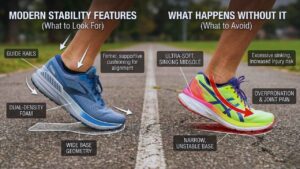
Shopping for the best running shoes for flat feet requires you to look entirely past the flashy neon colors and focus directly on the hidden midsole engineering. You essentially need a shoe that acts as a reliable, sturdy foundation to correct your overpronation without making you feel like you are running with concrete blocks attached to your feet. Modern running technology gives us a massive variety of smart tools to prevent joint pain and keep your running stride aligned perfectly from start to finish.
Modern Stability Features
Just a few years ago, shoe brands simply glued a stiff, unforgiving piece of plastic inside the arch to physically stop the foot from rolling inward. Now, forward-thinking companies use incredibly smart guide rails and dynamic dual-density foam frames to fix the problem smoothly. These modern features act exactly like the inflatable bumpers on a bowling alley lane.
If your foot stays perfectly straight during your stride, you never even feel the stability features working against you. If your foot gets tired and tries to collapse inward, the firmer foam walls gently nudge your heel back to the center line without causing friction or blisters. This holistic approach to foot guidance makes long runs significantly more enjoyable and drastically reduces the break-in period for new shoes.
| Stability Technology | How It Works | Best Suited For |
| Guide Rails | Raised foam walls wrap around the heel to center the foot | Runners who want unobtrusive, as-needed support |
| Dual-Density Foam | Firmer foam on the inside edge stops inward rolling | Traditional overpronators needing constant support |
| Wide Base Geometry | Extending the outsole width for intrinsic stability | Runners who hate the feel of structured arch bumps |
| 4D Guidance | Adapts to stride changes using elastic foam under the arch | Severe overpronators needing dynamic correction |
Foam Firmness and Base Width
You might naturally think that maximum squish automatically equals maximum comfort, but ultra-soft foam can actually spell absolute disaster for runners with flat feet. When a running shoe is entirely too soft, your overpronating foot just sinks deeper and deeper into the inward roll, exacerbating the exact problem you are trying to fix. You desperately want a slightly firmer midsole that actively holds its shape under the heavy pressure of your body weight.
A substantially wider shoe base also provides a wonderfully natural platform for your foot to splay out, giving you inherent, built-in stability right from the ground up. Combining a firm cushion with a wide footprint is the ultimate secret recipe for keeping flat feet happy over double-digit mileage.
| Feature Type | Why Flat Feet Need It | What Happens Without It |
| Firmer Midsole Cushioning | Prevents the foot from sinking unevenly into the shoe | Foot collapses inward, worsening overpronation |
| Wide Toe Box | Allows flat feet to naturally spread out upon impact | Blisters, pinched toes, and cramped metatarsals |
| Flared Outsole Base | Creates a larger surface area for better ground contact | Wobbly landings and increased risk of ankle rolls |
| Torsional Rigidity | Stops the shoe from twisting side-to-side easily | Arch fatigue and severe strain on the plantar fascia |
1. Brooks Adrenaline GTS 24
The Brooks Adrenaline remains arguably the most famous and widely trusted stability shoe currently on the market, and the newest version continues that prestigious legacy perfectly. It consistently offers a wonderful balance of reliable daily comfort and trustworthy structural support. You get a daily trainer that feels instantly familiar, boasts highly durable construction, and stands fully ready to soak up hundreds of miles without ever losing its supportive shape.
Why It Works for Flat Feet?
Brooks incorporates their brilliant signature GuideRails technology right into the midsole, which intelligently places firmer foam walls on both the inside and outside of your heel. This specific setup stops excessive side-to-side motion right at the source before it ever reaches your knees. The brand recently upgraded the entire midsole to their nitrogen-infused DNA Loft v3 foam, which feels noticeably lighter but miraculously retains the exact firmness needed to hold up flat arches. The traditional 12-millimeter heel drop is also an absolutely excellent feature for runners who strike heavily with their heel and constantly struggle with tight calf muscles after long workouts.
| Brooks Adrenaline GTS 24 Specs | Detail |
| Shoe Weight | 10.1 ounces |
| Heel-to-Toe Drop | 12 millimeters |
| Core Stability Tech | Holistic GuideRails system |
| Ideal Running Scenario | Daily training miles and recovery runs |
2. Hoka Arahi 7
Hoka completely changed the running world a decade ago with their massive foam stacks, but they also know exactly how to build a highly supportive shoe specifically for heavy overpronators. The Arahi 7 is the absolute perfect solution if you desperately want cloud-like impact protection without feeling forced to carry heavy, sluggish weights on your feet. It looks quite massive right out of the box but feels incredibly airy and light as soon as you lace it up.
Why It Works for Flat Feet?
Hoka utilizes their patented J-Frame stability system to wrap a continuous hook of denser, firmer foam completely around the heel and straight down the medial side of the foot. This firm J-shaped foam actively stops your foot from collapsing inward without feeling overly rigid or giving you annoying arch blisters. The Arahi 7 also features an updated flat-knit upper that locks down your midfoot tightly, giving flat feet a secure wrap that prevents sliding around inside the shoe. Combining this structure with their early-stage meta-rocker geometry means your foot rolls smoothly forward instead of slapping flatly against the pavement.
| Hoka Arahi 7 Specs | Detail |
| Shoe Weight | 9.4 ounces |
| Heel-to-Toe Drop | 5 millimeters |
| Core Stability Tech | Firmer J-Frame foam support |
| Ideal Running Scenario | Long slow distance runs and walking |
3. ASICS Gel-Kayano 31
When experienced podiatrists talk about dealing with severe overpronation, the ASICS Gel-Kayano is almost always the very first clinical recommendation they write down. It is built entirely like a luxury tank, wrapped in premium materials, and designed to outlast almost any other shoe in your closet. If you have completely collapsed arches, a heavier physical frame, or a history of knee surgeries, this shoe offers the ultimate uncompromised protection against returning joint pain.
Why It Works for Flat Feet?
ASICS completely revolutionized this model by introducing their 4D Guidance System, which actually adapts in real-time to your unique running stride as you get tired. Instead of relying on a hard, punishing medial post, they use a softer, bouncier piece of elastic foam directly under the arch that actively springs your foot back outward after you land. The Gel-Kayano 31 also features a massive slab of FF Blast Plus Eco foam paired with hidden PureGEL in the heel to aggressively absorb heavy road impacts. This makes it a highly versatile and deeply cushioned stability monster that refuses to let your form break down.
| ASICS Gel-Kayano 31 Specs | Detail |
| Shoe Weight | 10.7 ounces |
| Heel-to-Toe Drop | 10 millimeters |
| Core Stability Tech | Adaptive 4D Guidance System |
| Ideal Running Scenario | Marathon training and severe overpronation |
4. Saucony Guide 17
The Saucony Guide series focuses entirely on providing a smooth stability experience that you barely even notice until you actually need it at the end of a long run. It serves as an excellent everyday choice for runners who absolutely hate the clunky, restrictive feeling of old-school traditional support shoes. It offers a wonderfully snug fit, buttery smooth heel-to-toe transitions, and more than enough protective cushioning to keep your joints comfortable on long weekend adventures.
Why It Works for Flat Feet?
This specific shoe uses an innovative Center Path Technology framework that completely abandons medial posts in favor of a much broader platform and higher asymmetrical sidewalls. The Guide 17 strikes a truly fantastic sweet spot between plush softness and necessary firmness, ensuring you never sink too deeply into the footbed. A very noticeable rocker shape carved into the outsole helps roll your flat foot forward incredibly efficiently with every step. This specific rocking motion drastically reduces the total amount of time your unsupported arch spends bearing your full body weight on the hard concrete.
| Saucony Guide 17 Specs | Detail |
| Shoe Weight | 9.4 ounces |
| Heel-to-Toe Drop | 6 millimeters |
| Core Stability Tech | Center Path broad geometry |
| Ideal Running Scenario | Moderate overpronation and daily jogging |
5. Mizuno Wave Inspire 20
Mizuno prefers to tackle the complex issue of stability from a completely different mechanical engineering angle, making them a massive favorite for runners who greatly prefer a snappy, firm, and highly responsive feel underfoot. The Wave Inspire is incredibly well-built, incredibly durable, and breathes exceptionally well when you run in hot summer weather. It looks incredibly sharp on the foot and performs brilliantly for runners who like to actually feel the ground rather than floating blindly above it.
Why It Works for Flat Feet?
Instead of just gluing together different densities of heavy foam, Mizuno firmly inserts a thermoplastic wave plate directly inside the midsole layers. For the Inspire series, the inside edge of this rigid wave plate is intentionally raised higher and reinforced to physically block your foot from rolling inward. This purely mechanical support system never compresses, softens, or breaks down over time, giving you exactly the same high level of arch support on mile four hundred as you had on mile one. Paired with their bouncy Enerzy foam, the shoe delivers a surprisingly fast and energetic ride for a stability trainer.
| Mizuno Wave Inspire 20 Specs | Detail |
| Shoe Weight | 10.7 ounces |
| Heel-to-Toe Drop | 12 millimeters |
| Core Stability Tech | Asymmetrical thermoplastic Wave Plate |
| Ideal Running Scenario | Runners preferring a firm, snappy ground feel |
6. New Balance Fresh Foam X 860v14
New Balance consistently excels at making some of the most accommodating, comfortable, and reliable daily trainers in the entire running industry. The 860 series is a heavily tested and tried-and-true classic that offers endless width options for hard-to-fit feet and highly reliable mild stability. It functions perfectly as a dedicated workhorse shoe that you can confidently leave by your front door and trust for literally any type of run or long neighborhood walk.
Why It Works for Flat Feet?
The v14 introduces New Balance’s clever Stability Plane technology, which is a very thin, flexible EVA plate neatly embedded right into the midsole structure. It provides excellent torsional rigidity so the shoe simply does not twist or bend sideways, keeping your foot perfectly flat and stable upon impact. The dual-density foam setup ensures the inner edge of the shoe remains firm enough to correct moderate overpronation, while the thick Fresh Foam X top layer provides a very soft, welcoming step-in feel. If you have flat feet that are also exceptionally wide, New Balance’s extra-wide sizing options are an absolute lifesaver.
| New Balance 860v14 Specs | Detail |
| Shoe Weight | 10.9 ounces |
| Heel-to-Toe Drop | 8 millimeters |
| Core Stability Tech | EVA Stability Plane and dual-density foam |
| Ideal Running Scenario | Wide flat feet requiring daily workhorse reliability |
7. Nike Structure 25
Nike is usually famous for creating their incredibly aggressive carbon-plated racing shoes, but they actually make a highly reliable and heavily padded stability shoe in the Structure series. It serves as a plush, highly cushioned training option that looks exactly like a standard fashionable lifestyle sneaker but hides serious, biomechanically sound running technology inside. It appeals heavily to younger runners who want solid overpronation support without looking like they are wearing orthopedic medical shoes.
Why It Works for Flat Feet?
The Structure 25 deliberately uses a significantly widened midfoot base to create massive intrinsic stability without needing to use aggressive, heavy medial posts. They also implemented heavily targeted midfoot lockdown panels integrated directly into the upper mesh to keep your foot from sliding sideways off the footbed during sharp turns. It boasts a very generous and roomy toe box, which serves as a massive point of relief for runners whose flat feet naturally spread out widely when they bear weight. The thick layer of Cushlon foam provides ample shock absorption for heavier runners hitting the pavement hard.
| Nike Structure 25 Specs | Detail |
| Shoe Weight | 11.3 ounces |
| Heel-to-Toe Drop | 10 millimeters |
| Core Stability Tech | Widened base and midfoot lockdown panels |
| Ideal Running Scenario | Slower paces, gym workouts, and lifestyle crossover |
8. On Cloudflyer 4
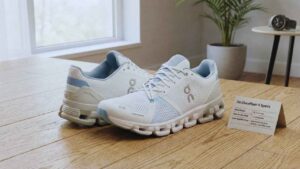
If you desperately want reliable stability but completely refuse to sacrifice modern style, the On Cloudflyer 4 is a visually stunning and highly functional option. It boldly features the Swiss brand’s highly unique hollow cloud pod technology, but cleverly tweaks those pods specifically for runners who need a lot of extra lateral support. The overall build quality is undeniably premium from top to bottom, featuring incredibly soft upper materials and highly durable rubber grip pads on the outsole.
Why It Works for Flat Feet?
The specific cloud pods located directly under the medial arch and the heel are engineered to be significantly firmer and much wider than the squishy pods located on the outside of the shoe. This brilliant asymmetrical design naturally slows down the rapid rate of overpronation as soon as your heel strikes the ground. The shoe also prominently features a molded external plastic heel counter that tightly grabs your ankle and holds it securely in place. This entirely prevents the sloppy, dangerous heel-wobble that very frequently plagues flat-footed runners when they get fatigued.
| On Cloudflyer 4 Specs | Detail |
| Shoe Weight | 10.5 ounces |
| Heel-to-Toe Drop | 11 millimeters |
| Core Stability Tech | Asymmetrical dual-density CloudTec pods |
| Ideal Running Scenario | Firm support with high-end aesthetic appeal |
9. Altra Provision 8
Altra does things entirely differently from the rest of the running industry by focusing strictly on natural, anatomically correct foot shapes and zero-drop midsole platforms. The Provision 8 serves as their dedicated, lightweight stability model designed specifically for overpronators. It acts as a fantastic option for runners who actively want to strengthen their own feet naturally while still getting a very helpful, unobtrusive safety net for when their running form inevitably breaks down.
Why It Works for Flat Feet?
The Provision exclusively uses Altra’s Innovarch technology, which is a highly specialized internal lacing system that actually wraps under your arch and gently lifts it upward as you tie your shoelaces tight. The famously wide, foot-shaped toe box allows your toes to splay out fully and grip the ground, using your own biological anatomy to create natural balance. Because it is a zero-drop shoe, meaning your heel and toes rest at the exact same height from the ground, it strongly encourages a midfoot strike. Landing on your midfoot drastically reduces the harsh impact forces that usually travel straight up your leg to cause severe knee pain.
| Altra Provision 8 Specs | Detail |
| Shoe Weight | 10.1 ounces |
| Heel-to-Toe Drop | 0 millimeters |
| Core Stability Tech | Innovarch wrapping system and FootShape box |
| Ideal Running Scenario | Natural running styles and transitioning to zero-drop |
10. Brooks Beast GTS 23
When standard, everyday stability shoes simply are not enough to stop your arches from collapsing, you bring out the heavy artillery known as the Beast. This is a maximum motion control shoe explicitly designed for heavily built runners, individuals with severe overpronation, and those who require extra interior depth to fit bulky prescribed medical orthotics. It is undeniably heavy and somewhat bulky, but it remains virtually indestructible and offers a level of support that no other shoe can match.
Why It Works for Flat Feet?
Just like the popular Adrenaline model, the Beast utilizes Brooks GuideRails, but the specific rails used here are substantially taller, significantly firmer, and far more aggressive at blocking inward movement. The outsole base of the shoe is incredibly wide and completely flat, meaning it is almost physically impossible to roll your ankle while wearing it on the road. The upper mesh construction deliberately provides maximum interior volume, which is absolutely critical for flat feet that require thick athletic socks or custom rigid inserts to remain pain-free during long bouts of exercise.
| Brooks Beast GTS 23 Specs | Detail |
| Shoe Weight | 11.7 ounces |
| Heel-to-Toe Drop | 12 millimeters |
| Core Stability Tech | Maximum height GuideRails and straight last |
| Ideal Running Scenario | Severe overpronation, heavy frames, and orthotic use |
11. Saucony Tempus
Historically, runners suffering from flat feet were strictly told they could never safely wear fast, bouncy racing shoes because modern super-foams were entirely too unstable and wobbly. The remarkably innovative Saucony Tempus completely shattered that outdated rule the moment it hit the market. It functions as a true, lightweight speed shoe that amazingly provides all the incredible bounce of a marathon racer while aggressively keeping your overpronation locked down securely.
Why It Works for Flat Feet?
Saucony brilliantly wraps a thick, bouncy core of their elite PWRRUN PB super-foam inside a much firmer, stiffer outer frame made of standard EVA foam. The firm outer frame acts exactly like a rigid cradle, perfectly keeping your flat feet centered and stable while the squishy, bouncy core powerfully propels you forward with massive energy return. It feels surprisingly lightweight on the foot and provides an incredibly fun, highly responsive ride. This makes it the ultimate weapon for flat-footed runners who want to safely tackle fast tempo runs, intense track workouts, and competitive race days.
| Saucony Tempus Specs | Detail |
| Shoe Weight | 8.9 ounces |
| Heel-to-Toe Drop | 8 millimeters |
| Core Stability Tech | Firmer EVA frame surrounding a super-foam core |
| Ideal Running Scenario | Fast tempo workouts, intervals, and half-marathons |
12. Asics GT-2000 12
If you absolutely love the reliable, heavily structured support of the premium Kayano but completely flinch at the massive premium price tag, the GT-2000 12 is undeniably your best friend. It serves as a noticeably lighter, slightly less plush alternative that still miraculously packs excellent, top-tier stability features into a sleeker package. It serves as a genuinely fantastic entry point for brand-new runners who are just starting to figure out how to correct their flat feet without emptying their wallets.
Why It Works for Flat Feet?
The GT-2000 effectively utilizes a scaled-down 3D guidance system paired with a highly flared forefoot to ensure perfectly smooth, unhindered heel-to-toe transitions on every single stride. It uses a very generous slab of FF Blast Plus foam in the midsole, providing a wonderfully lightweight bounce that makes easy morning runs feel completely effortless. The medial support is completely non-intrusive and hides well within the shoe, making it a stellar option for runners with mild flat feet who just need a tiny bit of extra structure to keep their knees aligned properly.
| Asics GT-2000 12 Specs | Detail |
| Shoe Weight | 9.7 ounces |
| Heel-to-Toe Drop | 8 millimeters |
| Core Stability Tech | 3D Guidance System and flared geometry |
| Ideal Running Scenario | Budget-friendly daily training and light gym use |
Tips for Running Safely with Flat Feet
Buying the absolute best gear on the market is certainly a great first step, but you also need to manage your body mechanics properly to see real results. Transitioning to a completely new type of stability shoe actively changes how your leg muscles fire and how your major joints align under heavy pressure. Keep these simple, highly effective rules in mind to completely avoid annoying transition injuries and maximize the lifespan of your new footwear investment.
Break Your Shoes In Gradually
Stability shoes physically correct your skeletal alignment, which means your knees, hips, and lower back will suddenly be moving slightly differently than they used to. This abrupt change can frequently cause some frustrating initial muscle soreness in areas you did not expect. Do not lace up your brand new shoes and immediately run ten miles on your very first day. You should wear them around the house, take them for short evening walks, and slowly mix them into your regular running routine over a couple of cautious weeks.
| Break-In Phase | Recommended Activity Level | Goal of the Phase |
| Days 1 to 3 | Walking around the house and running errands | Letting the firm foam mold slightly to your arch |
| Days 4 to 7 | Very short, easy-paced one-mile jogs | Allowing knee tracking to adjust to the new alignment |
| Days 8 to 14 | Alternating new shoes with your old pair | Preventing sudden overuse injuries in the calves |
| Day 15 Onward | Full integration into your regular training plan | Confident running with fully adapted biomechanics |
Focus on Ankle and Arch Strength
Supportive shoes act wonderfully as a helpful crutch, but your actual foot muscles still need to do the heavy lifting to keep you injury-free long term. Spending just ten short minutes a day on targeted foot-strengthening exercises actually works absolute wonders for flat feet. You should regularly try doing slow calf raises on the edge of a stair, balancing on one bare foot while brushing your teeth, or putting a hand towel on the floor and repeatedly scrunching it up using only your toes to build vital arch strength.
| Strengthening Exercise | How to Perform It | Biomechanical Benefit |
| Towel Scrunches | Pull a towel toward you using only bare toes | Strengthens the intrinsic muscles under the arch |
| Single-Leg Balance | Stand on one leg barefoot for sixty seconds | Improves ankle stability and proprioception |
| Calf Raises | Slowly lift your heels up and lower them down | Strengthens the posterior tibial tendon |
| Toe Splaying | Actively spread all five toes as wide as possible | Improves forefoot balance and prevents bunions |
Final Thoughts
Dealing with the reality of running with flat feet absolutely does not mean you are permanently destined for chronic injuries or doomed to wear incredibly ugly, heavy footwear for the rest of your life. By paying close attention to your specific biomechanics and carefully choosing a shoe that offers modern, dynamic support, you can train just as hard and fast as anyone else on the road. The footwear technology available to us today has quite literally never been better, lighter, or more accommodating to unique foot shapes.
Always remember that footwear comfort is incredibly subjective and highly personal to your exact anatomy. What works perfectly to support my flat feet might end up feeling entirely too firm, too restrictive, or way too narrow for your specific foot shape. Do not be afraid to visit a local store and test run a few completely different models to see which brand’s unique guidance system feels the absolute most natural to you. Once you finally find the best running shoes for flat feet that match your specific stride, your entire body will thank you, and those long weekend miles will start feeling a whole lot easier.