We live in an era defined by the chase for tenths of a second. Modern dual-clutch automatics and electric powertrains offer acceleration figures that defy physics, shifting faster than any human blink. Yet, for a dedicated group of driving purists, these technological marvels are missing a crucial component: soul. The hunt for the best manual transmission cars isn’t about finding the absolute fastest lap time; it’s about finding the deepest mechanical connection between man and machine.
The act of depressing the clutch, manually selecting the perfect gear, rev-matching a downshift with a blip of the throttle, and feeling the gears mesh through the palm of your hand is an analog experience in an increasingly digital world. It turns a commute into an event and a winding backroad into a conversation with the car. While the options are fewer than they once were, the machines that remain committed to the stick shift are arguably better than ever. They are the survivors, engineered specifically for those who love the art of driving.
Key Takeaways
-
The “Save the Manuals” movement: It is about experience, not just nostalgia. In an era of lightning-fast automatics, choosing a stick shift is a deliberate choice for connection and driver engagement.
-
Manuals are moving upmarket: While cheap economy cars have mostly dropped the third pedal, high-end performance brands like Porsche, Cadillac, and BMW are preserving it as a premium option for enthusiasts.
-
Variety still exists: From featherweight front-wheel-drive hatchbacks to supercharged V8 sedans and mid-engine exotics, there is still a diverse range of performance vehicles offering a row-your-own gearbox.
The Shift from Economy to Exclusive Experience
For decades, the manual transmission was the budget-friendly default—the “standard” option you chose to save money on the sticker price and squeeze better fuel economy out of a small engine. Today, that dynamic has completely flipped. In the modern automotive landscape, the stick shift has evolved into a premium feature, often reserved for higher trim levels or specific “driver’s packages.”
This shift in the market is driven by a desire for engagement rather than efficiency. While modern 10-speed automatics and dual-clutch gearboxes are technically superior in terms of shift speed and fuel consumption, they often isolate the driver from the mechanical workings of the vehicle. A manual gearbox removes that filter. It demands that you pay attention to the rev counter, understand the power band, and physically coordinate your hands and feet. In a world of autonomous driving aids and numb electric steering, this analog driving experience has become a rare luxury that enthusiasts are willing to pay a premium to preserve.
What Defines the “Best” Manual Car?
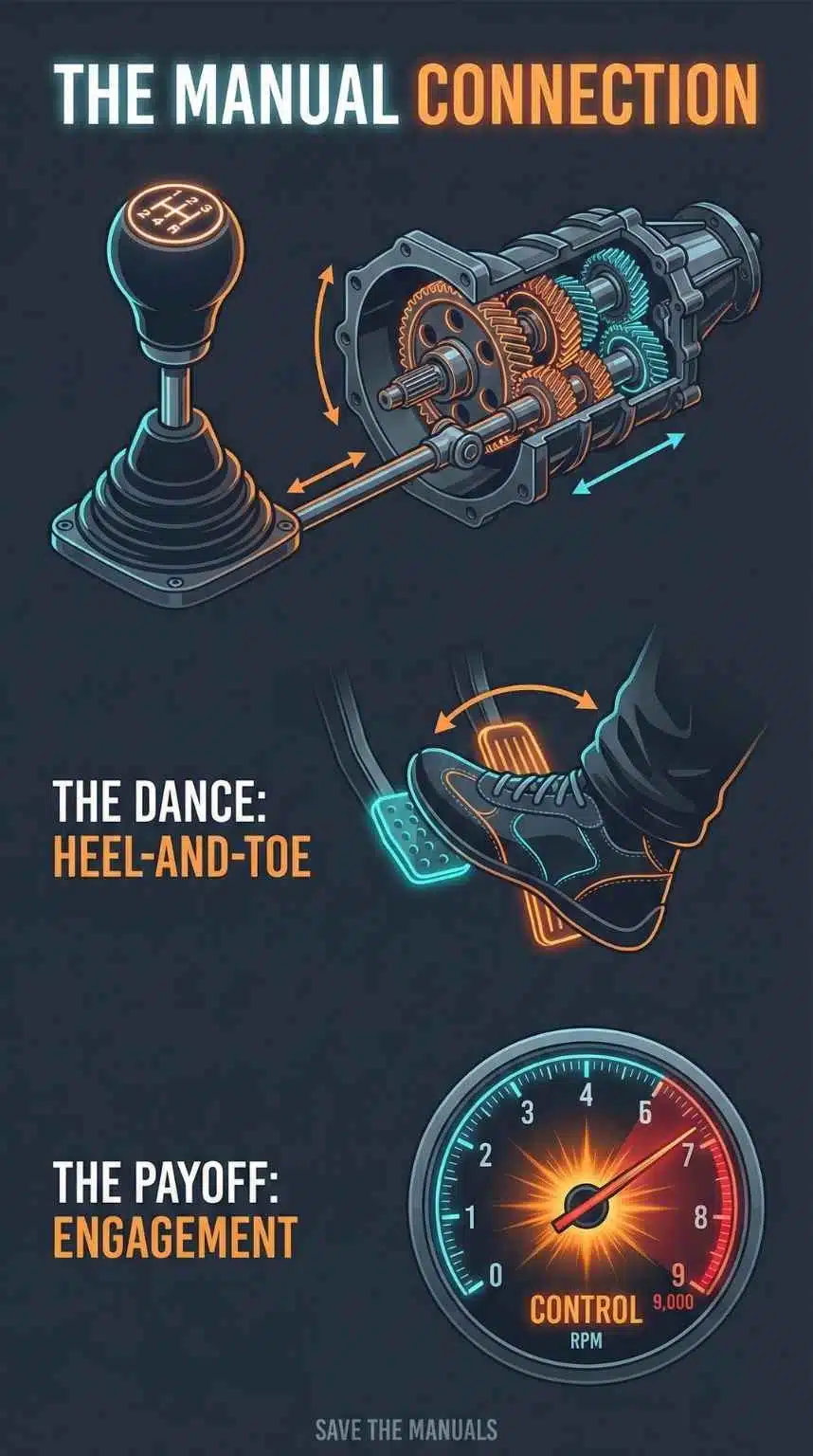
Identifying the best manual transmission cars requires looking beyond simple horsepower figures or 0-60 times. A great manual car is defined by the quality of its interaction points. We evaluated these vehicles based on three critical “feel” factors:
-
Shift Action and Throw: Does the gear lever slot satisfyingly into place with a mechanical “click,” or does it feel rubbery and vague? We looked for transmissions with precise gates and short, distinct throws.
-
Pedal Placement: For the true driving purist, the ability to “heel-and-toe” downshift (blipping the throttle with your heel while braking with your toes) is essential. The best cars have pedals positioned specifically to facilitate this footwork.
-
Clutch Feedback: A great clutch pedal communicates exactly when the friction point engages. It shouldn’t be so heavy that it becomes a chore in traffic, nor so light that it feels like stepping on air.
The seven cars listed below don’t just have a manual transmission; they have great manual transmissions that enhance the character of the car.
1. Porsche 911 GT3 / Carrera T
The Benchmark for Precision
If you want to understand the pinnacle of modern manual transmission engineering, you look to Stuttgart. Porsche understands its customer base better than perhaps any other manufacturer. While the majority of 911s sold are equipped with their brilliant PDK automatic, Porsche ensures the purists have options that are nothing short of spectacular.
The 911 offers two distinct flavors of manual excellence. The Carrera T is the “everyman’s” enthusiast spec, offering a pure experience paired with twin-turbo torque. But the true holy grail is the naturally aspirated GT3 (and its wingless sibling, the GT3 Touring).
Driving a GT3 with a manual gearbox is a transcendent experience. The engine screams to a stratospheric 9,000 RPM redline. The 6-speed GT Sport manual transmission isn’t just an afterthought; it is mechanically precise with a short, heavy throw that feels incredibly robust. Every shift feels significant. It requires effort, but the reward is absolute telepathic control over one of the finest chassis ever developed.
| Quick Specs | Porsche 911 GT3 |
| Engine Type | 4.0L Naturally Aspirated Flat-6 |
| Horsepower | 502 hp |
| Transmission | 6-Speed GT Sport Manual |
| Drivetrain | Rear-Wheel Drive |
| The Shifter Vibe | Mechanical, precise, heavy, and deeply rewarding. |
2. Cadillac CT5-V Blackwing
The Last Great American Super Sedan
There is something deeply satisfying about a massive American luxury sedan that can embarrass supercars on a track, all while the driver manages a cue-ball shifter. The Cadillac CT5-V Blackwing is likely the final chapter in the book of supercharged V8 sedans, and what a closing chapter it is.
Cadillac didn’t just throw a manual into this beast to appease a few journalists; they engineered one of the best driving experiences on the planet. The heart of the beast is a monolithic 6.2-liter supercharged V8, providing a tidal wave of torque that is present in any gear, at any RPM.
Connecting that power to the rear wheels is a TREMEC 6-speed manual that is shockingly refined. Given the immense power it has to handle, you might expect a truck-like shifting experience. Instead, the throws are relatively short, smooth, and slot into gear with a reassuring “thud.” It features excellent rev-matching technology (which you can turn off) and “No-Lift Shift,” allowing you to keep the accelerator pinned to the floor while clutching and upshifting, unleashing ferocious acceleration without cutting boost.
| Quick Specs | Cadillac CT5-V Blackwing |
| Engine Type | 6.2L Supercharged V8 |
| Horsepower | 668 hp |
| Transmission | TREMEC 6-Speed Manual |
| Drivetrain | Rear-Wheel Drive |
| The Shifter Vibe | Smooth despite the power, reassuring gates, excellent tech integration. |
3. Honda Civic Type R (FL5)
The FWD Track Weapon with the Perfect Shift
You don’t need to spend six figures to experience shift-action nirvana. In fact, many automotive journalists and professional drivers agree that the Honda Civic Type R possesses one of the absolute best manual transmissions currently on sale at any price point.
The latest generation Civic Type R has matured in its styling, but it hasn’t lost its edge. It remains the benchmark for front-wheel-drive performance, defying understeer with engineering wizardry that pulls the car through corners with shocking speed.
But the highlight is the interface in the center console. The tear-drop aluminum shift knob is cold to the touch on early mornings and connects to a linkage that feels incredibly direct. The throws are short, the gate spacing is perfect, and there is zero slop. It has often been described as having “rifle-bolt action” because of the satisfying metallic snick that accompanies every gear change. It makes driving at 30 mph fun, and driving at 130 mph phenomenal.
| Quick Specs | Honda Civic Type R |
| Engine Type | 2.0L Turbocharged Inline-4 |
| Horsepower | 315 hp |
| Transmission | 6-Speed Manual w/ Rev Match |
| Drivetrain | Front-Wheel Drive |
| The Shifter Vibe | The gold standard. Light, mechanical, incredibly precise “snick-snick” action. |
4. BMW M2
The Bavarian Compact Bruiser
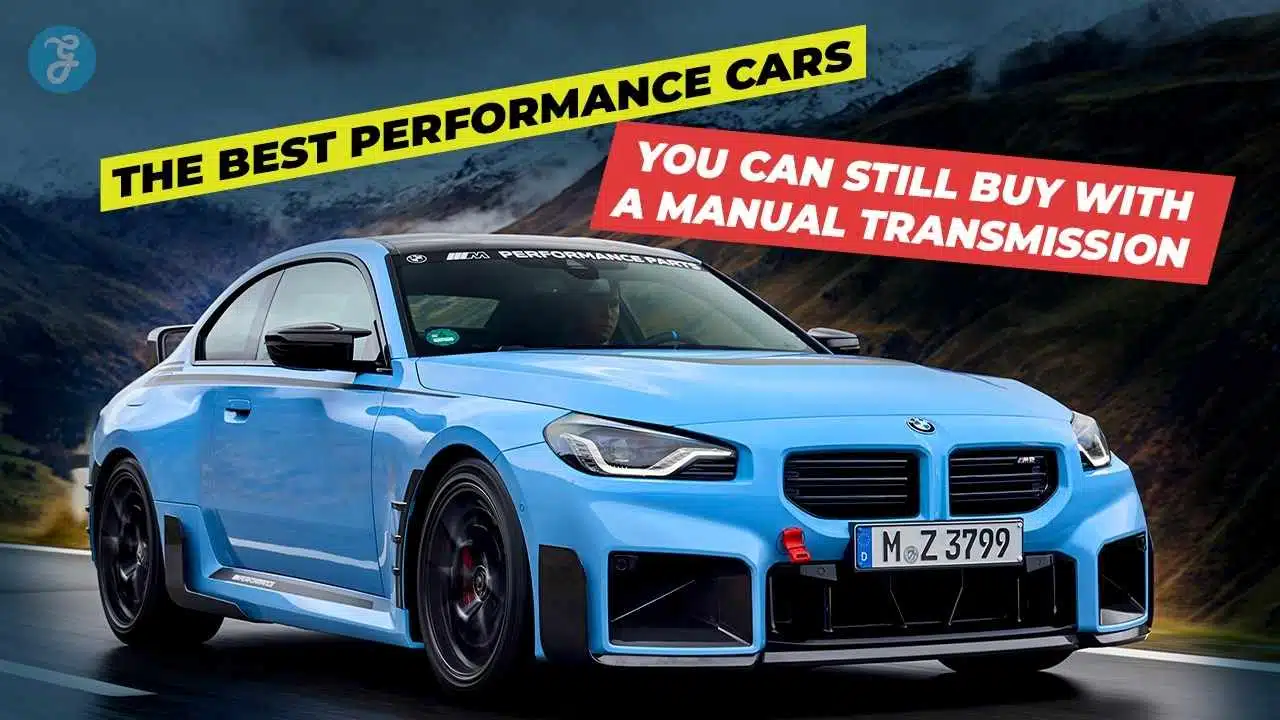
As BMW’s larger M3 and M4 grow in size and complexity, often favoring their excellent automatic transmissions and all-wheel-drive systems, the smaller M2 remains the spiritual successor to the compact, driver-focused BMWs of the past. It is currently the only way to get a small, rear-wheel-drive German coupe with a stick shift.
The M2 is a muscle car in a tailored European suit. It uses a detuned version of the twin-turbo inline-six found in its bigger brothers, providing immense punch.
While BMW manuals have historically been criticized for feeling a bit “rubbery” compared to Honda or Porsche, the unit in the M2 is well-matched to the car’s character. It features auto-rev-matching that works seamlessly, making you feel like a hero on downshifts during spirited driving. Choosing the manual in the M2 transforms the car from a sterile numbers-generator into a playful, engaging partner that demands your attention.
| Quick Specs | BMW M2 |
| Engine Type | 3.0L Twin-Turbo Inline-6 |
| Horsepower | 473 hp |
| Transmission | 6-Speed Manual |
| Drivetrain | Rear-Wheel Drive |
| The Shifter Vibe | Smooth and easy to operate, enhanced by excellent electronics. |
5. Ford Mustang Dark Horse
American Muscle, Evolved and Sharpened
The Ford Mustang has always been synonymous with V8 power and a stick shift. However, for years, serious enthusiasts bemoaned the standard manual transmission found in the Mustang GT (the MT-82), criticizing its vague feel and durability under track conditions.
With the introduction of the track-focused Dark Horse model, Ford listened. They ditched the standard gearbox and equipped it with a stout TREMEC TR-3160 6-speed. This is a transformative upgrade.
The Dark Horse pairs the visceral, naturally aspirated 5.0L Coyote V8—which revs freely and sounds incredible—with a transmission that finally feels up to the task. The shifter features a unique titanium ball and offers shorter, crisper throws with a much more positive engagement than the standard GT. It turns the Mustang from a cruiser into a genuine sports car that you want to hustle down a technical road, enjoying the physical exertion of managing that big V8 engine.
| Quick Specs | Ford Mustang Dark Horse |
| Engine Type | 5.0L Naturally Aspirated V8 |
| Horsepower | 500 hp |
| Transmission | TREMEC 6-Speed Manual |
| Drivetrain | Rear-Wheel Drive |
| The Shifter Vibe | Robust, mechanical, a massive upgrade over standard Mustang gearboxes. |
6. Lotus Emira V6
The Analog Exotic with Visual Drama
Lotus has built its legendary reputation on the philosophy of “simplify, then add lightness.” The Emira is their final internal combustion sports car, and it serves as a stunning love letter to analog driving. It looks like a ridiculously expensive exotic supercar, yet it retains a raw, mechanical feel that many modern supercars have lost.
Critically, if you choose the supercharged V6 engine option, you get access to a wonderful 6-speed manual gearbox and, crucially, old-school hydraulic power steering that offers tremendous road feel.
The manual transmission in the Emira provides a unique piece of automotive theater. Lotus designed the center console with an exposed gear linkage mesh. This means you don’t just feel the car shift; you can look down and actually watch the mechanical components sliding and engaging as you move the lever. It’s a stunning piece of functional art that emphasizes the car’s mechanical nature.
| Quick Specs | Lotus Emira V6 First Edition |
| Engine Type | 3.5L Supercharged V6 |
| Horsepower | 400 hp |
| Transmission | 6-Speed Manual |
| Drivetrain | Mid-Engine, Rear-Wheel Drive |
| The Shifter Vibe | Mechanical theater. Exposed linkage offers a visual connection to the gear changes. |
7. Toyota GR Corolla:
The Rally-Bred Rocket
Toyota has been on a tear recently, rediscovering its performance roots under the “Gazoo Racing” (GR) banner. The GR Corolla is a wild, rally-homologation special disguised as a practical hatchback.
It is powered by a furious little 1.6-liter turbocharged three-cylinder engine that punches way above its weight class. But the defining characteristic of the GR Corolla is its raw, unfiltered nature. It comes exclusively with a 6-speed manual transmission linked to a sophisticated, driver-adjustable all-wheel-drive system.
The shifter is perfectly placed high up on the dash, close to the steering wheel, facilitating quick hand movements. The throws are moderately short and have a distinct, notchy feeling as they engage. It feels rugged, designed to be abused on a gravel stage. Adding to the fun is a proper mechanical handbrake lever—a rarity these days—designed specifically to help initiate slides.
| Quick Specs | Toyota GR Corolla |
| Engine Type | 1.6L Turbocharged 3-Cylinder |
| Horsepower | 300 hp |
| Transmission | 6-Speed intelligent Manual (iMT) |
| Drivetrain | All-Wheel Drive |
| The Shifter Vibe | Rugged, notchy, and perfectly positioned for aggressive driving. |
Honorable Mentions: The Affordable Heroes
Not every great manual transmission requires a second mortgage. If you are looking for pure driving joy without the six-figure price tag, these three icons are the gatekeepers of the “slow car fast” philosophy. They prove that you don’t need 500 horsepower to have a good time—you just need a great stick shift.
Mazda MX-5 Miata
-
The Vibe: The spiritual successor to the classic British roadsters. It is impossibly light, playful, and features what is arguably the easiest, most satisfying manual gearbox to learn on.
-
Why it matters: It remains the benchmark for “smiles per mile.” The shifter is directly inserted into the transmission (no cables), providing instant mechanical feedback.
Toyota GR86 / Subaru BRZ
-
The Vibe: A focused, fixed-roof coupe that prioritizes handling balance above all else.
-
Why it matters: Unlike the Miata, you get a (small) back seat and a stiffer chassis. The manual box here is notchier and more industrial than the Mazdas, but it feels incredibly robust when driven hard.
Nissan Z
-
The Vibe: A throwback to the golden era of Japanese muscle.
-
Why it matters: While the Nismo version was initially automatic-only, the standard Z offers a 6-speed manual with a powerful twin-turbo V6. It’s a bit rougher around the edges than the Supra, but that grit is exactly what manual lovers are looking for.
Mastering the Modern Manual: Tech You Need to Know
Driving a stick shift in 2026 is a different experience than it was in 1995. Modern engineering has removed many of the frustrations associated with manual gearboxes while enhancing the fun. Here are three terms you should know before you buy.
1. Auto Rev-Matching
-
What it is: When you downshift (e.g., 4th to 3rd), the engine speed (RPM) naturally spikes. If you don’t match the engine speed to the wheel speed perfectly, the car will jerk.
-
The Tech: Cars like the Civic Type R and BMW M2 automatically “blip” the throttle for you the instant you move the lever into a lower gear.
-
The Benefit: You look and sound like a professional racing driver on every downshift, and the car remains perfectly stable entering corners. (Purists can usually turn this off).
2. No-Lift Shift
-
What it is: A feature found in high-performance American cars like the Cadillac Blackwing and Mustang Dark Horse.
-
The Tech: It allows you to keep the accelerator pedal pinned to the floor while you press the clutch and change gears. The computer cuts the ignition for a split second to allow the shift.
-
The Benefit: It keeps the turbochargers spooled (in the Cadillac) and maintains momentum, resulting in faster acceleration times without damaging the transmission.
3. Hill Start Assist
-
What it is: The terror of every new manual driver is rolling backward on a hill while trying to find the bite point of the clutch.
-
The Tech: Almost all modern manuals (including every car on our list) hold the brakes for 2-3 seconds after you lift off the brake pedal, holding you in place until the clutch engages.
-
The Benefit: Zero anxiety at stoplights on steep inclines.
Reality Check: Can You Daily Drive a Manual in 2026?
The romantic idea of a manual transmission often clashes with the reality of rush-hour traffic. Is living with a third pedal actually feasible today?
-
The Clutch Weight Factor: Modern clutches are significantly lighter than older muscle cars. The Honda Civic Type R, for example, has a clutch so light you could depress it with your big toe, making it a breeze even in bumper-to-bumper traffic.
-
Traffic Jam Assist: One downside is that manual cars often lack the advanced “Stop & Go” adaptive cruise control found in automatics. If you commute 90 minutes in heavy gridlock every day, a manual might become tiresome.
-
The Verdict: If your commute is mostly moving on highways or backroads, the trade-off is absolutely worth it. If you live in the heart of a congested city like Los Angeles or New York, a manual is best reserved as a “weekend car.”
Comparative Analysis: Finding Your Perfect Shift
When looking for the best manual transmission cars, you have to balance power, drivetrain preference, and budget. Here is how these seven titans stack up against each other.
| Vehicle | Drivetrain Layout | HP Output | The Ideal Buyer |
| Honda Civic Type R | FWD | 315 hp | The track rat who wants the absolute best shifter feel under $50k. |
| Toyota GR Corolla | AWD | 300 hp | The rally fan who wants all-weather fun and a raw personality. |
| BMW M2 | RWD | 473 hp | The enthusiast wants a premium German coupe in a compact package. |
| Ford Mustang Dark Horse | RWD | 500 hp | The V8 lover who wants a track-capable chassis and a stout gearbox. |
| Lotus Emira V6 | Mid-Engine RWD | 400 hp | The driver who wants exotic looks and an analog steering feel. |
| Cadillac Blackwing | RWD | 668 hp | The power-hungry driver who needs four doors but refuses to compromise on fun. |
| Porsche 911 GT3 | Rear-Engine RWD | 502 hp | The purist with the budget for the ultimate driving experience. |
Frequently Asked Questions (FAQ)
1. Are manual transmission cars slower than their automatic counterparts?
Generally, yes. Modern dual-clutch automatics (DCTs) and advanced torque-converter automatics shift in milliseconds, faster than any human can move a lever and a clutch pedal. If your only metric is 0-60 mph times or quarter-mile splits, the automatic usually wins. However, buyers of manual cars are prioritizing engagement and fun over shaving tenths of a second off a stopwatch.
2. Are manual transmission cars going to disappear completely?
In mainstream commuter cars, they are almost entirely gone. However, in the enthusiast and high-performance sports car market, they have found a stable niche. Manufacturers like Porsche and Honda keep making them because buyers keep demanding them. While they will remain a minority, they are likely to stick around in specialized performance cars for as long as internal combustion engines are being sold.
3. Which of these cars has the easiest manual transmission to learn on?
While all these cars have significant power, the Honda Civic Type R and the BMW M2 are quite forgiving. They both feature excellent auto-rev-matching technology, which handles the tricky throttle blips on downshifts for you, smoothing out the ride. The Honda also has a very light and communicative clutch pedal, making it easier to find the “bite point” without stalling.
4. Do manual transmission cars hold their value better?
In the performance car segment, absolutely. Because they are rarer and highly sought after by enthusiasts, manual versions of cars like the Porsche 911, BMW M-cars, and the Cadillac Blackwings often command higher resale prices on the used market compared to their automatic equivalents. They are seen as future classics.
5. What is “No-Lift Shift” mentioned in the Cadillac Blackwing?
No-Lift Shift is a performance feature that allows the driver to keep the accelerator pedal pressed fully to the floor (WOT) while pressing the clutch and shifting gears. Normally, you have to lift off the gas to prevent the engine from over-revving between gears. No-Lift Shift technology cuts the ignition momentarily to manage RPMs, allowing the turbo or supercharger to maintain boost pressure during the shift, resulting in uninterrupted acceleration.
The Last Stand of Analog Joy: Grab the Keys While You Can
The automotive landscape is changing rapidly. As manufacturers pivot toward electrification, the manual gearbox is becoming an endangered species. However, this scarcity has only clarified its value.
The cars on this list are not merely appliances for transportation; they are experiences. They require skill to master, offer sensory feedback that no computer can simulate, and provide a level of satisfaction that pulling a plastic paddle simply cannot match. If you love driving, buying one of the best manual transmission cars available today isn’t just a purchase—it’s an investment in joy.