Leadership in 2026 requires a new playbook. The strategies that worked five years ago—or even five months ago—are rapidly becoming obsolete in the face of generative AI, geopolitical instability, and a workforce demanding deep human significance.
The books dominating the business landscape in the final quarter of 2025 don’t just recycle old advice; they address the specific “trust crisis” and “competence crisis” facing modern executives. Whether you are looking to gift a mentor or prepare your own mind for the fiscal year ahead, this curated list filters out the noise. Focused on the titles that offer high-impact, actionable insights into the intersection of technology, humanity, and governance.
Below are the Top 6 Leadership Books you need to read before the ball drops on 2026.
6 Best Leadership Books of Late 2025
The books dominating the business landscape in the final quarter of 2025 don’t just recycle old advice; they address the specific “trust crisis” and “competence crisis” facing modern executives. Whether you are looking to gift a mentor or prepare your own mind for the fiscal year ahead, this curated list filters out the noise.
Focused on the titles that offer high-impact, actionable insights into the intersection of technology, humanity, and governance. These selections represent the most influential voices shaping how we will manage teams and drive innovation throughout 2026. Below are the Top 6 Leadership Books you need to read before the ball drops on the new year.
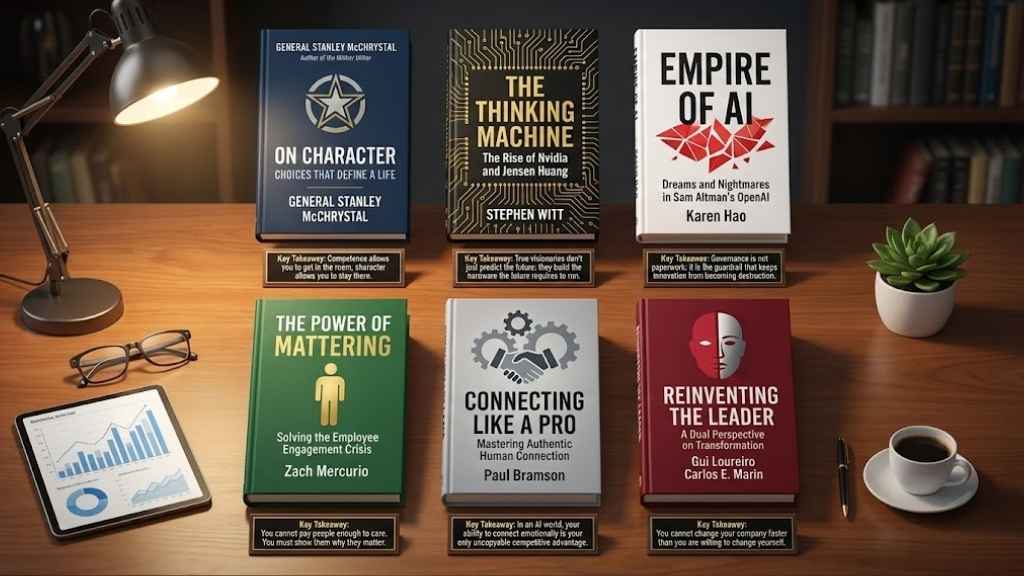
1. “On Character: Choices That Define a Life”
Author: General Stanley McChrystal
Focus: The non-negotiable trait of character in an era of radical transparency.
In a world where leaders are often measured by quarterly results and stock performance, General Stanley McChrystal argues that the only metric that truly sustains an organization is character. Released to critical acclaim and gaining massive traction in late 2025 boardrooms, On Character treats moral fiber not as a fixed gift, but as a muscle that must be exercised daily.
McChrystal draws on his decades of military service and subsequent consulting work to show that in the AI age—where “competence” can be automated—character is the last distinct human advantage. He breaks down the components of character into actionable “choices” leaders make under pressure.
Who Should Read This
- Executives navigating public relations crises.
- Founders building a company culture from scratch.
- Leaders who feel their team has lost its “moral compass.”
Key Takeaway: Competence allows you to get in the room; character allows you to stay there.
2. “The Thinking Machine”
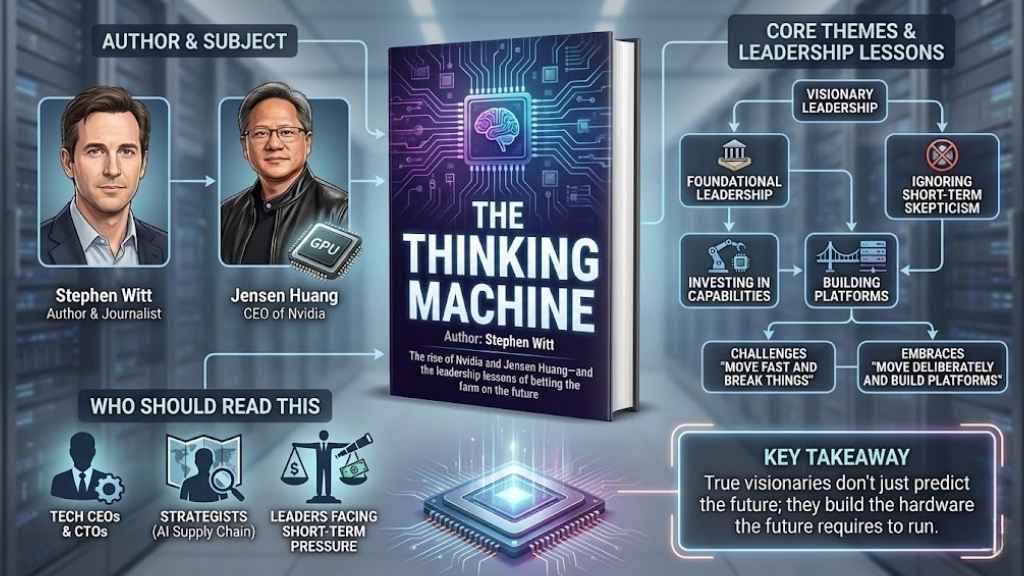
Author: Stephen Witt
Focus: The rise of Nvidia and Jensen Huang—and the leadership lessons of betting the farm on the future.
While ostensibly a biography of Nvidia and its leather-jacket-wearing CEO Jensen Huang, Stephen Witt’s The Thinking Machine is actually a masterclass in visionary leadership. It dissects how Huang ignored short-term market skepticism for years to build the infrastructure for a revolution (AI) that hadn’t happened yet.
For leaders in late 2025, this book provides the blueprint for “foundational leadership”—investing in capabilities that may not pay off for a decade. It challenges the “move fast and break things” mantra, replacing it with “move deliberately and build platforms.”
Who Should Read This
- Tech CEOs and CTOs.
- Strategists looking to understand the “AI Supply Chain.”
- Any leader facing pressure to prioritize short-term profits over long-term vision.
Key Takeaway: True visionaries don’t just predict the future; they build the hardware the future requires to run.
3. “Empire of AI: Dreams and Nightmares in Sam Altman’s OpenAI”
Author: Karen Hao
Focus: Navigating power, ethics, and messy governance in high-growth tech.
If The Thinking Machine is about the hardware of AI, Empire of AI is about the politics. Karen Hao delivers a gripping, rigorous account of the internal wars at OpenAI. For the general reader, it’s a thriller; for the leader, it’s a warning.
The book explores the tension between mission and money. How do you lead an organization when your stated mission (safe AGI for humanity) conflicts with your business model (shipping product)? Hao’s reporting offers a critical look at governance structures and the dangers of “cult of personality” leadership in the tech sector.
Who Should Read This:
- Board members and governance professionals.
- Non-profit leaders transitioning to for-profit models.
- Anyone managing a team of “true believers” or idealists.
Key Takeaway: Governance is not paperwork; it is the guardrail that keeps innovation from becoming destruction.
4. “The Power of Mattering”
Author: Zach Mercurio
Focus: Solving the employee engagement crisis by ensuring every team member feels they “matter.”
“Quiet Quitting” and “Coffee Badging” are symptoms of a deeper problem: a lack of significance. Zach Mercurio’s The Power of Mattering has become the HR bible of late 2025. Mercurio argues that human beings have an innate need to feel that their existence makes a difference.
The book provides a framework for “Significance-Centric Leadership.” It moves beyond generic “employee appreciation” (pizza parties) to structural changes that show employees exactly how their specific daily tasks impact the customer and the company.
Who Should Read This:
- HR Directors and Chief People Officers.
- Middle managers struggling with retention.
- Team leads in remote/hybrid environments.
Key Takeaway: You cannot pay people enough to care. You must show them why they matter.
5. “Connecting Like A PRO”
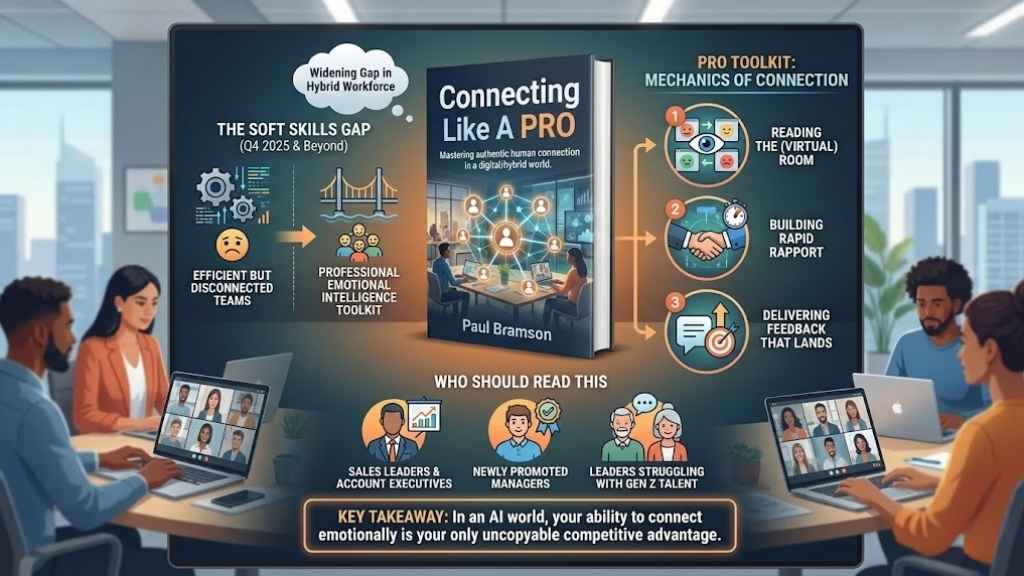
Author: Paul Bramson
Focus: Mastering authentic human connection in a digital/hybrid world.
Released just in time for the Q4 2025 strategic planning season, Paul Bramson’s Connecting Like A PRO addresses the “soft skills gap” widening in the hybrid workforce. As we move into 2026, many leaders are realizing their teams are efficient but disconnected.
Bramson offers a toolkit for “Professional Emotional Intelligence.” He breaks down the mechanics of reading a room (even a virtual one), building rapid rapport, and delivering feedback that lands. It is a tactical guide to being a “human” leader in a digital interface.
Who Should Read This:
- Sales leaders and account executives.
- Newly promoted managers.
- Leaders struggling to connect with Gen Z talent.
Key Takeaway: In an AI world, your ability to connect emotionally is your only uncopyable competitive advantage.
6. “Reinventing the Leader”
Author: Gui Loureiro and Carlos E. Marin
Focus: A dual perspective (CEO + Coach) on transforming oneself to transform a company.
This unique entry offers a “he said, he said” perspective on the massive transformation of Walmart Mexico (Walmex). Written by the CEO (Loureiro) and his executive coach (Marin), it documents the personal agony and triumph of leadership transformation.
It challenges the idea that a leader can stay the same while the company changes. Loureiro candidly admits his own blind spots and resistance to coaching, making it one of the most vulnerable and authentic leadership books of the year.
Who Should Read This:
- CEOs undergoing digital transformation.
- Executive coaches and mentors.
- Leaders managing large-scale organizational change.
Key Takeaway: You cannot change your company faster than you are willing to change yourself.
Emerging Leadership Trends from Late 2025 Releases
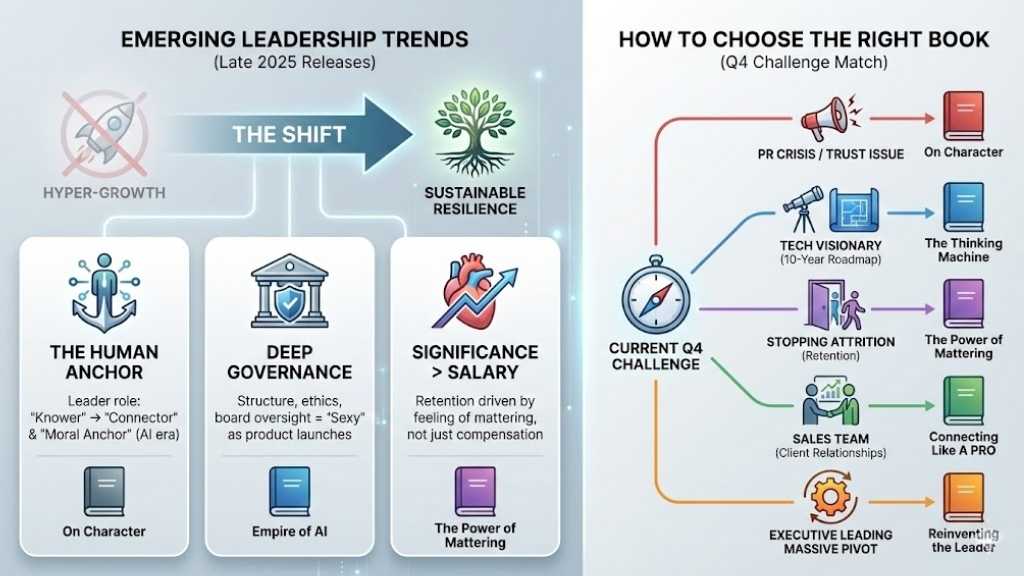
Analyzing these top titles reveals a distinct shift in what the market demands from leaders in 2026. We are moving away from “Hyper-Growth” and toward “Sustainable Resilience.”
| Trend | Description | Representative Book |
| The Human Anchor | As AI advances, the leader’s role shifts from “knower” to “connector” and “moral anchor.” | On Character |
| Deep Governance | Structure, ethics, and board oversight are becoming as “sexy” as product launches. | Empire of AI |
| Significance > Salary | Retention is now driven by the feeling of mattering, not just compensation. | The Power of Mattering |
How to Choose the Right Book for Your Team
Not every book fits every leader. Use this quick guide to match the book to your current Q4 challenge.
- For the leader facing a PR crisis or trust issue: On Character
- For the tech visionary planning a 10-year roadmap: The Thinking Machine
- For the manager trying to stop attrition: The Power of Mattering
- For the sales team needing to improve client relationships: Connecting Like A PRO
- For the executive leading a massive pivot: Reinventing the Leader
Final Thoughts
The books released in late 2025 share a common thread: The easy leadership of the low-interest-rate, pre-AI era is over. The leaders who thrive in 2026 will be those who can build deep human trust while navigating high-stakes technological warfare. Don’t let these titles sit on your shelf. Pick the one that addresses your biggest current bottleneck and commit to reading it before January 1st. Your team will thank you for it.