
Cloud hosting has revolutionized the way businesses and individuals manage websites and applications. As we step into 2025, the demand for best cloud hosting providers has skyrocketed, with companies seeking solutions that offer scalability, security, and cost-effectiveness.
Whether you’re running a high-traffic website, an eCommerce store, or a SaaS platform, choosing the right cloud hosting provider is crucial for performance and uptime.
This guide provides an in-depth analysis of the best cloud hosting providers for 2025, considering performance, pricing, features, and use cases. By the end of this article, you’ll have a clear understanding of which provider suits your needs best.
How to Choose the Best Cloud Hosting Provider

With so many cloud hosting options available, it can be challenging to decide which one is right for your website. Here are the key factors to consider:
Performance Metrics
- Uptime and Reliability: Look for providers with at least 99.99% uptime guarantees.
- Speed and Response Time: Opt for hosts with CDN integration and SSD storage for faster load times.
- Scalability: Ensure the provider allows easy upgrades as your traffic grows.
Pricing and Cost-effectiveness
- Transparent Pricing: Avoid hidden fees and understand renewal costs.
- Free Tiers and Trials: Some providers offer free trials, allowing you to test performance.
- Pay-as-you-go Models: Ideal for businesses that need flexibility.
Security and Compliance
- SSL Certificates and DDoS Protection: Essential for securing data and preventing attacks.
- Automatic Backups: Ensure the provider offers daily or weekly backups.
- Compliance Standards: Check if the host adheres to GDPR, HIPAA, and PCI DSS regulations.
Support and User Experience
- 24/7 Customer Support: Look for providers with multiple support channels, including live chat and phone support.
- Ease of Use: A user-friendly control panel like cPanel, Plesk, or custom dashboards is beneficial.
- Community Support: Some providers have active forums and knowledge bases for troubleshooting.
10 Best Cloud Hosting Providers for 2025 (Comparison Table)
With a variety of cloud hosting providers available, choosing the right one can be challenging. To help simplify the decision-making process, we have compiled a comparison table of the best cloud hosting providers based on uptime, pricing, and key features. This will give you a quick overview of which provider might best suit your needs.
| Provider | Uptime Guarantee | Starting Price | Key Features |
| AWS | 99.99% | $3.50/month | Scalable, Enterprise-grade |
| Google Cloud | 99.99% | $4.00/month | AI-driven, Reliable |
| Azure | 99.95% | $5.00/month | Best for Enterprise |
| Linode | 99.99% | $5.00/month | Developer-friendly |
| DigitalOcean | 99.99% | $4.00/month | Easy-to-use, Affordable |
| Vultr | 99.99% | $2.50/month | High-performance, Low-cost |
| Kamatera | 99.95% | $4.00/month | Fully Customizable |
| Cloudways | 99.99% | $10.00/month | Managed Hosting Option |
| IONOS Cloud | 99.99% | $1.00/month | Best Budget-Friendly |
| ScalaHosting | 99.99% | $9.95/month | Managed VPS with Security |
In-depth Review of the 10 Best Cloud Hosting Providers
Choosing the best cloud hosting providers requires evaluating performance, security, scalability, and pricing. Each provider offers unique advantages, making it essential to assess their features carefully before making a decision. Below is a detailed review of the top 10 cloud hosting providers, starting with Amazon Web Services (AWS).
1. Amazon Web Services (AWS)
Amazon Web Services (AWS) is the world’s leading cloud hosting provider, offering a vast array of cloud-based solutions. With a global presence, AWS provides scalable and secure cloud hosting for businesses of all sizes. Whether you’re a startup, a mid-sized business, or a large enterprise, AWS has an extensive portfolio of services tailored to various needs, including computing power, storage, and databases.
Key Features & Performance:
- Highly scalable infrastructure that grows with your business.
- Pay-as-you-go pricing, ensuring cost efficiency.
- Excellent global data center presence, reducing latency.
- Advanced security features, including encryption and compliance with global regulations.
- Integration with AI & ML services, making it ideal for advanced applications.
- Auto-scaling capabilities, ensuring your site can handle traffic spikes effectively.
Pricing Plans & Cost Analysis: AWS provides flexible pricing models, including a generous free tier and pay-as-you-go options.
| Plan | Pricing | Features |
| Free Tier | $0 (for 12 months) | Includes 750 hours of EC2 usage, 5GB of S3 storage, and more. |
| On-Demand Instances | Starts at $3.50/month | Pay for the compute resources you use. |
| Reserved Instances | Up to 75% savings compared to on-demand | Best for long-term commitments. |
| Spot Instances | Varies | Ideal for flexible workloads at discounted rates. |
Pros & Cons:
- Reliable & scalable, ideal for large and growing businesses.
- Flexible pricing options, allowing businesses to optimize costs.
- Massive global infrastructure, ensuring high availability.
- Rich ecosystem of services, from AI to analytics.
- Complex setup for beginners, requiring technical expertise.
- Pricing can be confusing, especially for those new to cloud hosting.
Best Use Cases:
- Large-scale web applications and enterprise projects.
- AI-driven platforms and machine learning applications.
- eCommerce stores requiring high availability and redundancy.
- Startups looking for a scalable and flexible hosting solution.
AWS remains a top contender in the best cloud hosting providers category due to its powerful infrastructure and flexibility, making it a preferred choice for businesses worldwide.
2. Google Cloud Platform (GCP)
As one of the best cloud hosting providers, Google Cloud Platform (GCP) offers a powerful combination of speed, security, and flexibility. GCP is widely used by startups and enterprises looking for cutting-edge cloud solutions. It integrates seamlessly with Google’s ecosystem, making it an ideal choice for AI and data-driven applications.
Key Features & Performance:
- AI-driven performance optimization, utilizing Google’s advanced machine learning algorithms.
- Strong security measures, including DDoS protection and encryption.
- Highly scalable infrastructure suitable for both startups and enterprises.
- Integration with Google services such as BigQuery, Firebase, and Kubernetes.
- Global network with low-latency performance across multiple regions.
Pricing Plans & Cost Analysis:
- Free tier available with limited usage.
- Pricing starts at $4.00/month for basic VM instances.
- Pay-as-you-go pricing model for flexible cost management.
- Committed-use discounts available for long-term cost savings.
- Cost estimator tools provided to calculate potential expenses.
| Plan Type | Price Range | Features |
| Free Tier | $0/month | Limited compute, storage, and bandwidth |
| Standard VMs | $4.00+/month | Scalable virtual machines with SSD |
| Preemptible VMs | Up to 80% less | Temporary compute instances |
| Kubernetes Engine | Varies | Managed Kubernetes clusters |
| Cloud Storage | Pay-as-you-go | Object storage with multi-region access |
Pros & Cons:
- High-speed network with global CDN integration.
- Strong AI and machine learning capabilities.
- Secure and highly scalable for large businesses.
- Comprehensive documentation and support.
- Can be expensive for small projects with fluctuating workloads.
- Requires some technical knowledge for setup and management.
Best Use Cases:
- AI-driven applications and machine learning projects.
- Enterprises requiring a secure and scalable cloud environment.
- Developers needing integration with Google’s ecosystem.
- Startups looking for cloud solutions with pay-as-you-go pricing.
3. Microsoft Azure
Microsoft Azure is a leading cloud hosting provider, known for its enterprise-grade capabilities and seamless integration with Microsoft services. Azure offers a range of cloud computing solutions that cater to businesses of all sizes, from startups to large enterprises. It provides advanced security, AI-driven analytics, and scalable infrastructure, making it one of the best cloud hosting providers available.
Key Features & Performance:
- Enterprise-grade cloud computing with a broad range of services.
- Seamless integration with Microsoft products like Office 365, Dynamics 365, and Windows Server.
- AI and machine learning capabilities for data-driven applications.
- Strong global presence with multiple data centers worldwide.
- Advanced security features, including multi-layered protection and compliance with international standards.
Pricing Plans & Cost Analysis: Microsoft Azure offers flexible pricing models, including a free tier and pay-as-you-go options.
| Plan Type | Pricing | Features |
| Free Tier | $0 for 30 days | Includes $200 credit for testing Azure services. |
| Pay-as-you-go | Starts at $5.00/month | Flexible billing based on resource usage. |
| Reserved Instances | Discounted rates | Up to 72% savings for long-term commitments. |
| Spot VMs | Varies | Cost-effective option for temporary workloads. |
Pros & Cons:
- Ideal for enterprises and developers looking for high performance and security.
- Strong integration with Microsoft services, making it a top choice for Windows-based environments.
- Wide global presence with multiple data centers ensuring high availability.
- More expensive compared to some competitors, especially for small businesses.
- Steep learning curve for beginners due to its wide range of services and configurations.
Best Use Cases:
- Large enterprises needing a robust and secure cloud hosting solution.
- Organizations heavily reliant on Microsoft services.
- AI-driven applications and big data analytics.
- Businesses requiring compliance with stringent security regulations.
With its strong reputation and extensive features, Microsoft Azure remains a dominant force in the cloud hosting market, offering unparalleled services to businesses worldwide.
4. Linode (Akamai Cloud)
Linode, now part of Akamai, is one of the best cloud hosting providers known for its developer-friendly approach and transparent pricing. Linode offers high-performance SSD-based cloud infrastructure designed for businesses, developers, and IT professionals looking for a cost-effective yet powerful hosting solution. With global data centers and a strong community, Linode provides a great balance between affordability and performance.
Key Features & Performance:
- Developer-friendly cloud hosting with easy-to-use APIs.
- Simplified pricing structure with predictable monthly costs.
- High-performance SSD storage for faster website loading speeds.
- Global network of data centers for low-latency performance.
- Dedicated CPU instances for compute-intensive applications.
- Kubernetes support for scalable containerized applications.
- Automated backups and DDoS protection for enhanced security.
Pricing Plans & Cost Analysis: Linode offers a flat-rate pricing model with no hidden fees, making it one of the most budget-friendly cloud hosting options.
| Plan Type | Pricing | Features |
| Nanode | $5.00/month | 1GB RAM, 1 vCPU, 25GB SSD storage, 1TB bandwidth |
| Standard | $10.00/month | 2GB RAM, 1 vCPU, 50GB SSD storage, 2TB bandwidth |
| Dedicated CPU | $30.00/month | 4GB RAM, 2 vCPUs, 80GB SSD storage, 4TB bandwidth |
| GPU Instances | $100.00/month | High-performance GPUs for AI/ML workloads |
| Kubernetes Engine | Varies | Managed Kubernetes for scalable workloads |
Pros & Cons:
- Transparent pricing and excellent customer support.
- High-speed SSD storage for improved performance.
- Scalable compute instances, ideal for developers.
- Strong security features, including DDoS protection.
- Limited global data center locations compared to AWS and GCP.
- No fully managed hosting options, requiring technical expertise.
Best Use Cases:
- Developers needing flexible and cost-effective cloud infrastructure.
- Businesses looking for predictable, transparent cloud pricing.
- Companies running compute-intensive applications and AI workloads.
- Users seeking an alternative to AWS, GCP, and Azure with more control.
With its strong reputation in the cloud hosting industry, Linode remains one of the best cloud hosting providers in 2025, offering reliable and affordable cloud services tailored for developers and businesses alike.
5. DigitalOcean
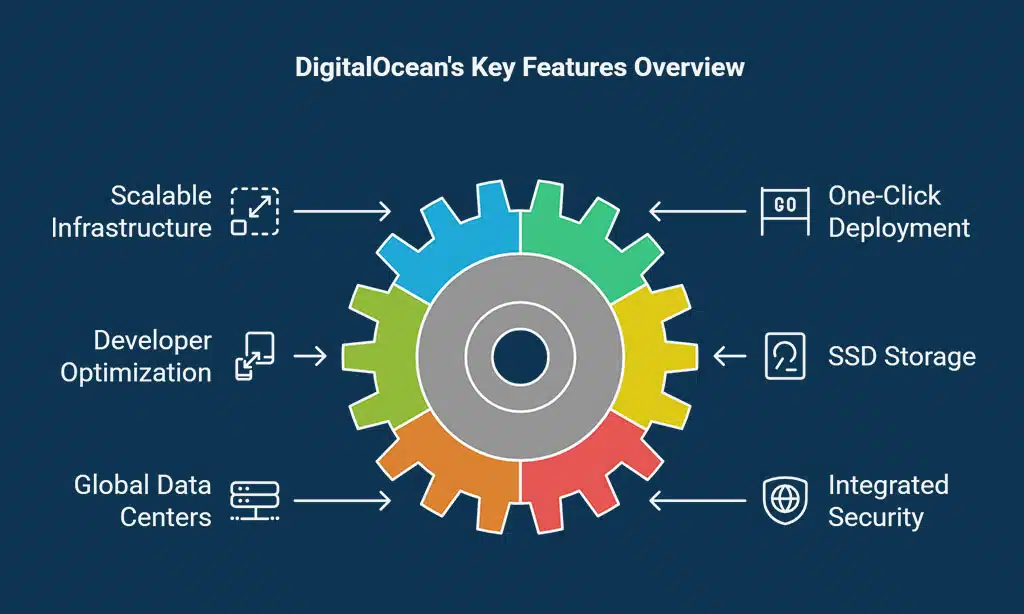
DigitalOcean is widely recognized as one of the best cloud hosting providers, offering a balance of affordability and performance. It is a preferred choice for startups, developers, and small businesses due to its easy-to-use control panel and extensive documentation.
With a focus on simplicity and scalability, DigitalOcean provides a variety of cloud solutions, including Droplets (virtual machines), Kubernetes-based container hosting, and managed databases.
Key Features & Performance:
- Simple and scalable cloud infrastructure with robust performance.
- One-click app deployment for ease of setup.
- Optimized for developers and small businesses with a user-friendly interface.
- High-speed SSD-based storage for enhanced website performance.
- Global data centers ensuring low latency and high availability.
- Integrated security features including automated backups and DDoS protection.
Pricing Plans & Cost Analysis: DigitalOcean offers a range of pricing plans tailored for different needs.
| Plan Type | Pricing | Features |
| Basic Droplet | $4.00/month | 1 vCPU, 1GB RAM, 25GB SSD storage, 1TB bandwidth |
| Standard Droplet | $6.00/month | 1 vCPU, 2GB RAM, 50GB SSD storage, 2TB bandwidth |
| General Purpose | $60.00/month | 8 vCPUs, 32GB RAM, 100GB SSD storage, 6TB bandwidth |
| CPU-Optimized | $40.00/month | 4 vCPUs, 8GB RAM, 50GB SSD storage, 4TB bandwidth |
| Managed Kubernetes | Varies | Scalable Kubernetes clusters for containerized apps |
Pros & Cons:
- Affordable and user-friendly with transparent pricing.
- High-speed SSD storage ensures excellent performance.
- Scalable options for growing businesses.
- Strong security with automated backups and firewalls.
- Limited customer support on lower-tier plans.
- No fully managed hosting options, requiring some technical expertise.
Best Use Cases:
- Startups and small businesses looking for cost-effective cloud hosting.
- Developers needing an easy-to-use and scalable cloud infrastructure.
- Companies running containerized applications using Kubernetes.
- Websites requiring high-speed SSD performance and global availability.
6. Vultr
Vultr is one of the best cloud hosting providers known for its affordability and high-performance infrastructure. With a focus on simplicity and cost-effectiveness, Vultr caters to developers, businesses, and startups looking for cloud hosting solutions that are easy to deploy and manage.
Whether you need scalable cloud compute instances, bare metal servers, or high-frequency compute options, Vultr provides a variety of hosting plans tailored to different workloads.
Key Features & Performance:
- High-performance servers with SSD storage for improved speed and reliability.
- Wide range of customizable plans, allowing businesses to scale efficiently.
- Low-cost cloud hosting options with pay-as-you-go pricing models.
- Global network of data centers for reduced latency and enhanced uptime.
- API access and automation tools for seamless deployment and management.
- DDoS protection and advanced security measures for safeguarding data.
Pricing Plans & Cost Analysis: Vultr offers a variety of pricing plans to cater to different needs, from individual developers to enterprises.
| Plan Type | Starting Price | Features |
| Basic Cloud Compute | $2.50/month | 1 vCPU, 512MB RAM, 10GB SSD, 0.5TB bandwidth |
| High Frequency Compute | $6.00/month | 1 vCPU, 1GB RAM, 32GB NVMe SSD, 1TB bandwidth |
| Dedicated Cloud | $60.00/month | 4 vCPUs, 8GB RAM, 120GB SSD, 5TB bandwidth |
| Bare Metal | $120.00/month | Fully dedicated resources for enterprise-grade performance |
Pros & Cons:
- Affordable and easy to set up, with flexible pricing options.
- High-performance SSD storage enhances website speed and reliability.
- Global data centers ensure optimal performance and reduced latency.
- Customizable plans suited for different workloads and applications.
- Limited managed hosting support compared to competitors.
- Some advanced features may require technical expertise to implement.
Best Use Cases:
- Developers and startups looking for an affordable yet powerful cloud hosting solution.
- Businesses needing scalable and customizable cloud infrastructure.
- Users requiring high-performance hosting for web applications and databases.
- Enterprises seeking dedicated resources for large-scale projects and workloads.
7. Kamatera
Key Features & Performance:
- Fully customizable cloud hosting with scalable infrastructure.
- Data centers across multiple continents for global reach.
- Flexible pricing with no long-term commitments, making it ideal for startups and enterprises.
- Advanced security options, including firewalls, DDoS protection, and automated backups.
- High-performance SSD storage and fast networking options for optimal speed.
- API access and automation tools for seamless cloud management.
Pricing Plans & Cost Analysis: Kamatera provides a flexible, pay-as-you-go pricing structure with various configurations.
| Plan Type | Starting Price | Features |
| Basic Cloud VM | $4.00/month | 1 vCPU, 1GB RAM, 20GB SSD, 5TB bandwidth |
| High-Performance VM | $12.00/month | 2 vCPUs, 4GB RAM, 50GB SSD, 10TB bandwidth |
| Enterprise Solution | Custom Pricing | Fully customizable CPU, RAM, storage, and bandwidth |
| Private Cloud | Custom Pricing | Dedicated cloud environment for large businesses |
Pros & Cons:
- Great for businesses needing full control over cloud resources.
- Pay-as-you-go model ensures flexibility and cost efficiency.
- Strong security features and global data centers.
- Ideal for custom configurations and high-performance needs.
- Requires technical expertise to configure and manage efficiently.
- No fully managed hosting options, requiring manual setup and maintenance.
Best Use Cases:
- Startups and enterprises needing scalable and flexible cloud infrastructure.
- Businesses requiring custom configurations and high-performance computing.
- Users needing dedicated private cloud environments for added security.
- Developers and IT professionals looking for advanced cloud solutions with full control.55
8. Cloudways (Managed Cloud Hosting)
Cloudways is a managed cloud hosting platform that simplifies cloud infrastructure management for businesses and developers. It allows users to deploy cloud hosting solutions from top providers such as AWS, Google Cloud, Linode, DigitalOcean, and Vultr. With its user-friendly interface, Cloudways eliminates the complexities of cloud hosting, offering automated scaling, security features, and performance optimizations.
Key Features & Performance:
- Fully managed hosting environment with automatic updates and security patches.
- Support for major cloud providers: AWS, GCP, Linode, DigitalOcean, and Vultr.
- Built-in caching mechanisms (Varnish, Memcached, and Redis) for optimized performance.
- Free SSL certificates and dedicated firewalls to enhance security.
- Pay-as-you-go pricing model, ensuring cost flexibility.
- 24/7 customer support with expert assistance.
Pricing Plans & Cost Analysis: Cloudways offers a variety of pricing plans based on the cloud provider chosen.
| Cloud Provider | Starting Price | Features |
| DigitalOcean | $10.00/month | 1GB RAM, 1 vCPU, 25GB storage, 1TB bandwidth |
| Linode | $12.00/month | 1GB RAM, 1 vCPU, 25GB storage, 1TB bandwidth |
| Vultr | $11.00/month | 1GB RAM, 1 vCPU, 25GB storage, 1TB bandwidth |
| AWS | $36.51/month | 1.75GB RAM, 1 vCPU, 20GB storage, 2TB bandwidth |
| Google Cloud | $33.18/month | 1.70GB RAM, 1 vCPU, 20GB storage, 2TB bandwidth |
Pros & Cons:
- Simplifies cloud hosting with managed services.
- Choice of multiple cloud providers for flexibility.
- Built-in caching for high performance.
- Free site migration and security features.
- More expensive than unmanaged cloud hosting.
- Lacks root access for advanced customizations.
9. IONOS Cloud
IONOS Cloud is one of the most affordable cloud hosting solutions, offering enterprise-level security and infrastructure at budget-friendly prices. With a strong presence in Europe, IONOS Cloud is ideal for businesses that prioritize compliance with GDPR and data protection regulations. It provides scalable and flexible hosting services suitable for small to medium-sized businesses.
Key Features & Performance:
- Highly secure data centers with compliance to GDPR regulations.
- Affordable pay-as-you-go pricing for cost-effective scaling.
- High-performance SSD storage for fast data processing.
- AI-driven security features for enhanced protection.
- 99.99% uptime guarantee for reliable performance.
Pricing Plans & Cost Analysis: IONOS Cloud offers some of the lowest starting prices in the cloud hosting market.
| Plan Type | Starting Price | Features |
| Entry-Level Cloud Server | $1.00/month | 1 vCPU, 512MB RAM, 10GB SSD storage, 1TB bandwidth |
| Standard Cloud Server | $5.00/month | 1 vCPU, 2GB RAM, 50GB SSD storage, 2TB bandwidth |
| Business Cloud Server | $20.00/month | 4 vCPUs, 8GB RAM, 100GB SSD storage, 5TB bandwidth |
| Enterprise Cloud Solution | Custom Pricing | Fully customizable resources and dedicated infrastructure |
Pros & Cons:
- Very affordable for beginners and small businesses.
- Secure European-based data centers with high compliance standards.
- Scalable solutions suitable for all business sizes.
- Pay-as-you-go pricing ensures cost control.
- Limited global reach compared to AWS and Google Cloud.
- Fewer advanced features for large-scale enterprises.
10. ScalaHosting
ScalaHosting is an innovative cloud hosting provider known for its fully managed VPS hosting solutions. The company stands out due to its proprietary SPanel, an all-in-one control panel that enhances security, performance, and ease of use. ScalaHosting is an excellent choice for businesses seeking high-performance cloud hosting with a focus on security and managed services.
Key Features & Performance:
- Managed VPS hosting with the SPanel control panel for easy management.
- Free website migration services.
- Built-in security features, including automated backups and advanced firewalls.
- Fully scalable infrastructure to grow with your business.
- 24/7 expert support for troubleshooting and optimizations.
Pricing Plans & Cost Analysis: ScalaHosting provides fully managed VPS solutions with competitive pricing.
| Plan Type | Starting Price | Features |
| Entry VPS | $9.95/month | 1 vCPU, 2GB RAM, 50GB SSD storage, unlimited bandwidth |
| Advanced VPS | $21.95/month | 2 vCPUs, 4GB RAM, 100GB SSD storage, unlimited bandwidth |
| Business VPS | $41.95/month | 4 vCPUs, 8GB RAM, 150GB SSD storage, unlimited bandwidth |
| Enterprise VPS | $72.95/month | 8 vCPUs, 16GB RAM, 200GB SSD storage, unlimited bandwidth |
Pros & Cons:
- Great for businesses needing high security and managed services.
- Proprietary SPanel makes server management easy.
- Free website migration included.
- High-performance SSD storage ensures fast loading speeds.
- Higher entry-level pricing compared to shared hosting.
- Limited data center locations compared to larger cloud providers.
Best Cloud Hosting Providers by Use Case
Choosing the right cloud hosting provider depends on specific use cases and business needs. Whether you’re a small business owner, a developer, or an enterprise, selecting the best cloud hosting provider ensures optimal performance, security, and scalability. Below, we categorize the top cloud hosting providers based on different use cases.
Best for Small Businesses
Small businesses need reliable and affordable cloud hosting solutions that offer simplicity and scalability without technical complexities. DigitalOcean and Linode are excellent choices due to their user-friendly interfaces, predictable pricing models, and efficient performance. DigitalOcean provides one-click app installations and managed Kubernetes, while Linode offers strong developer support and excellent documentation for small teams.
Best for High-Traffic Websites
Websites experiencing high traffic need a cloud hosting provider with robust scalability and excellent uptime guarantees. AWS and Google Cloud stand out due to their extensive global infrastructure, low-latency networking, and powerful compute instances. AWS provides elastic load balancing and auto-scaling features, ensuring seamless performance even during peak traffic hours, while Google Cloud’s AI-driven optimizations help enhance website speed and security.
Best Budget-Friendly Option
For individuals and small businesses looking for affordable yet reliable cloud hosting, IONOS Cloud offers one of the lowest starting prices in the industry at just $1.00/month. With its pay-per-use model, businesses can scale up resources only when needed, keeping costs low. Additionally, IONOS Cloud’s data centers comply with strict European security standards, ensuring reliable service at an unbeatable price.
Best for Developers and Customization
Developers require cloud hosting providers that offer flexibility, powerful APIs, and full customization capabilities. Vultr and Kamatera are ideal for developers as they provide high-performance cloud instances with configurable resources. Vultr offers low-cost compute options with fast NVMe storage, while Kamatera allows complete control over CPU, RAM, and networking configurations, making it an excellent choice for highly customizable cloud environments.
Best for Enterprise Solutions
Enterprises demand cloud hosting providers with high availability, strong security, and extensive integration options. Azure and AWS cater to large-scale business needs with enterprise-grade security, compliance certifications, and AI-driven analytics. Azure integrates seamlessly with Microsoft applications and hybrid cloud solutions, while AWS provides an extensive suite of cloud tools, including machine learning and IoT capabilities, making them the preferred choice for global enterprises.
Takeaways
Choosing the best cloud hosting providers in 2025 depends on your specific needs. For small businesses, DigitalOcean and Linode are great choices, while enterprises can benefit from AWS and Azure.
Budget-conscious users should consider IONOS Cloud, whereas developers may prefer Vultr and Kamatera.
No matter your requirements, investing in reliable cloud hosting ensures a fast, secure, and scalable web presence. Make your choice wisely, and ensure that your website’s hosting aligns with your growth goals!