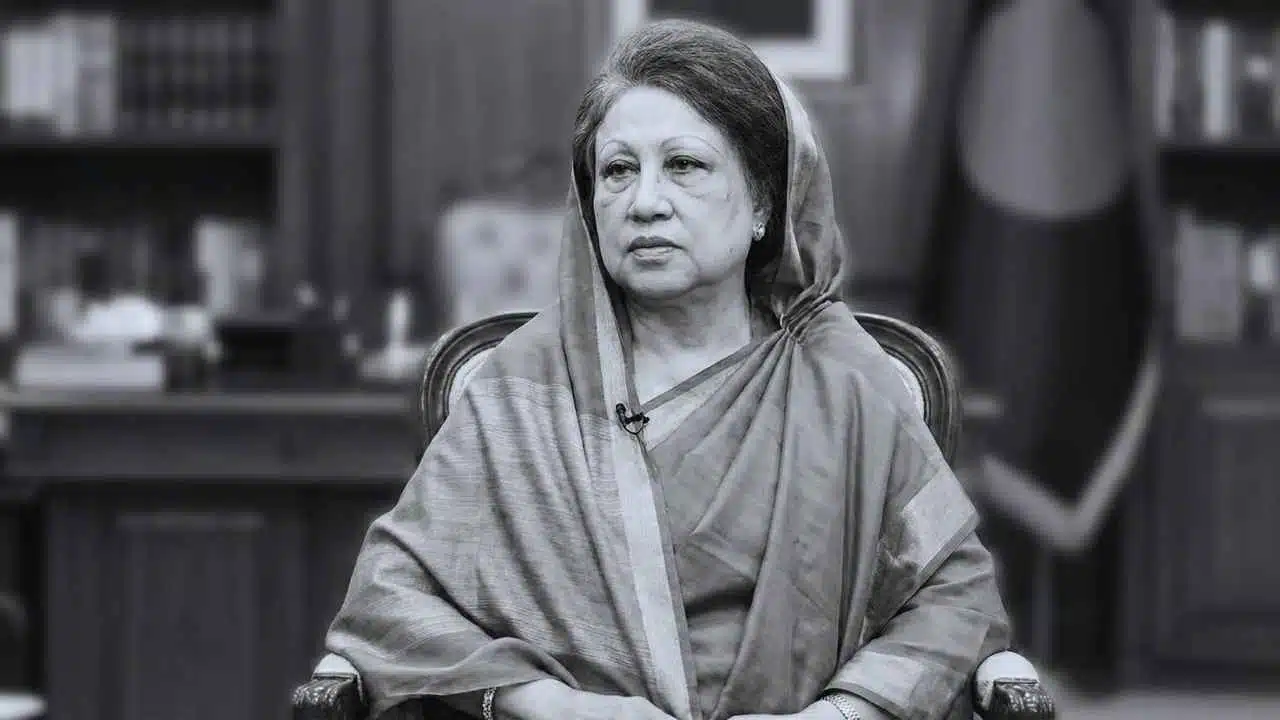
Begum Khaleda Zia, the uncompromising “Deshnetri” (Leader of the Country) who became Bangladesh’s first female prime minister and defined its political landscape for over three decades, has died today at 80. The Chairperson of the Bangladesh Nationalist Party (BNP) breathed her last at 6:00 AM on Tuesday, December 30, 2025, at Evercare Hospital in Dhaka.
Her personal physician, Dr. AZM Zahid Hossain, confirmed the death, citing irreversible complications arising from advanced liver cirrhosis, compounded by chronic kidney and heart failure.
“She fought like a warrior until the very end,” Dr. Hossain told a tearful press gathering. “Despite the best efforts of the medical board and international specialists, her multi-organ failure was beyond recovery.”
The Final Reunion
Her passing comes just five days after a historic and emotional reunion with her eldest son and political heir, Tarique Rahman. The Acting Chairman of the BNP returned to Bangladesh on December 25, 2025, ending 17 years of self-imposed exile in London.
Sources at Evercare Hospital confirmed that Rahman, along with his wife, Dr. Zubaida Rahman and daughter, Zaima, was by Khaleda Zia’s bedside during her final hours. The reunion was described as the “one wish that kept her holding on” through her deteriorating health in late 2024.
National Reaction: A Nation in Mourning
As news of her passing broke shortly after Fajr prayers, a pall of gloom descended over Dhaka. Thousands of BNP supporters, weeping and chanting “Mother of Democracy,” began gathering outside the hospital gates and the BNP central office at Naya Paltan.
Official Statements
BNP Secretary General Mirza Fakhrul Islam Alamgir announced a 7-day national mourning period, with party flags to be flown at half-mast across the country. “The nation has lost its guardian,” Alamgir stated. “She was not just a leader; she was the symbol of our sovereignty and resilience.”
Public Sentiment
Spontaneous processions have been reported in Bogura, Feni, and Chattogram. Political analysts describe the mood as one of “end of an epoch,” noting that her death marks the definitive close of the post-1990 democratic transition era.
Interim Government
Chief Advisor Dr. Muhammad Yunus issued a statement expressing deep condolences, recognizing her “undeniable role in the restoration of democracy in 1990.”
Early Life and Family
Khaleda Khanam “Putul” was born in 1945. She was born in Jalpaiguri, which is now in India. Her family was from Fulgazi, Bangladesh. Her father was named Iskandar Ali Majumder. He was a tea businessman from Feni. Her mother was named Taiyaba Majumder. Khaleda was the third of five children. In 1947, the family moved to Dinajpur in East Pakistan.
Education and Marriage
She went to school in Dinajpur. In 1960, she married Ziaur Rahman. He was an army captain at the time. After marriage, she changed her name to Khaleda Zia. She briefly attended college in Dinajpur. In 1965, she moved to West Pakistan to live with her husband. Her husband fought in the war of 1965. The couple moved back to East Pakistan in 1969. Later, they moved to Chittagong.
Children and Siblings
Her first son is Tarique Rahman. He became a politician. He is a leader in the Bangladesh Nationalist Party. Her second son was Arafat Rahman “Koko.” He died of a heart attack in 2015.
Her sister was Khurshid Jahan. She served as a government minister. Her brother was Sayeed Iskander. He was also a politician. Her other brother is Shamim Iskandar. He worked as a flight engineer. Her other sister is named Selina Islam.
Looking Ahead
The BNP has announced a 7-day mourning period. Her funeral schedule is expected to be announced later today, with anticipation of one of the largest public gatherings in Dhaka’s history.
With the general election just two months away, political analysts believe her passing will galvanize the BNP’s support base, likely creating a massive sympathy wave for Tarique Rahman as he takes the full helm of the party.