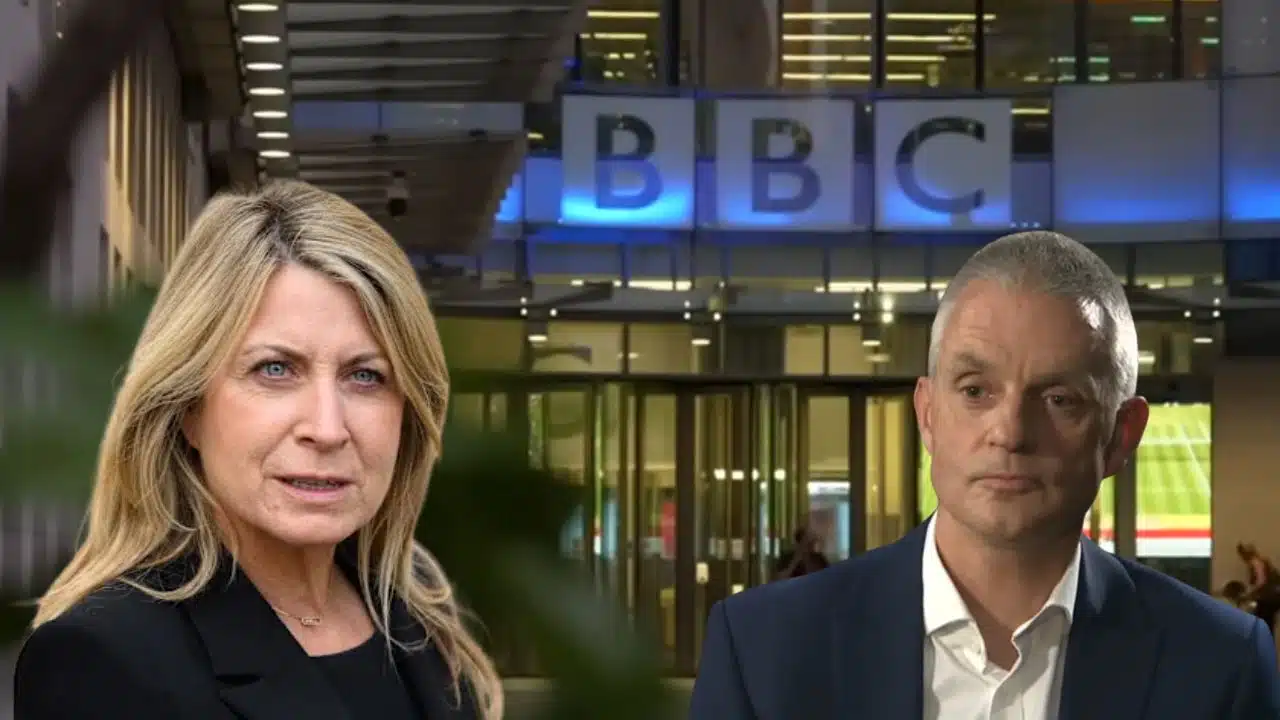
In an unprecedented shake-up, two of the most senior figures at the British Broadcasting Corporation — Director General Tim Davie and Head of News and Current Affairs Deborah Turness — have resigned following mounting criticism over an edited segment in a BBC Panorama documentary about former U.S. President Donald Trump. The controversy, which erupted after the Telegraph revealed details of a leaked internal memo, accused the program of deliberately editing parts of Trump’s January 6, 2021, speech in Washington, D.C., in a way that misrepresented his words and intentions.
The memo suggested that two separate parts of Trump’s speech, originally spoken nearly an hour apart, were spliced together to create a misleading narrative implying he encouraged the Capitol Hill riots. The edited version presented Trump as saying, “We’re going to walk down to the Capitol… and we fight. We fight like hell.” However, the full unedited speech contained context such as “peacefully and patriotically make your voices heard”, which was omitted from the program. This revelation triggered widespread outrage and claims that the BBC — long regarded as one of the world’s most trusted broadcasters — had compromised its editorial integrity.
Tim Davie, who served as Director General for five years, announced his resignation in a statement on Sunday evening, acknowledging that the ongoing debate about the BBC’s journalistic conduct had made it increasingly difficult for him to continue. “Like all public organizations, the BBC is not perfect,” he said. “We must always be open, transparent, and accountable. While not being the only reason, the current debate around BBC News has understandably contributed to my decision. Overall, the BBC is delivering well, but there have been some mistakes made, and as Director General, I have to take ultimate responsibility.” Davie, a BBC veteran of two decades who previously led BBC Studios, had faced months of political pressure over accusations of bias, lapses in editorial oversight, and repeated controversies around impartiality in coverage of polarizing global issues.
Deborah Turness, who had been CEO of News and Current Affairs for three years, also issued a statement confirming her decision to step down. “The Panorama controversy has reached a stage where it is causing damage to the BBC. The buck stops with me,” she said. Turness added that while the organization had made mistakes, the accusations that BBC News was “institutionally biased” were “absolutely wrong.” She expressed deep regret over the situation but emphasized the need for accountability in public life, saying leaders must take full responsibility when trust is eroded.
Their resignations came within hours of each other, a rare occurrence in BBC history, and mark a pivotal moment for the public broadcaster. The crisis intensified after the publication of the internal memo, written by Michael Prescott, a former independent adviser to the BBC’s editorial standards committee. Prescott’s document, leaked to The Telegraph, accused the organization of ignoring “systemic problems” of bias and editorial negligence. He cited not only the Trump edit but also coverage of the Israel-Gaza conflict, suggesting that BBC Arabic exhibited slanted reporting, and expressed concerns that discussions about transgender issues within the newsroom were “censored” by activists internally pushing a particular narrative. Prescott wrote that he felt “despair” at the lack of leadership action to correct such issues before he left his role in June.
The scandal over Trump’s edited speech set off a firestorm internationally. The White House called the incident an example of “100% fake news,” while Trump himself seized the opportunity to attack the broadcaster. On his social media platform, he wrote, “Top people at the BBC are quitting or being fired because they were caught ‘doctoring’ my very good (PERFECT!) speech of January 6th. These are very dishonest people who tried to step on the scales of a Presidential Election. What a terrible thing for democracy!” Trump’s reaction fueled global headlines, deepening political divides and further damaging the BBC’s reputation for neutrality.
The BBC’s Board, led by Chairman Samir Shah, expressed sadness at the resignations. Shah described Davie as a respected leader who had his “full support throughout his tenure,” but acknowledged the “personal and professional pressure” that led to his decision. He also confirmed that the Board would oversee an orderly transition and begin the process of appointing new leadership. The BBC’s next Director General and Head of News will inherit a formidable challenge — restoring public trust and guiding the corporation through its upcoming Royal Charter renewal negotiations with the UK government before 2027.
In Parliament, political leaders reacted swiftly. Culture Secretary Lisa Nandy thanked Davie for his leadership “through a period of significant change” and underscored the BBC’s importance to Britain’s democratic and cultural life. She promised that the forthcoming Charter review would help the BBC “adapt to this new era” and strengthen accountability. Conservative leader Kemi Badenoch, however, was more critical, calling the resignations “necessary but insufficient” and insisting that the broadcaster must “finally demonstrate true impartiality” before expecting continued public funding through the license fee. Liberal Democrat leader Sir Ed Davey defended the BBC’s broader value, calling it “one of the few institutions standing between our British values and a populist, Trump-style takeover of our politics,” while Nigel Farage demanded “wholesale reform” and the appointment of an outsider capable of transforming the BBC’s internal culture.
The resignations are the latest in a long line of editorial crises to hit the BBC, from earlier impartiality complaints to the resignation of previous Director General George Entwistle in 2012 over a flawed Newsnight investigation. The corporation recently upheld 20 viewer complaints against presenter Martine Croxall for altering a live script to use the phrase “pregnant people,” sparking a debate over gendered language. It also faced backlash for failing to disclose that the narrator of a Gaza documentary was the son of a Hamas official, and for broadcasting a Glastonbury performance where the punk duo Bob Vylan chanted “death, death to the IDF,” a violation of editorial guidelines on harm and offence.
Media observers have described the resignations as a watershed moment. Roger Mosey, former head of BBC News, said the Trump edit “doesn’t seem defensible” and noted that the broadcaster was “slow to respond” to the allegations. Dorothy Byrne, former Channel 4 head of news, condemned the BBC’s handling of the situation as “a basic error compounded by an inordinate delay in apology.” Both commentators argued that the organization’s reputation, built over decades as the global standard for impartial journalism, now faces a severe credibility test.
Despite the turmoil, Davie maintained that the BBC’s “journalism and quality content continue to be admired as a gold standard.” He expressed hope that his departure would allow a new leader to guide the broadcaster positively into its next Charter phase. He added that the BBC remains “overwhelmingly kind, tolerant, and curious,” emphasizing the enduring dedication of its staff.
The upcoming weeks are expected to be crucial for the BBC. Chairman Samir Shah will face a parliamentary committee to explain how the Trump edit occurred, and an internal review of editorial procedures is anticipated. Beyond the immediate scandal, the BBC must also confront existential questions about its funding model, independence, and cultural role in an era where media trust is eroding worldwide. Whoever succeeds Davie and Turness will not only inherit a public relations crisis but also the monumental responsibility of steering one of the world’s most influential broadcasters through a defining chapter in its history.
Political and Cultural Impact of the BBC Crisis
The dual resignations have sent shockwaves through the British media landscape and reignited debate over the future of public broadcasting. Critics argue that the incident reflects deeper institutional weaknesses that go beyond one misjudged edit. The BBC, established under a Royal Charter and funded largely through a compulsory license fee, has long been under pressure to prove its impartiality in an increasingly polarized information environment.
The Trump documentary controversy also intersects with broader discussions about misinformation and accountability in the digital age. The fact that a program as prestigious as Panorama — historically a symbol of investigative excellence — could make an editing error with global political implications has fueled concerns about editorial oversight and internal checks. Many commentators warn that such incidents could further erode public confidence in legacy media, particularly when populist leaders seize upon them to discredit journalism as a whole.
Within the BBC, morale reportedly remains low. Staff members have privately expressed frustration that management failed to act quickly to address the issue when concerns first arose. Others fear that the scandal will be exploited by political actors seeking to weaken the BBC’s independence. Analysts note that the timing of the crisis — just two years before the 2027 Charter renewal — could embolden government calls for reform, including potential privatization or a shift to a subscription-based funding model.
Internationally, the controversy may tarnish the BBC’s reputation as a trusted global news source. For decades, its World Service has been viewed as a model of factual, impartial reporting. The Trump edit episode risks undermining that image, especially among audiences already skeptical of Western media narratives. Foreign broadcasters have begun to highlight the scandal as evidence that even venerable institutions are vulnerable to bias and political pressure.
Meanwhile, the United States has closely followed developments, with Trump’s supporters celebrating the resignations as vindication of long-standing claims that Western media outlets misrepresent conservative voices. Some American commentators have also drawn parallels with domestic debates over media partisanship and the ethics of selective editing.
What Lies Ahead for the BBC
The immediate focus now shifts to the BBC Board’s search for new leadership capable of restoring confidence both internally and publicly. Industry analysts suggest that the Board may consider restructuring the organization’s leadership model — possibly separating corporate management from editorial control — to reduce the concentration of accountability in a single role.
The BBC is expected to launch a thorough internal audit of its editorial standards, training, and compliance procedures. There are growing calls for an independent review to examine how such a serious editing oversight went unchallenged before broadcast. The corporation also faces pressure to increase transparency in its corrections and complaints processes to reassure audiences of its commitment to fairness.
Beyond structural reform, the BBC must rebuild its cultural credibility. Restoring trust among viewers, political leaders, and international partners will require decisive action and consistent demonstration of impartiality. The Charter renewal discussions with the government, due before the end of 2027, will be a critical juncture. The process determines how the BBC is funded, regulated, and held accountable. The resignations, therefore, could profoundly shape the broadcaster’s long-term future.
As Britain’s most influential media institution, the BBC stands at a crossroads. The resignations of Tim Davie and Deborah Turness mark not only the end of an era but also a test of whether the organization can adapt to modern demands for transparency, accuracy, and public trust. The crisis surrounding the Panorama edit has exposed the fragility of that trust — and the immense challenge now lies in proving that the BBC’s foundational values of truth and fairness still hold firm in an age of division and doubt.
The Information is Collected from BBC and NPR.