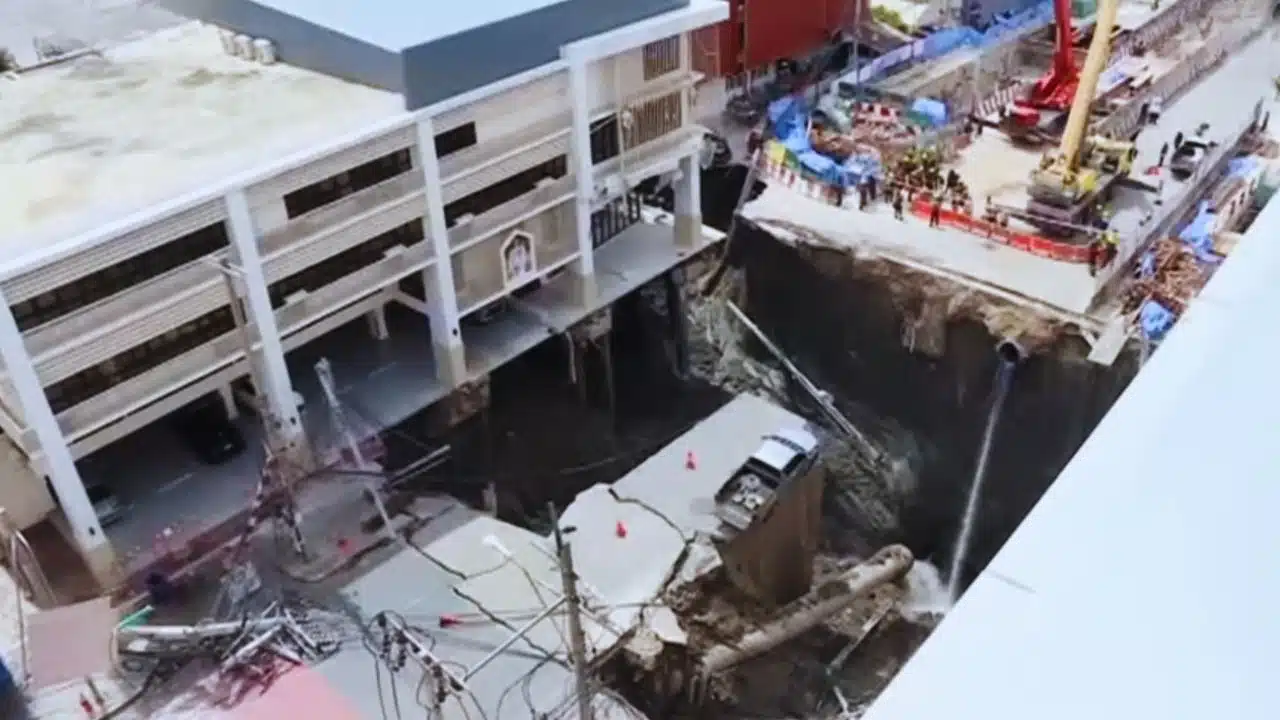
Bangkok was shaken on Wednesday morning when a giant sinkhole suddenly opened in front of Vajira Hospital, one of the city’s key public healthcare facilities, located on Samsen Road in the Dusit district. The collapse happened around 7:15 a.m. local time, when commuters were beginning their day and the hospital was already active with patients and staff.
The sinkhole, described by local media as 50 metres deep and roughly 30 by 30 metres wide, left a gaping crater in the middle of a busy road. Witnesses reported a loud rumbling sound, followed by the cracking of the asphalt. Power lines and street poles toppled into the hole, while dust and debris filled the area. Some residents were jolted awake by the noise, mistaking it for an earthquake.
Videos circulating on social media show the dramatic moment the road gave way. In one clip, a white truck stood precariously close to the edge, its front wheels hanging just inches from the steep drop. Another video captured water gushing into the sinkhole from a ruptured underground pipe, turning the crater into a muddy torrent.
Sinkhole in Bangkok pic.twitter.com/72DKMT4jU9
— @ (@anthraxxxx) September 24, 2025
Evacuations and Immediate Emergency Measures
Authorities reacted quickly. Police officers, hospital security, and municipal disaster response teams cordoned off the area and ordered evacuations of nearby buildings, including hospital wings and residences.
Patients who were able to move were shifted to safer areas inside the hospital, while critical patients were kept under close supervision as backup power and water supplies were arranged. Staff members carried out an emergency drill, ensuring that operating theatres, emergency wards, and intensive care units remained functional despite the crisis.
The Bangkok Metropolitan Administration (BMA) also ordered road closures between Vajira intersection and Sanghi intersection, a busy commuter route. Traffic was diverted, causing heavy congestion in other parts of the city during morning rush hour.
Damage to Infrastructure
The collapse tore through underground utilities, including a major water pipeline, which burst and worsened the erosion. As the soil underneath weakened, it flowed down into a tunnel where construction of a new subway station was underway.
The sinkhole also damaged electricity lines and communication cables, leaving several blocks temporarily without power. Emergency crews worked to cut off electricity in the danger zone to prevent electrocution risks.
Cause of the Sinkhole
Bangkok Governor Chadchart Sittipunt confirmed that the sinkhole was linked to ongoing construction for the city’s expanding underground rail network.
According to Suriyachai Rawiwan, Director of Bangkok’s Disaster Prevention and Mitigation Department, the main trigger was a water leak that eroded soil beneath the surface. The eroded soil gradually slipped into the under-construction train tunnel. Combined with recent heavy rainfall, the underground pressure proved too much, and the road finally gave way.
Prime Minister Anutin Charnvirakul added that the soil around the tunnel had been destabilised for weeks and the collapse was an accident waiting to happen. He announced that the government will form an expert taskforce to inspect all subway construction zones across the city to ensure there is no further risk.
No Casualties Reported but Property Damage Significant
Remarkably, officials confirmed that no deaths or injuries were reported despite the dramatic collapse. However, at least three vehicles were damaged — including motorcycles and a car that slid partially into the hole. The truck seen in viral footage was later removed by a crane.
Still, the economic cost could be high. The hospital suspended outpatient services for the day, while surgeries and emergency treatment continued. Local businesses in the area have also been forced to shut temporarily due to accessibility and safety concerns.
Bangkok’s History with Sinkholes and Infrastructure Risks
While this incident is among the most dramatic in recent memory, it is not the first time Bangkok has faced issues with unstable ground. The city is built on soft clay soil, making it vulnerable to erosion, flooding, and subsidence.
Heavy rains, aging drainage systems, and rapid urbanisation have worsened the risks. Sinkholes have occasionally appeared in residential areas and construction zones, but rarely at such a critical location near a major hospital.
Experts point out that Bangkok, like other megacities, needs stricter urban safety inspections and geological risk assessments, especially for large-scale underground projects such as subway systems.
What Happens Next
The Prime Minister estimated that repairs may take up to a year, given the scale of the damage to both the road and the subway tunnel. Engineers are now working to stabilise the crater and prevent further soil collapse.
Key next steps include:
- Reinforcing surrounding structures — especially the nearby police station and residential blocks.
- Repairing the damaged water pipelines and power grids.
- Filling and securing the sinkhole with concrete and steel reinforcements.
- Independent safety inspections of subway projects in progress.
The BMA has promised full transparency in its investigation and pledged to hold construction companies accountable if negligence is proven.
A Reminder of Urban Fragility
The Bangkok sinkhole highlights the fragility of fast-growing cities where infrastructure struggles to keep up with urban expansion. Although no lives were lost, the sight of a massive crater outside a hospital is a stark reminder of how vulnerable city residents are to unexpected disasters.
For now, the city breathes a sigh of relief that the collapse caused disruption but not tragedy. But as repair works begin, many Bangkok residents are demanding stronger assurances that the ground beneath them is secure.
The Information is Collected from India Today and MSN.