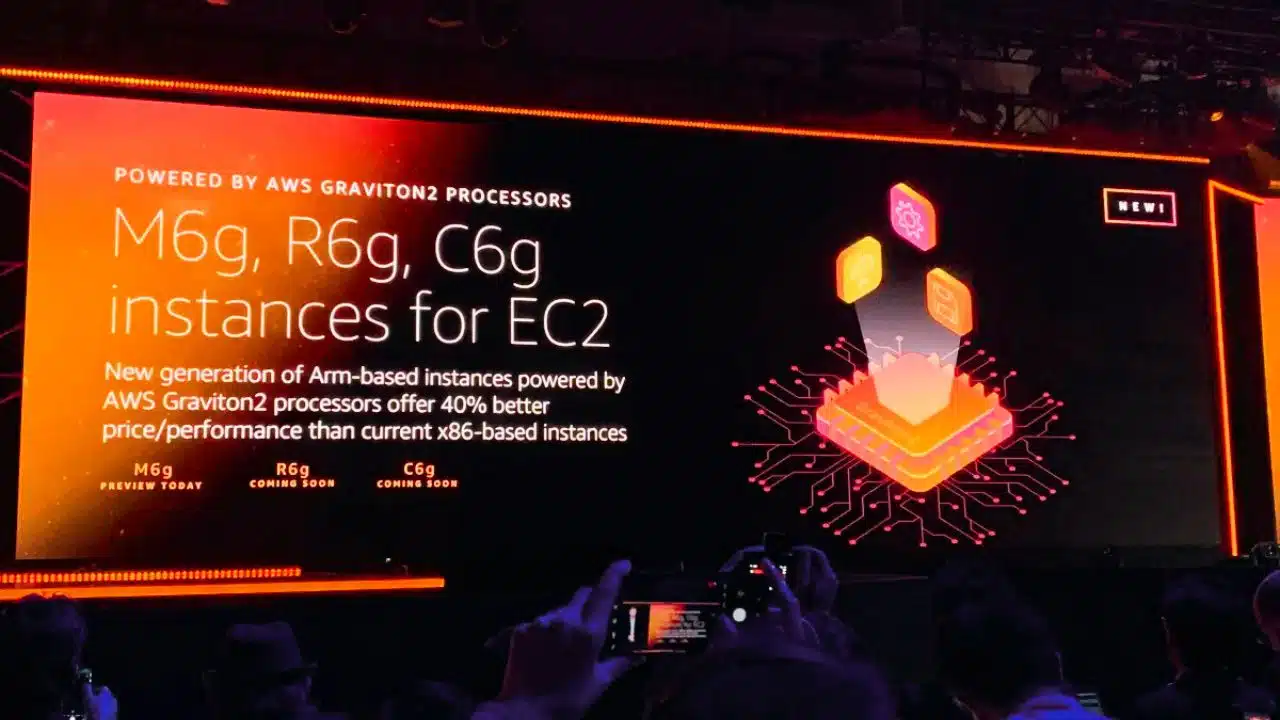
AWS unveiled the Graviton5 processor at re:Invent 2025, doubling the core count to 192 and promising up to 25% higher compute performance over the previous generation in new M9g EC2 instances.
What AWS announced
Amazon introduced Graviton5 as its most powerful and efficient Arm-based CPU to date, positioning it for a broad set of cloud workloads and highlighting improved performance, bandwidth, and energy efficiency. The chip was announced during AWS re:Invent 2025 (Dec 1–5) in Las Vegas, alongside preview availability of M9g instances built on Graviton5.
| Item | Detail |
| Event | AWS re:Invent 2025, Las Vegas (Dec 1–5) |
| Announcement | Graviton5 processor revealed as AWS’s most advanced CPU |
| Core count | 192 cores per chip (double Graviton4’s 96) |
| EC2 instances | M9g instances powered by Graviton5 (preview) |
| Headline gains | Up to 25% higher compute performance vs previous gen |
Inside the chip
Graviton5 is built on Arm Neoverse V3 and fabricated on TSMC’s 3 nm process, enabling high core density and improved efficiency in a single-socket design. AWS highlights a five-times larger L3 cache than before and up to 2.6x more L3 cache per core, with a total 192 MB L3 reported by technical coverage.
| Specification | Graviton5 |
| Architecture | Arm Neoverse V3 |
| Process node | TSMC 3 nm |
| Cores | 192 per package |
| L3 cache | 192 MB total; 5x larger than prior gen, 2.6x per-core cache |
| I/O | First AWS CPU with PCIe 6 support |
| Memory | Faster memory subsystem; 7200 MT/s today, support for 8800 MT/s in the works |
Performance and EC2 instances
AWS reports M9g instances deliver up to 25% higher compute performance than Graviton4-based M8g, alongside gains in network and storage bandwidth. The platform also targets lower inter-core latency—AWS cites up to a 33% reduction—which helps latency-sensitive workloads such as online gaming, high‑performance databases, EDA, and analytics.
| Area | Improvement |
| Compute | Up to 25% higher vs prior generation |
| Inter-core latency | Up to 33% lower |
| Network bandwidth | Up to 15% higher on average; up to 2x for largest instances |
| EBS bandwidth | Up to 20% higher on average |
| Target workloads | Real-time gaming, high-performance databases, analytics, application servers, EDA |
Market context and implications
By consolidating performance into a single socket with 192 cores, AWS reduces cross-socket latency seen in previous two-CPU M8g configurations, aiming for more consistent performance at scale. AWS says the higher core density and larger cache are designed to boost price-performance and energy efficiency, aligning with customers’ cost and sustainability goals. Industry outlets note Graviton5’s core count rivals top-tier x86 offerings—AMD at up to 192 cores and Intel at up to 144—while adding first-in-class PCIe 6 support in AWS compute.
| Topic | Snapshot |
| CPU landscape | Graviton5 at 192 cores; AMD up to 192; Intel up to 144 |
| Interconnect | AWS emphasizes single-socket design to minimize latency overhead |
| I/O evolution | First AWS CPU with PCIe 6 |
| Customer signals | Early reports from brands like Adobe and Airbnb cite performance gains |
Security and platform notes
Coverage indicates Graviton5 includes default memory encryption and support for Arm Confidential Compute Architecture to isolate workloads at the hardware level. AWS also notes improvements in network and storage subsystems across instance sizes, with the largest configurations offering the most significant bandwidth headroom.