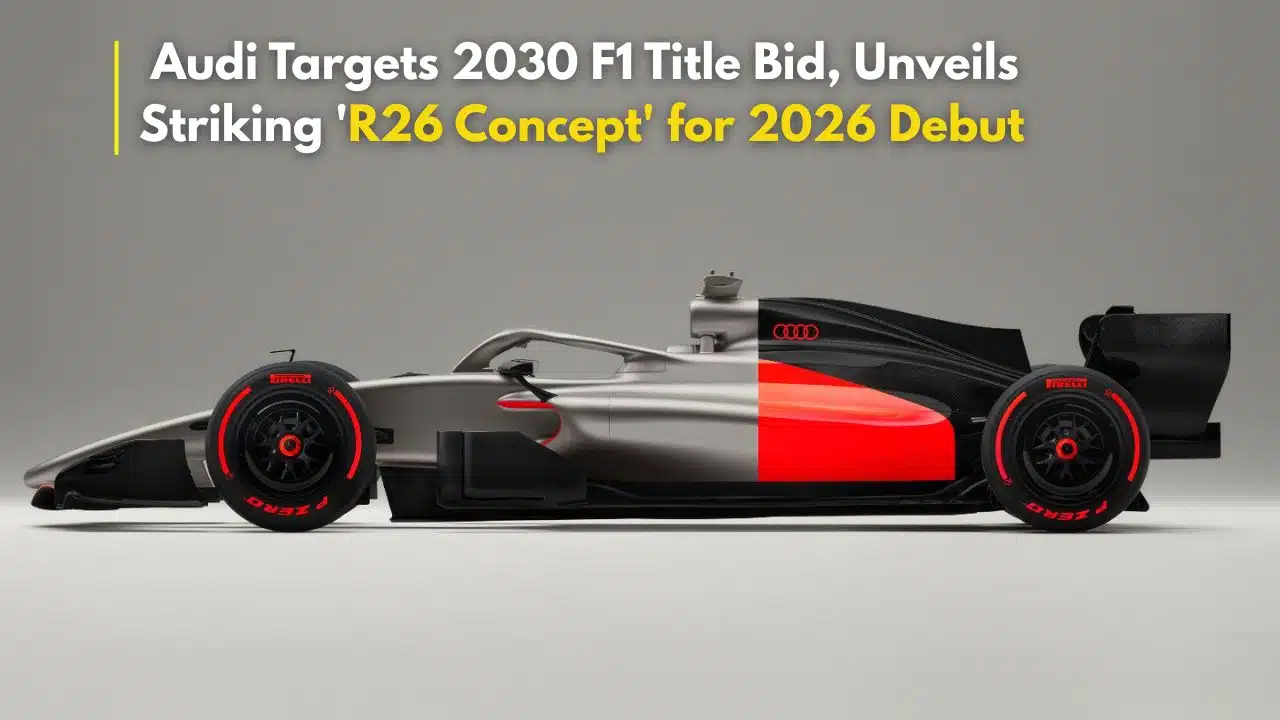
Audi has drawn a definitive line in the sand, officially targeting an Audi 2030 F1 Title Bid at a high-profile launch event in Munich. The German automotive giant simultaneously unveiled the “R26 Concept,” a striking preview of its 2026 Formula 1 challenger, signalling the depth of its commitment to conquering the pinnacle of motorsport.
The reveal, held Wednesday, November 12, 2025, at the Audi Brand Experience Center, ends years of speculation and marks the most significant milestone to date in Audi’s ambitious F1 project. CEO Gernot Döllner, flanked by the team’s new leadership, presented a clear, albeit challenging, roadmap: Audi is not just joining the grid; it is joining to win.
Key Facts & Quick Take
- The Goal: Audi CEO Gernot Döllner has officially stated the team’s ambition is to “fight for the World Championship title” by 2030.
- The Car: The “R26 Concept” was unveiled, showcasing a new design identity. It is a concept livery on a show car, with the final 2026 race car set for a January 2026 launch.
- The Debut: The official Audi F1 team (currently operating as Sauber) will make its debut at the Australian Grand Prix in Melbourne on March 6-8, 2026.
- The Team: The project is led by COO/CTO Mattia Binotto (formerly Ferrari) and Team Principal Jonathan Wheatley (formerly Red Bull).
- The Drivers: The confirmed 2026 driver lineup consists of veteran Nico Hülkenberg and rookie Gabriel Bortoleto, who are driving for the Sauber team in 2025.
- The Takeover: This is a full-factory effort. Audi completed a 100% acquisition of the Sauber Group (based in Hinwil, Switzerland) in March 2024.
A Statement of Intent: The 2030 Title Target
In a statement of unambiguous intent, Audi CEO Gernot Döllner set a concrete timeline for the brand’s Formula 1 ambitions.
Döllner framed the multi-billion dollar F1 entry as a “catalyst for the change towards a leaner, faster, and more innovative Audi,” linking the project directly to the company’s core “Vorsprung durch Technik” (Advancement through Technology) philosophy.
This 2030 timeline is seen by analysts as both ambitious and realistic. It provides the team with a four-season runway (2026-2029) to build infrastructure, optimize its power unit, and become a front-running contender before mounting a full-scale championship assault in its fifth year.
Mattia Binotto, the team’s Chief Operating and Chief Technical Officer, echoed this sentiment. “The goal is clear: to fight for championships by 2030,” Binotto said. “That journey takes time, the right people and a mindset of continuous improvement.
Introducing the R26: A ‘Pioneer’ for the Brand
While the actual 2026 race car remains under development, Audi unveiled the R26 Concept to showcase the team’s visual identity.
The concept livery is a departure from traditional motorsport designs, featuring minimalist geometric surfaces and a striking palette of titanium, carbon black, and a new “Audi Lava Red.” In a significant brand move, Audi’s iconic four rings will appear in red for its F1 presence, rather than the traditional chrome or white.
Audi’s Chief Creative Officer, Massimo Frascella, described the F1 project as a “pioneer for the new brand identity,” which is based on four principles: “clear, technical, intelligent and emotional.”
The car, which will be formally launched in January 2026, will be backed by title sponsor Revolut, with Adidas and bp also confirmed as major partners.
A New ‘Dream Team’ and 100% Control
Audi has spent the last 18 months aggressively restructuring its F1 operations, culminating in a formidable new leadership structure.
The Management
The project is now firmly in the hands of two of F1’s most respected figures:
- Mattia Binotto (COO/CTO): The former Ferrari Team Principal was brought on in July 2024 to oversee the entire technical and operational project from both Hinwil and Neuburg.
- Jonathan Wheatley (Team Principal): Poached from Red Bull Racing, Wheatley brings championship-winning operational and sporting expertise to the day-to-day trackside team.
This structure was put in place after a decisive management shuffle in mid-2024 that saw the departure of former CEO Andreas Seidl, signaling Audi’s board-level decision to install its hand-picked leaders for the long-term project.
The 100% Takeover
Critically, Audi confirmed its entry is not a mere partnership or engine supply deal. The company accelerated its plans and completed a 100% acquisition of the Sauber Group in March 2024.
This complete takeover gives Audi full control over its destiny, integrating chassis and engine development—a strategy considered essential for championship success in F1’s modern era.
The Driver Lineup
The team’s 2026 driver pairing is already locked in, providing stability.
- Nico Hülkenberg (Germany): The experienced veteran was signed on a multi-year deal and is racing with the Sauber team in 2025, embedding him in the Hinwil operation a full year before the Audi rebrand.
- Gabriel Bortoleto (Brazil): The highly-rated F2 champion and rookie will partner Hülkenberg in 2025 and 2026, representing the “youth” portion of the team’s strategy.
The ‘Made in Germany’ Powertrain: A Three-Pillar Operation
Audi’s strategy is built on a complex, three-site operational plan, a necessity to compete with established giants like Mercedes, Ferrari, and Red Bull Powertrains.
1. The 2026 Technical Challenge
The 2026 regulations are a key reason for Audi’s entry. The new rules mandate a new hybrid power unit (PU) with a radically different split:
- Engine: A 1.6-liter V6 turbocharged internal combustion engine (ICE).
- Electric: A vastly more powerful electric motor (MGU-K) delivering approximately 400 kW (544 hp).
- Power Split: The new rules create a nearly 50/50 split between ICE and electric power, a massive increase in electrification.
- Fuel: The PUs must run on 100% sustainable e-fuels, a technology Audi is developing with partner bp.
2. The Three-Site Strategy
Audi is developing its F1 car across three specialized locations:
- Neuburg an der Donau, Germany: This is the “heart” of the operation. Audi’s Competence Center Motorsport is developing and building the entire power unit, including the V6 engine, electric motor, battery, and gearbox. This makes it the only F1 power unit being built in Germany.
- Hinwil, Switzerland: The existing, state-of-the-art Sauber factory. This team is responsible for the chassis design, development, build, and all trackside race operations.
- Bicester, UK: Audi has established a new “Technology Office” in the heart of the UK’s “Motorsport Valley.” This move is designed to attract and employ top F1 engineering talent from the UK-based F1 cluster, ensuring Audi does not miss out on key personnel.
The Road to 2026: Key Milestones
The timeline from concept to competition is now incredibly tight. Audi’s development, which began in 2022, achieved a major milestone earlier this year when the full powertrain (engine, motor, and gearbox) ran dynamically for the first time in a race simulation on the test bench.
The next steps are:
- December 2025: First race-ready power units to be shipped from Neuburg.
- January 2026: Official team launch and unveiling of the final 2026 race car.
- End of January 2026: First closed-door shakedown and test session in Barcelona, Spain.
- February 11–13 & 18–20, 2026: Official public pre-season testing in Bahrain.
- March 6–8, 2026: First-ever Grand Prix: The Australian Grand Prix in Melbourne.
Analysis: Why the F1 Cost Cap Makes This ‘Economically Sensible’
For decades, F1 was a financially ruinous endeavor for auto manufacturers. However, Audi’s entry comes at a time of profound change for the sport’s economics.
Audi CFO Jürgen Rittersberger stated that the F1 project “makes perfect sense for Audi – also economically.” The key reason is the FIA Cost Cap, which limits how much teams can spend, preventing the uncontrolled spending wars of the 2000s.
Rittersberger also cited F1’s “enormous reach” as a primary driver. The sport attracted over 820 million fans and 1.6 billion TV viewers in 2024, providing a global platform to attract new, younger customers to the Audi brand.
While the 2030 goal is distant, Audi’s presentation was one of meticulous, long-term planning. The company has secured the funding, acquired the facilities, hired the leadership, and now set the target. The message from Munich is clear: Audi is not just coming to race; it is building a German-engineered dynasty to take on the world.