
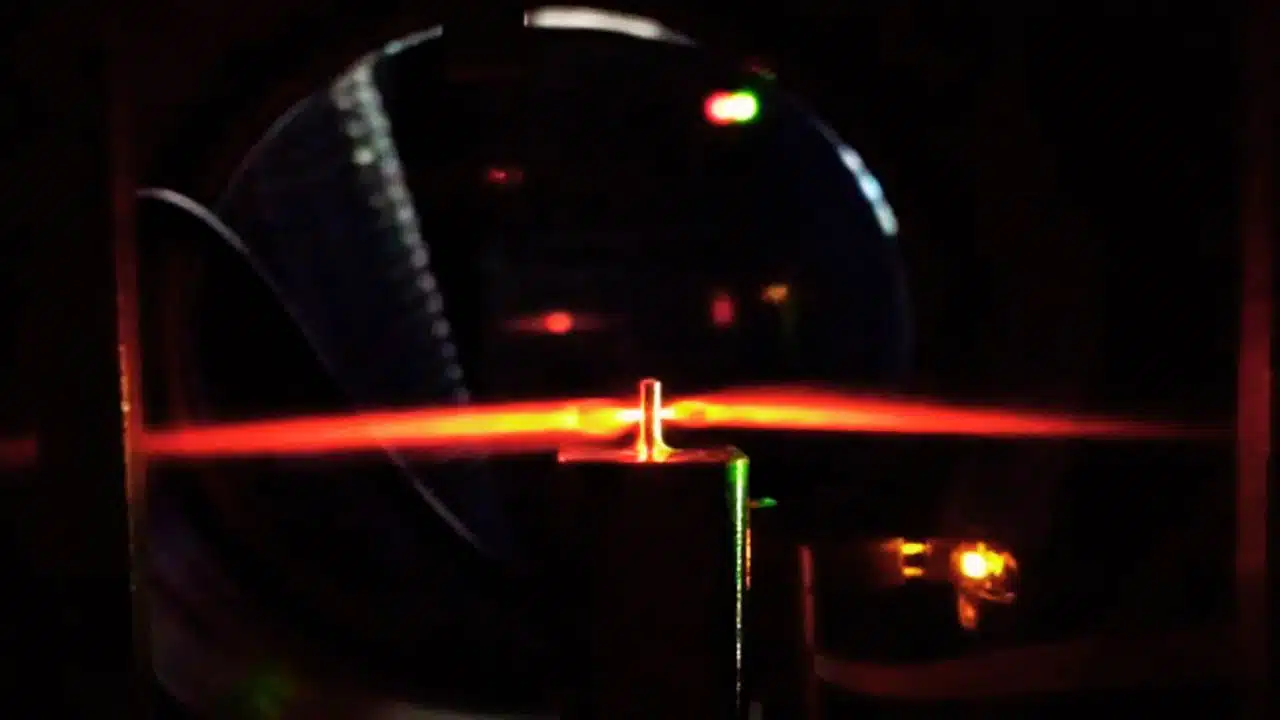
Researchers in Spain report a record 19.2-attosecond soft X-ray attosecond pulse—shorter than the atomic unit of time—aimed at capturing electron motion, as the result sparks a public debate over how the pulse was measured.
In a development that pushes ultrafast science deeper into the realm where electrons move and interact, a team at ICFO (Institut de Ciències Fotòniques) in Spain has reported a 19.2-attosecond soft X-ray light pulse—an interval so short that it is below the atomic unit of time (24.2 attoseconds).
The work is notable not only for the claimed record duration, but also because it aims at the soft X-ray “water window” region, prized for element-specific probing of carbon, nitrogen, and oxygen—key building blocks in chemistry, biology, and materials.
At the same time, the result has triggered a technical dispute in the community: a separate researcher published a formal critique raising questions about experimental and analysis choices, followed by a detailed reply defending the original approach.
What was achieved, and why the attosecond pulse matters
An attosecond pulse is a burst of light lasting on the order of 10⁻¹⁸ seconds. In that time, electrons can move, scatter, and reorganize—processes that set the pace for chemical reactions, energy transfer in biomolecules, and many material properties.
The newly reported 19.2-attosecond soft X-ray pulse is presented as an “isolated” pulse (a single burst rather than a repeating train) with a spectrum centered at 243 eV, extending to 390 eV, and crossing the carbon K-edge (284 eV)—a key threshold for carbon-specific spectroscopy.
Because core-level (inner-shell) transitions are element-specific, soft X-ray attosecond tools can enable site- and element-selective measurements of ultrafast dynamics in complex systems.
Key numbers at a glance
| Metric | Reported value |
| Pulse duration | 19.2 attoseconds |
| Atomic unit of time (reference) | 24.2 attoseconds |
| Spectrum (center / max) | 243 eV / 390 eV |
| Carbon K-edge | 284 eV |
| Total photon flux (overall) | 4.8 × 10¹⁰ photons/s |
| Photon flux near carbon edge (10% bandwidth) | 4.1 × 10⁹ photons/s |
These figures are reported in the study and reiterated in the public discussion around it.
How the pulse was generated: high-harmonic generation in neon
The reported pulse is tied to high-harmonic generation (HHG)—a well-established method where an intense laser drives a gas to emit much higher-frequency light (extending into X-rays under the right conditions).
In the described setup, the team used a neon-based HHG target under high pressure and high intensity conditions:
- The high-energy pulse was focused to about 54 µm, reaching roughly 4.3 × 10¹⁴ W/cm².
- The HHG medium involved neon with a stated backing pressure of 3.5 bar, with an interaction region shorter than 1 mm (and additional discussion elsewhere in the debate referencing millimeter-scale propagation conditions).
The broader goal: generate a coherent soft X-ray burst that is both ultrashort and spectrally broad—useful for time-resolved spectroscopy around absorption edges.
How the pulse was measured: “attosecond streaking” and a new retrieval method
Creating an ultrashort pulse is only half the challenge. The other half is measuring its temporal profile.
The work relies on attosecond streaking, a technique where a synchronized infrared field “streaks” (shifts) the energies of photoelectrons created by the X-ray pulse, producing a trace that can be inverted to reconstruct the pulse timing.
A central claim in the debate is that the 19.2-as value emerged from a refined re-analysis of streaking data using a newer reconstruction approach called Variational Phase Gradient Temporal Analysis (VPGTA).
This matters because pulse retrieval in the soft X-ray regime becomes harder as bandwidth grows—small modeling choices can strongly affect the reconstructed duration.
The “where” and “when”
- Where: ICFO (Barcelona area, Spain) is the main institution listed for the work.
- When: The main preprint describing the 19.2-as pulse is dated and posted in October 2025, while the critique and reply appeared as separate public documents in October 2025 and November 2025.
- The journal-linked announcement states the work is associated with Ultrafast Science and provides a DOI for the published version.
The challenge: a public critique questions the measurement
After the 19.2-as claim circulated, a critique argued that several physical and technical factors could undermine the retrieval, especially if not properly accounted for.
Main concerns raised
The critique highlights (among other issues):
- Potential contamination from low-energy harmonics that could ionize krypton valence orbitals and overlap spectrally with inner-shell photoelectrons.
- Intrinsic pulse “chirp” (frequency-time structure) expected in HHG pulses, with skepticism that the retrieved pulse could be nearly chirp-free without filtering or explicit compensation.
- A claimed mismatch between measured and retrieved streaking traces, suggesting the reconstruction might be overly idealized.
- Auger electrons (from inner-shell ionization) as a potentially non-negligible contribution in the relevant energy ranges, which could complicate retrieval.
- Questions about photon-flux calibration, including an argument that accurate flux measurement typically requires filtering out residual driving laser light.
The critique also emphasizes that extracting ~20-as durations from streaking traces can be extremely demanding because the signatures distinguishing ultra-short from much longer chirped pulses may be subtle.
The response: authors say the critique misreads the experimental regime
In their reply, the original authors argue that the critique’s objections do not apply under their high-pressure soft X-ray HHG conditions and that some concerns arise from applying assumptions from different regimes.
Key points of the reply
- Reabsorption at high pressure: The reply argues that under high-pressure generation conditions, lower-energy harmonics are strongly absorbed in the medium, reducing the likelihood that unfiltered low-energy components dominate the measured signal the way the critique suggests.
- Orbital access and cross sections: The reply notes that krypton’s 3d orbital requires photon energies above 94 eV and asserts that in the relevant energy range, the 3d cross section can exceed valence contributions significantly.
- Chirp arguments: The reply contends that quoting isolated “attochirp” numbers without macroscopic propagation context is misleading, since the experimentally observed pulse reflects both microscopic and propagation/phase-matching effects.
- Flux “discrepancy” framing: The reply argues that comparing flux values integrated over different bandwidths can create an apparent mismatch that is not physically meaningful.
In short, the authors maintain that the data, retrieval, and calibration are internally consistent for the conditions used and that the 19.2-as claim stands.
Why the “water window” target is strategically important
The study repeatedly emphasizes that reaching into the soft X-ray water window is valuable because it enables element-specific spectroscopy at absorption edges central to organic and biological matter.
In the paper’s framing, combining:
- very short duration (time resolution), and
- broadband coherent soft X-ray spectrum (spectroscopic reach)
could support new measurements of many-body electron dynamics, non-adiabatic energy flow, and correlated materials behavior, among other use cases.
Separately, an institutional highlight about the work points to applications across physics, chemistry, biology, and quantum materials—while also noting that earlier soft X-ray attosecond techniques have already been used to probe dynamics in solids and molecules.
What happens next: how the field typically resolves disputes like this
In attosecond science, record claims often hinge on metrology robustness—especially when durations approach fundamental limits like the atomic unit of time.
Practically, the community tends to look for:
- independent reproduction (ideally by multiple groups),
- cross-validation with alternative retrieval methods, and
- additional diagnostics (spectral measurements, calibration details, controlled filtering tests where feasible).
For readers outside the field, the key point is that the argument is not about whether attosecond soft X-ray pulses exist—they do—but about whether the specific retrieved duration (19.2 as) is uniquely supported by the measurements and analysis under the stated conditions.
Final Thoughts
The reported 19.2-attosecond attosecond pulse marks an ambitious push toward observing electron dynamics at their natural timescale, with soft X-ray coverage that can target carbon-edge phenomena central to chemistry and materials.
At the same time, the rapid back-and-forth critique and reply underscores a core reality of frontier measurement science: at extreme limits, how you measure can be as contentious—and as important—as what you generate.