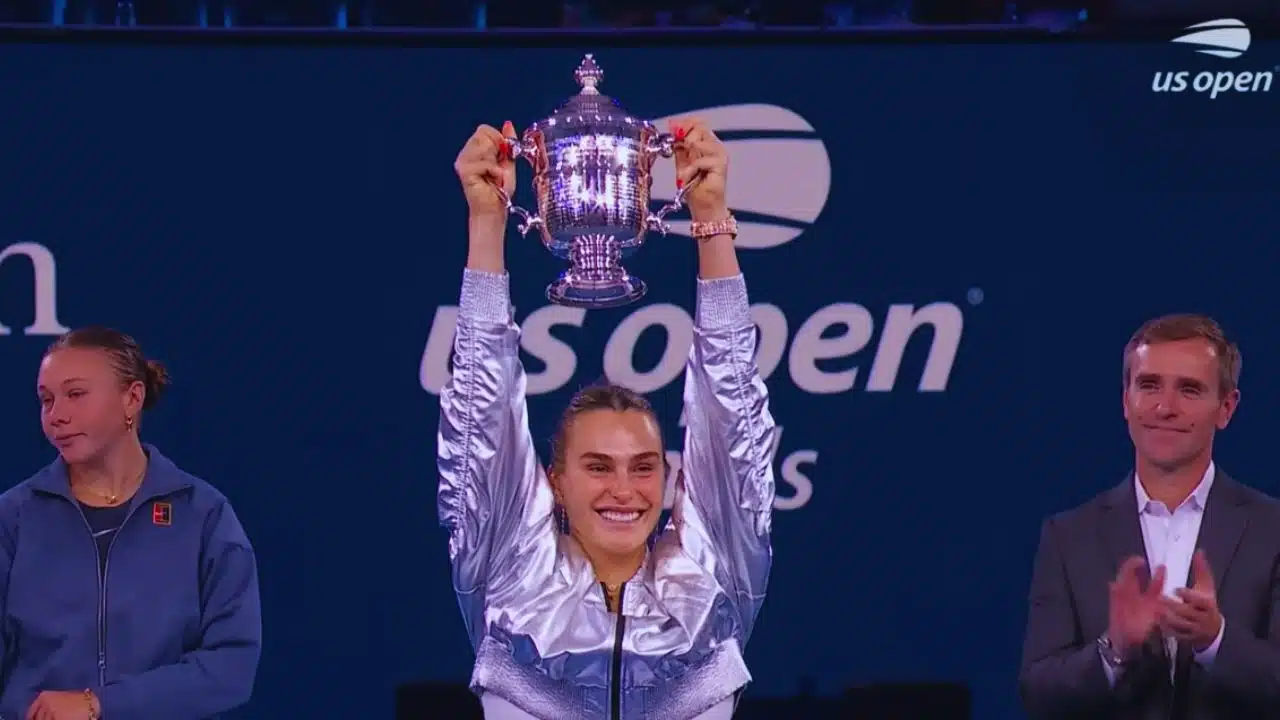
Aryna Sabalenka, the world No. 1 and one of the most dominant forces in women’s tennis today, etched her name even deeper into the history books by claiming her second consecutive US Open title on Saturday night in New York. Playing inside a closed-roof Arthur Ashe Stadium due to heavy rain, Sabalenka defeated American star Amanda Anisimova in straight sets, 6-3, 7-6 (3), to secure the trophy once again.
With this victory, Sabalenka became the first woman since Serena Williams (2012–14) to successfully defend the US Open crown. She also joined an elite group of only 10 women in tennis history to win the championship in consecutive years, alongside names like Margaret Court, Billie Jean King, Chris Evert, Martina Navratilova, Steffi Graf, Monica Seles, Venus Williams, Kim Clijsters, and Serena Williams herself.
The Match: Power, Patience, and Composure
Sabalenka’s Early Struggles
The final didn’t begin easily for Sabalenka. Known for her explosive serve and forehand, she initially struggled to dominate with those weapons. Anisimova, urged on by the home crowd, was quick to pounce. She chased down every shot, pushed Sabalenka deep behind the baseline, and countered with precision groundstrokes.
For a moment, it looked as though the 24-year-old American might flip the script and deliver a stunning upset. Her forehand winners, often aimed into the corners, repeatedly left Sabalenka scrambling. Her backhand slices also landed just inside the lines, frustrating the Belarusian champion.
Adjustments and Control
But Sabalenka, who in the past has been vulnerable to letting emotions overwhelm her, showed newfound composure. Instead of forcing the power game when it wasn’t working, she began adjusting her shot selection. She mixed in clever drop shots and angled slices that disrupted Anisimova’s rhythm, drawing errors and opening the court for finishing strikes.
The strategy worked. By the midpoint of the first set, Sabalenka had steadied herself. She broke Anisimova’s serve at a critical moment, maintained her lead, and closed out the set 6-3 with authority.
A Battle of Nerves in the Second Set
Anisimova’s Fightback
The second set brought out the most drama of the night. Anisimova, refusing to surrender in front of a supportive crowd, raised her level. She struck winners from both wings and managed to break Sabalenka’s serve, erasing what had seemed like a comfortable lead. At 5-3, Sabalenka looked ready to close out the match — but Anisimova stormed back, winning three consecutive games to suddenly hold a 6-5 advantage.
The atmosphere inside Arthur Ashe was electric. The closed roof amplified every cheer, and for the first time, it seemed the momentum had swung to the American’s side.
The Defining Tiebreak
Facing the possibility of losing the set, Sabalenka displayed the mental toughness that has transformed her from a fiery talent into a two-time US Open champion. Serving at 5-6 to stay in the set, she delivered a blistering wide serve that Anisimova couldn’t return over the net. That hold forced a tiebreaker.
What followed was vintage Sabalenka. She dominated the breaker with precise serving, aggressive baseline shots, and confident movement. Anisimova, in contrast, unraveled under the pressure. The same forehand and backhand shots that landed on the lines earlier began flying long or clipping the net. The final point saw Anisimova push a return wide, handing Sabalenka the tiebreak 7-3 — and with it, the championship.
The Numbers Behind the Victory
- Unforced Errors: Perhaps the most telling statistic — Anisimova committed 29 unforced errors, while Sabalenka limited herself to just 15. The disparity underscored how discipline and consistency ultimately decided the outcome.
- Tiebreak Record: Sabalenka extended her incredible record in tiebreakers this season to 21-1, showing why opponents fear her in clutch moments.
- Grand Slam Milestone: This was Sabalenka’s fourth Grand Slam title overall and her 100th career Grand Slam match win, a milestone that places her firmly among the greats of the modern game.
Anisimova’s Brave Effort
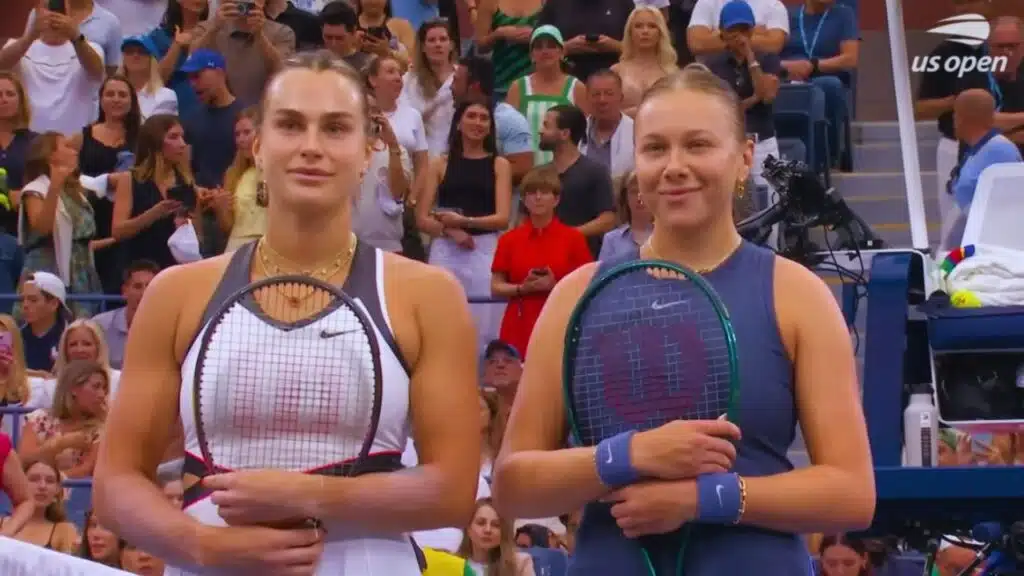
While the defeat was painful, Amanda Anisimova left the court with her head held high. At just 24, she reached her second Grand Slam final of the season (after Wimbledon 2025), signaling her return to the top tier of women’s tennis after earlier struggles with injuries and personal challenges.
For much of the match, she matched Sabalenka blow for blow, showcasing the shot-making talent that once made her a teenage prodigy. Her resilience in rallying from a 3-5 deficit in the second set won her admiration from fans and peers alike, even if she couldn’t finish the job in the tiebreak.
Projected to rise to World No. 4 after this tournament, Anisimova’s resurgence is one of the most compelling storylines of the year.
The Atmosphere: A Closed Roof and High Emotions
The match was played under unique conditions, with the roof at Arthur Ashe Stadium closed due to rain. Some believed the enclosed setting would favor Anisimova, amplifying the cheers of the American crowd. However, Anisimova later complained that the stadium lights from the roof interfered with her ball toss during serves.
Despite those frustrations, the crowd remained electric, roaring for every point she won and testing Sabalenka’s nerves. Yet, as champions do, Sabalenka found a way to silence the noise by letting her racquet do the talking.
Celebration and Legacy
When the final point was struck, Sabalenka fell to her knees, overcome with joy. She soon jumped into the stands to embrace her team and her boyfriend, Georgios Frangulis, in a celebratory kiss. Later, in a moment that has become her trademark, she playfully slapped her coach’s bald head while celebrating with champagne.
In her victory speech, Sabalenka was gracious. She acknowledged the “tough lessons” she had learned from previous defeats and reminded Anisimova that her time would come:
“When you win your first one, you’re going to win many more.”
Her words reflected the maturity of a player who has grown from an emotional competitor into a composed champion.
Why This Win Matters
- Hard-Court Dominance: All four of Sabalenka’s Grand Slam titles have now come on hard courts, solidifying her as the most dangerous player on this surface in the current era.
- Consistency at the Top: With her successful defense of the title, Sabalenka further cements her position as World No. 1, ahead of rivals like Iga Świątek and Coco Gauff.
- A Defining Rivalry?: With Anisimova returning to form and pushing Sabalenka hard in a Slam final, this matchup could be the beginning of a compelling rivalry in women’s tennis.
The 2025 US Open women’s final was more than just a championship match. It was a battle of skill, nerves, and resilience. Aryna Sabalenka’s ability to adapt, stay calm, and execute in the biggest moments is what separaAryna Sabalenka Wins 2025 US Open Finaltes champions from challengers.
For Amanda Anisimova, this final might sting now, but it signals that her comeback is real and her potential is far from fulfilled.
As the tennis world looks ahead, Sabalenka’s back-to-back triumphs make it clear: she is not just at the top — she is setting the standard.
The Information is Collected from CNBC and Yahoo.