In the grand theater of international football, few events outside of the World Cup itself can command the global spotlight. The upcoming Finalissima, scheduled for March 2026, is precisely one of those events. This is not a mere friendly. It is a heavyweight clash for bragging rights, a tactical proving ground, and the ultimate barometer of world football supremacy.
CONMEBOL and UEFA have confirmed that the champions of South America, Argentina, will face the champions of Europe, Spain, for the “Champion of Champions” crown. The setting? A place of footballing legend: the Lusail Stadium in Doha, Qatar—the very arena where Lionel Messi and Argentina were immortalized as World Cup winners in 2022.
Staged just three months before the 2026 FIFA World Cup, this match is a tantalizing prelude to the main event. It’s a battle of footballing philosophies, a clash of generations, and a psychological test where the winner will be marked as the definitive team to beat.
The Narrative-in-Chief: The Master vs. The Prodigy
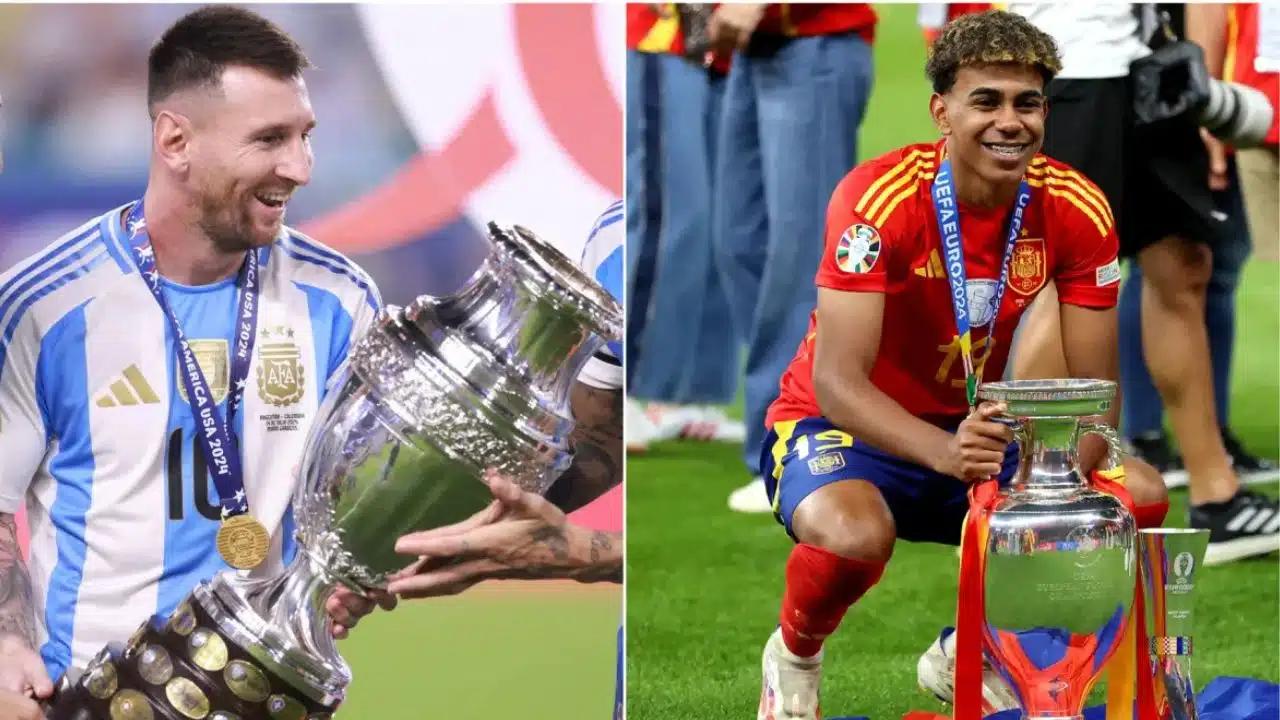
Football is driven by stories, and this match presents the most compelling one possible: Lionel Messi vs. Lamine Yamal.
It is a narrative that writes itself. Messi, the undisputed legend and Barcelona’s greatest-ever player, will (barring injury) lead his world-champion Argentina. On the other side is Lamine Yamal, the 18-year-old phenom who inherited Messi’s shirt number at Barcelona and spectacularly led Spain to Euro 2024 glory.
For Messi, it is another opportunity to burnish his legacy, to prove that his era of dominance, which now includes a Copa América, a Finalissima, and a World Cup, is not yet over. For Yamal, it is the ultimate test. A decisive performance against the master himself on an intercontinental stage would be more than a passing of the torch; it would be a coronation, anointing him as the sport’s next global ruler.
Tactical Chessboard: Scaloni’s Grit vs. De la Fuente’s New-Era Flair
This match is a fascinating collision of two of the world’s sharpest coaching minds.
Argentina (Lionel Scaloni): Scaloni has forged a team in his own image: pragmatic, flexible, and utterly ruthless. Gone are the days of a top-heavy, disjointed Albiceleste. Scaloni’s Argentina is a transition-based powerhouse. They are comfortable in a 4-3-3, a 4-4-2, or a 4-2-3-1, and they excel at two things: pressing suffocatingly as a unit the instant they lose the ball and launching vertical, lightning-fast counterattacks when they win it back. The grit of players like Rodrigo De Paul and Enzo Fernández provides the platform for Messi’s magic.
Spain (Luis de la Fuente): De la Fuente has successfully evolved Spain from its dogmatic “Tiki Taka” possession. While they still prize the ball, this La Roja is vertical, direct, and devastatingly fast. The key is their two “wing-wizards,” Lamine Yamal on the right and Nico Williams on the left. Unlike past Spanish teams that passed opponents to death, this side seeks to create 1-v-1 situations for their wingers, who can either cut inside to shoot or drive to the byline. This is a far more aggressive and versatile Spanish side, anchored by the world’s best pivot, Rodri.
The Decisive Battleground: The Flanks
The match will almost certainly be won or lost on the wings. Spain’s primary strength is the aforementioned duo of Yamal and Williams. Argentina’s response to this threat will define the game.
Expect Scaloni to task his famously tenacious full-backs (like Nahuel Molina or Nicolás Tagliafico) with support from his indefatigable wide midfielders (like De Paul or Alexis Mac Allister). The duels of Nico Williams vs. Molina and Lamine Yamal vs. Tagliafico/Acuña will be brutal, tactical mini-battles. If Spain’s wingers are neutralized, Argentina’s path to victory becomes clear. If they are allowed to run rampant, Argentina’s defense will face a test it hasn’t seen since the 2022 World Cup final.
History as a Precedent: From Maradona’s Last to Messi’s First
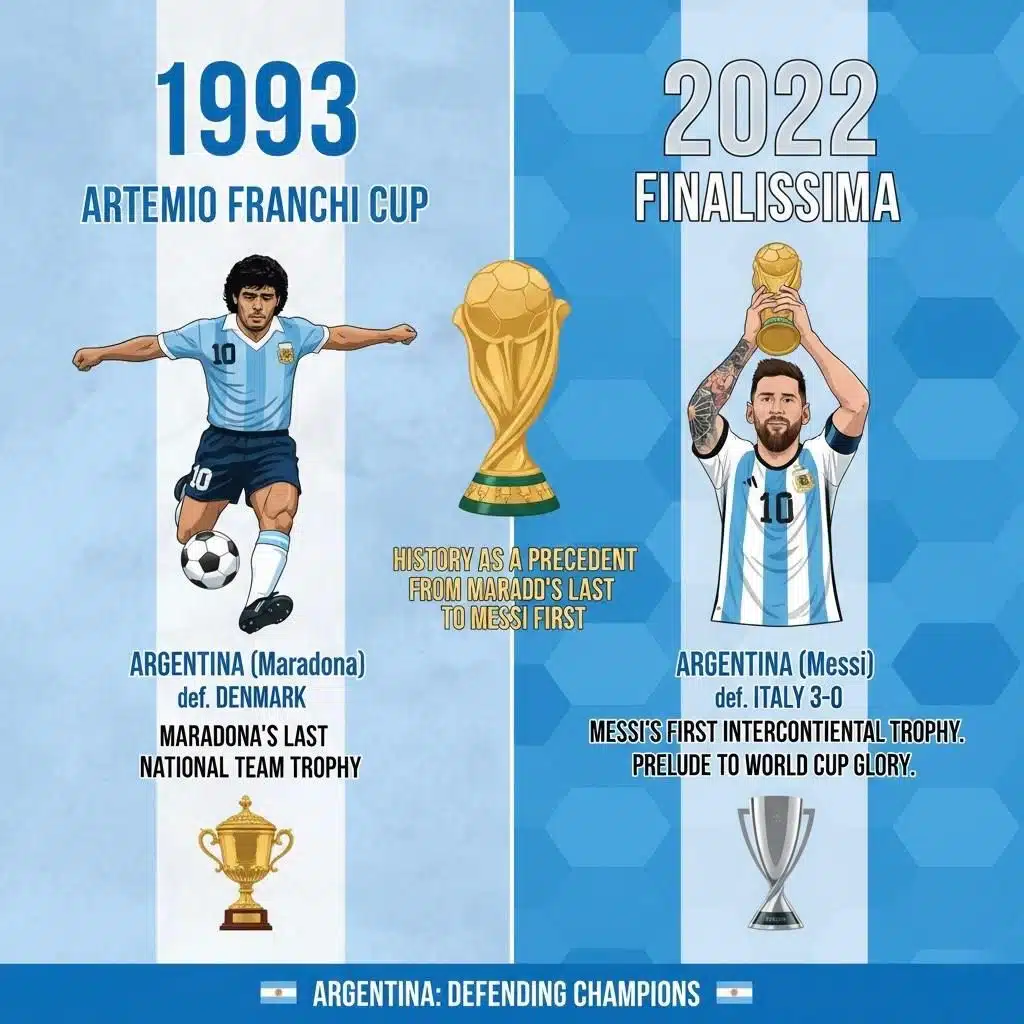
This trophy, revived in 2022, has a poignant history for Argentina.
1993 (Artemio Franchi Cup): The precursor to this match saw Argentina, led by Diego Maradona, defeat European champions Denmark. It was, significantly, the last national team trophy Maradona would ever win.
2022 (Finalissima): The reborn event saw Lionel Messi’s Argentina systematically dismantle European champions Italy 3-0 at Wembley. That match was no mere celebration; it was a statement of intent, a performance of such dominance that it announced Argentina as the clear favorites for the World Cup they would go on to win six months later.
Argentina sees this trophy as a significant part of its footballing heritage. They are the defending champions and will treat this match with the seriousness of a major final.
The Scheduling Caveat
There is one minor asterisk. The Finalissima is set for the March 2026 international window. That same window is reserved for the European World Cup qualifying play-offs. While Spain, as Euro champions, are overwhelming favorites to qualify directly for the World Cup, should an unthinkable series of results drop them into the playoff spots, this match would need to be postponed. All parties, however, are proceeding with the expectation that La Roja will secure their direct ticket, clearing the path for this showdown.
Final Verdict: More Than a Trophy
This is not an exhibition. For both teams, the 2026 Finalissima is the final, high-stakes dress rehearsal before the 2026 World Cup.
For Spain, it is a chance to prove their new, dynamic generation can topple the reigning world champions and enter the World Cup as the undisputed top contender. A win in Lusail would be a massive psychological coup.
For Argentina, it is a title defense, a return to their most sacred ground, and a chance to prove that the “Scaloneta” remains the most dominant force in global football.
In a sport often saturated with meaningless fixtures, this is the opposite. It’s a genuine super-cup between the two strongest confederations, a clash of styles, and a battle of generations. The winner in Doha will not just lift a trophy; they will carry the immense weight and momentum of being the “Champion of Champions” heading into the World Cup.