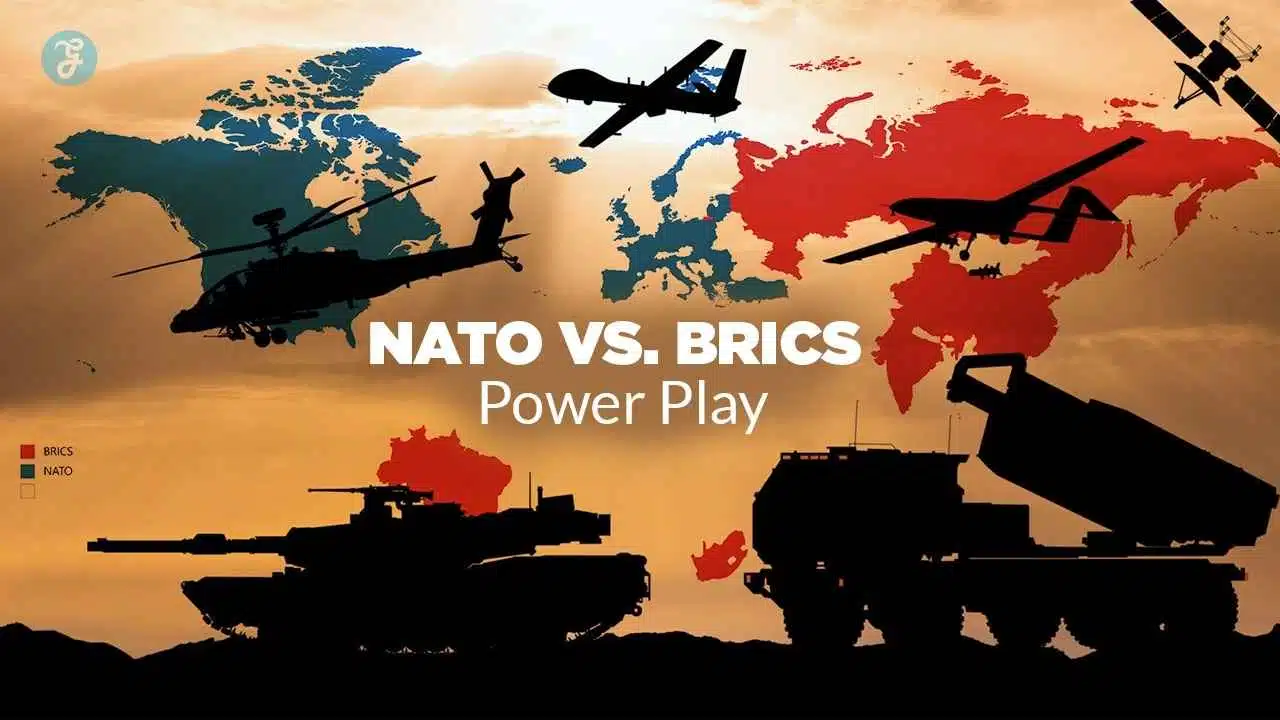
In early 2026, the Arctic has definitively ceased to be a zone of “low tension.” It is now the world’s most volatile geopolitical theater, bifurcated between a NATO-dominated “Arctic 7” constructing a formidable Northern Wall and a Russia-BRICS alliance actively operationalizing the Polar Silk Road. This analysis dissects the friction points, from the militarization of the Kola Peninsula to the resource race in Greenland, defining the new Cold War at the top of the world.
Key Takeaways
- Bipolar Arctic Reality: The region is no longer a global commons; it is split into two distinct operational theaters—the Euro-Atlantic (NATO) and the Eurasian-Pacific (Russia-China-India).
- The “Harbin Pivot”: The October 2025 Russia-China agreement to jointly commercialize the Northern Sea Route (NSR) marks the transition of Beijing from a “near-Arctic state” to a direct stakeholder in Arctic logistics and security.
- NATO’s “Sensor-to-Shooter” Grid: The accession of Sweden and Finland has allowed NATO to integrate air and naval defenses across the Nordic cap, creating a unified “Northern Wall” that challenges Russia’s ability to project power from Murmansk.
- Greenland as Ground Zero: The race for critical minerals has moved from commercial speculation to state-backed security strategy, with the U.S. Export-Import Bank directly financing projects to counter Chinese influence in rare earth supply chains.
- Institutional Zombie: The Arctic Council, currently under Danish Chairship (2025–2027), exists in name only. High-level diplomacy has evaporated, leaving dangerous gaps in climate monitoring and crisis communication.
Contextual Background: The Death of Arctic Exceptionalism
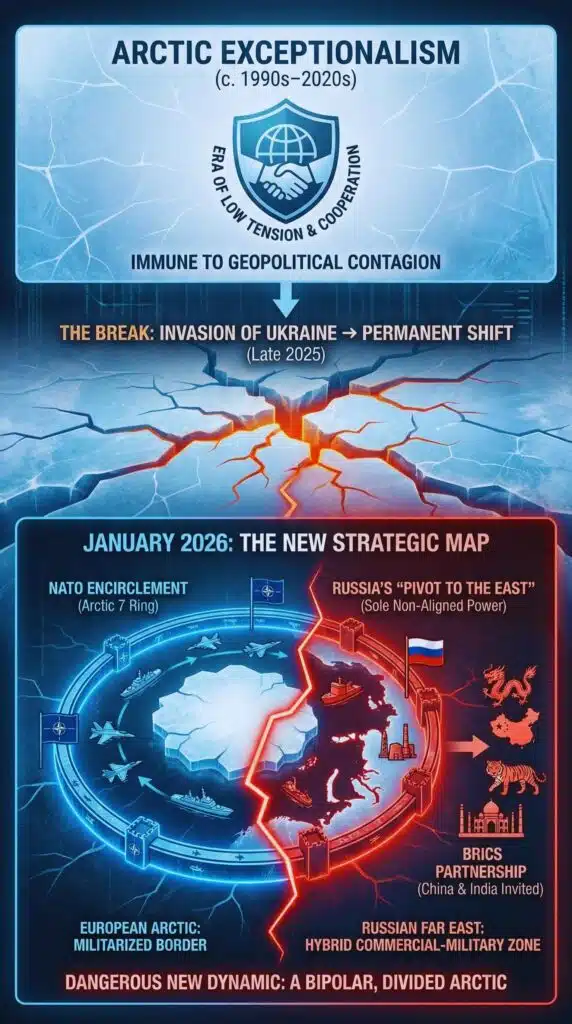
For thirty years following the Cold War, the Arctic was governed by the mantra of “Arctic Exceptionalism”—the notion that the High North was immune to the geopolitical contagion plaguing the rest of the globe. That era is dead. The collapse began with the invasion of Ukraine but solidified into a permanent structural shift by late 2025.
By January 2026, the strategic map has been completely redrawn. The Arctic Ocean is now ringed by NATO members, leaving Russia as the sole non-aligned littoral power. This encirclement has forced Moscow to abandon its hesitation regarding Chinese involvement in the Arctic. Deprived of Western technology and capital for its massive LNG projects, the Kremlin has executed a “Pivot to the East,” inviting BRICS nations—specifically China and India—to become active participants in Arctic development. The result is a dangerous new dynamic: a militarized border in the European Arctic and a hybrid commercial-military zone in the Russian Far East.
The Militarization of the Melt: NATO’s “Northern Wall” vs. The Kremlin’s Bastion
The accession of Sweden and Finland to NATO has fundamentally altered the military calculus of the High North. For the first time in history, the alliance can treat the entire Nordic region as a single, integrated operational space. This “Nordic Fortress” is not merely defensive; it is designed to bottle up Russia’s Northern Fleet before it can reach the Atlantic gap.
The “Ice Curtain” and Integrated Defense
The “Nordic Response” exercises conducted in late 2025 were a watershed moment. Unlike previous drills that focused on individual national borders, these exercises tested the seamless movement of heavy armor and air assets across the Norwegian, Swedish, and Finnish frontiers. The reactivation of the Bardufoss Air Station in Norway and its integration with Swedish air bases has created a dense air-defense network. NATO’s strategy is now predicated on a “sensor-to-shooter” grid, where a Finnish radar can track a Russian missile launch from the Kola Peninsula and feed targeting data to a U.S. destroyer in the Norwegian Sea or a battery of Patriot missiles in Sweden.
Russia’s “Bastion” Strategy
Moscow views this NATO consolidation as an existential threat to its nuclear deterrent. The Kola Peninsula is home to the Northern Fleet and the bulk of Russia’s sea-based nuclear second-strike capability. In response to NATO’s expansion, Russia has accelerated the refurbishment of Soviet-era bases along its entire Arctic coastline. Intelligence reports from late 2025 indicate the deployment of new hypersonic missile batteries capable of striking NATO command centers in the Nordics within minutes. Russia’s strategy is one of Anti-Access/Area Denial (A2/AD)—creating a “bubble” of denial that makes entering the Barents Sea suicidally dangerous for NATO surface vessels.
Strategic Assets Balance (2026 Estimates)
| Asset Class | NATO (Arctic 7) | Russia | Strategic Implication |
| Icebreakers | ~45 (Mostly non-nuclear) | ~55 (Incl. 13+ Nuclear) | Russia dominates deep-ice access; NATO relies on “blue water” projection and seasonal access. |
| Air Defense | Integrated (F-35 joint fleet) | Layered A2/AD (S-400/S-500) | NATO has superior 5th-gen air superiority; Russia has superior ground-based denial bubbles. |
| Submarines | High Quality (US/UK/France) | High Tonnage (Northern Fleet) | NATO focuses on sub-hunting (ASW) to protect Atlantic convoys; Russia protects the “Bastion.” |
| Command | Joint Force Command Norfolk | Northern Fleet Command | NATO is shifting to a unified regional command; Russia maintains centralized control from Moscow. |
The New Silk Road on Ice: BRICS and the Northern Sea Route
While the European Arctic is defined by hard security, the Russian Arctic is defined by a geoeconomic gamble. The melting ice has opened the Northern Sea Route (NSR) for longer navigation windows, and Russia is aggressively marketing this as the “Suez of the North.”
The Harbin Agreement and the China Factor
In October 2025, Russian and Chinese officials met in Harbin to sign a landmark agreement on the “Joint Development and Commercialization of the Northern Sea Route.” This was more than a trade deal; it was a geopolitical capitulation by Moscow. Historically wary of Chinese presence in its backyard, Russia has now granted Beijing effectively preferred status. The agreement includes provisions for joint construction of ice-class container ships and the development of dual-use port infrastructure. For China, the NSR offers a “strategic lifeline”—a trade route to Europe that bypasses the Malacca Strait and the Suez Canal, both of which are vulnerable to U.S. naval interdiction.
India’s Strategic Autonomy
India’s growing role is the wildcard. New Delhi has refused to cede the Arctic solely to China. In late 2025, the Russia-India Working Group on Arctic Cooperation finalized plans to train hundreds of Indian seafarers in polar navigation at Russian institutes. For India, the logic is twofold: energy security and strategic autonomy. With the Red Sea remaining unstable due to regional conflicts, the NSR offers a route that is 40% shorter and free from drone attacks. India is investing in Russian oil and gas fields (like Vostok Oil) to secure long-term energy supplies that are immune to Western sanctions or Middle Eastern volatility.
Route Comparison – The Logistics of Geopolitics
| Feature | Suez Canal Route | Northern Sea Route (NSR) | Advantage |
| Distance (Asia-Europe) | ~21,000 km | ~13,000 km | NSR: 40% reduction in fuel and time. |
| Transit Time | 35–45 Days | 20–25 Days (Summer) | NSR: Faster turnover for cargo. |
| Security Risks | High (Red Sea piracy/conflict) | Low (Russian control) | NSR: Immune to Middle East instability. |
| Choke Points | Bab el-Mandeb, Suez, Gibraltar | Bering Strait | NSR: Fewer choke points, but weather dependent. |
| Seasonality | Year-round | July–November (expanding) | Suez: Reliability vs. NSR: Potential speed. |
The Greenland Gambit: Critical Minerals and the West’s Security Dilemma
If the Barents Sea is the military frontline, Greenland is the economic frontline. As the global energy transition accelerates, the island’s immense untapped mineral wealth has become a matter of national security for the West.
Breaking the Chinese Monopoly
Greenland holds some of the world’s largest undeveloped deposits of Rare Earth Elements (REEs), uranium, and zinc—materials vital for electric vehicles, wind turbines, and F-35 fighter jets. For decades, China has dominated the processing of these minerals. The U.S. and EU are now engaged in a frantic game of catch-up. The focus is on the Tanbreez project, a massive REE deposit in South Greenland. Unlike the controversial Kvanefjeld project, which stalled due to uranium concerns, Tanbreez is seen as politically viable.
State-Backed Intervention
The market alone has failed to break China’s grip, leading to direct state intervention. In mid-2025, the U.S. Export-Import Bank issued a letter of interest for a $120 million loan to support infrastructure development for the Tanbreez mine. This marks a significant shift in U.S. policy—using state capital to de-risk private mining projects in the Arctic. The goal is to create a “transatlantic supply chain” that ships raw ore from Greenland to processing facilities in Norway or Canada, completely bypassing Chinese refineries.
The Political Wedge
However, this push faces local resistance. The Greenlandic government in Nuuk is balancing the desire for economic independence from Denmark against environmental preservation. The Danish Chairship of the Arctic Council (2025–2027) has prioritized “Green Transition,” but this often clashes with the industrial reality of open-pit mining. Adversaries are exploiting this wedge. Disinformation campaigns targeting Indigenous communities have amplified fears of environmental degradation from Western mining projects, complicating the “social license to operate.”
The “Gray Zone” Front: Svalbard and Hybrid Warfare
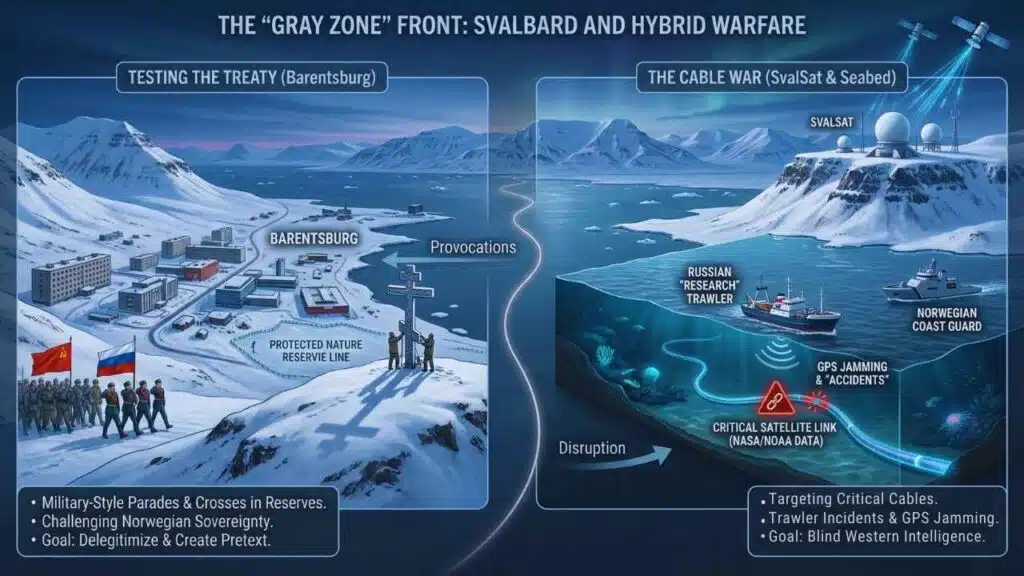
The Svalbard archipelago, governed by the 1920 Svalbard Treaty, is becoming the most dangerous flashpoint for “gray zone” conflict—actions below the threshold of open war but aggressive enough to destabilize.
Testing the Treaty
Russia maintains a presence in the mining settlement of Barentsburg. Through 2025 and into 2026, Moscow has used this foothold to stage provocations. These include military-style parades celebrating Soviet victories, the erection of Orthodox crosses in protected nature reserves, and increasingly aggressive rhetoric accusing Norway of violating the Treaty by inspecting Russian cargo. The strategic goal is to delegitimize Norwegian sovereignty and create a pretext for intervention.
The Cable War
The seabed surrounding Svalbard hosts critical fiber-optic cables connecting the satellite station at SvalSat to the mainland. This station downloads data from NASA and NOAA polar-orbiting satellites. In the past year, mysterious “trawler accidents” and GPS jamming incidents have occurred near these cables. NATO planners fear that in a pre-conflict scenario, Russia could sever these links, blinding Western intelligence assets in the High North. This has led to the permanent deployment of Norwegian Coast Guard vessels to shadow Russian “research” ships operating in the area.
Diplomatic Paralysis: The Danish Chairship and the Two Arctics
The Arctic Council, once the gold standard for scientific diplomacy and peaceful cooperation, is effectively paralyzed. The handover of the Chairship from Norway to Denmark in May 2025 was a somber affair.
Institutional Zombie
While the Council technically functions, it is a zombie institution. The “Arctic 7” (Canada, Denmark, Finland, Iceland, Norway, Sweden, USA) refuse to engage in high-level political dialogue with Russia. Work on vital issues—such as permafrost thaw monitoring, black carbon emissions, and search and rescue (SAR) coordination—has fractured. We are seeing the emergence of two parallel governance structures: a Western-led “Nordic” council focusing on security and environmental standards, and a Eurasian “BRICS-Polar” dialogue focused on economic development and logistics.
The Risk of Miscalculation
The suspension of military-to-military hotlines and the breakdown of the Arctic Coast Guard Forum’s joint exercises mean there are few mechanisms left to de-escalate a crisis. If a Russian tanker were to collide with a NATO frigate in a snowstorm, or if a major oil spill occurred in the shared waters of the Bering Strait, the lack of communication channels could turn an accident into a geopolitical catastrophe.
The Diplomatic Fracture
| Feature | The “Arctic 7” (West) | The “Eurasian Arc” (East) |
| Governance Model | Multilateral, Rule of Law, Environmental Focus | Bilateral, Sovereignty-First, Development Focus |
| Key Alliances | NATO, NORDEFCO, EU Arctic Policy | BRICS+ Polar Working Group, SCO |
| Investment Strategy | Private Capital, ESG-Compliant | State-Owned Enterprises, Long-Term Debt |
| Stance on Climate | Preservation and Mitigation | Adaptation and Exploitation |
Expert Perspectives
Dr. Elena K., Senior Analyst at the Institute for Polar Strategy:
“The West often misreads Russia’s Arctic pivot. It is not just about selling oil; it is about regime survival. By inviting BRICS nations into the Arctic, Moscow is trying to ‘sanction-proof’ its northern flank. The danger is that China will extract a high price for its support—potentially demanding docking rights for naval vessels in Murmansk or Arkhangelsk under the guise of ‘convoys protection’.”
Gen. (Ret.) Marcus Thorn, Former NATO Northern Commander:
“We must be careful not to confuse presence with capability. Russia has more icebreakers, yes, but NATO has the economic and technological edge. The real threat isn’t a tank battle in Lapland; it’s a synchronized hybrid attack—cyber on the power grid, cable cutting at Svalbard, and disinformation in Nuuk—all happening at once to paralyze decision-making.”
Future Outlook: What Comes Next?
As we look toward the remainder of 2026, three specific developments will dictate the trajectory of the Arctic conflict:
- The Svalbard Escalation: Expect Russia to increase the tempo of “hybrid” incidents on Svalbard. We may see the deployment of “private security contractors” to Barentsburg to protect Russian assets, creating a “little green men” scenario similar to Crimea in 2014, testing NATO’s article 5 resolve in a demilitarized zone.
- The First “BRICS Icebreaker”: Watch for the official keel-laying ceremony of a joint Russian-Indian or Russian-Chinese nuclear-powered icebreaker. This would symbolize the technological fusion of the East and the end of Russia’s jealousy over its nuclear propulsion technology.
- Greenland’s Election Cycle: As Greenland approaches its next election cycle, expect foreign interference to spike. If a pro-independence, anti-mining coalition gains power, it could derail Western hopes for a secure mineral supply chain, forcing the U.S. to consider more transactional, bilateral security arrangements with Nuuk, potentially bypassing Copenhagen.
The Arctic has evolved from a scientific preserve into a crucible of great power competition. The “High North, Low Tension” era is history. The new reality is a “High North, High Stakes” environment where the ice is melting, but the geopolitical lines are freezing hard. For the West, the challenge is to secure the region without militarizing it to the point of inevitable conflict. For the BRICS nations, the Arctic represents the ultimate test of their ability to build an alternative global trade infrastructure. The winner of this contest will control the trade routes and resources of the 21st century.