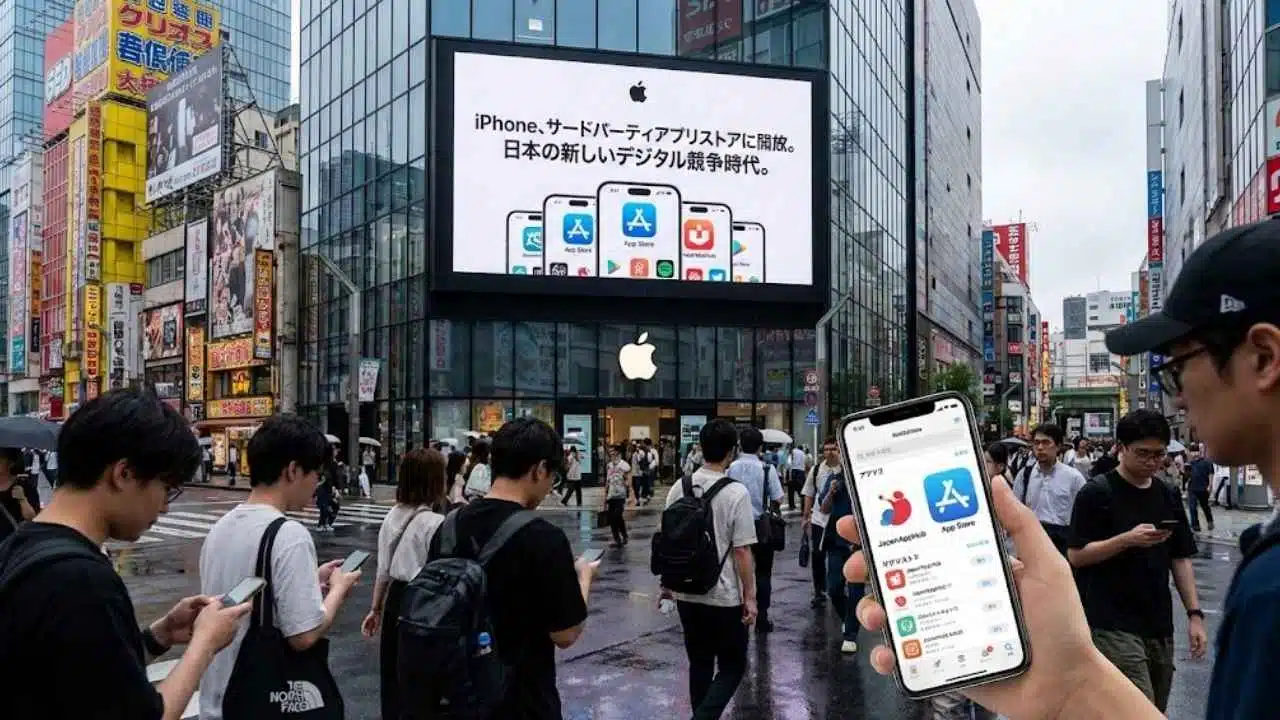
Apple opened iPhone app distribution in Japan to third-party app stores and new payment options this week, rolling out iOS 26.2 ahead of Japan’s Mobile Software Competition Act taking effect on December 18.
What changed—and who it applies to
Apple’s update introduces several major shifts for iPhone users in Japan:
- Alternative app marketplaces can now be installed, allowing apps to be distributed outside Apple’s App Store—while still passing Apple’s security screening.
- More payment choice is available for digital goods and services, including third-party payment methods and links that can take users to purchase outside an app.
- More default choices are added during setup, including browser and search engine selections.
- New device customization options include assigning the iPhone’s side button to trigger alternative voice assistants instead of Siri, depending on user preference and app support.
Japan becomes the first market outside the European Union where Apple has enabled third-party app marketplaces at the operating-system level, signaling a widening global shift in how Apple manages iOS distribution rules.
Why Apple is making these changes now
Japan’s Mobile Software Competition Act (MSCA) is designed to reduce “gatekeeper” control in smartphone ecosystems by requiring more openness around:
- app store competition,
- payment processing options,
- default app settings (like browsers and search engines),
- and interoperability requests.
Japan’s regulator has already taken formal steps toward enforcement, including publishing guidance and implementation materials tied to the law’s rollout.
Japan’s model differs from the EU’s DMA approach
Japan’s approach is broadly similar in spirit to the EU’s Digital Markets Act (DMA), but it includes structural differences that shape how Apple is implementing compliance:
No “web sideloading” route
Unlike the EU model—where app distribution can include additional pathways—Japan’s framework keeps distribution routed through approved marketplaces, rather than allowing apps to be freely installed directly from any developer website.
Security screening stays mandatory
Apps distributed via third-party marketplaces in Japan are still expected to go through Apple’s notarization-style security checks, which aim to identify known threats and ensure baseline platform integrity.
Payment choice comes with presentation rules
Japan’s rules also require that when developers offer alternative payment methods, Apple’s in-app purchase option must remain available and presented fairly—meaning the Apple option cannot be hidden behind extra steps or made harder to find.
New fees: how Apple says developers will be charged in Japan
Apple’s updated Japan business terms introduce a tiered fee structure that depends on where an app is distributed and how purchases are processed.
Fee structure snapshot (Japan)
| Scenario | Distribution | Payment method | Reported fee components | Notes |
| App sold via alternative marketplace | Third-party store | Marketplace payment | 5% “Core Technology” style commission | Lower entry rate, but tied to alternative distribution |
| App via App Store using Apple IAP | Apple App Store | Apple in-app purchase | Base commission + payment processing fee (reported up to ~26% total) | Closest to the traditional model |
| App via App Store using external link/payment | Apple App Store | Third-party payment or web link | Reduced commission (reported ranges ~10%–21% depending on setup) | Designed to allow competition while keeping Apple’s cut |
These fees matter because Apple’s classic App Store structure has historically charged commissions that many developers view as too high—particularly for subscription apps, digital services, and games.
What iPhone users in Japan will notice
1. Third-party app stores become possible
Japanese users can install alternative marketplaces such as those expected to be early entrants (including well-known developer-run and game-focused stores). This can change:
- where users discover apps,
- how promotions and pricing are handled,
- and how quickly certain categories (notably games) experiment with distribution outside Apple’s store.
2. Browser and search engine choice screens during setup
Japan’s rules push iPhone setup toward explicit choice rather than default lock-in. Users are expected to see options for:
- browsers other than Safari, and
- search engines beyond Google’s default placement.
This could influence mobile web traffic patterns over time, especially if users select privacy-focused or domestic options.
3. More customization around assistants
Apple’s changes also support a wider set of assistant behaviors and preferences. For users, the headline impact is practical: the iPhone becomes less “Siri-first” by default if users choose alternatives.
Child and teen safety: stricter rules under the new framework
Apple has introduced additional guardrails for minors under the new Japan rules, addressing a key concern critics often raise about broader app distribution: whether it increases exposure to scams or inappropriate content.
Reported protections include:
- Kids-category apps restricted from including external purchase links.
- Under-13 users blocked from being shown certain external payment pathways.
- Under-18 users required to pass a parental gate before completing purchases through some alternative payment flows.
These controls are intended to preserve Apple’s family-safety positioning even as distribution expands.
Security and fraud risks: the tradeoff Japan is trying to manage
Opening iOS distribution—even partially—changes the risk landscape. Alternative marketplaces may increase:
- malware attempts through disguised apps,
- fraudulent payment pages,
- subscription scams,
- and social engineering campaigns.
Japan’s policy structure appears designed to trade openness for controlled oversight by keeping a formal review/security checkpoint (notarization) while still allowing competition in storefronts and payments.
What happens next: Japan as a global test case
Japan is likely to become a proving ground for Apple’s “selective openness” strategy:
- If alternative stores gain traction without major security incidents, regulators elsewhere may cite Japan as evidence that tighter ecosystems can open safely.
- If abuse rises, Apple may point to Japan’s extra controls (like mandatory screening and child protections) to argue for stricter guardrails in other markets.
Meanwhile, other governments continue evaluating platform rules for mobile distribution, payments, and default app choice—meaning Japan may be the start of a broader expansion of iOS marketplace competition beyond Europe.
Japan’s MSCA forces a meaningful shift in Apple’s iPhone business model: more app stores, more payment choices, and more setup-time defaults—but with stronger security and child-safety controls than some other regulatory regimes. The next phase will be measured by two realities: whether users adopt alternative marketplaces at scale, and whether the new system can stay resilient against scams and fraud.