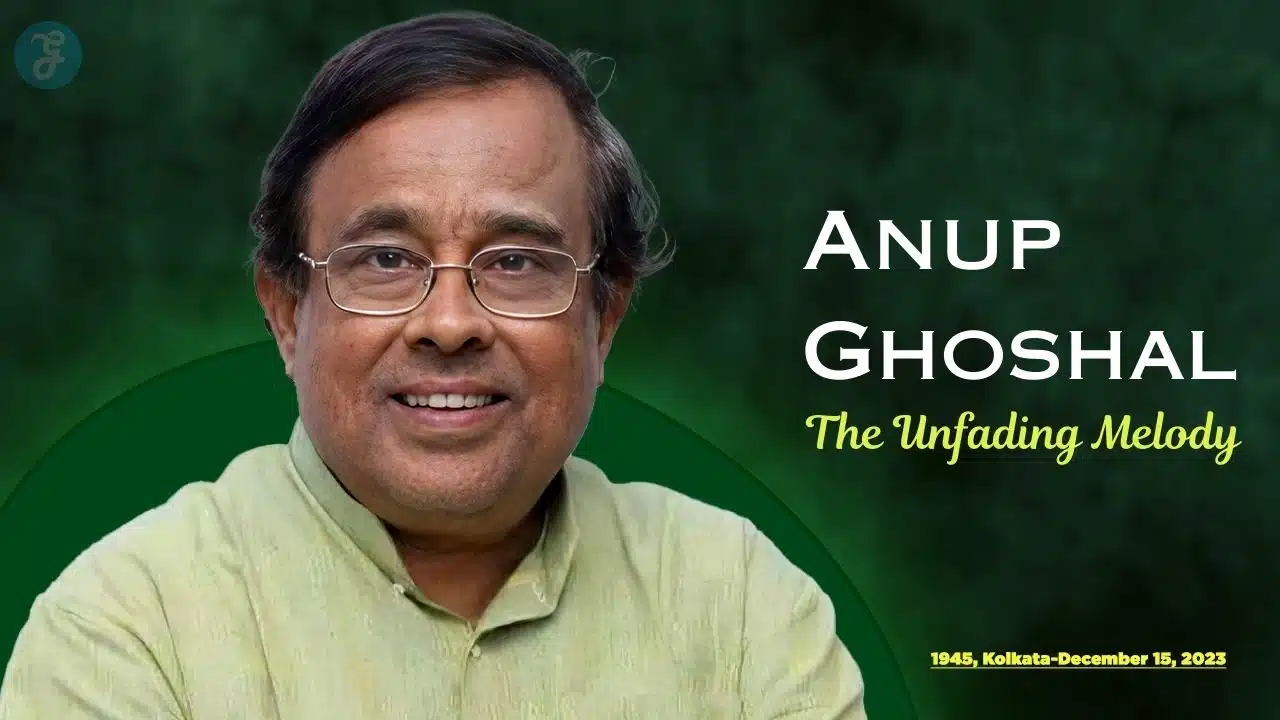
The legacy of Anup Ghoshal is etched not just in vinyl records or film reels, but in the collective childhood of millions who grew up believing in the magic of the “Ghost King.” On December 15, 2025, two years after his passing, many listeners are returning to his songs not only to remember him, but to feel what his voice always offered: reassurance without exaggeration, emotion without noise, and artistry without ego.
For some, he will always be the singer behind the unforgettable “Tujhse Naraz Nahin Zindagi” from Masoom (1983)—a song that seems to sit beside you when words fail. For others, he is woven into the musical world of Satyajit Ray, where songs could be playful, political, and philosophical all at once. And for generations of Bengali music lovers, Anup Ghoshal (also spelled Anup Ghosal) remains a respected interpreter of Nazrulgeeti, Rabindra sangeet traditions, and modern Bengali music—an artist who carried heritage with humility.
While the headlines in 2023 spoke of the passing of a “veteran singer,” a true tribute requires us to look deeper. We must look past the statistics and into the soul of the man who could hold a PhD thesis in one hand and a tanpura in the other. This tribute is not a checklist of achievements. It’s a remembering of a voice that shaped moments, movies, and memories across languages and eras.
Anup Ghoshal at a glance
-
Known for: “Tujhse Naraz Nahin Zindagi” (Masoom, 1983) and Ray’s musical classics
-
Signature Ray films: Goopy Gyne Bagha Byne (1969), Hirak Rajar Deshe (1980)
-
Major honor: National Film Award (Best Male Playback Singer) for Hirak Rajar Deshe (listed in standard film award records/biographies)
-
Public life: Elected MLA from Uttarpara in 2011 on a Trinamool Congress ticket
-
Passed away: December 15, 2023, Kolkata (reports vary on age: 77/78)
Early Life: The Foundation and A Scholar in the Making
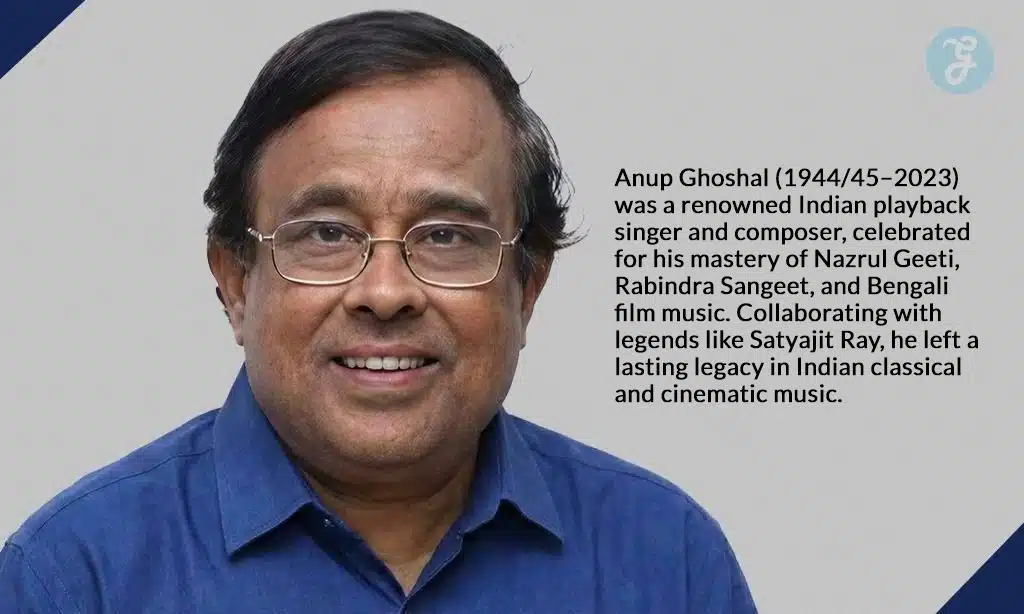
A lot of singers become famous because of one moment. Anup Ghoshal became enduring because of the years behind the moment. To understand the artist, one must first understand the student. Unlike many playback singers who were discovered in talent hunts or through industry connections, Anup Ghoshal was crafted in the disciplined fires of classical training.
Born around 1945 in a culturally rich Kolkata, his musical lineage was his first classroom. His mother, Labanya Ghoshal, was his initial guide, instilling in him the fundamentals of melody and rhythm. However, Ghoshal did not stop at home tuition. He sought out the giants of the era. He underwent rigorous training in classical music under the tutelage of Sangeetacharya Tarapada Chakraborty and, later, Sukhendu Goswami.
But what truly set Ghoshal apart was his intellectual curiosity. He wasn’t satisfied with just performing; he wanted to understand the theoretical underpinnings of the art form.
A Rare Distinction: In an industry often driven by instinct, Anup Ghoshal was a scholar. He held a Master’s degree and eventually earned a Ph.D. from Rabindra Bharati University.
His doctoral thesis, titled “Nazrulgeeti — Roop O Rashanabhuti,” was not a vanity project. It was a deep academic dive into the aesthetics and emotional architecture of Kazi Nazrul Islam’s songs. This academic background gave his singing a unique precision—he understood the weight of every word he sang, ensuring that the literary value of a song was never lost in its melody.
The Satyajit Ray Era: The “Goopy” Phenomenon
If there is one chapter in Ghoshal’s life that defines his public image, it is his collaboration with the maestro, Satyajit Ray.
In 1969, Ray was casting for Goopy Gyne Bagha Byne, a fantasy adventure about two bumbling musicians. The character of Goopy required a singing voice that sounded unpolished yet melodious—a “village singer” who had been gifted magical abilities. Ray, known for his fastidious attention to detail, initially considered the great Kishore Kumar. However, he realized that Kishore’s voice was too recognizable, too urban, and perhaps “too good” in a commercial sense.
In simpler terms: Ray didn’t just need a singer. He needed a voice that could sound innocent without being childish—and intelligent without being heavy. A 19-year-old Anup Ghoshal fit that rare space.
Goopy Gyne Bagha Byne (1969): The voice of Goopy that generations remember
The songs of Goopy Gyne Bagha Byne still feel like a childhood doorway—one you can open at any age. Ghoshal’s rendition of these tracks was transformative:
-
“Dekho Re Nayan Mele” (Look with Open Eyes): This song is a hymn to the beauty of the world. Ghoshal’s voice captures the sheer, unadulterated joy of seeing nature for the first time without fear. It is simple, devoid of heavy ornamentation, and utterly effective.
-
“Bhuter Raja Dilo Bor” (The Ghost King’s Boon): A playful, rhythmic track that required impeccable comic timing. Ghoshal navigated the complex meter with a playfulness that made children believe the character was real.
-
“Maharaja Tomarey Shelam” (Salute to the King): Here, Ghoshal demonstrated his classical prowess. The song is a parodic yet technically sound presentation of court music, showcasing his ability to switch between genres instantly.
This collaboration extended to the sequel, Hirak Rajar Deshe (1980). It was for the song “Aaha Ki Anondo” from this film that Anup Ghoshal won the prestigious National Film Award for Best Male Playback Singer in 1981. This was a vindication of Ray’s choice and Ghoshal’s talent—proving that a voice did not need to be “Bollywood standard” to be national quality; it just needed to be true.
The “Sagina” Connection – Singing for the Thespian
One of the most glaringly overlooked chapters in standard biographies of Anup Ghoshal is his association with the tragic king of Indian cinema, Dilip Kumar.
In 1970, Tapan Sinha directed Sagina Mahato, a film set in the tea gardens, dealing with labor unions and politics. Dilip Kumar played the lead. The challenge for the music director was immense: Who could provide the singing voice for Dilip Kumar? The voice needed to be masculine yet vulnerable, commanding yet capable of breaking into a drunken stupor.
Tapan Sinha chose Anup Ghoshal. The result was magic. In the song “Saala Main To Saab Ban Gaya,” Ghoshal captures the tragic-comedy of the protagonist’s intoxication and delusions of grandeur. He modulates his voice to mimic the slurring of a drunkard without ever losing the melody—a technical tightrope walk that very few singers can achieve.
Then came “Tumre Sang To Rain Bitayi,” a classical-based number that required immense control. Ghoshal’s rendition was so soulful that it reportedly moved Dilip Kumar himself. This film proved that Ghoshal was not just a “voice for children” (as he was typecast after Goopy Gyne); he was a voice for the giants. When the film was remade in Hindi as Sagina (1974), the songs were retained, and Ghoshal’s voice traveled across India, proving his mettle against the Bombay heavyweights.
The Unsung Hero of Bhojpuri Cinema
This is the chapter that often surprises people. Anup Ghoshal was a superstar in the world of Bhojpuri cinema.
During the 1970s and 80s, when the Bhojpuri film industry was finding its feet, Ghoshal was a preferred voice for composers like Chitragupta. He understood the folk roots of the language. Unlike singers who would force a “rural accent,” Ghoshal’s classical training allowed him to grasp the Poorbi and Kajri styles natural to the region.
Songs in films like Dagabaaz Balma became anthems in the Hindi heartland. His duet with Asha Bhosle, “Hum Tohke Sajanwa,” is a classic. His contribution to regional cinema wasn’t a “step down” for him; it was an extension of his belief that music belongs to the soil, regardless of the language spoken on it.
Beyond Bengal: The “Masoom” Connection
For the non-Bengali audience, Anup Ghoshal is immortalized by a single, haunting track that remains a staple of Indian radio to this day. The film was Masoom (1983), directed by Shekhar Kapur. The music director was the legendary R.D. Burman. The song was “Tujhse Naraz Nahin Zindagi”.
Anatomy of a Masterpiece
The song exists in two versions: a female version by Lata Mangeshkar and a male version by Anup Ghoshal. While Lata’s version is technically flawless, it is Ghoshal’s version that often tugs harder at the heartstrings. Why?
The context of the song is a father looking at his illegitimate son, torn between love and the chaos the child’s existence has brought to his marriage. It required a voice that sounded weary, broken, yet filled with a gentle, paternal love.
R.D. Burman, who had been introduced to Ghoshal via the Ray-Kishore Kumar connection, knew that a polished “hero” voice wouldn’t work here. He needed the texture of a common man. Ghoshal delivered a performance that was famously understated. He didn’t over-emote. He sang the lines “Hairan hoon main” (I am bewildered) with a genuine sense of confusion and fatigue.
It is a testament to his skill that despite not being a regular in the Mumbai circuit, he held his own against the dominance of Kishore Kumar, Mohammed Rafi, and Mukesh, carving out a permanent niche with just this one song.
The Guardian of Nazrulgeeti: A Voice Rooted in Bengal
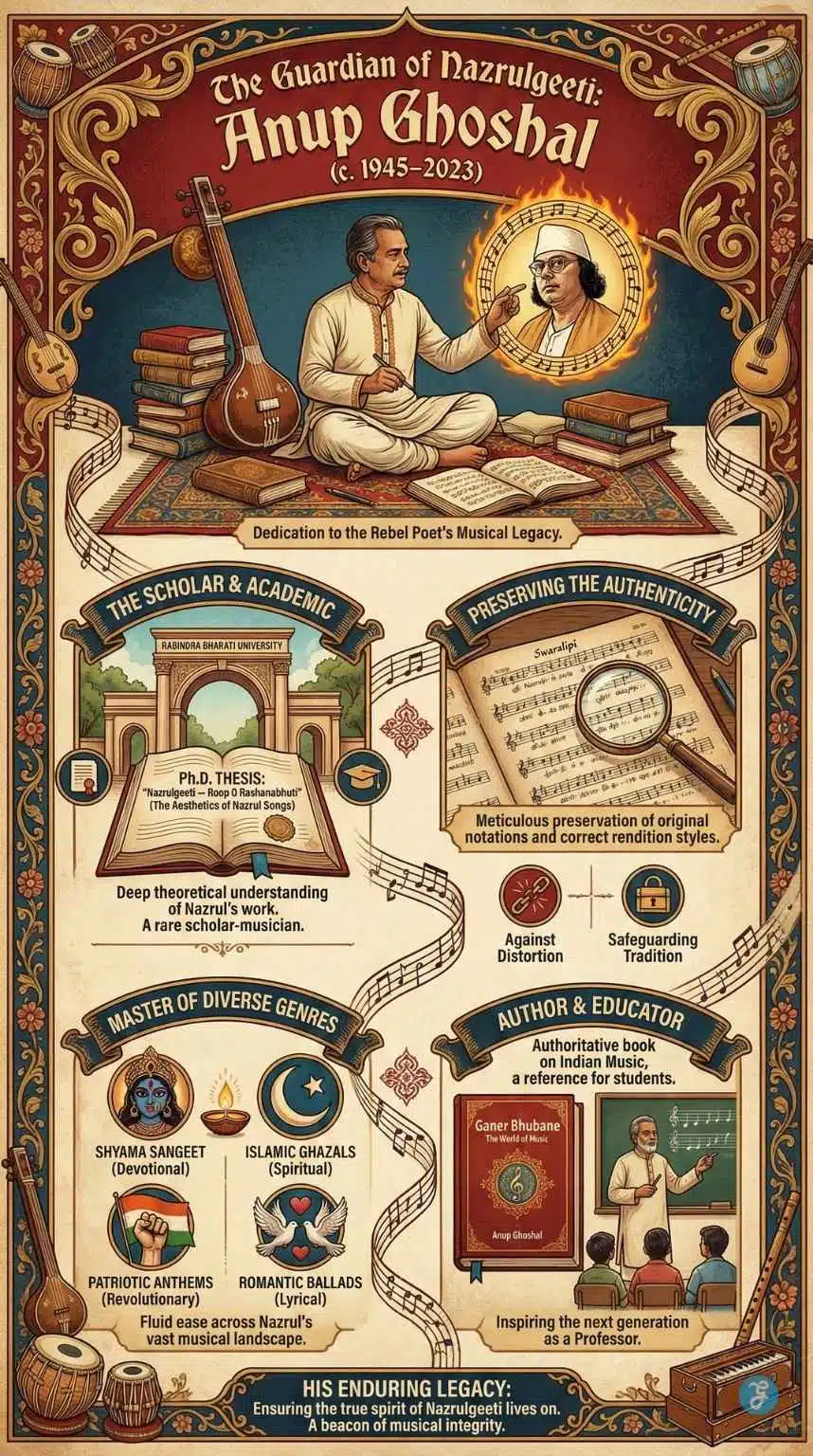
While the world applauded his film songs, Anup Ghoshal’s heart beat for something more traditional. He was a lifelong devotee of Nazrulgeeti—the songs of the Rebel Poet, Kazi Nazrul Islam.
The “Golden Age” of Nazrulgeeti saw many stalwarts, but Ghoshal brought his academic rigour to the genre. He did not just sing the songs; he preserved them. His album Ganer Bhubane and his other compilations are considered reference points for students of music.
He possessed the vocal flexibility required for Nazrul’s diverse range. Nazrulgeeti is not a monolith.
It includes:
-
Shyama Sangeet (Devotional songs for Goddess Kali)
-
Islamic Ghazals
-
Patriotic Anthems
-
Romantic Ballads
Ghoshal moved between these sub-genres with fluid ease. His rendition of tracks like “Khelichho E Biswa Loye” showed his spiritual depth, while his patriotic numbers resonated with the fiery spirit of the freedom movement.
A Brief Stint in Public Service: The MLA Chapter
It is often rare for artists to transition successfully into the turbulent world of politics, but Anup Ghoshal managed this with the same quiet dignity he applied to his music.
In 2011, riding the wave of change in West Bengal, he contested the Legislative Assembly elections on an All India Trinamool Congress (TMC) ticket. He ran for the Uttarpara constituency, a culturally conscious locality in the Hooghly district.
He won the seat, defeating the incumbent candidate. For five years (2011–2016), he served as an MLA. His constituents often remembered him as an approachable figure, far removed from the arrogance often associated with political office. However, the rough-and-tumble of long-term politics was perhaps not for him. He did not contest the 2016 elections, choosing instead to step back into the privacy of his musical and family life.
This brief political interlude showcased his desire to serve society not just through art, but through action.
His Final Years and Passing: A Loss Felt Across Generations
Anup Ghoshal passed away on December 15, 2023, in Kolkata, following complications related to age and health. News of his death carried a familiar sadness—because it felt like the closing of a cultural chapter. Artists like him are not only performers; they are bridges. They connect eras, languages, and listening habits.
He is survived by family, including his daughters (as widely reported in obituary coverage at the time). Condolences from cultural and political figures reflected what listeners already knew: a significant voice had fallen silent.
But what does it really mean for a singer to “fall silent,” when the songs remain?
Why Anup Ghoshal Still Matters
Two years after his passing, Anup Ghoshal’s relevance hasn’t shrunk—it has sharpened.
1) He proved that softness can be powerful
In an age that often rewards volume—high notes, high drama, high intensity—his voice teaches the value of restraint. He could break your heart without raising his voice.
2) He made meaning the priority
Whether the song was whimsical, satirical, devotional, or heartbreaking, his aim was not to show off. It was to communicate.
3) He connected “art” and “popular” worlds
Some artists stay locked inside classical spaces. Others stay only in commercial sound. Anup Ghoshal moved between worlds—Ray’s cinema, Bengali traditions, and mainstream Hindi film music—without losing integrity.
That balance is a legacy in itself.
A Simple Listening Guide for Today
As we’re remembering him today, one beautiful way is to listen with intention. Here are a few starting points:
-
“Tujhse Naraz Nahin Zindagi” (Masoom, 1983) – when you need comfort without false optimism
-
Songs from Goopy Gyne Bagha Byne (1969) – for wonder, childhood joy, and musical storytelling
-
Songs from Hirak Rajar Deshe (1980) – when you want satire with melody and meaning
-
Selected Nazrul songs in his voice – for devotion, rebellion, and Bengali cultural soul in one place
You don’t have to listen to everything. Just listen deeply to one song—and you’ll understand why his voice lasts.
A Tribute in One Thought
Anup Ghoshal’s voice didn’t try to dominate your emotions—it respected them. That’s why it still feels present: not as nostalgia, but as companionship.
On this day, remembering him is not only about loss. It’s also about gratitude—for a voice that could make you feel understood without ever raising its volume.
Frequently Asked Questions About Anup Ghoshal
1. What is Anup Ghoshal’s most famous Hindi song?
His most celebrated Hindi song is “Tujhse Naraz Nahin Zindagi” (Male Version) from the 1983 cult classic Masoom. Composed by R.D. Burman, Ghoshal’s soulful and understated rendition perfectly captured the film’s emotional depth, earning him nationwide recognition beyond Bengal.
2. Did Anup Ghoshal win a National Award?
Yes, he received the prestigious National Film Award for Best Male Playback Singer in 1981. This honor was awarded for the song “Aaha Ki Anondo” from Satyajit Ray’s Hirak Rajar Deshe, acknowledging his unique ability to bring classical precision to a children’s fantasy film.
3. When did Anup Ghoshal pass away?
Dr. Anup Ghoshal passed away on December 15, 2023, at the age of 78 in a private hospital in Kolkata. He had been hospitalized for some time and ultimately succumbed to multi-organ failure, leaving behind a rich legacy in Indian music.
4. What role did he play in Satyajit Ray’s films?
He was the “musical soul” of the character Goopy in Ray’s iconic Goopy Gyne Bagha Byne and its sequel Hirak Rajar Deshe. Satyajit Ray specifically chose Ghoshal’s fresh, untrained-sounding (yet highly skilled) voice to bring the magical village singer to life.
5. Was Anup Ghoshal involved in politics?
Yes, he had a successful stint in politics, serving as an MLA for the Uttarpara constituency in West Bengal from 2011 to 2016. He contested on an All India Trinamool Congress ticket and served his term with dignity before returning to his private life.
Final Words: The Echo of the Ghost King
Dr. Anup Ghoshal passed away on December 15, 2023, at the age of 78, due to multi-organ failure. He is survived by his two daughters and a rich archive of music that will outlive us all.
As we mark his second death anniversary, it is important to recognize what we lost. We lost a bridge between the classical and the popular. We lost a man who could sing for a King and a ghost with equal conviction.
In Goopy Gyne Bagha Byne, the Ghost King gives Goopy three boons. One of them is the ability to mesmerize people with song—to make them stop in their tracks, forget their anger, and simply listen. Anup Ghoshal had that boon in real life.
Whether you play “Tujhse Naraz Nahin Zindagi” to nurse a heartbreak or “Bhuter Raja Dilo Bor” to entertain a child, Anup Ghoshal remains present. He is the invisible narrator of our joys and sorrows.
Rest in peace, Dr. Ghoshal. The song has ended, but the melody lingers on.