
Google has entered a new phase in its long-running artificial intelligence strategy, with CEO Sundar Pichai revealing that AI now generates more than 30% of the code written at the company and predicting that “vibe coding” will fundamentally change how software is built.
In recent internal and public remarks, Pichai described a company that has moved beyond years of AI preparation and infrastructure-building and is now deploying the technology across almost every corner of its business—from engineering workflows to consumer products and cloud services. The shift comes as Alphabet’s market value hovers around the $3.8 trillion mark after a year of sharp gains driven by optimism around its flagship Gemini 3 model.
“We are firmly in the implementation period,” Pichai said, contrasting today’s rollout-focused environment with the lower-profile foundational work of the previous decade. “The fun is just beginning.”
AI Now Writes a Third of Google’s Code
The clearest indicator of that shift is in Google’s software development itself. According to Pichai, more than 30% of the code written at Google today is generated by AI systems, up from “over 25%” just a year earlier.
The company has rolled out internal AI coding assistants built on its own Gemini models, which are now deeply integrated into engineering workflows. Developers can describe a feature or function in natural language and have the AI propose implementations, generate tests, refactor old code, or port logic between languages.
Pichai says this has translated into tangible productivity gains. Internal measurements point to roughly a 10% uplift in engineering productivity among teams that have embraced AI tools at scale. In practical terms, that means faster iteration cycles, more experiments, and more time spent on higher-level design rather than boilerplate implementation.
The cultural expectation is shifting as well. Role descriptions and performance expectations for many engineering positions now explicitly assume regular use of AI tools. Managers across product areas have been asking teams not just whether they are using AI, but how effectively and how aggressively they are building it into their workflows.
At the same time, Pichai has been careful to avoid portraying AI as a replacement for human engineers. Instead, he frames the technology as an amplifier.
“AI is not doing the job for you,” he has emphasized in various conversations. “It is changing the nature of the work and letting you focus on more ambitious problems.”
‘Vibe Coding’ and the New Programming Culture
Central to Google’s internal transformation is the rise of “vibe coding,” a term that has migrated from online AI circles into the mainstream of the software industry.
In its purest form, vibe coding describes a style of development where a person tells an AI system what they want—“build me a mobile app that tracks my spending,” for example—and then iteratively nudges the AI toward the desired result using conversational prompts and tests rather than direct edits to the code. The developer steers the project by describing intentions and reacting to outputs, rather than writing every line.

Pichai has been openly enthusiastic about this trend. He calls it one of the most exciting shifts in software since the rise of high-level languages, especially because it lowers the barrier to entry for people who are not formally trained as engineers. Non-technical staff can spin up internal tools, dashboards, and prototypes by talking to AI systems in natural language.
“It is making coding so much more enjoyable and more approachable,” he has said, likening it to giving every team the equivalent of an on-demand engineering companion.
But he also draws an important line. Pichai has said he personally does not “vibe code” on large, security-critical, or deeply complex codebases. For systems that require high reliability, strict performance guarantees, or sophisticated architecture, he argues that traditional software engineering practices—including careful code review, design documentation, and testing—remain indispensable.
That tension—between fast, AI-driven experimentation and the discipline required for production systems—is now at the center of how many inside Google are rethinking their craft.
From ‘AI First’ to Full-Scale Implementation
Google’s journey to this moment began nearly a decade ago. In 2016, Pichai declared that the company would become “AI first,” signaling a shift away from a purely “mobile first” orientation. The years that followed were dominated by internal investments rather than high-profile product launches: custom Tensor Processing Units (TPUs), hyperscale data centers, training pipelines, and a succession of increasingly capable models.
One of the pivotal moves was the merger of Google Brain and DeepMind into a single research and product organization, Google DeepMind. That consolidation aimed to align cutting-edge research with practical deployment and to reduce duplication across teams.
According to Pichai, much of this work was deliberately quiet. From the outside, critics sometimes accused Google of moving slowly as rivals rolled out headline-grabbing chatbots and generative AI tools. Internally, executives insisted they were “stacking the blocks”—ensuring that infrastructure, safety frameworks, and product surfaces were ready for a more aggressive AI rollout.
That moment arrived with Gemini and, more recently, Gemini 3. The latest version is tuned not just for raw reasoning and multimodal understanding, but also for “agentic” behavior—AI systems that can plan, act, and interact with external tools and services to complete tasks.
With Gemini 3 integrated into Search, the Gemini app, Workspace, Android, and a growing suite of internal tools, Pichai argues the company has finally flipped from preparation to deployment.
Gemini 3: The Inflection Point
Launched on November 18, 2025, Gemini 3 has become the flagship of Google’s AI ambitions. The model promises improved performance in logical reasoning, coding, and multimodal tasks spanning text, images, audio, and video.
For developers inside Google, Gemini 3 powers more advanced coding assistants, project-level reasoning, and early forms of autonomous agents that can manage multi-step tasks such as debugging, refactoring, or integrating APIs.
Externally, the model has been positioned as a direct answer to rival offerings in the AI race. Early reactions from industry leaders have highlighted the model’s speed and reasoning capabilities, with some executives publicly declaring they have switched away from competing systems after testing Gemini 3.
Pichai has acknowledged the human cost behind the launch. The Gemini 3 release followed what he described as an intense sprint by Google’s AI teams, prompting him to say he now hopes those groups can “get a bit of rest” after months of accelerated deadlines.
Founders’ Energy and a Cultural Reset
If the infrastructure and models are the technical backbone of Google’s AI transformation, the cultural engine has been powered in part by the renewed presence of co-founder Sergey Brin.
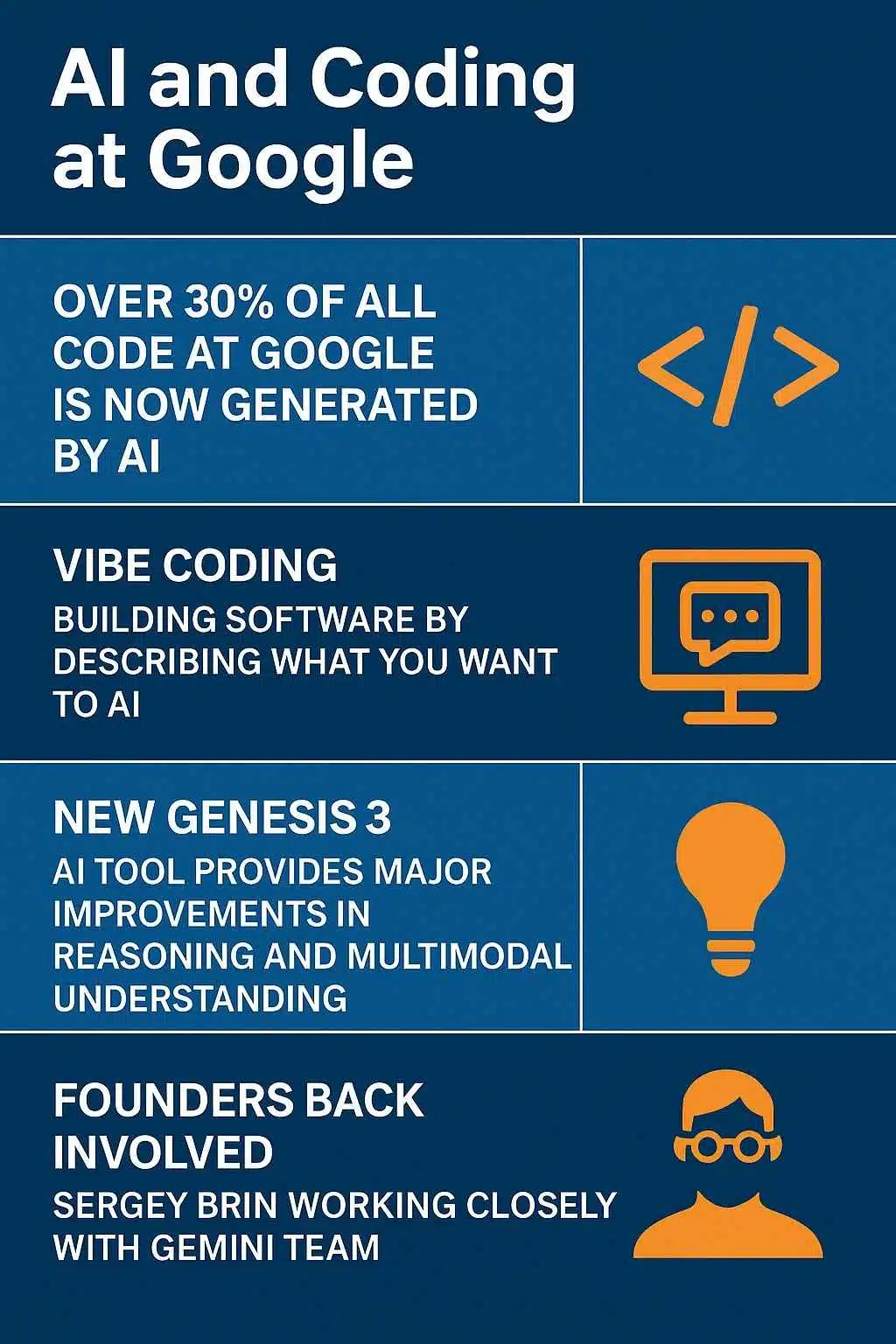
After stepping back from day-to-day leadership in 2019, Brin has re-emerged as a central figure in Google’s AI efforts. He has been coding with the Gemini team, attending internal reviews, and pushing for faster progress on the path toward more general AI systems. Internal communications from Brin have urged employees to adopt AI tools more aggressively and to approach the moment as a decisive phase in the race toward more powerful AI.
Pichai has said this involvement has given certain corners of Google a feeling reminiscent of the company’s earliest days—leaner decision-making, more direct founder input, and a renewed emphasis on technical excellence.
Larry Page, the other co-founder, has taken a different path. While he remains a key shareholder and board member at Alphabet, his primary focus is now outside Google at a new AI venture focused on using AI to design and optimize physical products for manufacturing. His presence is still felt at Google strategically, but he is not involved in the same hands-on way as Brin.
Even so, the combined influence of Pichai, Brin, and Google’s AI leadership has created what many inside the company describe as a clear mandate: every part of the business must become AI-native.
Wall Street Rewards Google’s AI Bet
The market has responded decisively to Google’s AI pivot. Alphabet’s share price has climbed sharply this year, with the stock gaining close to 70% amid enthusiasm for Gemini 3 and the broader AI story.
That rally has pushed Alphabet’s market capitalization to around $3.8 trillion, placing it among the world’s most valuable public companies and just below the $4 trillion valuations of Nvidia and Apple. Alphabet now trades in the same valuation band as Microsoft, and investors increasingly view the group of AI leaders as a small, high-stakes club.
Several factors underpin this confidence: the expectation that AI will raise margins in Search and advertising; growth in Google Cloud, which bundles AI tooling and infrastructure; and the belief that Google’s extensive data and distribution across Android, Chrome, YouTube, and Workspace give it unique leverage in the AI era.
The company’s AI-heavy narrative has become a core part of its investor messaging. Earnings calls now feature detailed metrics on AI usage, from code generation percentages to AI-powered search features and cloud AI adoption.
A Wider Industry Shift Toward AI-Written Code
Google is not alone in turning AI into a first-class citizen of software development.
At Microsoft, executives have said that between a fifth and a third of the company’s code is now generated by AI. The company has embedded AI coding assistants across its developer stack, from GitHub to Visual Studio, and has similarly started to frame AI-assisted development as a standard expectation rather than an experiment.
Elsewhere in the industry, some younger, more nimble firms are pushing even further. At Robinhood, for example, leadership has said roughly half of the company’s new code is now AI-generated, with near-universal adoption of AI coding tools among engineers.
Together, these figures suggest a structural change: AI is no longer a novelty or a sidecar to human developers. It is becoming an integral layer of the software production process, changing how teams are staffed, how projects are scoped, and how quickly products ship.
Security, Reliability, and the Human in the Loop
While Pichai is bullish on AI-generated code and vibe coding’s potential, he has repeatedly warned about the risks of overreliance on AI in high-stakes systems.
Large codebases that underpin core infrastructure, handle sensitive data, or operate in regulated environments cannot rely solely on AI “vibes.” Even subtle mistakes in such systems can cascade into outages, security vulnerabilities, or compliance failures.
To mitigate these risks, Google is trying to pair AI coding capabilities with stricter safeguards:
- Human review as a default: For critical services, AI-generated code typically passes through multiple layers of human review and automated testing before it reaches production.
- Internal-only models for code: Engineers are expected to use only Google’s internal AI tools for sensitive or proprietary code, reducing the risk of code leakage to external systems.
- Expanded testing and verification: As AI-generated changes proliferate, testing frameworks, fuzzing infrastructure, and formal verification tools are being scaled up to match.
There are also softer risks. Some engineers worry that heavy reliance on AI for routine coding tasks could, over time, erode deep technical understanding—particularly among junior developers who may have fewer opportunities to write code from scratch.
Pichai’s response echoes a long-standing pattern in technological change: tools evolve, and job definitions evolve with them. The goal, he argues, is not to preserve every old task, but to move the human contribution to a higher level of abstraction—defining problems, designing systems, and enforcing safety and ethics.
The Next Phase of Google’s AI Journey
With AI now writing more than a third of its code, Gemini 3 deployed across major products, and a founder-driven cultural push underway, Google appears committed to an aggressive AI trajectory.
The question for the company—and for the broader industry—is how sustainable this pace will be. AI models are becoming more powerful, but also more expensive to train and run. Regulatory scrutiny is rising. Expectations from consumers, developers, and investors continue to escalate.
For now, Pichai is betting that deep integration of AI into Google’s own operations is both a practical advantage and a proof point. If AI can reliably and safely write code for one of the world’s most complex technology stacks, he suggests, it can transform workflows far beyond Silicon Valley.
Vibe coding, AI-written code at scale, and agentic systems are, in his telling, not just trends but early glimpses of a new default for how digital products are conceived and built.