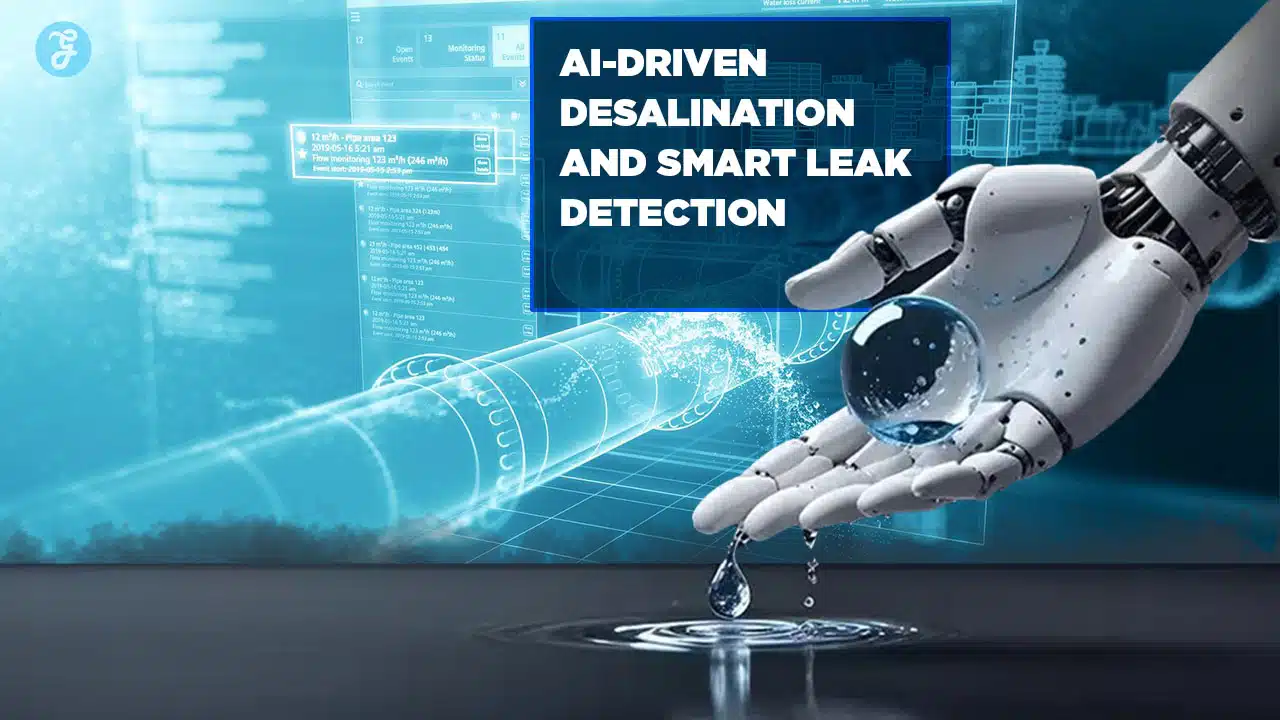
AI in water management is turning water systems into smarter, more efficient networks. That matters because water is no longer a quiet background utility in many places. Drought cycles are getting harsher, infrastructure is aging, demand is rising, and energy prices keep squeezing operations. At the same time, many cities lose a surprising share of treated water through leaks before it reaches a customer. In coastal and arid regions, desalination is expanding to close supply gaps, but it can become expensive and energy-heavy when it is not run efficiently.
This is where AI becomes practical instead of theoretical. It helps utilities detect leaks earlier, predict failures before they become emergencies, optimize pumping and pressure, and improve treatment and desalination efficiency. These gains are not only operational. They lower waste and emissions because water and energy are tied together. When you waste water, you also waste the energy used to treat and move it.
This guide explains how AI is used in leak detection and desalination, what benefits are realistic, what risks and limitations to watch, and how to evaluate tools without falling for buzzwords.
Why Water Is A Tech Problem Now
Water systems were built for a different climate and a different pace of change. Many networks are decades old. Pipes crack, joints loosen, valves fail, and corrosion quietly spreads. Maintenance budgets often lag behind needs. Meanwhile, climate volatility increases the frequency of droughts and extreme storms, which can stress treatment plants, pumps, and distribution networks.
Water also has a visibility problem. When a road collapses, people notice. When a pipe leaks underground for months, the damage can remain invisible until the loss becomes severe. This invisibility is one reason non-revenue water stays high in many regions.
AI in water management addresses the visibility problem by turning hidden behavior into signals. It does not magically replace infrastructure, but it helps operators see where systems are failing and prioritize the most valuable fixes.
The Two Big Challenges AI Targets
- Losing water you already treated and paid for
- Producing and delivering enough water with stable quality at a lower energy cost
Both challenges are measurable, and both can improve with better data and better decisions.
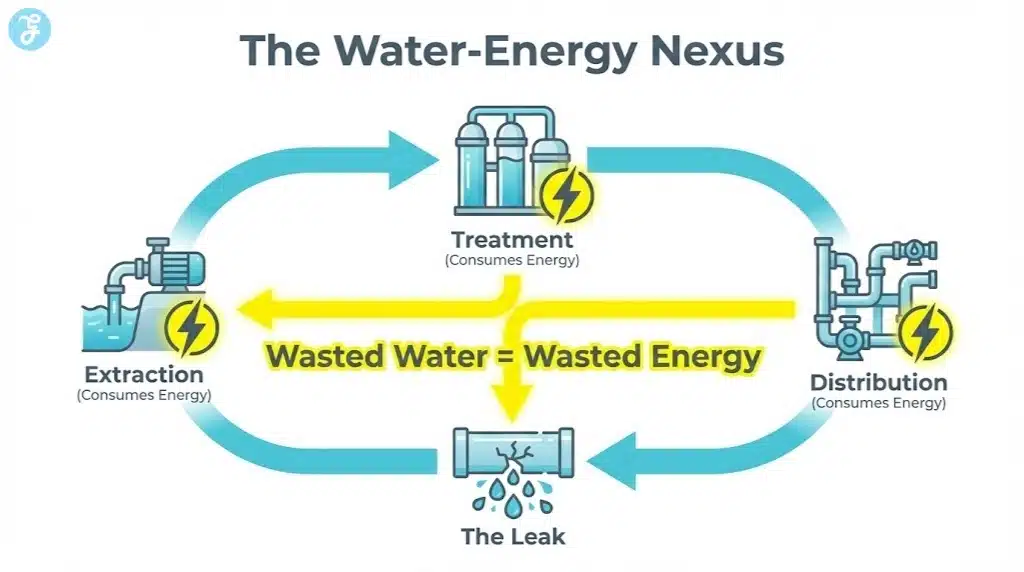
The Water-Energy Link That Makes Efficiency So Valuable
Water is an energy story. Every stage consumes electricity in some way:
- Extracting raw water from rivers, reservoirs, or wells
- Treating and filtering to meet health standards
- Pumping water across elevations and long distances
- Pressurizing distribution zones so households can use taps
- Heating and cooling in buildings, which depends on water use patterns
- Desalinating seawater or brackish water where natural freshwater is limited
When water leaks from a pipe, you lose the water and the energy invested in it. When pressure is too high, you increase leakage and bursts, and you increase pumping energy. When a desalination membrane fouls, you consume more energy for the same output.
This is why “saving water” often means “saving power.” That connection is a major reason AI in water management has become a high-impact technology category.
What AI In Water Management Actually Means
AI in water management usually refers to a combination of sensors, data pipelines, and machine learning models that detect patterns and optimize decisions. It can be applied across treatment plants, pumping stations, distribution networks, and customer endpoints.
In practice, AI supports five major functions:
- Detecting anomalies such as leaks, bursts, and unusual flow
- Predicting asset failures such as pumps, valves, and motors
- Optimizing pressure and pumping schedules to reduce energy
- Improving treatment process control for stable water quality
- Optimizing desalination operations to reduce energy and protect membranes
AI is most useful when it fits the daily workflow of operators. If it produces alerts that do not connect to field action, it becomes noise. The best implementations are designed around decisions, not dashboards.
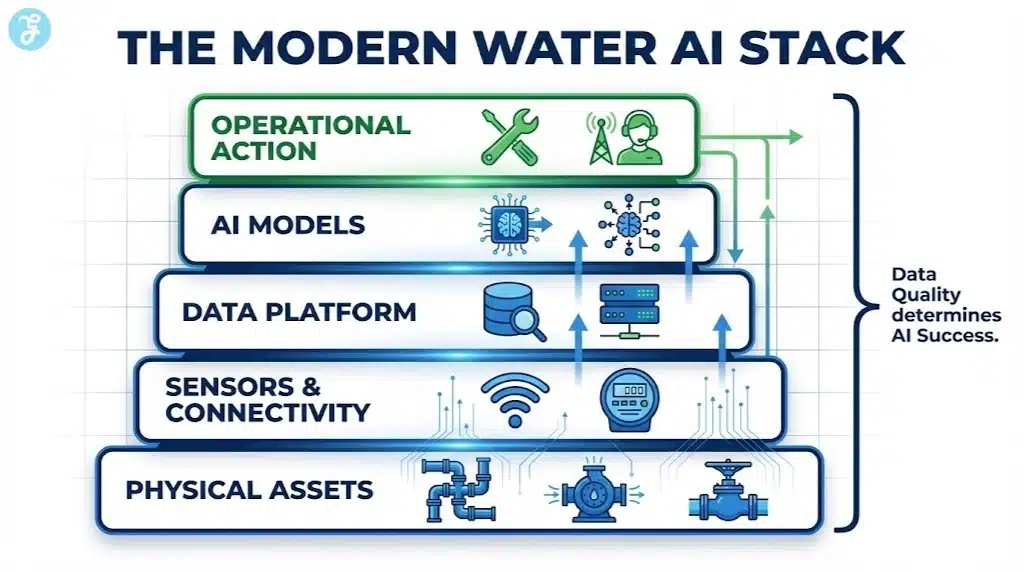
The Data Stack Behind Modern Water AI
Most systems rely on a stack like this:
- Sensors and meters that collect flow, pressure, acoustic, and quality data
- Connectivity that moves data reliably and securely
- A data platform that cleans and synchronizes data
- Models that detect anomalies and predict failures
- A user layer that supports dispatch, maintenance, and planning
If any layer is weak, performance suffers. Many failed projects do not fail because “AI does not work,” but because data quality and integration were not solved.
Smart Leak Detection: The Highest ROI Use Case
For many utilities, leak detection delivers the fastest return because non-revenue water can be a large financial burden. Leaks also cause structural damage, road washouts, and contamination risk when pressure drops allow intrusion.
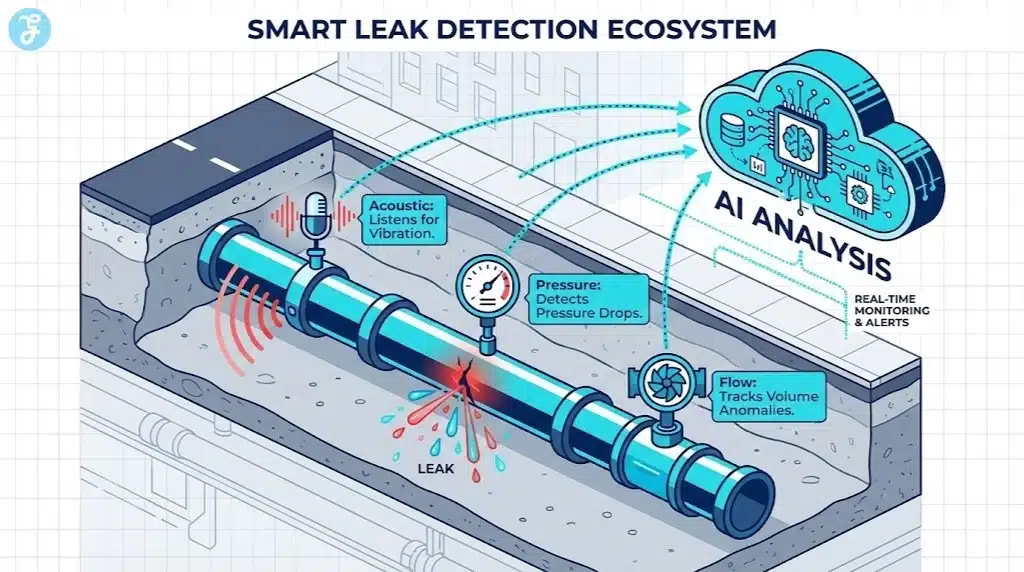
Traditional leak detection is often reactive. Crews respond after a visible break or a customer complaint. AI shifts this to proactive detection by analyzing pressure, flow, and acoustic patterns continuously.
How Smart Leak Detection Works
- Smart meters detect unusual household usage that suggests internal leaks.
- Machine learning models learn normal behavior and flag anomalies earlier.
Many utilities divide networks into district metered areas. AI can then compare inflow and consumption to estimate losses within that zone and narrow down search areas.
What AI Adds Compared To Manual Surveys
AI adds speed, coverage, and prioritization:
- It reduces time-to-detect, sometimes from weeks to hours.
- It narrows likely leak zones so crews do less searching.
- It reduces false alarms by learning normal daily and seasonal patterns.
- It helps prioritize repairs by estimating severity and risk.
This is why AI in water management is often introduced through leak detection first. The value is easy to understand, and the outcomes can be measured quickly.
Leak Detection Methods And Where They Fit
| Method | Data Used | Best For | Limits To Watch |
| Acoustic monitoring | Leak sound signatures | Pinpointing location on targeted mains | Needs sensor placement and calibration |
| Pressure analytics | Pressure transients and drops | Bursts, sudden events, zone anomalies | Harder to localize without zoning |
| Flow balance | Zone inflow versus usage | Identifying leaking zones | Depends on accurate metering and boundaries |
| Smart meter analytics | Customer usage patterns | Household leaks and unusual consumption | Requires smart meter coverage |
| Satellite and remote sensing | Surface moisture signals | Large-area scanning | Not real-time and can be noisy |
A strong program often mixes methods. It uses flow and pressure to find the zone, then acoustic tools to pinpoint the exact location.
Pressure Management: The Quiet Leak Prevention Strategy
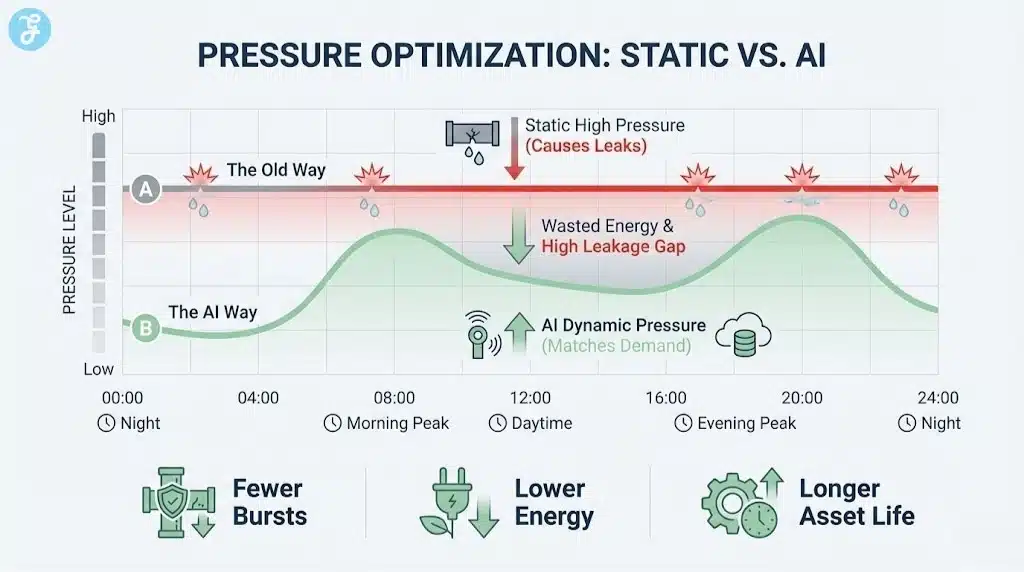
Leak detection finds problems. Pressure management prevents problems from expanding. High pressure increases leakage rate and stresses pipe joints. Even modest reductions can cut losses and reduce bursts in many systems.
AI helps pressure management by forecasting demand and adjusting setpoints dynamically. Instead of using one fixed pressure level all day, systems can lower pressure during low-demand hours and stabilize pressure during peak hours.
How AI Supports Pressure Optimization
- Forecasts demand by time and zone
- Adjusts pump schedules to reduce energy peaks
- Identifies zones with excessive pressure
- Detects pressure transients that damage pipes
- Suggests valve control strategies that smooth flow
Pressure optimization is one of the best examples of AI in water management delivering two wins at once: lower losses and lower energy.
Pressure Optimization Benefits That Show Up On Bills
- Reduced leakage volume
- Fewer emergency bursts
- Lower pumping energy costs
- Longer asset life for pipes and valves
- More stable service quality
Predictive Maintenance For Pumps, Valves, And Treatment Assets
Water utilities run on rotating equipment and control systems. Pumps, motors, and valves fail slowly before they fail suddenly. Predictive maintenance uses sensor data to identify early warning signs so maintenance can be scheduled before breakdown.
AI models can analyze:
- Vibration patterns
- Temperature drift
- Power draw changes
- Flow and head efficiency shifts
- Start-stop cycles and stress indicators
What Predictive Maintenance Improves
- Fewer emergency repairs
- Better uptime and service reliability
- Lower replacement costs over time
- Improved energy efficiency from well-tuned equipment
- Better staff planning and safer operations
Predictive Maintenance Signals And Actions
| Asset | Common Early Signals | Typical Action |
| Pumps | Vibration increase, efficiency drop | Inspect bearings and alignment |
| Motors | Temperature rise, current imbalance | Test insulation, check cooling |
| Valves | Irregular flow, pressure instability | Service actuator, check seals |
| Filters | Differential pressure increase | Clean or replace before breakthrough |
| Chemical dosing | Sensor drift, quality variance | Recalibrate, adjust dosing logic |
The biggest risk is alert fatigue. Models must be tuned so operators trust them. Otherwise, warnings get ignored, and value disappears.
AI-Driven Desalination: Why Optimization Matters
Desalination is essential in some regions, but it is sensitive to energy cost and operational stability. Reverse osmosis dominates modern desalination because it is generally more efficient than older thermal methods, but it still requires significant pressure and careful membrane management.
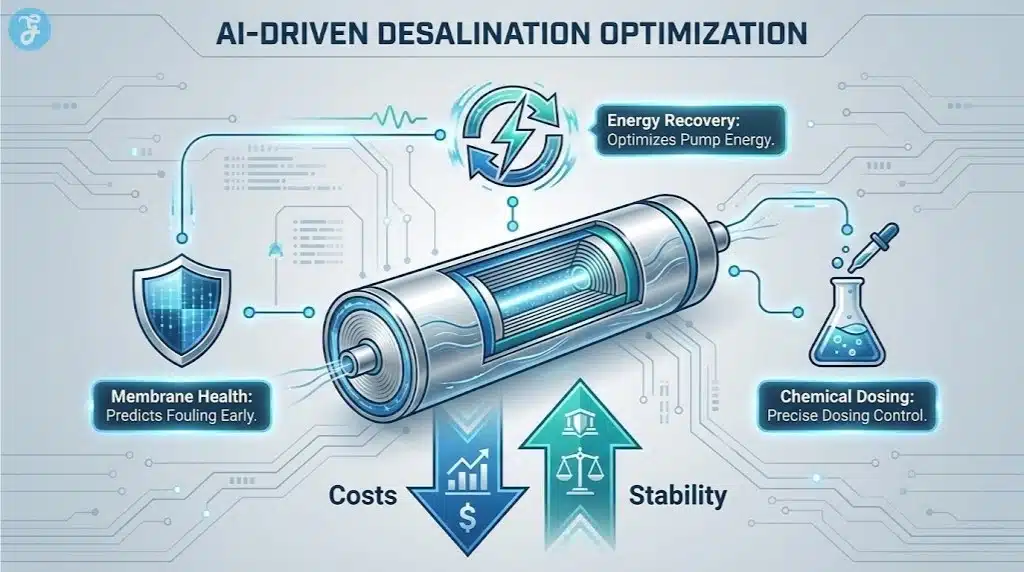
AI helps desalination plants reduce energy waste and protect membranes. It improves process stability during feedwater changes, and it supports better maintenance timing.
How Reverse Osmosis Desalination Works
At a high level:
- Seawater or brackish water is pre-treated to remove particles and biological matter
- High-pressure pumps push water through membranes
- Freshwater passes through, while salts remain in concentrated brine
- Energy recovery devices reduce net power consumption
- Post-treatment stabilizes water chemistry for distribution
Small deviations in pretreatment or pressure control can create large efficiency penalties. That makes desalination a good candidate for AI-driven optimization.
Where AI Helps Most In Desalination Plants
- Predicting membrane fouling before performance collapses
- Optimizing pressure setpoints to minimize energy per unit water
- Detecting sensor drift that misleads control systems
- Adapting operations to changing salinity, temperature, and turbidity
- Optimizing chemical dosing to protect membranes without waste
This is one reason AI in water management is increasingly tied to desalination in policy and investment conversations.
Membrane Fouling: The Core Performance Bottleneck
Membrane fouling increases resistance. The plant must push harder to maintain output, which increases energy use. Fouling also increases cleaning frequency, chemical consumption, and downtime.
AI helps by analyzing trends that signal early fouling, such as:
- Rising differential pressure across membranes
- Drift in salt rejection performance
- Changes in flow at constant pressure
- Increases in pump power draw for the same output
With early detection, operators can intervene before energy cost spikes.
How AI Changes Membrane Maintenance
Instead of cleaning on fixed schedules, plants can move toward condition-based maintenance:
- Clean when indicators show rising fouling risk
- Adjust pretreatment to reduce particle load
- Optimize chemical dosing based on real feedwater conditions
- Identify which membrane trains are degrading faster
Condition-based maintenance reduces waste because it avoids unnecessary cleaning while preventing severe fouling events.
Energy Optimization In Desalination: The Largest Operational Prize
Energy is often the biggest cost in desalination. AI can reduce energy by optimizing pump control, improving energy recovery performance, and stabilizing operating conditions.
Desalination Optimization Areas
| Area | What AI Watches | Why It Matters |
| Pump efficiency | Power, flow, head curves | Reduces wasted electricity |
| Pressure control | Setpoints and transients | Minimizes energy per unit output |
| Energy recovery | Device performance trends | Improves net efficiency |
| Pretreatment stability | Turbidity and particle load | Reduces fouling and downtime |
| Chemical dosing | Quality targets and drift | Avoids overuse and protects membranes |
If a plant reduces energy per unit water even slightly, the financial and climate impact can be large over the years of operation.
Around this point in the article, it helps to restate the focus in a practical way: AI in water management becomes most valuable when it reduces energy per unit water delivered while improving reliability.
Smart Metering And Customer-Side Water Intelligence
Utilities often focus on the supply side, but customer-side leakage can be significant too. Smart meters and analytics allow utilities to detect abnormal patterns and alert customers quickly.
AI can identify:
- Constant low flow that suggests a hidden leak
- Sudden consumption spikes that suggest a burst pipe
- Night-time usage that suggests irrigation or toilet leaks
- Seasonal patterns that indicate overwatering or system faults
Customer Analytics Patterns And Typical Causes
| Detected Pattern | Likely Cause | Useful Response |
| Constant low flow | Hidden leak or running toilet | Notify customer with simple test steps |
| Sharp spike | Appliance failure or burst | Immediate alert and shutoff guidance |
| Night-time usage | Irrigation leak or mis-schedule | Recommend inspection and adjustments |
| Neighborhood shift | Zone leak or meter drift | District investigation and calibration |
| Frequent short bursts | Faulty valve or pressure issue | Maintenance check and pressure review |
Customer-side programs work best when they are supportive, not punitive. Clear messaging and easy next steps improve adoption and reduce frustration.
Water Quality Monitoring And Treatment Optimization
Water treatment is a continuous control problem. Operators balance disinfection, filtration, chemical dosing, and regulatory targets. Sensor drift, changing raw water quality, and equipment wear can cause instability.
AI can support:
- Early warning for quality deviations
- Better dosing control to prevent overuse
- Predictive monitoring for filtration performance
- Faster anomaly detection for contamination risk
- More stable operations with fewer manual interventions
The benefit is not only compliance. Stable treatment can reduce chemical waste, prevent emergency responses, and reduce energy use through smoother operations.
Why Treatment AI Needs Careful Governance
Water quality is high-stakes. AI recommendations should be explainable and audited. Operators need visibility into what the model is using and why it is recommending changes. This is where utility-grade AI differs from consumer AI. It must be controlled, tested, and accountable.
Operational Reality: Why Some AI Water Projects Fail
AI in water management can succeed, but it is not plug-and-play. Many deployments underperform because the basics were not addressed.
Common reasons include:
- Sensors were installed sparsely or inconsistently
- Data streams were noisy, missing, or not synchronized
- The network model was outdated, so zones did not match reality
- Alerts did not connect to dispatch and maintenance workflows
- Staff were not trained, so tools were ignored
- Vendors delivered dashboards, not operational change
A strong program treats AI as a system upgrade, not a software subscription.
A Deployment Readiness Checklist
- Asset inventory is accurate and updated
- Zones are clearly defined and maintained
- Sensors are calibrated and monitored for drift
- Data governance is established with ownership
- Response workflows are documented and staffed
- Performance metrics are agreed and measured monthly
If these are missing, AI will not deliver its promise.
Cybersecurity And Privacy: Non-Negotiable In Water Systems
Water utilities are critical infrastructure. Adding connectivity increases risk. Smart meters also produce sensitive usage data that can reveal household patterns.
A credible AI program includes:
- Network segmentation between operational tech and IT systems
- Strong authentication and access controls
- Regular patching and vendor accountability
- Monitoring for anomalies and intrusion attempts
- Clear data minimization and privacy practices for customer data
Security is not a bonus feature. It is part of whether AI in water management is safe to deploy.
How To Evaluate AI Water Solutions Without Falling For Buzzwords
Water tech vendors often market “AI-powered” systems. The safest evaluation focuses on outcomes and operational fit.
Questions That Reveal Real Value
- How much did non-revenue water drop after deployment, in measurable terms?
- How much did time-to-detect and time-to-repair improve?
- How are false positives handled and reduced over time?
- Does the tool integrate with existing dispatch and asset systems?
- What is the security architecture and incident response plan?
- How are results reported, and are they independently validated?
AI Water Management Scorecard
| Category | What Strong Looks Like | What Weak Looks Like |
| Measured impact | Clear reduction in losses and repairs | No baseline, no outcome reporting |
| Operational integration | Alerts tied to work orders | Alerts with no workflow |
| Model transparency | Accuracy and false positive tracking | Black box with vague claims |
| Data quality handling | Drift detection and calibration plan | Assumes sensors stay perfect |
| Security | Segmented architecture and audits | Security added late or ignored |
| Scalability | Works across seasons and zones | Breaks when conditions change |
A mature solution is one that can explain limitations clearly. Overconfident marketing is often a red flag.
How AI In Water Management Fits The Green Tech Revolution
The Green Tech Revolution is about efficiency and system redesign. Water is one of the most direct places where efficiency becomes real-world benefit. Most people do not see leaks, pump inefficiency, or membrane fouling. AI turns these invisible costs into actionable signals.
AI in water management supports sustainability because it:
- Reduces water waste in distribution systems
- Lowers energy use per unit water delivered
- Extends infrastructure life, reducing replacement emissions
- Improves resilience during drought and climate stress
- Stabilizes quality and reliability without constant expansion
In many regions, the cleanest “new supply” is the water you stop losing. AI helps unlock that supply without building entirely new plants.
Conclusion
AI in water management is one of the most practical sustainability technologies in modern infrastructure. Smart leak detection reduces non-revenue water and prevents failures from becoming emergencies. Pressure optimization reduces leakage and pumping energy. Predictive maintenance improves reliability and lowers long-term costs. In desalination, AI improves membrane performance, reduces energy waste, and stabilizes output quality.
The technology is real, but the value depends on implementation. Data quality, sensor coverage, workflow integration, and cybersecurity determine whether AI becomes a high-impact efficiency engine or an expensive dashboard that operators ignore.
The most credible programs focus on measurable outcomes: fewer losses, faster repairs, lower energy per unit water, longer asset life, and more resilient service. When those results are achieved, AI in water management stops being a buzzword and becomes a real upgrade to the systems that keep cities alive.