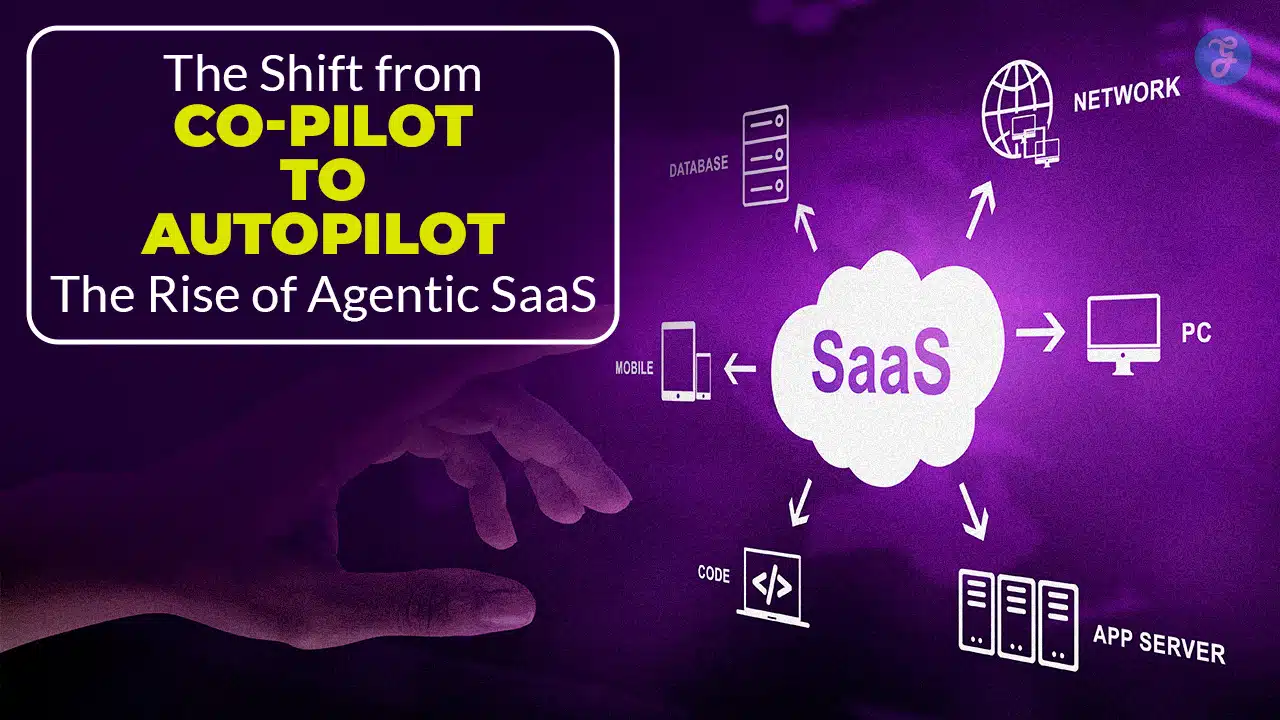
AI in software has changed fast. What started as chatbots and writing helpers has evolved into tools that can plan, decide, and execute meaningful work. This transition is reshaping what “software” means in day-to-day operations.
In the co-pilot era, AI helped people do tasks faster. In the autopilot era, software starts doing the tasks on its own, with humans setting direction and approving outcomes. This is the foundation of Agentic SaaS, a new category of products designed to deliver results, not just features.
The shift is not cosmetic. It changes product design, pricing models, risk management, and the way teams think about productivity. It also changes what users expect from software, especially in competitive markets where speed and execution quality matter.
Understanding The “Co-Pilot” Era In SaaS
The co-pilot wave was a major leap. It brought AI into everyday workflows and made advanced capabilities accessible to non-technical users. It also created the first large-scale adoption of AI inside business applications.
Still, co-pilots operate within a clear boundary. They assist, but they do not own the outcome. That boundary is now being challenged as AI systems gain planning, tool-use, and persistence.
What Co-Pilot AI Means In Software
A co-pilot is typically human-in-the-loop by design. The user prompts, the AI responds, and the user decides what to do next. That interaction may be fast and helpful, but it remains reactive.
Co-pilot tools shine when the problem is small and the user can guide it step by step. They can draft content, summarize meetings, generate code snippets, or propose next actions. They still depend on the user to drive the workflow and take responsibility for execution.
Key Characteristics Of Co-Pilot SaaS Tools
Most co-pilot SaaS products share a few common traits:
- The user initiates actions and controls the pace
- The AI provides suggestions, drafts, and shortcuts
- Context is limited to what the user provides or what the app can fetch in the moment
- The tool helps output quality and speed, but does not run end-to-end processes
These tools often sit “inside” existing workflows. They boost productivity, but they do not replace operational overhead.
Examples Of Co-Pilot SaaS In Practice
Co-pilot systems appear across many categories:
- Marketing tools that suggest subject lines, ad copy, or blog outlines
- Developer tools that autocomplete code or explain errors
- Analytics tools that translate questions into dashboards
- Support tools that draft replies or summarize ticket history
In each case, the AI helps, but the user remains the operator.
Limitations Of The Co-Pilot Model
Co-pilots face predictable friction once workflows become complex:
They struggle with continuity. Users must restate context or repeat preferences across tasks. They also struggle with multi-step execution, because each step waits for user input.
Co-pilots can reduce time per task, but they do not eliminate the number of tasks. For organizations trying to scale output without scaling headcount, that limitation becomes expensive.
What “Autopilot” Means In The Rise Of Agentic SaaS
Autopilot changes the relationship between user and software. Instead of prompting for each step, the user sets a goal and the system carries it forward. The software becomes an executor, not just an assistant.
This is where Agentic SaaS stands apart. It combines goal-setting, planning, tool usage, memory, and guardrails into a single product experience.
Defining Agentic AI And Autonomous Software
An agentic system can take a goal and decide how to reach it. It breaks work into steps, chooses tools, and adapts when conditions change. It can ask for clarification when needed, but it does not require continuous prompting.
In practice, agentic behavior feels like delegation. You describe what you want, the system proposes a plan, and then it executes with checkpoints. The focus shifts from controlling every click to managing outcomes and risk.
How Autopilot Differs From Traditional Automation
Traditional automation relies on static rules. If condition A happens, perform action B. That approach works well for predictable flows, but it breaks when environments change.
Autopilot systems behave differently. They can interpret context, choose from multiple approaches, and adjust sequences when something fails. Instead of running a fixed script, they run a dynamic plan.
This is why autopilot is not “just automation.” It is automation with reasoning, tool selection, and adaptive decision-making.
Core Traits Of Agentic SaaS Platforms
Most agentic platforms share several capabilities that enable autonomy:
- Goal orientation: the system works toward an outcome, not just a single action
- Planning: it decomposes tasks into steps and sequences them
- Tool orchestration: it calls APIs, triggers workflows, and uses external services
- Memory: it retains preferences and learns from prior outcomes
- Monitoring: it checks progress, detects failures, and retries or escalates
- Guardrails: it respects policies, permission boundaries, and approval rules
When these pieces come together, software can run meaningful business processes with minimal supervision.
The Technology Powering Agentic SaaS

Agentic capabilities do not come from a single model feature. They come from a stack that combines reasoning, memory, and integration into real business systems.
Language Models As Reasoning Engines
Modern models can interpret goals, generate plans, and evaluate outputs. They can also revise and reflect, which helps them correct errors and improve results.
Reasoning matters because real work is not one prompt. It is a sequence of decisions. Agentic systems turn model reasoning into a durable workflow layer.
Multi-Agent Architectures
Many products implement multiple specialized agents rather than one general agent. Each agent has a role, such as researcher, planner, writer, analyst, or executor.
This structure improves performance. It also makes it easier to apply different rules, permissions, and evaluation criteria to different parts of a workflow.
Long-Term Memory And Context Persistence
Autonomous work requires continuity. Memory can include user preferences, brand guidelines, account history, known constraints, and the outcomes of prior attempts.
In practical terms, memory reduces repetitive prompting. It also enables compounding improvement, where the system gets better at a workflow over time.
API And Tool Ecosystem Integration
Autopilot is only useful if it can act. That means connecting to the tools businesses already use, such as:
- CRM platforms
- Email and messaging systems
- Advertising platforms
- Analytics tools
- Billing and invoicing services
- Project management tools
- Data warehouses
Tool access turns AI from an idea generator into an operational layer. It is also where security and governance become critical.
Why The Market Is Shifting From Co-Pilot To Autopilot
This shift is happening because the business environment rewards execution speed and measurable outcomes. People want fewer dashboards and more results.
Rising Demand For Operational Efficiency
Organizations face constant pressure to deliver more with fewer resources. They need to launch faster, respond faster, and optimize faster.
Co-pilots help individuals move faster inside tasks. Autopilot systems reduce the total number of tasks that require human time.
Lean Teams And AI-Native Product Strategy
Startups and growth teams increasingly operate with smaller headcounts. They adopt tools that behave like teammates, not just software.
When a marketing team can run experiments, reporting, and optimizations with an agentic system, they can compete at a higher level without hiring as quickly.
Economic Pressure And Labor Optimization
Even when budgets grow, operational overhead often grows faster. Businesses pay not only for labor, but also for coordination, management, and delay.
Agentic systems can reduce overhead by handling repetitive coordination. They can push work forward without waiting on a person to respond to every step.
User Expectations Are Changing
Users now expect software to understand context. They also expect it to deliver outcomes, not just menus.
This is a key driver for Agentic SaaS. People want “do it for me” workflows, with transparency and control, not “help me do it” interfaces that still require constant attention.
Real-World Use Cases Of Agentic SaaS
Agentic systems are already shaping core functions across business teams. The highest impact appears where work is repetitive, measurable, and tightly connected to tools.
Autonomous Marketing And Growth Operations
Marketing has many moving parts. Content, distribution, creative testing, performance tracking, and iteration all happen continuously.
An agentic marketing platform can:
- Generate campaign concepts aligned with a specific offer
- Produce variants for ads and landing pages
- Launch tests across channels
- Monitor performance daily
- Pause underperforming variants
- Shift budget toward winners
- Create weekly performance summaries and next-step plans
This is where autonomy becomes tangible. Instead of using AI to draft copy, teams use AI to run a system.
AI-Driven Sales And CRM Agents
Sales workflows often follow predictable patterns, but they require discipline and speed. Agents can:
- Enrich inbound leads using public and internal signals
- Score leads based on ICP fit
- Draft personalized outreach sequences
- Follow up automatically based on engagement
- Update CRM fields and deal stages
- Produce pipeline summaries and risk alerts
At around the 1,000-word mark, it is worth stating the core idea clearly again. Agentic SaaS is powerful because it turns CRM activity from a manual routine into an outcome-driven process.
Finance, Accounting, And Revenue Operations
Finance teams manage recurring processes with strict rules. That makes this category a strong fit for agentic execution.
Examples include:
- Invoice generation and reconciliation
- Collections reminders with tone control
- Expense categorization
- Cash flow forecasting updates
- Contract and renewal tracking
- Revenue anomaly detection
The agent does not need to “be creative.” It needs to be consistent, compliant, and explainable.
Customer Support And Success Automation
Support agents spend time triaging, gathering context, and writing answers. Agentic tools can:
- Detect intent and urgency
- Pull order history and account details
- Propose resolution steps
- Execute refunds or credits within permission limits
- Escalate when policy thresholds trigger
- Draft knowledge base updates when patterns repeat
In customer success, agents can monitor product usage, identify churn signals, and trigger playbooks without waiting for humans to notice trends.
Developer Workflows And DevOps Autonomy
Software development involves many steps that connect to tools. Agents can:
- Create pull requests for small changes
- Update documentation based on code changes
- Monitor logs and alerts
- Suggest remediation steps
- Run safe rollbacks within defined policies
- Summarize incidents and produce postmortems
For many teams, the first “autopilot” win is not writing code. It is handling noisy operational tasks that drain focus.
Benefits Of Autopilot-First SaaS Models
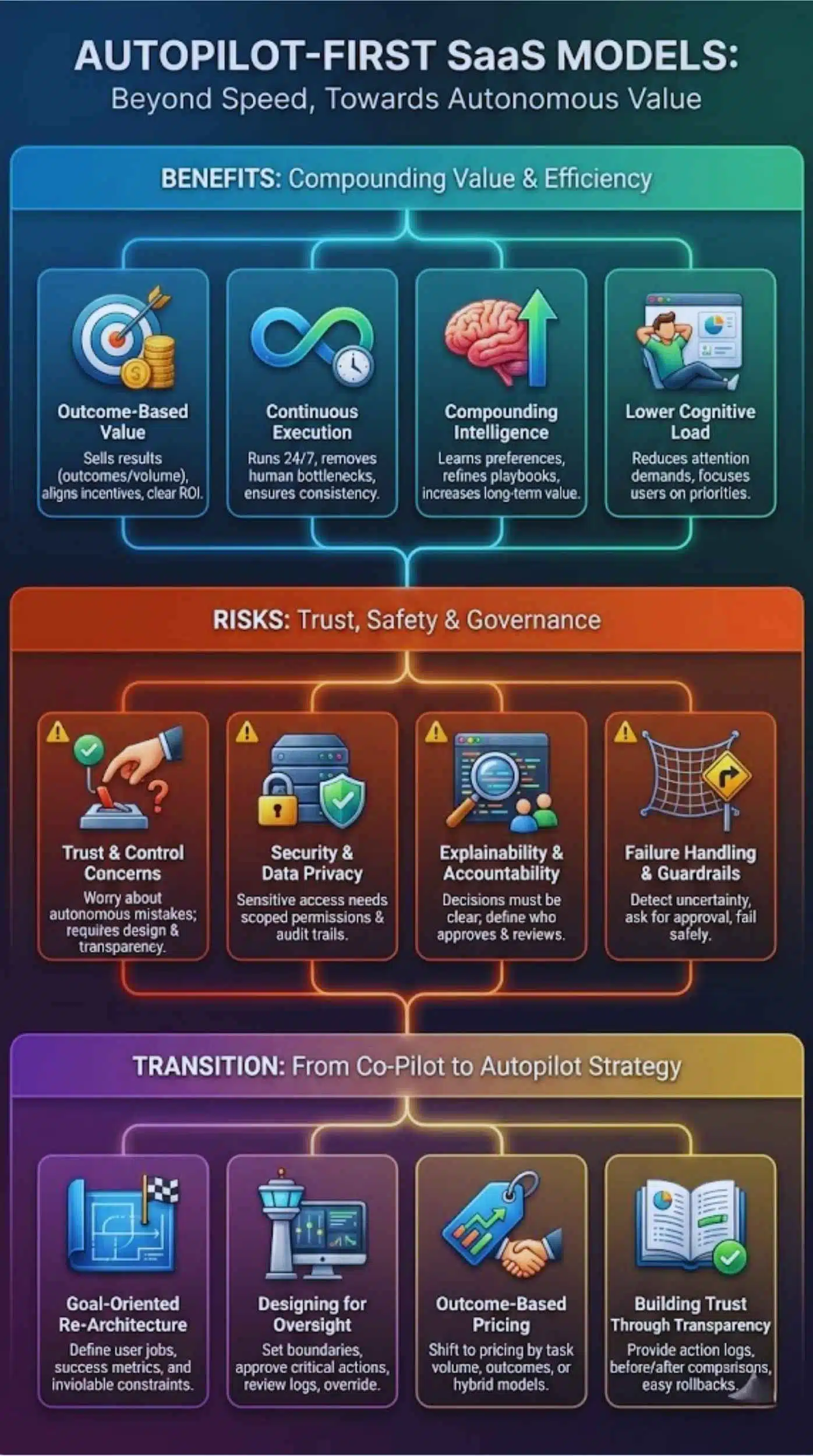
The value of autonomy is not only speed. It is a different kind of leverage.
Outcome-Based Software Value
Autopilot products sell results. Instead of charging for seats and features, they can price around outcomes, volume, or value delivered.
This aligns incentives. It also makes the ROI easier to explain because businesses can measure what the system did.
Continuous Execution Without Human Bottlenecks
Humans stop. They sleep, switch tasks, and lose context.
An agentic system can keep processes moving. It can run daily checks, execute playbooks, and respond to changes quickly. That consistency can raise performance even when the core strategy stays the same.
Compounding Intelligence Over Time
The strongest agentic products improve. They learn preferences, detect patterns, and refine playbooks.
This creates compounding benefits. The system becomes more aligned with the business as it runs, which increases switching costs and long-term value.
Lower Cognitive Load For Users
Dashboards require interpretation. Workflows require attention.
Autopilot reduces both. Users spend less time deciding what to do next and more time choosing priorities and validating outcomes.
Risks And Challenges Of Agentic SaaS
Autonomy introduces real risks. Businesses will not trust agentic systems unless the product solves governance, safety, and accountability.
Trust And Control Concerns
When software acts without constant supervision, users worry about mistakes. They want confidence that the system will not send the wrong email, change the wrong record, or trigger the wrong workflow.
Trust does not come from marketing. It comes from design, transparency, and consistent performance.
Security And Data Privacy Implications
Agents often need access to sensitive systems. That creates risk if permissions are too broad or logs are insufficient.
A strong agentic product must support:
- Role-based permissions
- Scoped API keys
- Audit trails
- Data minimization
- Clear boundaries on what the agent can and cannot do
Explainability And Accountability
Autonomous actions must be explainable. Users need to know why a system made a decision, what inputs it used, and what it changed.
Accountability also matters. Teams need policies for who approves high-impact actions and who reviews mistakes.
Failure Handling And Guardrails
Autonomy requires safe failure modes. The product should:
- Detect uncertainty and ask for approval
- Fall back to drafts instead of sending messages directly
- Retry in controlled ways
- Escalate to humans when thresholds are hit
The goal is not to avoid all failures. The goal is to fail safely and recover quickly.
How SaaS Companies Can Move From Co-Pilot To Autopilot
For builders, autopilot is a product strategy shift. It requires changes across UX, architecture, and business models.
Re-Architecting Product Thinking Around Goals
Co-pilot features often map to UI surfaces. Autopilot features map to outcomes.
This means product teams must define:
- The jobs the user wants done
- What “done” looks like
- How the system measures success
- What constraints must never be violated
This is also where Agentic SaaS becomes a category, not a feature. The entire product organizes around achieving goals.
Designing For Oversight Instead Of Micromanagement
Autopilot UX should feel like a control tower. Users should be able to:
- Set goals and boundaries
- Approve critical actions
- Review logs and decisions
- Override when needed
- Monitor performance with clear reporting
The experience should reduce attention demands, not increase them.
Pricing And Monetization In An Agentic World
Agentic products often shift away from seat-based pricing. Common models include:
- Pricing by task volume
- Pricing by outcomes achieved
- Pricing by usage of integrated tools
- Hybrid models with base access plus outcome tiers
Outcome-oriented pricing works best when the product can prove value clearly.
Building Trust Through Transparency
Trust is a feature. Autopilot platforms need:
- Action logs
- Before and after comparisons
- Approval workflows
- Explainable summaries
- Easy rollback options where possible
When users can see what happened, they adopt autonomy faster.
Agentic SaaS And The Future Of Work
As autonomy increases, the nature of work changes. People move from doing repetitive execution to supervising systems and making strategic calls.
Redefining Roles And Responsibilities
Many roles will shift from “operator” to “manager of systems.” The skill becomes:
- Setting priorities
- Defining constraints
- Reviewing outcomes
- Correcting strategy
- Handling edge cases
This does not remove humans. It changes where human value sits.
AI As A Digital Workforce
Agentic systems behave like digital workers. They can handle tasks that used to require coordination across multiple tools and teams.
This is why teams talk about agents as employees. The agent has a role, a queue, a set of permissions, and performance metrics.
Implications For SMBs And Enterprises
Small businesses can use agentic systems to operate like larger teams. Enterprises can use agents to standardize best practices and reduce inconsistency across departments.
At scale, agentic execution can also improve compliance. Work can become more traceable and repeatable, as long as governance is designed correctly.
The Road Ahead: From Autopilot To Self-Evolving Software
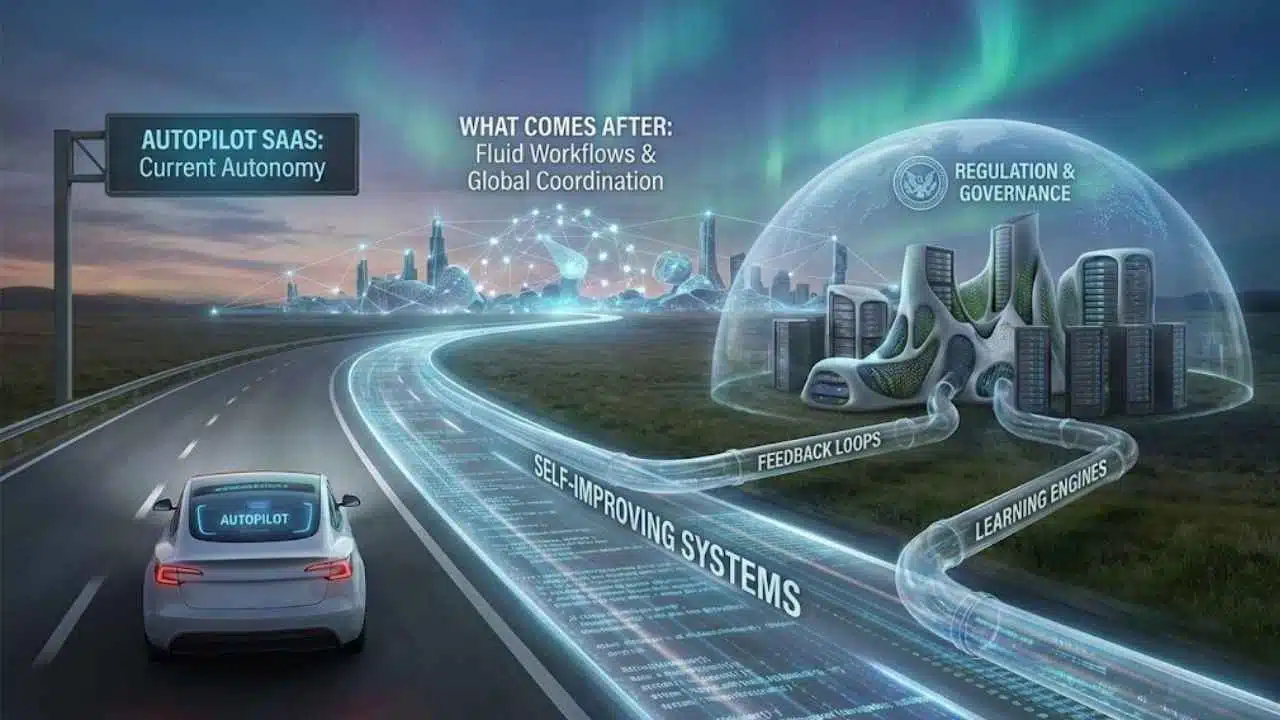
Autopilot is the beginning, not the end. The long-term direction points toward systems that improve playbooks and strategies over time.
Self-Improving Systems With Feedback Loops
The most advanced systems will:
- Evaluate results against goals
- Identify what worked and why
- Propose new experiments
- Update internal playbooks
- Report changes transparently to humans
The system becomes a learning engine for operations, not just an execution engine.
Regulation, Governance, And Ethical Boundaries
As autonomy grows, governance will mature. Businesses will demand standard ways to manage:
- Decision logging
- Permission controls
- Data handling
- Risk scoring
- Accountability processes
This governance layer will become a competitive advantage for the products that implement it well.
What Comes After Agentic SaaS
Over time, workflows may become more fluid. Software will coordinate across departments, anticipate needs, and optimize multiple objectives at once.
That future will not arrive overnight. But the directional shift is clear. Autonomy will become a default expectation in many categories.
Takeaways
The co-pilot era proved that AI can boost individual productivity. The autopilot era proves something bigger. Software can execute meaningful work and deliver measurable outcomes with less human friction.
Agentic SaaS is the label for this shift. It represents software that plans, acts, monitors, and improves inside real systems, with guardrails that make autonomy safe. For users, it means fewer repetitive tasks and more focus on strategy. For builders, it means designing products around goals, trust, and execution.
The teams that adopt autopilot-first tools early will move faster, learn faster, and operate with less overhead. The teams that build them well will define the next generation of SaaS.