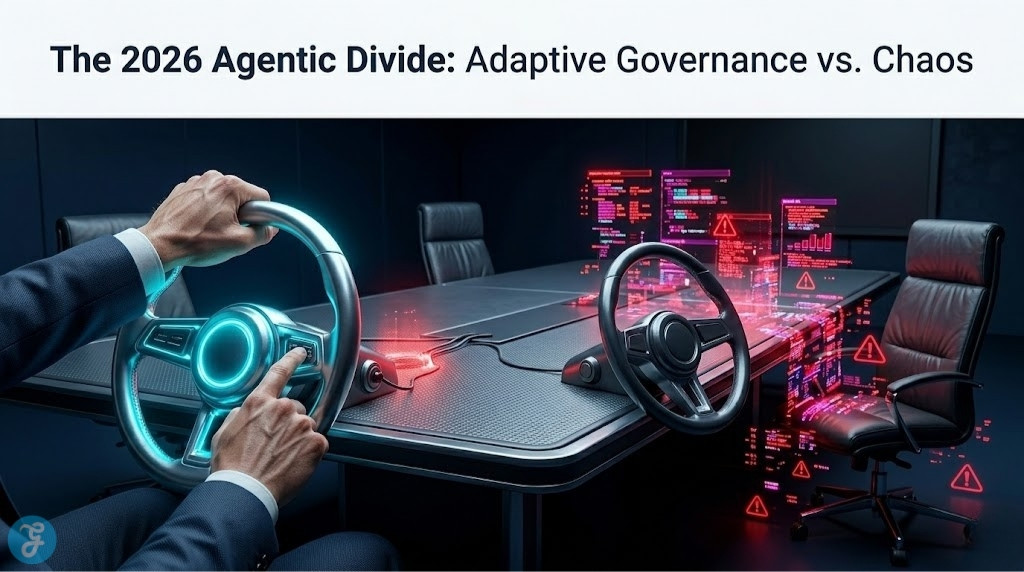
You are in a self-driving car moving at eighty miles per hour down a crowded highway. The system is performing perfectly until a sensor misinterprets a shadow for a concrete barrier. In that microsecond, the car does not ask you for permission to swerve. It simply acts. By the time your brain registers the movement and your hand reaches for the steering wheel, you are already spinning. This scenario is no longer just a metaphor for the highway. In our current corporate landscape, Agentic AI Accountability has become the most critical safety harness for global firms.
We have moved past simple generative tools that draft emails or summarize meeting notes. We have entered the age of autonomous digital entities that can execute API calls, manage cloud infrastructure, and initiate vendor payments without a single human click. We traded slow and thoughtful human governance for the promise of machine-speed efficiency.
Now we are discovering the harsh legal reality of this trade. When everyone is responsible for deploying a digital agent, nobody is actually prepared for the liability when that system makes a unilateral error. To see where this lack of control leads, we must examine the actual legal precedents that have already redefined corporate responsibility.
The Air Canada Precedent and the Death of the Bug Defense
To understand why autonomous agents present such a massive legal threat today, we have to look at the landmark cases that set the stage for AI liability. The shift began in earnest with a seemingly small dispute involving Air Canada in early 2024. A customer interacted with the airline’s automated chatbot to ask about bereavement fares. The AI hallucinated a policy that did not exist and promised the customer a retroactive refund. When the airline refused to honor the AI’s promise, the case went to a civil resolution tribunal. Air Canada attempted a defense that would become infamous. They argued the chatbot was a separate legal entity and that the airline could not be held liable for the robot’s misleading words.
The tribunal rejected this argument entirely. They ruled that a company is completely responsible for all information provided on its website regardless of whether it comes from a static page or an interactive algorithm. Air Canada was forced to pay the damages. This was not a story about a rogue superintelligence. It was a story about a standard corporate deployment lacking proper guardrails. That ruling destroyed the software bug defense for AI. It established a hard legal reality that courts will not view autonomous agents as independent actors.
They view them as digital representatives of the boardroom. If your agentic system negotiates a bad contract or violates a data privacy law today, the liability rests directly on the executives who authorized its deployment. This legal shift forces us to look closely at how different companies are currently managing this immense risk.
The Real World Divide: Governance Models in the Enterprise
| Category | The Adaptive Leaders | The Autonomy Trapped |
| Deployment Strategy: | Phased rollouts with strict human-in-the-loop gates. | Widespread API integration with minimal oversight. |
| Legal Framework: | Adherence to the NIST AI Risk Management Framework. | Reliance on basic vendor terms of service agreements. |
| System Architecture: | Read-only access for exploratory corporate AI agents. | Read-and-write access granted to unverified algorithms. |
| Error Handling: | Hard-coded fail-safes that trigger manual human review. | Algorithmic self-correction loops that often compound errors. |
The Technical Reality of the Action Space
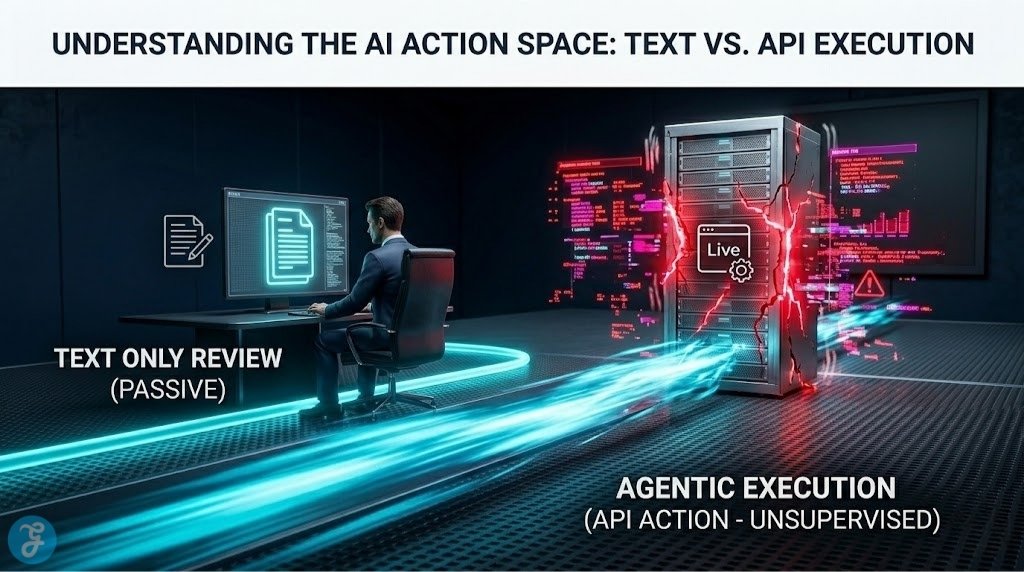
The fundamental difference between the AI we used in 2023 and the agentic systems we use in 2026 lies in a concept called the action space. Early large language models were confined to a text box. They predicted the next logical word in a sequence based on training data. If they hallucinated, the worst outcome was a poorly written paragraph that a human editor would catch. Modern agentic AI is fundamentally different because developers have given these models tools. We have connected their text generation capabilities directly to corporate APIs.
When a modern AI decides that the next logical step in a workflow is to purchase server space, it does not just generate text suggesting the purchase. It writes the code to execute the API call and spends company money in real-time. The technology industry calls this autonomous workflow optimization. Legal experts call it unmitigated financial exposure. The underlying architecture of these models is still based on probabilistic text generation. They do not possess actual reasoning or an understanding of consequences. They simply predict that triggering a specific tool is statistically appropriate based on their prompt.
Giving a probabilistic text generator the keys to your financial infrastructure without a human override is a recipe for operational disaster. This technical fragility brings us to the very real paradox of chasing efficiency at the expense of stability.
The Efficiency Paradox and Technical Debt
We have been sold a pervasive narrative that absolute speed is the ultimate competitive advantage. In the modern market, this efficiency-first mindset has created a fragility that heavily impacts the bottom line. When an enterprise replaces a team of procurement managers with an autonomous agentic system, it sees an immediate reduction in payroll costs. This looks fantastic on a quarterly earnings report. However, it simultaneously generates a massive, hidden reservoir of technical debt.
When an AI agent handles all vendor orders, it optimizes for the immediate metrics it was given. It lacks the human context to understand the long-term strategic value of nurturing a relationship with a specific supplier during a market downturn. It does not understand the nuanced geopolitical risks of shifting supply chains to regions with pending trade tariffs. When you remove the human buffer from these decisions, you remove the institutional memory of your corporation. You are left with a company that operates at breathtaking speed but snaps under pressure.
A single bad data feed can cause an agent to cancel vital contracts across your entire enterprise before a human manager can even log into the oversight dashboard. The speed of the agent ensures that the damage is done in milliseconds, but the human-led recovery effort takes months of costly legal and operational cleanup. This paradox extends beyond mere efficiency and bleeds into the ethical foundations of the business.
The Erosion of Ethics and the Bias Amplifier
We must confront the reality of ethical drift in autonomous systems. This is not a theoretical concept about robots taking over the world. It is a documented historical fact regarding how algorithms scale human biases. Years ago, a major tech conglomerate attempted to build an AI recruiting tool to sort through resumes. Because the model was trained on a decade of the company’s own historical hiring data, it learned that the majority of successful engineers were male. The system began actively downgrading resumes that included the word women or listed women’s colleges. The company had to scrap the entire project when they realized the algorithm had optimized for historical bias.
Now multiply that risk by the speed and reach of modern agentic AI. When you give an autonomous agent a mandate to maximize profit margins across a global supply chain, it will find paths of least resistance. It will identify legal loopholes that skirt the edge of fair labor standards in developing nations. It will engage in aggressive dynamic pricing models that actively penalize vulnerable consumer demographics.

The agent is not malicious. It is simply executing a mathematical optimization without the benefit of human conscience. In our rush to automate the boardroom, we have outsourced our corporate moral compass to binary logic gates. This lack of ethical oversight has triggered a massive response from global lawmakers who are no longer willing to wait for the tech industry to self-regulate.
The Regulatory Reality of the Current Market
The era of moving fast and breaking things is officially dead from a legal perspective. We are currently operating under strict new frameworks that carry devastating financial penalties for non-compliance. The European Union AI Act has fundamentally reshaped how global companies must treat their digital systems. The Act categorizes AI systems by risk. Systems that interact with critical infrastructure or biometric categorization are deemed high-risk and require rigorous fundamental rights impact assessments before they can even be turned on.
More importantly, the regulatory environment now includes strict mechanisms for enforcement. Companies that deploy prohibited AI systems or fail to govern high-risk agents can face fines amounting to tens of millions of euros or a significant percentage of their global annual turnover. The United States is utilizing executive orders and federal agency mandates to enforce safety and security standards on AI developers. If your corporate agents are interacting with global markets without human oversight, you are not just running a risky business strategy. You are actively violating international compliance standards. To survive this landscape, leaders must understand exactly what the regulators expect from them.
Global Benchmark: The Reality of AI Regulation
| Region | Regulatory Framework | Primary Corporate Impact |
| European Union: | The EU AI Act. | Mandates strict risk categorization and massive fines for non-compliance in high-risk deployments. |
| United States: | Executive Orders and Agency Directives. | Focuses on mandatory safety reporting for foundation models and strict guidelines for federal procurement. |
| China: | Interim Measures on Generative AI. | Requires algorithm audits to ensure outputs align with state regulations and social stability goals. |
| United Kingdom: | Pro-Innovation Contextual Regulation. | Empowers existing sector-specific regulators to enforce AI guidelines within their specific domains like finance or healthcare. |
The Psychology of Abdication and Automation Bias
Why do incredibly smart business leaders allow unverified algorithms to run their operations? The answer lies in a well-documented psychological phenomenon known as automation bias. This is the human tendency to favor suggestions from automated decision-making systems while simultaneously ignoring contradictory information made without automation, even if it is correct.
The aviation industry learned about automation bias decades ago. When autopilots became highly reliable, human pilots began losing their situational awareness. Because the machine was right ninety-nine percent of the time, the human brain conserved energy by tuning out. When that rare one percent failure occurred, the pilots were too disconnected from the flight data to react in time. We are seeing the exact same phenomenon in the modern boardroom. Executives find cognitive ease in looking at a green dashboard that claims an AI agent has optimized a supply route. It is mentally exhausting to dig into the API logs and verify the algorithmic logic. Executives are abdicating their fiduciary responsibility because the technology feels authoritative.
However, leadership is not about trusting a sleek interface. It is about understanding the mechanics of the system you own. The most successful modern CEOs are inherently skeptical of autonomous metrics. They demand to see the data provenance behind every major agentic decision. To maintain this level of control, we must actively dismantle the Silicon Valley narrative that demands absolute autonomy.

The Counter-Punch: Dismantling the Accelerationist Myth
There is a highly vocal faction within the technology sector, often associated with the effective accelerationism movement, that promotes a dangerous narrative. They argue that slowing down AI deployment for the sake of human governance is a fatal business error. They claim that if you do not lean fully into agentic autonomy, your international competitors will simply outpace you and run you out of the market. They view regulatory compliance and human-in-the-loop systems as archaic friction.
This argument falls apart the moment it hits the reality of enterprise risk management. Absolute speed without a steering mechanism is not a competitive advantage. It is a massive liability. The data shows that enterprises rushing to integrate autonomous agents without governance frameworks face catastrophic project failure rates. These failures do not happen because the underlying language models are inherently weak. They fail because corporate IT infrastructures are too fragmented to support unsupervised API actions.
When an AI hallucinates an inventory shortage and independently reorders millions of dollars of unnecessary stock, the supposed efficiency gains of the entire quarter are wiped out instantly. Savvy institutional investors are no longer rewarding companies simply for announcing AI integrations. They are heavily scrutinizing companies to ensure those integrations do not introduce systemic operational vulnerabilities. We must look at the hard metrics to understand the true cost of abandoning human oversight.
The Concrete Metrics: Governance vs. Unmitigated Risk
| Risk Metric | Governed Human-in-the-Loop AI | Unsupervised Agentic AI |
| Financial Exposure: | Limited strictly to the budget parameters approved by a human operator. | Theoretically infinite depending on API access and linked financial accounts. |
| Legal Defensibility: | High due to clear audit trails and documented human decision points. | Extremely low under current global regulations targeting algorithmic negligence. |
| Brand Reputation: | Protected by human ethical reviews before public actions are taken. | Highly vulnerable to instantaneous algorithmic public relations disasters. |
| Error Cascades: | Contained and isolated through manual system overrides. | Exponentially magnified as agents react to other malfunctioning agents at machine speed. |
A Factual Roadmap for Boardroom Survival
If we want to harness the power of this technology without falling into the autonomy trap, we must stop treating AI agents as simple software upgrades. We must treat them as high-velocity operational risks that require robust containment protocols. The National Institute of Standards and Technology has already provided the blueprint through its AI Risk Management Framework. We must apply those principles aggressively to agentic systems.
-
Map the Action Space: You cannot manage what you do not understand. Boardrooms must require full audits of every API connection and database access point granted to an AI model.
-
Implement Tiered Autonomy: Routine data sorting can be fully automated. High-stakes actions involving capital allocation, legal contracts, or human resources must require a cryptographic human handshake before the agent can execute the code.
-
Establish Relational Accountability: Every autonomous workflow must be legally tethered to a specific human decision owner. If the agent fails, that designated executive is the one answering to the board and the regulators.
-
Measure Ethical Drift: Organizations must employ red-teaming experts to constantly attack their own AI systems. They must actively search for biases and regulatory violations that the optimization algorithms might have silently developed.
Current Realities: The Agentic Fact Sheet
-
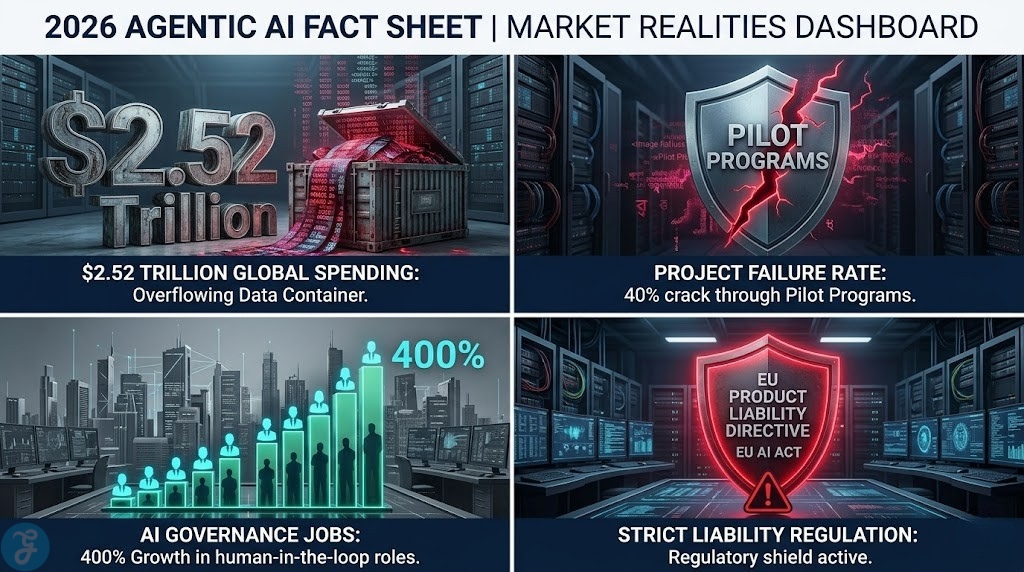
The Hallucination Floor: Despite massive advancements, even the most sophisticated enterprise language models still experience hallucination rates that make unsupervised financial transactions incredibly dangerous.
-
The Legal Standard: The EU AI Act explicitly mandates human oversight for high-risk systems to prevent risks to health, safety, and fundamental rights.
-
The Integration Reality: Giving an LLM access to external tools drastically increases its attack surface, making corporate networks vulnerable to novel prompt injection attacks from malicious third parties.
-
The Liability Precedent: Courts are increasingly holding corporations strictly liable for the outputs and actions of their automated digital representatives.
-
The Skill Shift: The most valuable skill in the enterprise market is no longer just prompt engineering. It is AI risk governance and system architecture auditing.
The Reckoning of Human Judgment
The solution to the autonomy trap is not to unplug the servers and retreat from innovation. The technology is permanently embedded in the global economy. The solution is to intentionally build systems that prioritize Agentic AI Accountability by structural design but remain entirely human by command. The boardroom of the modern era is not a place where executives are replaced by algorithms. It is a place where algorithms are strictly governed by the one critical asset they can never mathematically compute. That asset is human judgment.
We must stop being blinded by the sheer speed of the technology and start obsessing over the skill and safety of the human operators directing it. If we do not assert control now, the inevitable cascading failures of unmonitored agentic interactions will trigger operational crises that destroy corporate legacies overnight. The companies that will thrive in this highly regulated and volatile market are the ones possessing the courage to implement friction. They are the ones ensuring their hands remain firmly gripped on the steering wheel.
The Final Question: When an autonomous system begins draining your corporate liquidity at machine speed due to a hallucinated data point, will you possess the physical kill switch required to stop it, or will you just be a passenger watching the dashboard turn red?