You want to land better clients. Every agency owner reaches a point where grinding out low-budget projects becomes exhausting. I have seen countless talented teams burn out because they compete on price rather than value. The truth is that premium clients do not haggle over minor line items. They look for authority, reliability, and a partner who understands their specific business challenges. Attracting these high-ticket accounts requires a fundamental shift in how you present your business to the world. It requires a focused agency branding strategy that speaks directly to decision-makers who have money to spend and high expectations to meet.
Premium buyers operate differently. Data from 2026 shows that 92 percent of B2B buyers start their journey with at least one vendor already in mind. By the time they reach out to you, they have already evaluated your website, read your case studies, and formed an opinion about your market position. If your brand looks generic or sounds exactly like your competitors, you will lose the deal before you even get on a discovery call. You need to build a brand that does the heavy lifting for your sales team. This article will break down exactly how to structure your brand, refine your messaging, and build an automated pipeline that brings ideal clients right to your inbox. Let us dive into the core components that make high-value clients choose you over everyone else.
1. Understanding the Mindset of High-Ticket Clients
Before you can attract premium clients, you have to understand what drives their purchasing decisions. High-ticket buyers are not looking for a quick fix or the cheapest option available. They are looking to mitigate risk. When a marketing director or CEO hires an agency for a major project, their job and reputation are often on the line. They want a safe pair of hands. I always tell teams that premium clients buy confidence just as much as they buy services. Your brand needs to project that confidence at every touchpoint. This section explores the psychological triggers and business needs that motivate high-value decision-makers.
Here is a quick overview of what premium clients prioritize when evaluating an agency partner.
| Client Priority | Agency Solution | Expected Outcome |
| Risk Mitigation | Detailed case studies and proven track records | Trust and peace of mind |
| Specialized Expertise | Niche positioning and thought leadership | Confidence in technical execution |
| Strategic Partnership | Consultative sales approach and business acumen | Long-term growth and aligned goals |
| Seamless Experience | Streamlined onboarding and clear communication | Saved time and reduced frustration |
Recognizing What Premium Buyers Value Most
High-ticket clients care about outcomes, not outputs. They do not want to know how many hours you will spend on a task; they want to know how your work will increase their market share or streamline their operations. This means your messaging must shift from detailing your service features to highlighting your strategic impact. If you sell website design, premium buyers want to hear about conversion rate optimization and improved lead generation. If you sell content marketing, they want to see how your writing drives qualified pipeline growth. You have to speak the language of business, not just the language of your specific craft.
Premium buyers also value their time immensely. They expect a frictionless experience from the moment they discover your brand. If your website is slow, your messaging is confusing, or your consultation scheduling process requires six emails back and forth, they will move on. Every interaction with your brand sets an expectation for what it will be like to work with you. A polished, highly organized brand presence signals that your agency runs smoothly and handles projects professionally.
The Shift in B2B Buying Behavior
The way companies buy services has changed significantly in recent years. Today, buying committees are larger and more complex. A typical B2B purchase now involves multiple stakeholders across different departments, including finance, operations, and IT. Your brand needs to resonate with all of them. The end-user might care about the creative aspects of your work, but the CFO needs to see a clear path to return on investment. A strong brand anticipates these diverse needs and provides tailored resources that help your internal champion sell your agency to the rest of the committee.
Furthermore, economic pressures have forced buyers to become more decisive. Recent industry data indicates that almost 45 percent of buyers say economic conditions have shortened their buying cycles. They are engaging sellers earlier, but they are also doing more intense upfront research. About 45 percent of B2B decision-makers typically research two to three vendors when looking for a new service provider. If your brand does not immediately communicate specialized expertise and clear value, you will not even make that short list.
2. Crafting a Winning Agency Branding Strategy
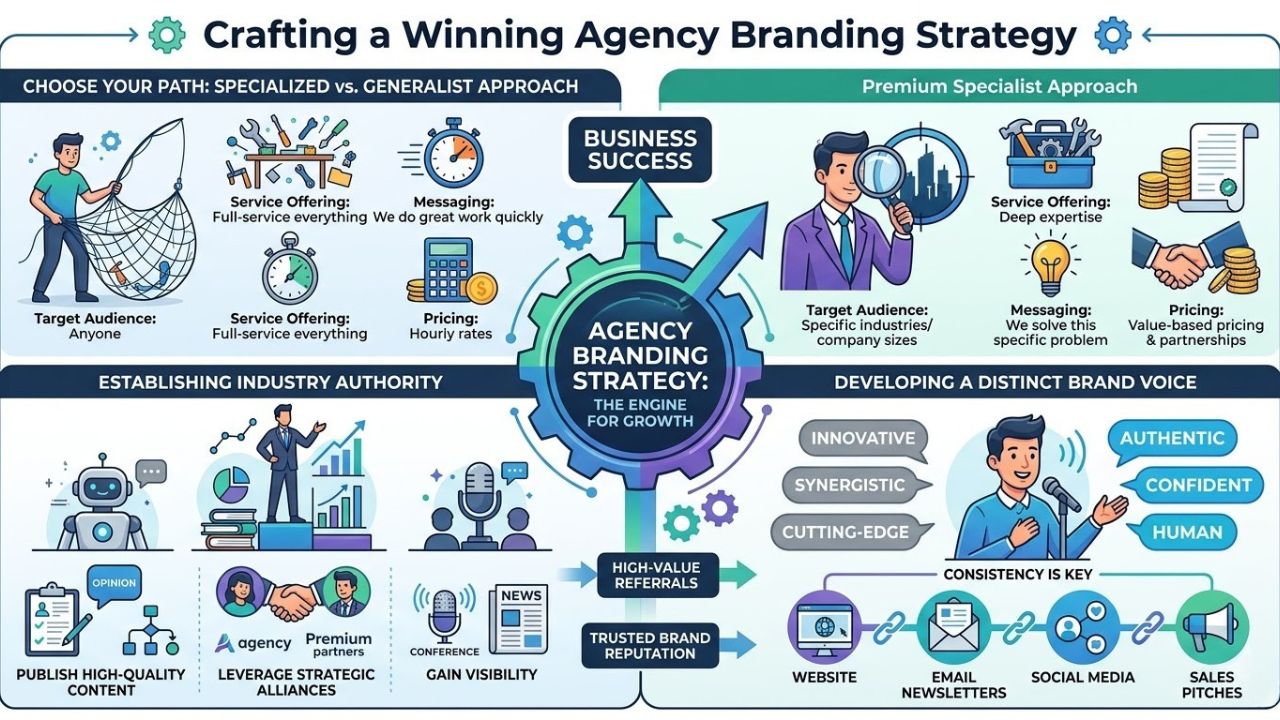
A powerful agency branding strategy is the engine that drives your business growth. It is not just about having a nice logo or a clever tagline. It is about defining exactly who you are, who you serve, and why you are the absolute best choice for that specific audience. When you try to be everything to everyone, you end up meaning nothing to nobody. Premium clients want specialists, not generalists. This section breaks down how to narrow your focus, establish authority, and develop a brand voice that commands attention in a crowded market.
The following table breaks down the essential components of a specialized brand strategy.
| Strategy Component | Generalist Approach | Premium Specialist Approach |
| Target Audience | Anyone who needs our services | Specific industries or company sizes |
| Service Offering | Full-service everything | Deep expertise in core competencies |
| Messaging Focus | We do great work quickly | We solve this specific business problem |
| Pricing Model | Hourly rates or competitive bidding | Value-based pricing and retained partnerships |
Positioning Your Firm as an Industry Authority
To attract high-ticket clients, you must position yourself as a thought leader in your space. This requires publishing high-quality, insightful content that tackles the complex problems your ideal clients face. Stop writing generic blog posts about basic industry concepts. Instead, share original research, strong opinions on market trends, and detailed breakdowns of your successful methodologies. According to 2026 marketing statistics, 65 percent of effective B2B teams point to content relevance and quality as the main driver of their success. Your content should prove that you understand your clients’ industry better than they do.
Authority also comes from the company you keep. Partnering with other premium brands, speaking at respected industry conferences, and securing placements in top-tier publications all elevate your brand perception. When premium clients see your agency associated with other names they trust, they naturally transfer that trust to you. I highly recommend building strategic alliances with non-competing agencies that serve the same high-end demographic. These relationships often lead to high-quality referrals that bypass the traditional sales process entirely.
Developing a Distinct Brand Voice
Your brand voice is how you sound across all your marketing channels. Most agency websites read like they were copied from the exact same corporate template. They use words like innovative, synergistic, and cutting-edge without actually saying anything meaningful. To stand out, you need a brand voice that is authentic, confident, and human. Speak directly to your reader using active voice and simple vocabulary. Avoid industry jargon unless it is necessary to demonstrate technical competence to a specific audience.
A distinct voice builds an emotional connection with your prospects. People buy from people they like and trust. Share your agency’s origin story, highlight your team’s personalities, and do not be afraid to show a little character. If your agency culture is bold and disruptive, let your copy reflect that. If your approach is highly analytical and data-driven, adopt a more academic but accessible tone. Consistency is the key here. Your voice should sound the same on your website, in your email newsletters, on your social media profiles, and during your sales pitches.
3. Leveraging Data and Proof to Build Trust
Premium clients do not make decisions based on gut feelings. They make decisions based on evidence. You can make all the bold claims you want in your marketing copy, but if you cannot back them up with hard data and verifiable proof, high-ticket buyers will walk away. Building trust requires extreme transparency about your past successes. This section details how to structure your case studies, gather impactful testimonials, and leverage data to prove your agency’s worth before a contract is ever signed.
Here is a summary of the most effective types of social proof for agencies.
| Type of Proof | What It Demonstrates | Best Placement |
| Data-Driven Case Studies | Strategic execution and measurable ROI | Dedicated website section and sales decks |
| Video Testimonials | Client satisfaction and emotional connection | Landing pages and social media |
| Industry Awards | Peer recognition and objective excellence | Website footer and press releases |
| Client Logos | Market experience and brand association | Homepage above the fold |
Using Case Studies to Drive High-Ticket Sales
A case study should read like a compelling business story, not a dry list of tasks completed. The best case studies follow a clear narrative arc showing the initial problem, the strategic intervention, and the measurable business outcome. Start by outlining the specific challenges your client faced before hiring you. Then, explain the strategy you developed to solve those problems. Finally, highlight the results using concrete numbers. Did you increase revenue by 30 percent? Did you reduce customer acquisition costs by half? Hard numbers are the currency of premium client acquisition.
You must also ensure your case studies are easy to find and consume. Do not bury them in a hidden menu on your website. Feature your strongest results prominently on your homepage and service pages. I also suggest creating shorter, highly visual versions of your case studies for use on social media platforms like LinkedIn. When a prospect sees a well-documented success story from a company similar to their own, their perceived risk of hiring you drops dramatically.
The Impact of Client Advocacy and Referrals
Word of mouth remains one of the most powerful marketing channels for B2B services. Happy clients are your best salespeople. When a respected executive recommends your agency to a peer, you completely bypass the standard vendor vetting process. However, you cannot just sit back and hope referrals happen organically. You need to build client advocacy into your agency branding strategy systematically. Ask for testimonials at the peak of client happiness, usually right after a successful project launch or a major milestone achieved.
Building a formal referral program can also incentivize your existing network to send leads your way. This does not necessarily mean offering cash kickbacks, which can sometimes feel cheap in a premium B2B environment. Instead, consider offering value-adds, shared marketing opportunities, or exclusive access to new services. Furthermore, maintaining long-term relationships through regular check-ins and valuable email newsletters ensures your agency stays top-of-mind long after the initial contract has ended.
4. Optimizing Your Visual Identity and Digital Presence
You have milliseconds to make a first impression. When a premium prospect lands on your website, they instantly judge your agency’s competence based on your visual identity. If your website looks outdated, cluttered, or templated, they will assume your work is of similar quality. Premium brands look premium. They utilize clean design, thoughtful typography, and high-quality imagery to communicate sophistication and attention to detail. This section covers how to elevate your visual assets to match the high-ticket pricing you want to command.
This table highlights the differences between average and premium visual identities.
| Design Element | Average Agency Presence | Premium Agency Presence |
| Website Layout | Cluttered, text-heavy, confusing navigation | Minimalist, whitespace-driven, intuitive flow |
| Typography | Standard system fonts, poor hierarchy | Custom typefaces, clear heading structures |
| Imagery | Stock photos of people pointing at laptops | Custom photography, bespoke illustrations |
| Performance | Slow load times, broken mobile elements | Lightning fast, perfectly responsive on all devices |
Creating a Website That Converts Premium Leads
Your website is your digital storefront, and it needs to guide visitors through a logical narrative journey. Remove the fluff. Every sentence and every image should serve a specific purpose. Start with a clear, benefit-driven headline above the fold that tells the visitor exactly what you do and who you do it for. Follow this with immediate social proof, such as client logos or brief testimonials. The goal is to establish credibility within the first five seconds of their visit.
Navigation should be frictionless. Do not make prospects click through four different pages to understand your services or find your contact information. Use clear calls to action that guide them toward the next step, whether that is reading a detailed case study or scheduling a consultation. Furthermore, your website must be technically flawless. Slow loading speeds or mobile formatting errors signal a lack of professionalism that high-ticket clients simply will not tolerate. Invest in high-quality hosting and rigorous quality assurance testing.
Consistency Across All Marketing Channels
A disjointed brand identity creates confusion and erodes trust. If your website looks sleek and modern, but your LinkedIn profile is outdated and your sales decks look like they were made in 2010, prospects will notice the disconnect. Premium branding requires absolute consistency across every single touchpoint. Your colors, fonts, logo usage, and tone of voice must remain uniform whether a client is reading an email newsletter, watching a promotional video, or reviewing a formal proposal.
To achieve this consistency, your agency needs a comprehensive brand guidelines document. This document should dictate exactly how visual and written elements are used both internally and externally. It ensures that every team member, from your junior designers to your senior sales executives, presents the agency in the same polished manner. When your brand looks and sounds cohesive across all platforms, it projects a level of stability and organization that highly appeals to enterprise-level clients.
5. Aligning Sales and Marketing for Premium Acquisition
Marketing gets the prospect to the door, but sales must bring them inside. If your marketing promises a premium, highly strategic partnership, but your sales process feels like a high-pressure transactional pitch, you will lose the deal. Attracting high-ticket clients requires total alignment between your marketing and sales operations. They must share the same data, the same goals, and the same understanding of the ideal customer profile. This section explores how to create a seamless handover from marketing to sales and how to use data to refine your targeting.
The table below outlines the key alignment points between marketing and sales teams.
| Alignment Area | Marketing Responsibility | Sales Responsibility |
| Lead Qualification | Creating content that filters out bad fits | Sticking to strict qualification criteria |
| Messaging | Establishing authority and brand promises | Reinforcing promises during direct conversations |
| Data Sharing | Tracking engagement and content consumption | Providing feedback on lead quality and objections |
| Client Journey | Nurturing leads until they are ready to buy | Guiding prospects smoothly through closing |
Removing Friction from the Buyer Journey
High-ticket buyers do not have the patience for clunky administrative processes. Every step from the initial inquiry to the final contract signature must be optimized for speed and clarity. When a qualified lead requests a consultation, they should not have to wait three days for a response. Implement automated scheduling tools that allow them to book a meeting immediately. Prepare tailored discovery questions in advance so you do not waste their time asking basic questions you could have answered through a quick search.
The proposal stage is where many agencies lose premium deals. A premium proposal should not be a generic document with a price tag attached at the end. It should be a customized strategic roadmap that clearly outlines the scope of work, the timeline, the required investment, and the expected business impact. Use professional proposal software that allows for digital signatures and easy reviewing. The easier you make it for the client to say yes and sign the dotted line, the higher your closing rate will be.
First-Party Data and Personalized Outreach
Relying on generic email blasts and rented audiences is becoming less effective every year. Privacy changes and shifting algorithms mean you need to own your audience. This is where a strong first-party data strategy comes in. By collecting data directly from your website visitors through newsletter signups, webinar registrations, and resource downloads, you build a list of highly engaged prospects. Recent data indicates that first-party data improves targeting and personalization for 52 percent of marketers.
Once you have this data, you can segment your audience and deliver highly personalized outreach. If you know a specific prospect has read three of your case studies on manufacturing branding, your sales team can reach out with a highly relevant message tailored to that industry. This level of personalization shows the prospect that you understand their specific context and are not just sending mass emails. It bridges the gap between automated marketing and human-to-human sales, which is exactly what premium clients expect from a high-end agency partner.
Frequently Asked Questions (FAQs)
What is an agency branding strategy?
It is a deliberate plan to position your agency in the market. It covers your visual identity, core messaging, and how you communicate your unique value to ideal clients. A solid agency branding strategy separates you from generalist competitors so you can confidently command premium rates and attract better projects.
How does branding attract high-ticket clients?
Premium clients buy trust and risk mitigation. When your brand looks highly polished and clearly communicates specialized expertise, high-ticket buyers feel confident handing over large budgets. Good branding proves you understand their specific business problems before they even book a discovery call with your sales team.
How much should a B2B agency spend on branding?
There is no single magic number, but you should treat it as a long-term investment rather than a one-off expense. Most growing B2B firms allocate roughly 10 to 15 percent of their overall marketing budget to brand development and maintenance. The exact amount heavily depends on whether you are executing a ground-up rebrand or simply refining your current digital assets.
How long does it take to see ROI from a brand refresh?
You will likely notice immediate improvements in how prospects respond to your updated website or sales decks. However, shifting overall market perception and consistently landing significantly larger enterprise contracts usually takes six to twelve months of steady messaging, content distribution, and targeted outreach.
Can we just copy what bigger agencies are doing?
No, and trying to do so usually backfires. Bigger agencies have different overhead costs, larger teams, and established market share. If you copy their messaging, you just look like a cheaper, generic version of them. Your agency branding strategy needs to highlight what makes your specific team, methodology, and niche expertise entirely unique.
Final Thoughts: Stepping Into Premium Agency Branding
Shifting from a volume-based business to a premium agency model does not happen overnight. It requires you to make hard choices about who you serve and, more importantly, who you turn away. You must be willing to let go of the low-budget clients that drain your team’s energy to make room for the high-ticket partnerships that drive real profitability. A strong agency branding strategy gives you the confidence to say no to bad fits because you know your pipeline is actively attracting the right people.
Focus on building deep authority in your chosen niche. Create content that educates and challenges your ideal clients. Ensure your visual identity reflects the high value of your services, and remove every ounce of friction from your sales process. By consistently proving your strategic worth through data and client advocacy, you will build a brand that decision-makers trust implicitly. The market is crowded, but there is always room at the top for agencies that refuse to compromise on quality and messaging. Start auditing your brand today, align your team around a unified vision, and watch as the caliber of your incoming leads completely transforms.