
Have you ever wondered why some countries get richer while others stay stuck in poverty? It’s not always about the money. The real answer might surprise you. It touches hunger, inequality, and the way we measure progress. That’s where one remarkable economist changed everything.
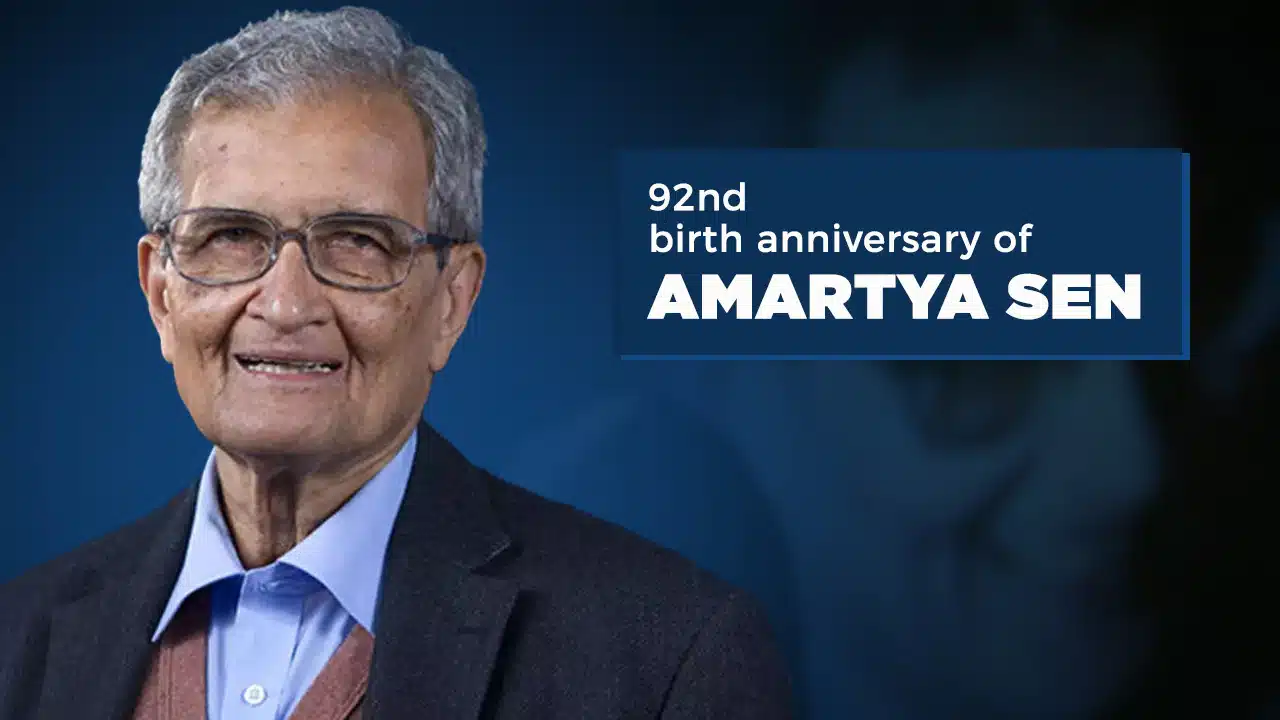
Amartya Sen is a Nobel laureate who challenged how the world thinks about economics and fairness. His work on welfare economics and what he called the capability approach opened leaders’ eyes to what poverty really means. Today is the 92nd birth anniversary of Amartya Sen.
This post will walk you through Sen’s life, from his childhood in Bengal to becoming one of the most influential thinkers of our time. You’ll discover his big ideas about social choice theory, how he shaped tools like the Human Development Index, and why his voice still matters in 2025.
Ready to see how one person’s ideas helped reshape our view of helping those who need it most?
Key Takeaways
- Amartya Sen was born on November 3, 1933, in Santiniketan, India and witnessed the Bengal famine as a child, which shaped his life’s work.
- He won the Nobel Prize in Economic Sciences in 1998 for work on welfare economics, social choice theory, poverty, and famine causes.
- According to the 2024 Global Multidimensional Poverty Index, 1.1 billion people live in multidimensional poverty, measured using Sen’s capability approach framework.
- Sen’s capability approach led to global adoption of tools like the Multidimensional Poverty Index by OPHI and the Human Development Index, first introduced in 1990 by Mahbub ul Haq working with Sen.
- His books include Development as Freedom (1999), Poverty and Famines (1981), Collective Choice and Social Welfare (1970), and The Idea of Justice (2009).
- In 1999, Sen received India’s highest civilian honor, the Bharat Ratna, and used his Nobel Prize money to establish Pratichi Trust, a charity focused on education and healthcare.
Early Life and Education
Amartya Sen grew up in Bengal during turbulent times. The place where he was born would shape not just his childhood, but his entire worldview.
Thinkers like Rabindranath Tagore at Visva Bharati University surrounded him. His time at Presidency College and Trinity College set the stage for a journey that would change economic thought forever.
Where was Amartya Sen born and raised?
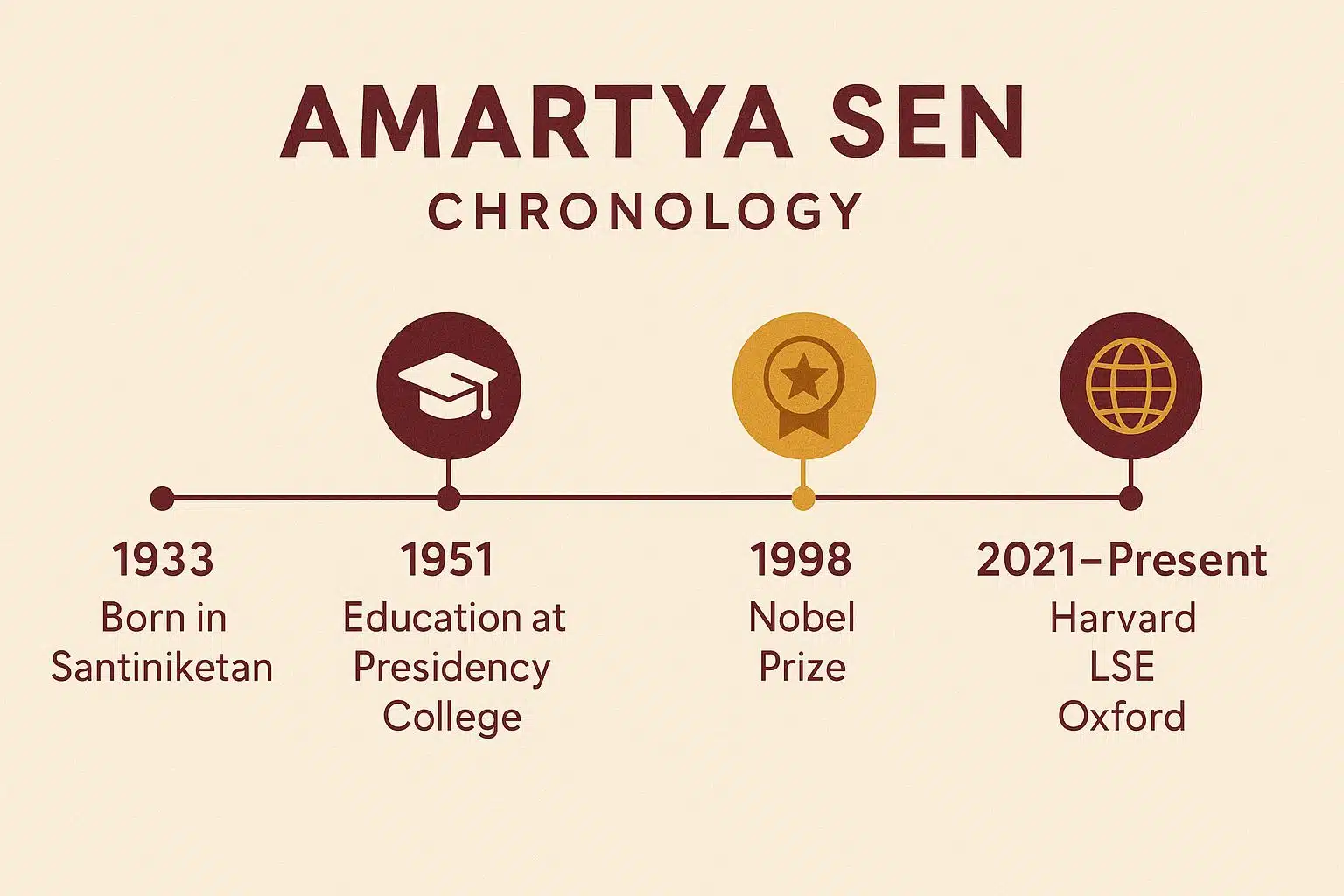
Born on November 3, 1933, in Santiniketan, India, Amartya Kumar Sen started life in a culturally rich town.
His family made their home in Bengal. Something interesting happened here: Rabindranath Tagore, the first Asian Nobel laureate, actually gave Sen his name, which means “immortal” in Bengali.
He grew up during hard times. As a nine-year-old boy in 1943, he witnessed the devastating Bengal famine with his own eyes. According to historian Cormac Ó Gráda, the scholarly consensus is that about 2.1 million people died in this tragedy. This experience wasn’t just traumatic. It lit a fire in young Sen that would burn for decades, shaping his deep concern for poverty and social welfare.
His maternal grandfather, Kshiti Mohan Sen, was an eminent scholar at Visva Bharati University in Santiniketan. Living in this intellectual heartland left deep marks on him early.
What shaped Amartya Sen’s academic journey?
That grave moment during the Bengal famine changed everything for Sen.
Young Sen watched people suffer not from lack of food but because of poor food distribution. That thought stuck like a thorn. He realized famine wasn’t just about shortages. It was about who could access what was available.
Sen later wrote that the Bengal famine was “caused by an urban economic boom that raised food prices, thereby causing millions of rural workers to starve to death when their wages did not keep up.”
He started school at Presidency College in Kolkata, earning his B.A. in 1953. Brilliant teachers like K.N. Raj influenced him there with fresh ideas on economic growth and collective choice theory.
Then Sen headed to Trinity College at Cambridge University for further study. He completed both his M.A. and Ph.D. by 1959 under the supervision of Joan Robinson and Maurice Dobb. These two legends in post-Keynesian economics pushed him to question old views about welfare economics and social justice every day he walked those ancient stone halls.
His dissertation focused on “The Choice of Techniques,” though he originally wanted to work on social choice theory. Cambridge wasn’t enthusiastic about that topic at the time, so he pivoted.
Academic Career
Amartya Sen didn’t just stay in one place. His teaching journey took him across continents and through some of the world’s most prestigious universities. From Cambridge to London, Delhi to Harvard, he sparked new conversations about welfare economics wherever he went.
What teaching roles did Amartya Sen hold in England and the U.S.?
At the London School of Economics, Sen worked as a teacher from 1971 to 1977.
He then joined Oxford University, where he served as the Drummond Professor of Political Economy until 1988. This wasn’t just any position. It carried serious weight in the economics world.
In the U.S., he became a professor at Harvard University in 1988. He taught economics and philosophy there for ten years, bridging two fields that most people kept separate. Later, he returned to Harvard in 2004 as the Thomas W. Lamont University Professor, a title he still holds today.
His time at these institutions put him side by side with great minds like John Rawls and Kenneth Arrow. At Trinity College, Cambridge, he also served as Master from 1998 to 2004.
His classroom always buzzed with debate. Students found his talks on famine relief and human development eye-opening, even life-changing. He had a gift for making complex economic theories feel relevant to real human suffering.
How did Amartya Sen contribute to Harvard University and Trinity College?
Sen’s impact at Harvard goes beyond just teaching.
From 1988 to 1998, he shared his groundbreaking ideas on welfare economics, social choice theory, and human development as a professor of economics and philosophy. His courses drew students who wanted to understand how economics could serve justice.
Here’s something remarkable: In 2008, India gave $4.5 million to create the Amartya Sen Fellowship Fund at Harvard’s Graduate School of Arts and Sciences. This fund helps Indian students study at Harvard, creating a bridge between his homeland and his adopted academic home.
At Trinity College, Cambridge, he led as master from 1998 to 2004. During that time, he guided students and collaborated with fellow thinkers in political philosophy and development economics.
His work at both institutions transformed how people see inequality and poverty research. Thanks to Sen, these aren’t just abstract concepts anymore. They’re about real people and real freedoms.
Major Contributions to Economics and Philosophy
Amartya Sen didn’t just write papers. He rewrote the rules.
His ideas challenged what economists thought they knew about measuring well-being. Instead of just counting dollars, he asked a different question: What can people actually do with their lives?
Welfare economics looks at how resources help people in a society.
Sen changed this field using fresh ideas about fairness and well-being. His famous book, “Collective Choice and Social Welfare,” came out in 1970. In it, he showed that economic choices must think about what people value, not just money or goods.
He built on Kenneth Arrow’s earlier work in social choice theory, which had shown the difficulty of combining individual preferences into group decisions. Sen studied how collective decisions happen when many needs clash. He used examples like voting systems to reveal the limits of traditional ways of measuring happiness and utility.
Here’s what made his approach different:
- He argued that people’s real freedoms matter more than their income
- He showed why traditional utility measures often miss the mark
- He demonstrated that choice itself has value, separate from what you choose
- He proved that economic policies need ethical foundations
Thanks to his research, experts today use better tools to measure inequality, freedom, and justice. It’s not just about helping the lucky few with wealth. It’s about expanding opportunities for everyone.
The capability approach and human development
Sen brought a revolutionary idea to economics called the capability approach.
This approach says people’s well-being isn’t just about money. It’s about what they can do and be. For example, having enough food or good health matters more than income alone. Martha Nussbaum also helped shape these ideas with him, developing a specific list of core human capabilities.
The impact was huge. His work led to the creation of the Human Development Index in 1990, developed with Pakistani economist Mahbub ul Haq. Instead of judging countries only by GDP, this new index looked at life expectancy, education, and income together.
The Human Development Index is based on the human development approach, “anchored in Amartya Sen’s work on human capabilities.”
Groups like the United Nations now use this framework to measure progress. According to the 2024 Global Multidimensional Poverty Index, 1.1 billion people (18.3% of the population) are multidimensionally poor across 112 countries. This data exists because of Sen’s vision.
The shift was profound. Leaders stopped just counting dollars and started checking if people have real choices. Education, healthcare, and equal rights became just as important as economic growth in measuring how well a nation serves its people.
Work on poverty, famine, and inequality
Sen’s landmark book “Poverty and Famines: An Essay on Entitlement and Deprivation” came out in 1981.
It changed everything we thought we knew about hunger. He showed that the Bengal famine he witnessed as a child was caused by problems in food distribution, not food shortage. People starved even when markets had enough food to go around.
He pointed out the real culprits:
- Lost jobs and falling wages
- Skyrocketing prices for rice
- Poor public action and policy failures
- People losing their “entitlement” to food due to economic shocks
Sen stressed that public-works programs could reduce future hunger crises. Price controls for basic foods can stop families from being priced out during tough times. His most striking insight? He noted that “no famine has ever taken place in a functioning democracy.”
These studies shaped policy worldwide. Organizations like the Oxford Poverty & Human Development Initiative (OPHI) and the United Nations use his framework to fight economic unfreedom and gender inequality. His ideas turned abstract economics into practical tools for saving lives.
What did Amartya Sen receive the Nobel Prize for in Economic Sciences?
In 1998, Amartya Sen won the Nobel Prize in Economic Sciences.
The award honored his groundbreaking work on welfare economics and social choice theory. It also recognized his deep studies about poverty and famine that showed how economic unfreedom ties directly to human rights.
Sen showed why food crises like the Bengal Famine happen even when enough food exists. His research explained the concept of “entitlement and deprivation.” It’s not about total food supply. It’s about whether people can access that food through their income, work, or social support.
The Nobel committee praised him for practical solutions that protect society’s most vulnerable members from hunger and inequality. His analysis moved beyond cold numbers to focus on real lives and actual human development.
This prize also spotlighted his capability approach, which now guides organizations worldwide that fight poverty. Sen used the Nobel Prize money in a practical way. He established Pratichi Trust in 1999, a research-based charity focusing on education and healthcare for children in India and Bangladesh.
As Sen himself said about the Nobel, “It was nice to have received it. I got some money and could start a charity called Pratichi Trust involving education and healthcare elements of children.”
Influence on Global Policy
Amartya Sen didn’t just write theories. His ideas literally changed how the world measures and fights poverty.
Working with organizations like the United Nations and OPHI, he helped rewrite the playbook on human development. The tools created from his work now guide policy in over 100 countries.
How did Amartya Sen shape poverty measurement frameworks?
Sen argued that cash alone cannot measure real poverty.
This was radical. Most economists at the time focused almost entirely on income levels. Sen said we need to look at people’s basic freedoms and what they can actually do with their lives.
His capability approach stressed that health, education, dignity, and other human capabilities are key signs of well-being. Can you read? Can you participate in your community? Can you live without shame? These questions matter just as much as your bank balance.
Policymakers at the United Nations and groups like OPHI listened. They used his methods to build new tools for studying poverty. The big one came in 2010: the Multidimensional Poverty Index.
This tool looks beyond money. It checks if people lack:
- Adequate nutrition and healthcare
- Access to education
- Clean water and sanitation
- Electricity and cooking fuel
- Safe housing and basic assets
The 2024 Global MPI now covers 112 countries and 6.3 billion people. Because of Sen’s work, many countries now use these broader frameworks to shape programs that fight deprivation directly. It’s not just about boosting incomes anymore. It’s about opening more doors for all citizens everywhere.
What collaborations did Amartya Sen have with OPHI and the United Nations?
Sen worked closely with the Oxford Poverty & Human Development Initiative, known as OPHI.
His capability approach shaped how OPHI built new measurement tools. The organization now sits on OPHI’s Advisory Committee, continuing to guide their work. OPHI’s flagship achievement is the Multidimensional Poverty Index, which uses Sen’s framework to measure poverty across three dimensions: health, education, and living standards.
The United Nations took inspiration from his ideas too. The Human Development Index, first introduced in 1990, is based directly on Sen’s work about what people can do or be in life, not just their income. Economist Mahbub ul Haq developed this index in collaboration with Sen while working for the UN Development Programme.
The results speak for themselves. According to the 2024 Global MPI report, this methodology now tracks 1.1 billion multidimensionally poor people across 112 countries, providing data disaggregated for 1,359 subnational regions. This granular detail helps target aid where it’s needed most.
By helping both OPHI and the UN rethink poverty measurement, Sen changed policies in many nations. Countries can now pinpoint exactly where people face multiple deprivations at once and design better interventions.
Legacy and Publications
Sen’s books aren’t gathering dust on shelves. They’re still sparking debates in classrooms and policy meetings worldwide.
His written work bridges the gap between academic theory and real-world change. From development to justice, his publications keep challenging how we think about fairness.
What are Amartya Sen’s notable books like “Development as Freedom”
“Development as Freedom” came out in 1999 and became an instant classic.
In this book, Sen makes a powerful argument: Real development means giving people freedom and choices, not just more money. He writes about poverty as a lack of opportunities. He talks about things like healthcare, education, and political rights as essential freedoms, not luxuries.
Sen wrote many other influential books too:
| Book Title | Year | Key Focus |
|---|---|---|
| Collective Choice and Social Welfare | 1970 | How groups can make fair decisions |
| Poverty and Famines | 1981 | Why famines happen despite food availability; uses Bengal Famine as example |
| Development as Freedom | 1999 | Freedom and choices as core of development |
| The Idea of Justice | 2009 | Challenges Rawlsian views; looks at fairness in daily life |
“The Idea of Justice” (2009) challenged old ideas by John Rawls and examined fairness in everyday situations. *The Argumentative Indian* (2005) explored India’s long tradition of public debate and pluralism.
These works changed how experts talk about welfare economics, social choice theory, inequality, human rights, gender discrimination, and development across the world. They’re still required reading in economics and philosophy departments everywhere.
Sen changed how people think about welfare economics and fairness.
His capability approach moved the focus from pure income to real freedoms. Things like health, education, and human rights aren’t just nice to have. They’re what development is actually about.
Policymakers now use these ideas to measure well-being worldwide. The United Nations Human Development Report, published annually since 1990, draws directly from his work. The Multidimensional Poverty Index, used to track progress in over 100 developing countries, exists because of his theoretical groundwork.
Projects on development economics today draw heavily on his research into famines in Bengal and inequality across genders. Books like “Development as Freedom” shaped global debates on what true progress means for a country or person.
Sen has been called “the Conscience of the profession” and “the Mother Teresa of Economics” for his work on famine, human development theory, and political liberalism.
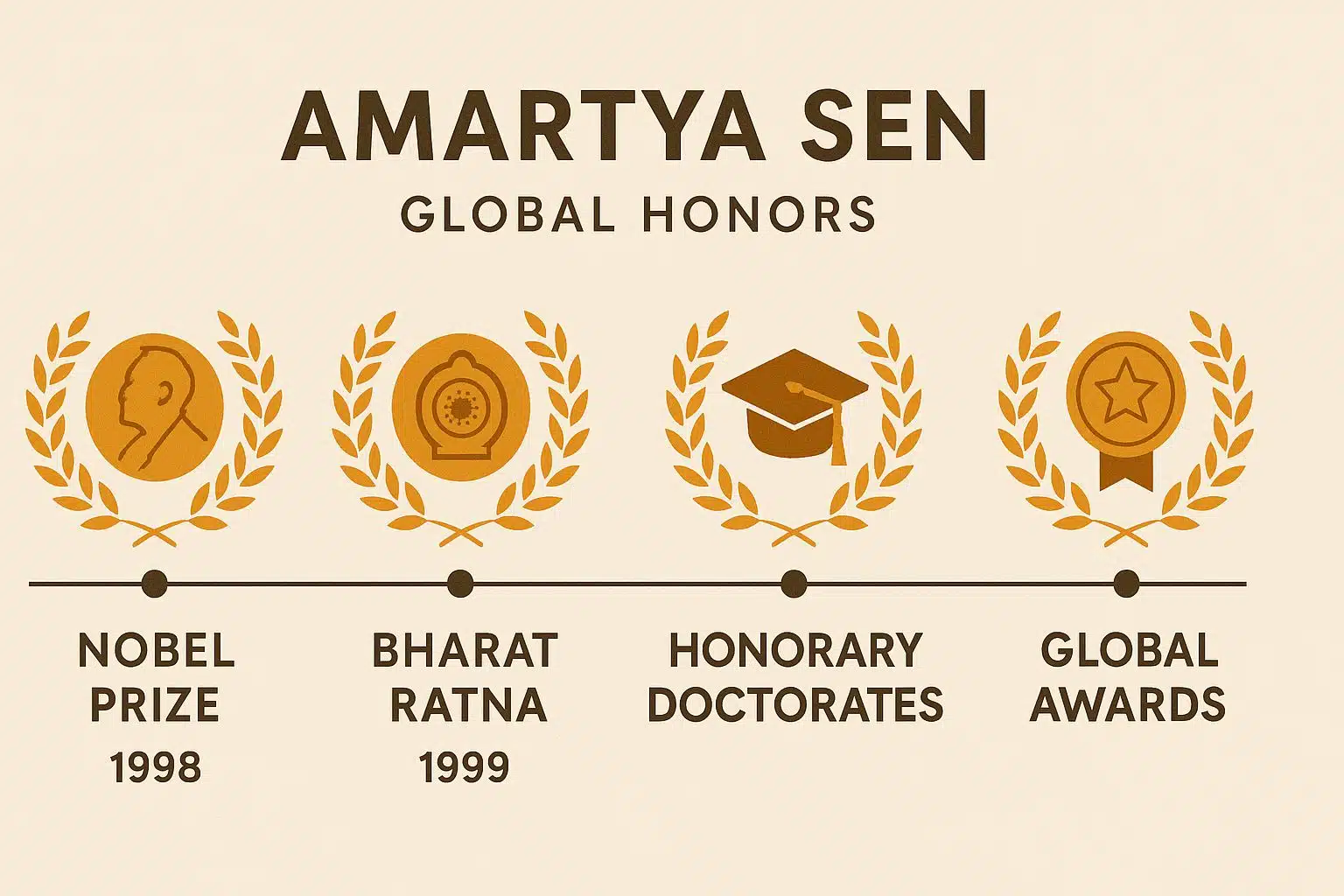
Sen received India’s highest civilian honor, the Bharat Ratna, in 1999. He’s been awarded over 90 honorary degrees from universities worldwide. In 2019, the London School of Economics created the Amartya Sen Chair in Inequality Studies, ensuring his work continues to influence new generations.
His thinking pushed both Cambridge University and Harvard University to rethink their studies of collective choice, social values, and entitlement theory. Many see him as someone who helped set new rules for judging fairness in public decisions. He made sure that all voices count in political philosophy discussions today, not just the powerful or wealthy.
As of 2025, Sen remains active, speaking on issues like migration, democracy, and human development. His voice continues to shape conversations about poverty and inequality around the world.
Takeaways
Amartya Sen proves that curiosity can change lives.
His work in welfare economics and human development keeps shaping how we fight poverty today. From witnessing the Bengal famine as a child to becoming a Harvard professor and Nobel laureate, his journey shows us why ideas matter, especially for those with the least power.
Sen’s legacy shines through books like “Development as Freedom” and the fresh hope he has brought to social choice theory. His capability approach transformed how over 100 countries measure poverty and plan policies. The tools he helped create, like the Human Development Index and Multidimensional Poverty Index, now track the well-being of billions.
If you want inspiration, just follow his footsteps. They lead straight to a better world for everyone, one where freedom and capability matter as much as income.
FAQs on Amartya Sen
1. Who is Amartya Sen and why did he win the Nobel Prize?
Amartya Sen is an Indian economist and philosopher who won the 1998 Nobel Memorial Prize in Economic Sciences. He received the award for his significant contributions to welfare economics and for his research on the causes of famine and poverty. His work has deeply influenced human development policies across the globe.
2. What is the capability approach that Amartya Sen created?
The capability approach suggests that we should measure development by people’s real freedoms and opportunities, not just by their income. Outlined in his 1999 book “Development as Freedom”, this framework focuses on what individuals are actually able to do and be, such as having access to education and healthcare.
3. Where did Amartya Sen study and teach?
Sen was educated at Presidency College in Kolkata and later earned his Ph.D. from Cambridge University. His notable teaching career includes positions at the Delhi School of Economics, the London School of Economics, and Harvard University. He also served as the Master of Trinity College, Cambridge from 1998 to 2004.
4. What are some famous books written by Amartya Sen?
His most influential books include “Poverty and Famines” (1981), “The Argumentative Indian” (2005), and “The Idea of Justice” (2009).
5. How did Amartya Sen’s research help understand famines?
By studying the 1943 Bengal famine, Sen demonstrated that famines are not typically caused by a simple lack of food, but rather by a failure of “entitlements.” His work showed that people starve when they lose their economic ability to access available food, an insight that has transformed famine relief efforts.
6. What awards and honors has Amartya Sen received?
In addition to the 1998 Nobel Prize, Sen was awarded the Bharat Ratna, India’s highest civilian honor, in 1999. He also received the National Humanities Medal from U.S. President Barack Obama in 2012 for his efforts to restore an ethical foundation to economics.