The future of TikTok in the United States has been uncertain for nearly a year. Lawmakers in Washington passed legislation in April 2024 requiring its Chinese parent company, ByteDance, to sell the U.S. arm of the platform or face a complete shutdown. The decision was driven by concerns over national security, data privacy, and fears that the app could be used as a tool of influence by Beijing.
Now, a new deal has been set in motion after U.S. President Donald Trump signed an executive order to approve the restructuring of TikTok US. The transaction values the U.S. business at $14 billion, far below the $330 billion valuation of ByteDance overall, but it is being hailed by U.S. officials as a way to safeguard American users’ data and ensure local control of the platform.
Abu Dhabi’s Entry Through MGX
One of the most striking features of the arrangement is the involvement of the Abu Dhabi royal family. Their role comes through MGX, an investment fund chaired by Sheikh Tahnoon bin Zayed Al Nahyan, who is widely recognized as a central figure in the United Arab Emirates’ strategic financial and security policies.
MGX will acquire a 15 percent stake in TikTok US and secure a seat on the company’s board once the U.S. business is formally spun out. This move marks a significant expansion of Gulf investment influence in global technology and media platforms, underlining Abu Dhabi’s growing role as an international financial powerhouse.
Ownership Breakdown and Control
The new ownership structure of TikTok US is designed to place the company firmly under U.S. and allied control. According to details confirmed by government and media reports:
-
Oracle, the American cloud computing giant, and Silver Lake, a leading private equity firm, are joining Abu Dhabi’s MGX to collectively hold about 45 percent of the new entity.
-
American investors overall will control just over 65 percent of TikTok US. This group includes not only Oracle and Silver Lake but also high-profile names such as technology pioneer Michael Dell and media mogul Rupert Murdoch’s Fox Corporation.
-
ByteDance will retain a 19.9 percent stake in the U.S. arm, giving it a limited but still notable share in the new structure.
The restructuring will also reshape TikTok US’s governance. A new seven-member board will be formed, with ByteDance permitted to nominate only one member while U.S. investors will occupy the remaining six seats. This design reflects the insistence of lawmakers that operational control be firmly in American hands.
Why the Valuation Matters
The $14 billion valuation of TikTok’s U.S. operations highlights the steep discount compared with the global worth of ByteDance. While ByteDance is estimated at around $330 billion, the U.S. spinoff is being valued at less than five percent of that figure.
For comparison, Meta, the parent company of Facebook and Instagram, has a market valuation of approximately $1.8 trillion. This disparity underscores TikTok US’s reduced value due to regulatory risks, political pressure, and the uncertainty that has surrounded its operations for months. Still, analysts believe the transaction will stabilize the app’s future in its most important market, where it has over 170 million active users.
U.S. National Security Concerns
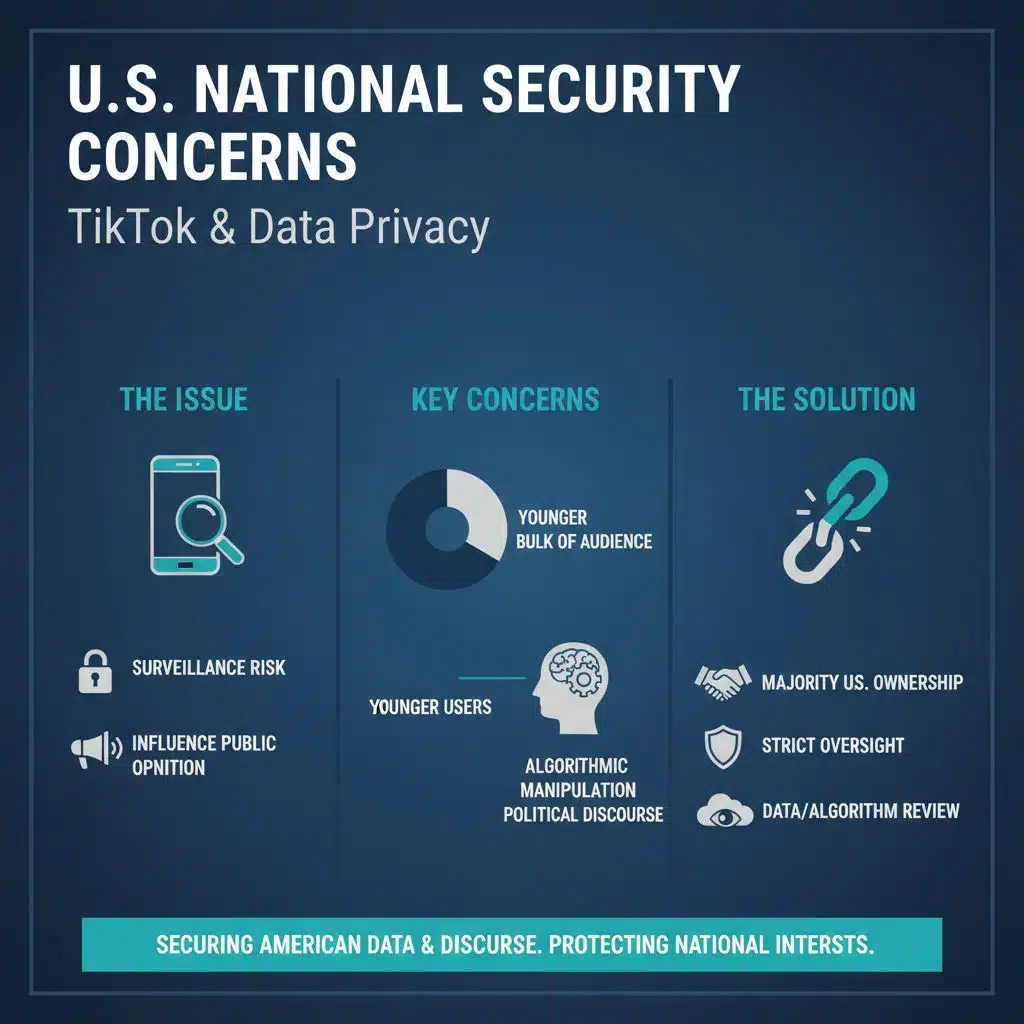
The restructuring stems from long-standing concerns that TikTok’s Chinese ownership could expose Americans to surveillance or allow for manipulation of public opinion through content algorithms. U.S. intelligence agencies and lawmakers have argued that Beijing could exploit the app to collect sensitive data or influence political discourse, especially among younger users who make up the bulk of TikTok’s audience.
By forcing ByteDance to reduce its stake and ensuring American investors and allies hold majority control, Washington aims to eliminate these risks. The deal also includes strict oversight requirements, with U.S. authorities reserving the right to review how TikTok handles data storage, algorithm development, and content moderation.
Reactions From Washington
Officials in Washington framed the agreement as a necessary compromise. They said it preserves TikTok for millions of American users while addressing the most pressing security concerns. The arrangement will now undergo further review to ensure compliance with U.S. law, particularly regarding data storage and operational independence from ByteDance.
Members of Congress, particularly those on the House Select Committee on China, have announced plans for public oversight hearings. These hearings will scrutinize whether TikTok US truly separates from its Chinese parent, whether algorithms remain free from foreign influence, and whether user data is fully protected under U.S. law.
Beijing’s Position and International Diplomacy
The role of China in approving the deal remains unclear. While Chinese authorities have not issued a public statement of support or opposition, reports suggest there was initial hesitation in Beijing. Some analysts argue that China may resist final approval because TikTok’s algorithm — one of its most valuable assets — remains at the heart of the dispute.
Despite these tensions, Trump stated that he had spoken directly with Chinese President Xi Jinping, who, according to him, did not block the move. However, Beijing has a history of leveraging technology ownership battles as a tool in broader U.S.-China relations, and final approval from Chinese regulators may still become a point of negotiation.
Implications for TikTok Users
For TikTok’s U.S. user base, which numbers more than 170 million, the deal brings relief. The threat of a nationwide ban had loomed large for over a year, with creators, businesses, and advertisers fearing disruption to a platform that has become a cornerstone of digital culture and commerce.
U.S. officials insist that, under the new structure, Americans can continue using TikTok with greater confidence. Data storage will be localized under stricter conditions, and operational oversight will fall to U.S.-aligned entities.
This outcome means that content creators, advertisers, and everyday users will not face the sudden loss of one of the most widely used social media apps in the country. Instead, TikTok will move forward with a new ownership model that addresses political concerns while keeping the platform active.
What Happens Next
Although the executive order sets the framework, the deal is not yet finalized. The parties involved have 120 days to work out final details, secure regulatory approvals, and establish the new governance structure. Both the U.S. Congress and Chinese authorities may still weigh in, and negotiations could encounter hurdles.
If successful, this will represent one of the largest restructurings of a foreign-owned tech platform in U.S. history. It could also serve as a precedent for how Washington handles future cases where national security concerns overlap with global technology ownership.
A Defining Moment for Tech, Politics, and Investment
The TikTok US deal underscores how deeply technology, politics, and global investment are now intertwined. With American investors, Oracle, Silver Lake, and Abu Dhabi’s MGX taking the lead, the platform will have a new identity shaped by U.S. interests and Gulf capital. ByteDance will maintain a smaller share, but the center of gravity will shift westward.
At the same time, the transaction illustrates the leverage that Washington can exert on foreign technology companies operating in its market, especially when issues of national security and data privacy are at stake. It also shows how Gulf sovereign wealth funds are positioning themselves as critical partners in global tech realignments.
The coming months will determine whether this complex arrangement satisfies both Washington and Beijing — and whether TikTok can maintain its place as one of the most influential social media platforms in the world.