
In September 2025, Apple unveiled the iPhone Air, a smartphone that immediately drew global attention for being the thinnest iPhone ever produced, measuring just 5.6 mm in thickness. The announcement, made at Apple’s annual product launch in Cupertino, California, included the usual mix of hardware reveals, software updates, and keynote speeches by senior executives.
But this year, something unusual happened: instead of only executives taking the stage, Apple introduced a new face to the world — Abidur Chowdhury, the industrial designer credited with shaping the iPhone Air’s groundbreaking form factor. His on-stage appearance marked a subtle yet important shift in Apple’s presentation style, highlighting not just products but also the people behind them.
Who Is Abidur Chowdhury?
Early Life and Background
Abidur Chowdhury was born and raised in London, United Kingdom, where he grew up in a multicultural environment. His background reflects both British and Bangladeshi influences, giving him a broader perspective on design and creativity. Growing up in London exposed him to global design trends, art, and technology, which shaped his worldview at a young age. While details about his personal family life remain private, what is known is that his heritage, combined with access to one of the world’s most vibrant design capitals, provided a strong foundation for his future career.
Academic Foundation at Loughborough University
Chowdhury studied Product Design and Technology at Loughborough University, one of the UK’s most respected institutions for engineering and design. His university years were marked by exceptional achievements, winning several prestigious awards that helped him establish credibility early in his career:
-
Red Dot Design Award (2016) for his project Plug and Play, a creative and functional product concept.
-
James Dyson Foundation Bursary, which supports innovative young inventors.
-
Kenwood Appliances Award and New Designers Kenwood Award, both highlighting his strength in industrial product solutions.
-
3D Hubs Student Grant, supporting innovative student projects in design and engineering.
These recognitions not only provided visibility but also gave him practical exposure to solving real-world design problems, a foundation that would later prove valuable at Apple.
Career Path Before Apple
Early Professional Experience
After graduating, Chowdhury began his career with roles in well-known UK design consultancies. He worked with:
-
Cambridge Consultants, a technology and product development firm known for blending engineering with design.
-
Curventa, a design and innovation consultancy focusing on user-driven solutions.
-
Layer Design in London, a progressive design studio engaged with industrial and consumer product projects.
These positions exposed him to diverse industries and client needs, sharpening his skills in material design, ergonomics, and user experience.
Independent Work: Abidur Chowdhury Design
Between 2018 and 2019, Chowdhury briefly operated his own consultancy, Abidur Chowdhury Design, collaborating with start-ups and agencies across Europe. This phase demonstrated his entrepreneurial initiative, giving him the chance to work on varied projects while building a professional network.
Joining Apple and Working in Secrecy
In January 2019, Chowdhury joined Apple’s Industrial Design team in Cupertino. Apple’s culture of secrecy meant that his specific contributions remained under wraps for several years. Unlike engineers or marketers, industrial designers at Apple often work behind the scenes, and their names rarely appear in public announcements.
For nearly six years, Chowdhury contributed quietly to Apple’s design process. While it is not publicly documented which projects he was involved in before the iPhone Air, his rise to prominence suggests that his role within the company steadily grew, positioning him as a key figure in Apple’s design evolution.
The iPhone Air: Why It Stands Out
Thinnest iPhone Ever
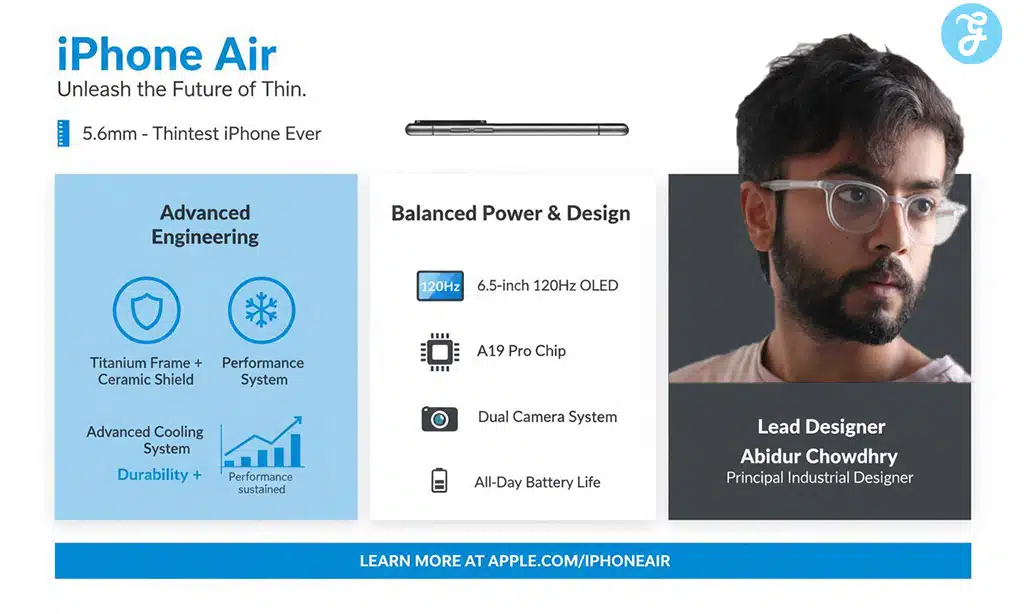
The iPhone Air represents a significant technical and design achievement. At 5.6 mm thick, it is slimmer than any of Apple’s previous smartphones, beating even the iPhone 6 (6.9 mm) and iPhone 15 (7.8 mm). This level of thinness required:
-
Advanced engineering of internal components to fit high-density batteries and processors into a smaller frame.
-
New materials, such as titanium combined with Ceramic Shield glass, to maintain durability despite reduced thickness.
-
Cooling and heat management systems, ensuring the A19 Pro chip doesn’t overheat inside the compact form.
Balancing Power and Design
Apple markets the iPhone Air as combining the slim profile of a lifestyle device with the performance of a Pro model. It features:
-
6.5-inch ProMotion OLED display with 120Hz refresh rate.
-
A19 Pro processor, delivering AI-driven performance and efficiency.
-
Compact dual-camera system with telephoto capabilities enhanced by computational photography.
-
All-day battery life, despite skepticism from analysts about how a thinner battery will hold up under real-world conditions.
Chowdhury’s Contribution
Abidur Chowdhury is credited with leading the industrial design direction of the iPhone Air. While Apple design is always a team effort, his visible role on stage suggests he was a central figure in the concept-to-production pipeline. The fact that Apple spotlighted him — unusual for the company — reflects growing recognition of individual design talent in shaping its identity.
Why His Story Matters
Representation in Global Tech
Chowdhury’s rise resonates widely because of his multicultural roots. As a British-Bangladeshi designer educated in the UK and now shaping products at Apple in California, his journey reflects the global nature of modern innovation. His visibility inspires young designers from diverse backgrounds to believe that their ideas and efforts can reach the world stage.
For students and young designers, his journey demonstrates the importance of:
-
Competing in design competitions (e.g., Red Dot, Dyson) to gain credibility.
-
Gaining diverse experiences through internships, freelancing, and consultancies.
-
Building a strong portfolio that highlights creativity and problem-solving.
Changing Face of Apple Design
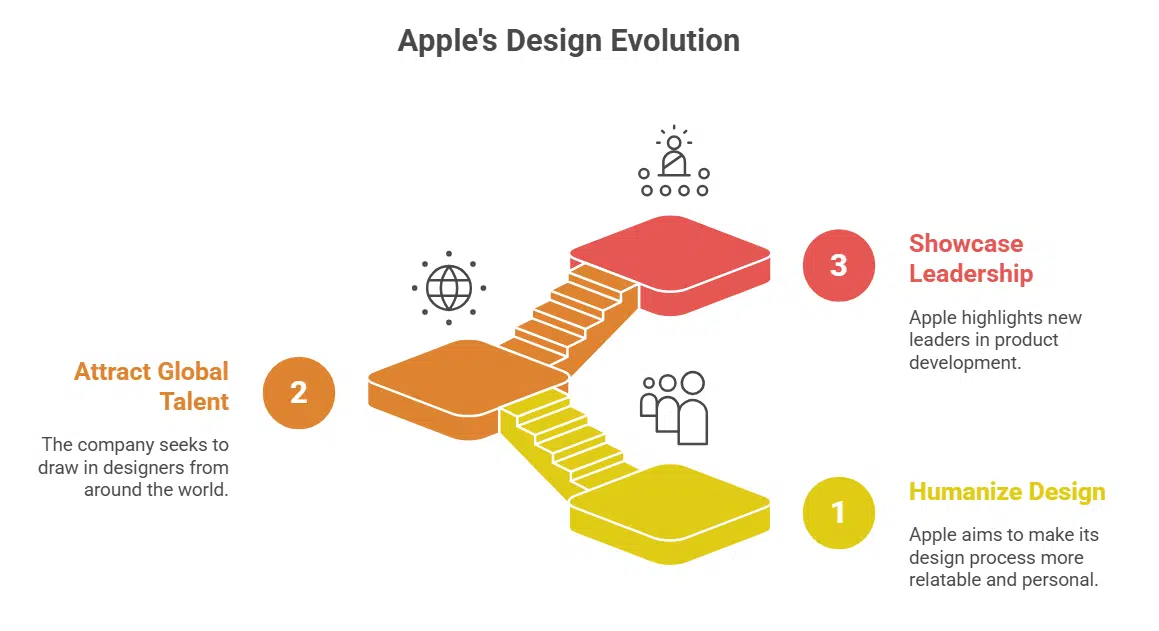
Apple’s decision to put Chowdhury on stage marks a shift in corporate culture. Traditionally, the company’s design team (once led by Jony Ive) worked in secrecy, with products presented by executives like Tim Cook or Phil Schiller. Highlighting a relatively young designer signals Apple’s intent to:
-
Humanize its design process.
-
Attract talent globally.
-
Showcase fresh leadership in product development.
What We Know and What Remains Unclear
Confirmed facts:
-
Chowdhury’s London origin and Loughborough education.
-
His award-winning student projects.
-
His early career in UK design firms and consultancy.
-
His joining Apple in 2019 and stage appearance in 2025.
Unclear aspects:
-
The exact roles and products he worked on at Apple between 2019–2024.
-
How much of the iPhone Air design was led personally by him versus team contributions.
-
His personal biography beyond education and early career.
These uncertainties are common with Apple’s secretive approach to design. As more interviews and reports emerge, the specifics of his contributions may become clearer.
Industry Reaction to iPhone Air
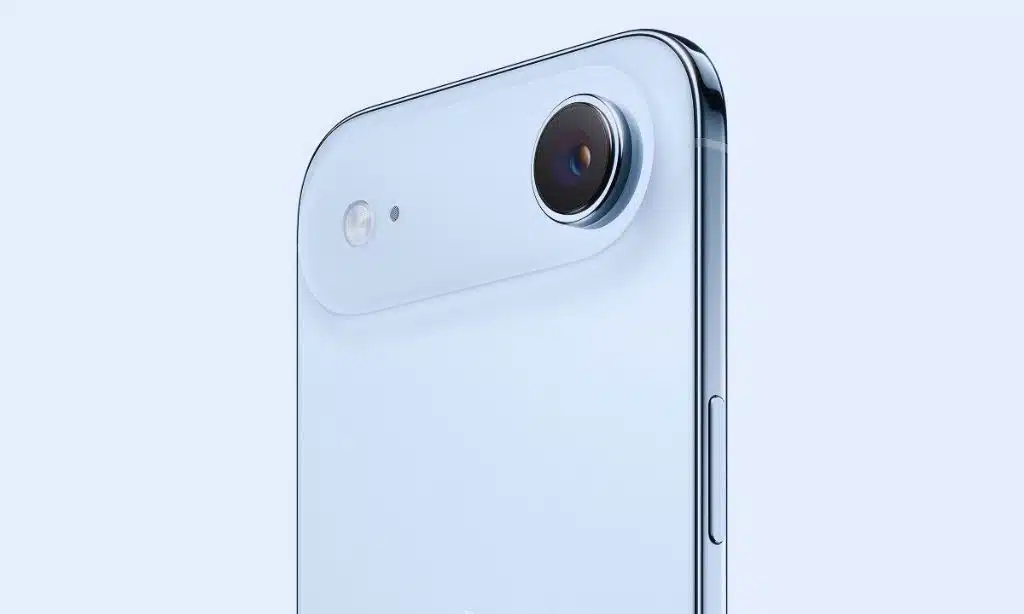
Analysts and reviewers see the iPhone Air as both a design triumph and a risk:
-
Positive reactions: praised for aesthetics, weight reduction, and comfort in hand.
-
Concerns: skepticism over battery life, durability in long-term usage, and whether thinness compromises function.
The iPhone Air could influence a broader trend toward ultra-thin premium devices, forcing competitors like Samsung and Xiaomi to respond with similar form factors.
A Designer to Watch
The September 2025 launch of the iPhone Air was more than just another Apple event. It marked the moment the world was introduced to Abidur Chowdhury, a designer whose career represents persistence, innovation, and the power of global talent.
His trajectory—from London classrooms to design competitions, from consultancy firms to Apple’s secretive labs, and finally to the Cupertino stage—illustrates the path of a modern industrial designer. His story highlights how design talent can emerge from diverse backgrounds and influence global technology.
As Apple moves forward, Chowdhury’s visibility suggests that industrial design will continue to move out of the shadows and into the spotlight. Whether the iPhone Air becomes a long-term success will depend on real-world adoption, but for now, his career is a powerful symbol of how creativity, education, and global opportunity converge in the technology industry.
Takeaways
Abidur Chowdhury’s emergence at the iPhone Air launch represents more than a personal achievement—it reflects a generational shift in how design talent is recognized on the world stage. His journey, from London classrooms and design competitions to the heart of Apple’s Industrial Design team, shows how persistence, global exposure, and creativity can converge to shape products that millions will use.
The iPhone Air, as the thinnest iPhone ever created, symbolizes Apple’s continued ambition to balance engineering excellence with design artistry. Chowdhury’s role in that process highlights the increasing importance of industrial design not only as a support function but as a driving force of innovation.
For aspiring designers, his story is both inspirational and instructive. It proves the value of competing in global design forums, building diverse career experiences, and pursuing opportunities beyond borders. For Apple, it marks a new era of celebrating the people behind the products, opening up its design culture to the world in a way that both humanizes and strengthens its brand.