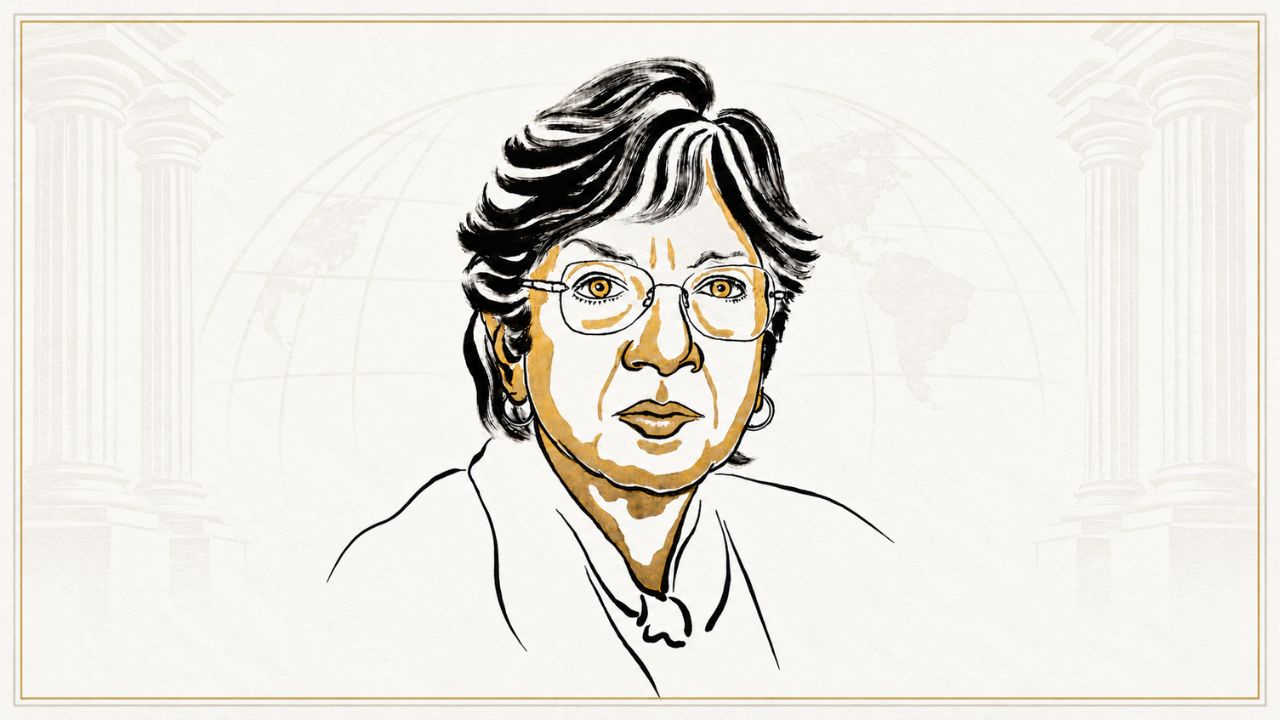
The 2026 Nobel Peace Prize was awarded to South African jurist and human rights champion Navanethem “Navi” Pillay on 9 October for her efforts to promote peace and international law. From defending people under apartheid to judging a landmark genocide case, Pillay has spent her career pursuing accountability. Her Nobel Prize arrives as the courts she helped build face a test of their own.
Pillay heard the news at a conference in Nuremberg. She had been sitting in Courtroom 600, where leading Nazi figures were tried after the Second World War. Her colleagues rose to applaud. Pillay later said she saw the prize as recognition for the institutions where she had served and the people who had worked alongside her.
The setting was remarkable, but the question raised by the award is current. Pillay’s career runs through some of the defining efforts to hold people accountable for mass violence. The Nobel Committee argues that this work belongs in a story about peace. Its choice also asks how much international law can achieve when governments resist the courts charged with applying it.
Why a jurist won the Nobel Peace Prize
A ceasefire can stop fighting. It does not, by itself, establish what happened to civilians, who gave orders, or whether survivors will have a chance to be heard. Courts can address those questions, even when the answers take years.
That is the idea behind the Nobel Committee’s decision. It recognized Pillay’s work in developing legal ways to prosecute war crimes, crimes against humanity and genocide. The committee sees accountability as part of the conditions for a more durable peace.
There is a precedent for this view of the prize. In 1904, the Institute of International Law received the Nobel Peace Prize for its work on peaceful relations between countries and more humane laws of war. Pillay’s award brings that tradition into a world with international criminal courts, UN investigations, and fierce disputes over their authority.
The case for law is strongest when we can see what it changed. For Pillay, the clearest example comes from Rwanda.
From an apartheid lawyer to an international judge
Pillay’s path to international justice began in South Africa, where she learned to use the law while living under a system built on racial discrimination.
A lawyer under apartheid
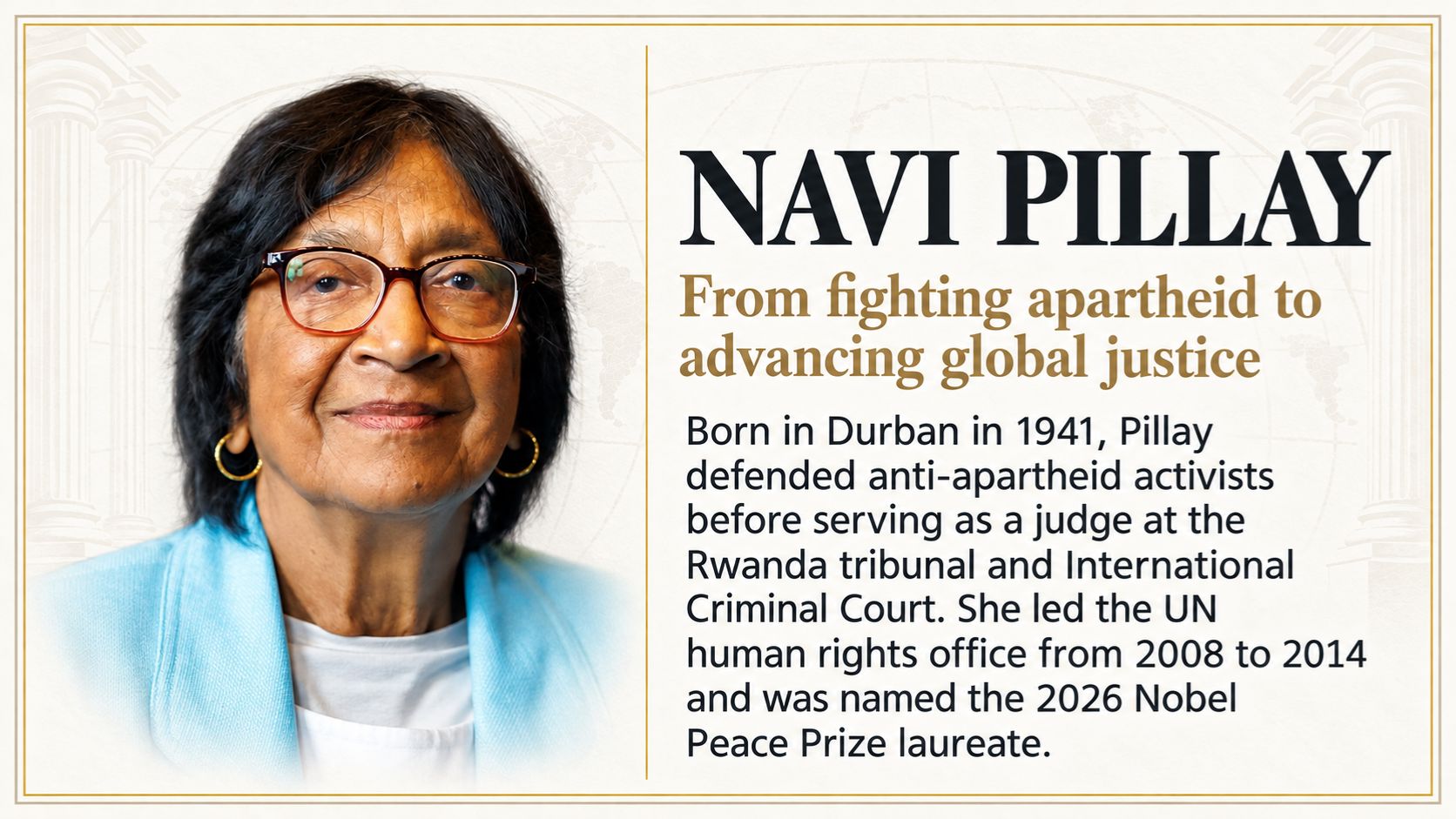
Born in Durban in 1941 to a family of Indian Tamil descent, Pillay entered a legal profession shaped by apartheid. In 1967, she became the first woman to establish a law practice in Natal province.
She defended anti-apartheid activists and worked for the rights of political prisoners, including Nelson Mandela. Those early cases concerned a direct question: what protection could the law offer people confronting an oppressive state?
A career across courts and the UN
After apartheid ended, Pillay was appointed to South Africa’s High Court in 1995. She went on to serve at the International Criminal Tribunal for Rwanda, where she later became president. She was a judge at the International Criminal Court from 2003 to 2008 and then served as UN High Commissioner for Human Rights until 2014.
Pillay subsequently chaired a UN commission of inquiry on the occupied Palestinian territory and Israel from 2021 to 2025. She now serves as a judge ad hoc in the International Court of Justice case brought by The Gambia against Myanmar. Each role gave her a different responsibility, from judging individual cases to investigating allegations and speaking for human rights at the UN.
You can read about the Nobel Prize in Literature 2026 here.
The Rwanda judgment that still matters
In September 1998, the International Criminal Tribunal for Rwanda convicted Jean-Paul Akayesu, a local official during the 1994 genocide. He was found guilty of genocide, direct and public incitement to commit genocide, and crimes against humanity, including rape.
It was the first conviction for genocide by an international court. The judgment also changed how sexual violence could be addressed under international law.
When sexual violence was recognized as part of genocide
The trial chamber held that rape and other acts of sexual violence can constitute genocide when they are committed with the specific intent to destroy, in whole or in part, a protected group. In Akayesu’s case, the judges examined sexual violence against Tutsi women as part of the campaign of destruction.
That finding was consequential because it brought those acts into the legal account of the genocide. The charges involving sexual crimes had been added during the trial. Testimony that could have remained at the edges of the case became central to its judgment.
The chamber also convicted Akayesu for inciting genocide through a public speech urging violence against Tutsis. The case showed how an individual could be held responsible for helping to drive a campaign of killing, as well as for crimes committed under his authority.
Pillay’s role in a collective decision
Pillay was one of three judges on the trial chamber, alongside Lennart Aspegren and presiding judge Laïty Kama. The judgment was their collective decision, based on evidence and arguments presented in court.
Giving that full account makes the achievement clearer. Survivors testified. Prosecutors brought charges. Judges assessed the record and set out principles that would matter beyond one trial. Pillay’s contribution belongs within that process, which is also the kind of process her Nobel Prize honors.
Read about the Nobel Prize in Physics 2026 here.
What Pillay’s different roles mean
Pillay’s work has involved two international courts and a UN commission. Their powers are distinct.
The International Criminal Court, where she served until 2008, investigates and prosecutes individuals accused of crimes within its jurisdiction. The International Court of Justice hears disputes between states. Pillay now serves as a judge ad hoc in the ICJ case brought by The Gambia against Myanmar over allegations of genocide against the Rohingya. She is not a permanent ICJ judge.
Pillay also chaired a UN commission of inquiry on the occupied Palestinian territory and Israel from 2021 to 2025. A commission can investigate allegations and publish findings. It cannot convict anyone or issue a court judgment.
Those differences matter because her work on Gaza has become central to the response to this year’s prize.
Gaza and the dispute over the award
In September 2025, the UN commission formerly chaired by Pillay concluded that Israel had committed genocide against Palestinians in Gaza. Israel rejects the conclusion and sharply criticized the decision to give Pillay the Nobel Peace Prize, accusing her of bias against the country.
The commission had also investigated the attacks of 7 October 2023. In earlier findings, it held Hamas and other Palestinian armed groups responsible for war crimes, including hostage-taking. Its mandate covered alleged violations in Israel as well as the occupied Palestinian territory.
The status of its 2025 finding is clear: it is the conclusion of an investigative commission, not a final ruling by the ICJ. South Africa has brought a separate genocide case against Israel before that court. The ICJ had not delivered a final judgment on the allegation when Pillay’s prize was announced. Pillay’s own ad hoc appointment at the ICJ concerns the Myanmar case.
The Nobel Committee referred to Pillay’s commission work, so Gaza is part of the story. Its stated reasons for the prize also reach back across decades of legal practice and international service. The commission’s findings should be examined and attributed as findings; the award itself settles none of the legal questions under dispute.
Learn more about the Nobel Prize in Physiology or Medicine 2026.
International courts face pressure of their own
On the same day as the Nobel announcement, the United States imposed sanctions on the International Criminal Court as an institution. The ICC rejected the measure and said it would continue to act independently.
Washington has long objected to the court asserting authority over US nationals and has opposed its actions involving Israeli officials. Under the ICC’s founding treaty, the court can examine certain alleged crimes committed on the territory of a member state even if an accused person comes from a country that has not joined. That rule is central to the disagreement.
The coincidence in timing is striking, but the Nobel decision has not been shown to have caused the US sanctions. Pillay left the ICC in 2008; the new measure targets an institution where she once served.
It is still a vivid example of the pressure the Nobel Committee described. International courts need cooperation to investigate crimes and bring suspects before judges. A dispute between a powerful government and the court can affect much more than public confidence in either side’s position.
The reactions to Pillay’s award revealed the same divide. South African President Cyril Ramaphosa and UN leaders praised her career. Israeli leaders condemned the choice. US President Donald Trump criticized the decision and argued that he deserved the prize. The Norwegian Nobel Committee, whose members are appointed by Norway’s parliament, selected Pillay; Norway’s government did not make the award.
Can a court deliver justice without cooperation?
The Akayesu case shows what a court can do. It can hear testimony, establish individual responsibility and state plainly that sexual violence can form part of genocide. For survivors, that recognition has weight.
The distance between a legal finding and its practical effect remains large. The ICC has no police force of its own. It relies on countries to arrest suspects and transfer them to the court. Investigators need access to evidence; witnesses may need protection. A judgment cannot make those requirements disappear.
The Nobel Committee acknowledged another difficulty in its announcement: powerful states have often escaped responsibility, and international law has produced uneven results. I find that admission as important as its praise for Pillay. It identifies the question that will determine whether the promise of accountability remains credible.
A court’s work should withstand scrutiny. Evidence must be tested, legal standards must be met, and judgments can be challenged. Those safeguards matter most in politically charged cases. So does the willingness of governments to accept scrutiny when it reaches their own side.
Learn more about the Nobel Prize in Chemistry 2026 here.
The measure of Pillay’s Nobel Prize
Pillay is due to receive the Peace Prize in Oslo on 10 December. The ceremony will honor a career that began with defending people under apartheid and continued through cases and investigations involving some of the gravest allegations in international law.
The prize can draw attention to judges, investigators, witnesses and survivors. It cannot enforce an arrest warrant, decide a pending case or compel a government to cooperate. Those outcomes depend on choices made well after the applause ends.
Pillay’s career shows that international law can change what courts are prepared to hear and what they are able to recognize. The measure of this Nobel Prize will be whether governments allow those same institutions to work when their findings become difficult to accept.