
A team offer can look simple: join the roster, attend practice, and receive a salary. But esports contracts can also shape prize money, sponsorships, streaming, image rights, roster status, and a player’s options when the relationship ends.
There is no single agreement for every game, organization, or country. Players should read the full document, including policies it refers to, and ask for verbal promises in writing. This guide offers general information, not legal advice. For a significant offer, get independent legal advice in the relevant jurisdiction.
What Esports Contracts Should Make Clear
The agreement should identify the organization’s legal entity—not only the team brand—and describe the player’s role, game, roster, competition, and region. A vague role can cause trouble if a player is later asked to compete in another title, take on regular content work, or represent sponsors.
Check every document the agreement incorporates, such as a team handbook, league rules, or sponsor policy. Ask which version applies and whether the organization can change it during the contract term. Keep a copy of the final signed agreement and any amendments.
Esports Contracts: Salary, Prize Money, and Expenses
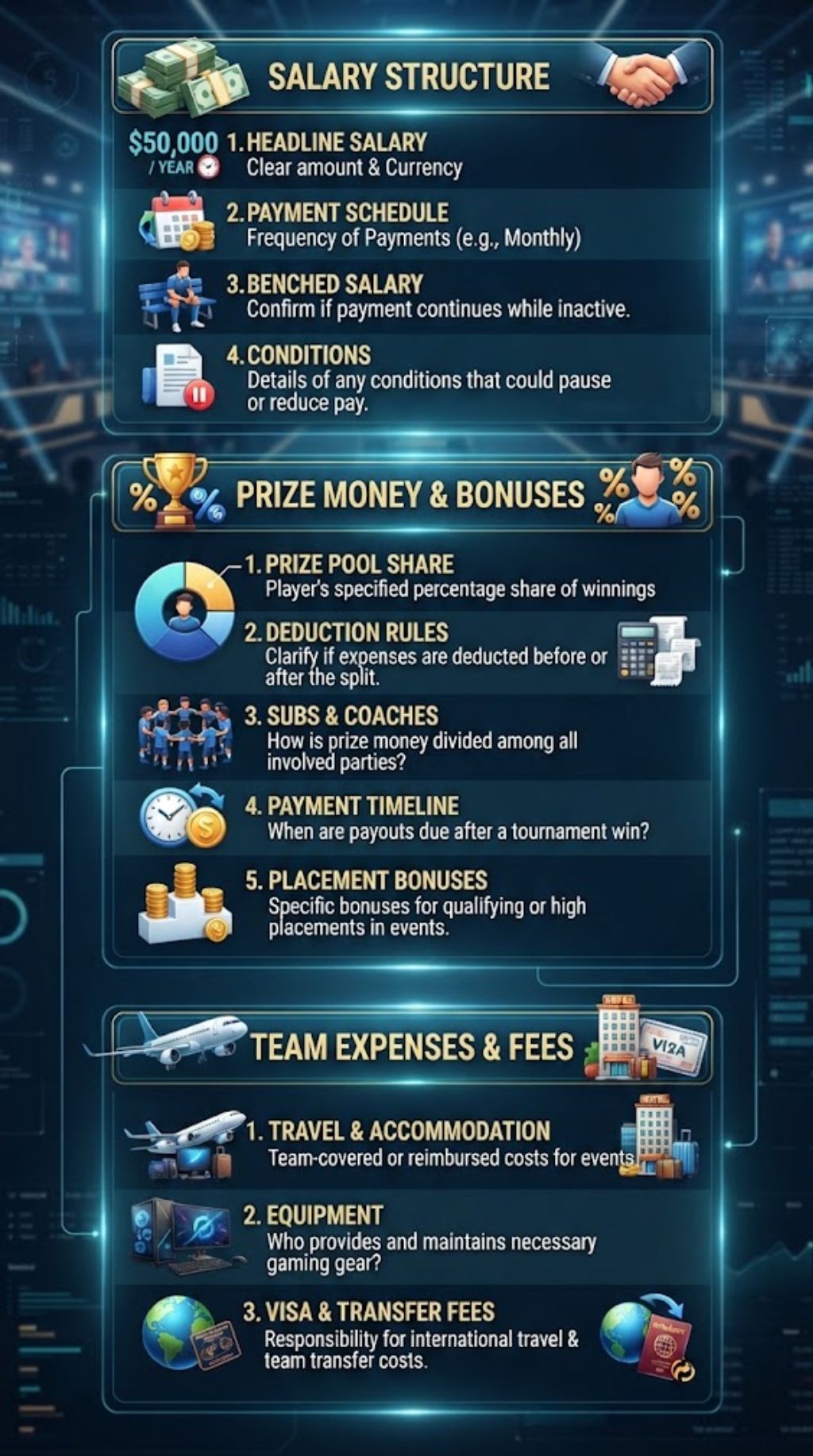
A headline salary is only useful if the payment terms are clear. Confirm the amount, currency, schedule, and any conditions that could pause or reduce payment. Ask directly whether salary continues if you are benched.
Prize money needs its own formula. The agreement should state the player’s share, whether expenses are deducted first, how substitutes or coaches are treated, and when payment is due. “The team will share winnings fairly” is too vague to rely on.
Also clarify who pays for travel, accommodation, equipment, visa costs, and transfer fees. If a bonus depends on qualifying for or placing in an event, the contract should name the event and define the payment trigger. Esports contract guidance from British Esports identifies pay, prize shares, expenses, duties, and sponsorship obligations as terms that should be set out clearly.
Contract Length, Renewals, and Roster Changes
Check the start and end dates, renewal options, and notice deadlines. Some agreements continue beyond the season or let one side extend the term. Put every notice date in a calendar; missing one can leave a player tied to the deal longer than expected.
Roster status matters just as much as duration. Ask what happens if you are benched, loaned to another organization, or kept under contract without competing. Will you still be paid? Can you leave if the situation lasts beyond a defined period? If the contract gives the team broad roster control, it should also explain the player’s pay and exit options.
Esports Contracts Practice, Content, and Sponsor Duties
A professional role can extend well beyond scrims and tournaments. The team may expect livestreams, media appearances, boot camps, sponsor events, or promotional videos. The agreement should describe these duties and set practical expectations for scheduling.
Read sponsor restrictions alongside any personal deals you already have. If the team has an exclusive sponsor in a category where you have a personal partner, ask whether you must remove branding from your stream, who approves future deals, and whether the restriction affects your pay. Do not leave a conflict to be settled after you have signed.
Name, Image, Gameplay, and Streaming Rights
The contract should explain how the organization may use your in-game name, image, voice, and content. Check whether the permission lasts only during the contract or continues afterward, and whether it covers advertising or merchandise.
Players’ rights can overlap with those held by game publishers and tournament organizers. The World Intellectual Property Organization’s esports guidance specifically addresses this overlap, so distinguish your own identity and original content from game assets and event footage.
Ask who owns team-produced videos, whether the organization can edit or monetize your streams, and whether you keep your channels and archives after leaving. A limited permission to promote the roster is different from a permanent transfer of broad rights.
Exclusivity and Restrictions after Leaving
An exclusivity clause may prevent you from competing for another organization while the deal is active. Make sure it names the games and activities it covers. Read any post-contract restrictions just as carefully, including limits on joining another team, streaming, or discussing the organization.
Their effect depends on the wording and local law. Do not assume a restriction is harmless because the team calls it standard, or assume it is unenforceable because it seems unusually broad. Ask a lawyer in the relevant jurisdiction to explain what it could mean for your next contract.
Termination, Suspension, and Buyouts
Read the conditions under which either side can end the agreement. Can you leave if the team fails to pay or seriously breaches the deal? Can the team terminate for performance, inactivity, or misconduct? Is there a warning or a chance to fix the problem first?
Vague language such as “failure to meet expectations” can give one side too much discretion. Ask how performance is judged and whether pay continues during a suspension or investigation.
A buyout or release clause can affect your next move. Check who can trigger it, who receives the payment, whether you must consent to a transfer, and whether the amount or process could make it difficult to join another roster.
Governing Law and Dispute Resolution
The agreement should say which law applies and where a dispute will be handled. It may require mediation or arbitration before a court case. Check the location, language, likely costs, and whether you can bring a lawyer or representative.
These details are easy to overlook when the team is based abroad. A process that requires costly travel or proceedings in an unfamiliar language may be difficult to use, even if the contract describes it clearly.
Extra care for Players Under 18
If you are under 18, involve a parent or legal guardian before negotiating or signing. Rules for minors’ agreements, work, travel, and education vary by country. A guardian’s signature does not necessarily answer every legal question.
Ask how the organization will handle travel approvals, promotional work, schooling, and accommodation. Get the complete agreement and related policies, and allow time for independent review. Pressure to sign immediately is a reason to slow down.
How to Review an Offer before Signing
Read the full agreement away from the pressure of a call or roster deadline. Make a list of unclear terms, ask the organization to answer in writing, and request changes where the written terms do not match what was promised.
Before signing, confirm that:
- Your role, game, duties, and roster status are defined.
- Salary, prize shares, bonuses, and expenses are specific.
- Contract dates, renewal options, and notice deadlines are clear.
- Benching, suspension, transfers, and termination are addressed.
- Image, content, streaming, and sponsor rights have limits.
- Exclusivity and post-contract restrictions are understandable.
- You know which law and dispute process apply.
If the agreement refers to a policy you have not received, ask for it. A team calling a clause “standard” does not tell you what it means for your career.
Final Thoughts
The most consequential terms may sit outside the salary line. Before signing, focus on the clauses that affect whether you get paid, can keep competing, and control how your identity and content are used.
Esports contracts should leave both sides clear about the work and the consequences if plans change. Get promises in writing, take time to review the full agreement, and seek independent advice when a term could affect your income or next move.
Frequently Asked Questions (FAQs) About Esports Contracts
What should I ask if I’m benched?
Ask whether salary and benefits continue, how long the benching can last, and whether you can end the agreement if you are not returned to active play. The answers should be written into the contract or a signed amendment.
Does calling a player an independent contractor settle their legal status?
Not necessarily. In the UK, government guidance says the reality of the working relationship matters alongside the contract wording. Other countries have their own tests, so players should check local rules.
Can a team use my image after I leave?
That depends on the agreement’s wording and applicable law. Check how long permission lasts, what uses it covers, and whether it applies to new campaigns or only content already created.
What should a minor do before signing?
Have a parent or legal guardian review the full agreement, and seek advice about the rules in the relevant country. Pay special attention to travel, work expectations, education, and how the agreement changes when the player turns 18.