
Finding money for college can feel like climbing a mountain with no end in sight. Many students dream of studying abroad, but the terrifying combo of high academic fees and living costs makes it tough to turn those dreams into real plans.
Here is something that might surprise you: Some countries actually offer free tuition at public universities for international students. This guide features six affordable destinations known for delivering strong educational opportunities.
Keep reading to find out how far your passport, and your ambition, can take you!
What is Free Tuition for International Students?
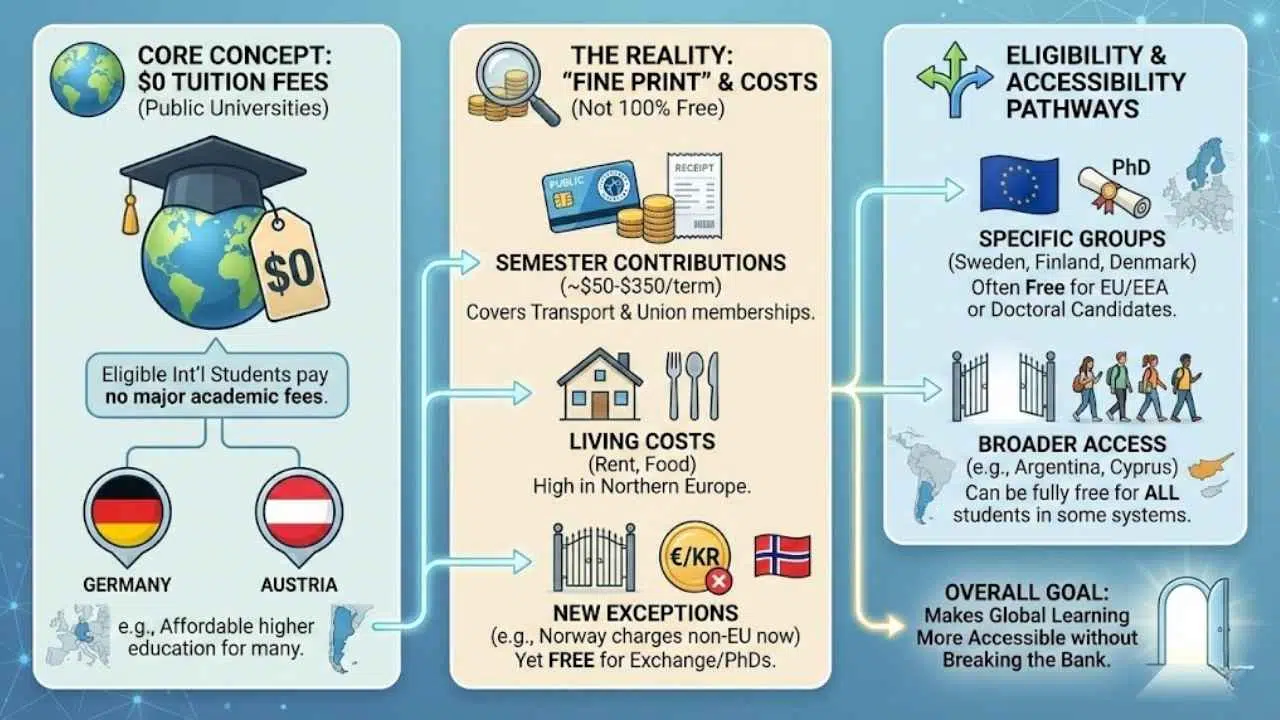
Free tuition means students from other countries pay no fees, or only a small administrative fee, to attend public universities. Countries like Germany and Austria have made higher education affordable for almost everyone, including international students from outside Europe.
However, it is vital to read the fine print. While tuition might be $0, you will often still pay for:
- Semester Contributions: These small fees (usually $50-$350) often cover student union memberships and public transport tickets.
- Living Costs: Rent and food in Northern Europe can be pricey.
- New Exceptions: Places like Norway recently started charging fees for non-EU students, though they remain free for exchange programs and PhDs.
Sweden, Finland, and Denmark also offer free or low-cost university programs, specifically for EU/EEA citizens or doctoral candidates. In some places, such as Argentina and Cyprus, college can be fully free for all students.
Some European nations keep academic fees very low in their public higher education systems. Eligibility rules may apply; sometimes free tuition is open only to citizens or EU members.
Many of these schools ask for payment just to cover basic costs, not full tuition amounts. This chance lets thousands of young people study abroad without breaking the bank each year, making global learning more accessible than ever before.
Top 6 Countries With Free Tuition for International Students
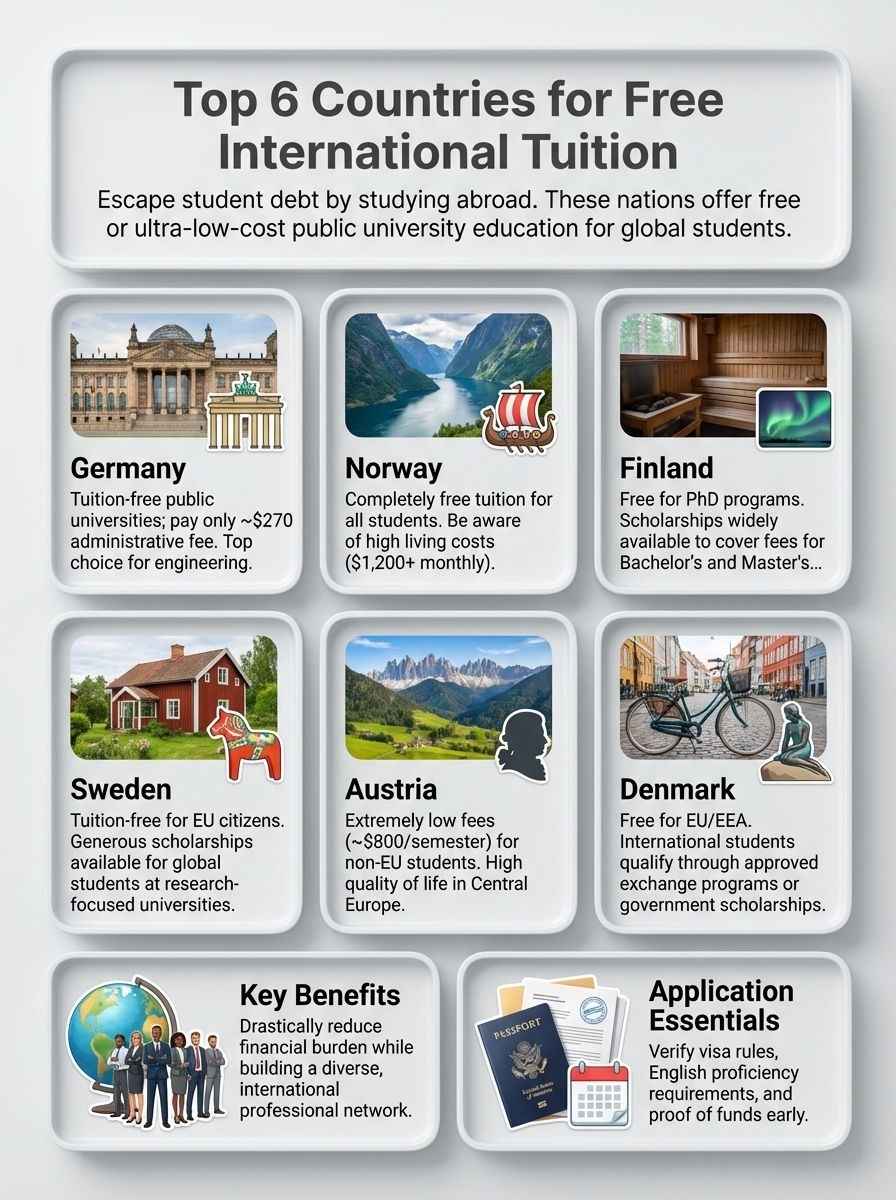
These countries open their doors wide for learners from across the globe, offering quality education without charging high academic fees. Many students flock to these places in hopes of easing their financial load while gaining a top-notch degree.
Germany
Germany is the heavyweight champion of free education. Public universities in Germany charge no tuition fees for international students, regardless of where you are from. Most courses, even at the bachelor’s and master’s levels, are completely free.
Only a small administrative fee applies each semester, usually around €250 (approx. $270). This fee often includes a “Semesterticket,” which gives you free access to public transportation in the region—a huge money saver.
Insider Warning: While most states are free, the state of Baden-Württemberg re-introduced tuition fees for non-EU students (approx. €1,500/semester). Also, the Technical University of Munich (TUM) has started charging fees for international students as of 2024. Always check your specific university!
Students from countries worldwide can study engineering, business, or science without worrying about high academic fees. Munich and Berlin attract many with their top-ranked schools like LMU Munich and Humboldt University. A student visa is required to enroll if you aren’t a European Union citizen.
Learning some German helps daily life; however, many programs use English as the instruction language. Education quality rates among the best globally while scholarships offer extra support for housing or books.
Thousands of students pick Germany every year because it opens doors to affordable higher education and global connections through public universities.
Norway
Heads up on a major update: As of 2023, public universities in Norway are no longer free for all international students. While they remain 100% free for EU/EEA citizens and exchange students, those from outside Europe must now pay tuition.
However, there is a silver lining for advanced scholars. PhD programs in Norway are still considered jobs, meaning they are free and you actually get paid a salary.
Students only need to pay a small semester fee, usually between $50 and $100. Courses are often taught in English at the master’s level, making it easy for students from all over the world to study here. Academic programs cover science, technology, art, and business.
The cost of living can be high in cities like Oslo and Bergen. Scholarships may help with expenses such as housing or food. Many enjoy Norway’s beautiful nature while gaining a top-quality education that does not break the bank on tuition fees.
Norway gives students access to international networks while studying abroad without worrying about academic fees or hidden costs.
Finland
Finland gives free tuition for international students in doctoral and PhD programs, regardless of nationality. For Bachelor’s and Master’s degrees, students from outside the EU or EEA need to pay fees; these usually start around €6,000 to €12,000 per year.
If you are a top student, don’t let that price tag scare you. Many public universities offer the “Finland Scholarship,” which covers the entire tuition fee and includes a €5,000 relocation grant.
Most classes use English, making it easy for global students to join top educational programs. Living costs add up fast in Finnish cities like Helsinki so planning your budget matters a lot. Student visa rules are clear, but you must show proof of funds before moving for higher education here.
Finland’s focus on equality helps everyone feel at home while studying abroad.
Sweden
Sweden offers free tuition for students from the EU and EEA, but international learners from outside these groups pay fees. However, just like its neighbors, PhD positions in Sweden are tuition-free and usually come with a monthly salary.
Public universities charge no academic fees to European students, making it a smart choice for many in Europe. For non-EU or EEA citizens, scholarships often cover tuition costs, especially at top schools like Lund University and Uppsala University.
| Feature | EU/EEA Students | Non-EU Students |
|---|---|---|
| Tuition Cost | $0 (Free) | $7,500 – $25,000 / year |
| Application Fee | None | Approx. $85 (900 SEK) |
| PhD Programs | Free + Salary | Free + Salary |
Many programs are taught in English so language is not a barrier. Living expenses can be high; Stockholm ranks as one of Europe’s pricier cities.
Still, Sweden stands out with its high-quality education and focus on research within public higher education. You’ll find a friendly learning culture that encourages questions and creativity over strict tests or rote memorization. Tuition free university spots go fast here, so meeting admission criteria matters if you want your spot in this Scandinavian favorite.
Austria
Austria is a hidden gem for affordability. Public universities in Austria charge very low tuition fees for students outside the European Union. Many international students pay around €726 (approx. $790) per semester, which is much lower than what American colleges ask for.
For students from developing countries, tuition is often waived entirely, leaving you to pay only the student union fee of about €24 per semester.
Some scholarships cover even this fee, making it almost free. Students can pick from a wide range of courses taught in both German and English. Austria’s higher education often ranks high in quality across Europe.
You will need to budget for living costs, with cities like Vienna and Graz being popular choices among students worldwide. Over 90,000 foreign students choose Austria each year because of its affordable public university system and strong academic programs.
Public transportation is reliable, so getting around is easy on a student budget. Student visas are straightforward if you get accepted to a program at one of Austria’s many respected universities.
Denmark
Denmark offers free tuition for students from the EU, EEA, and Switzerland. International students from outside these regions can also study in Denmark for free if they join an approved exchange program or receive a government scholarship.
Danish public universities have high standards and offer many courses taught in English, making it easier for international education seekers to fit in. Students do need to cover living costs, which can be higher than average; expect about $1,100–$1,600 per month for food and rent.
Top cities like Copenhagen attract students with modern facilities and academic programs known around Europe. Scholarships are available through several Danish universities to help ease financial stress for those who qualify.
Benefits of Studying in Countries With Free Tuition
Studying in countries with free tuition opens doors to learning, meeting new friends from around the globe, and saving money. Stick around to find out how life-changing it can be!
Reduced Financial Burden
Paying for higher education often feels like carrying a heavy backpack filled with bricks. Tuition-free public universities in Germany, Norway, and Finland lighten that load for international students. Sweden, Denmark, and Austria also keep academic fees low or even free at some schools.
Instead of worrying about tuition bills stacking up, you can save money or use it on living expenses, travel, books, or fun outings with friends. According to recent data, the average US student graduates with over $30,000 in debt, while students in these systems often graduate debt-free.
Free college in places like Argentina means you get access to quality education without emptying your wallet. This makes studying abroad much more affordable and stress-free for many families worldwide.
Access to High-Quality Education
Germany, Finland, and Norway offer free or low-cost higher education that meets top global standards. Their public universities have strong reputations for research and teaching.
Many schools in Sweden, Austria, and Denmark also provide classes taught by experts with advanced degrees. These countries attract students from all over the world who want international education without breaking the bank.
Many public universities in these nations rank high on lists of global universities. State-of-the-art labs and updated libraries help you learn new skills every day. In places like Germany or Sweden, professors encourage open discussion and critical thinking in class.
Students often work closely with teachers on real projects instead of only reading textbooks all term long. This mix of practical knowledge and theory shapes confident graduates ready for any challenge after college.
International Networking Opportunities
Meeting students from every corner of the world feels like joining a global team. Norway, Finland, Sweden, Denmark, Austria, and other countries with free or low-cost tuition attract crowds from over 120 nations each year.
You might share classrooms with peers speaking Spanish, Mandarin, Arabic, or Hindi. This mix gives you fresh ideas and friends that can last for life.
Top universities in these countries host events and clubs just for international students. Many offer language exchanges and career fairs connecting you to both local companies and worldwide organizations.
One day you could be studying next to someone from Ghana; the next day grabbing coffee with a classmate from Japan. These moments build friendships but also future work contacts, sometimes even opening doors to jobs outside your home country after graduation.
Considerations When Applying to Tuition-Free Universities
Small details can trip you up, so you want to read every requirement with care. One wrong step could mean starting your search all over again.
Language Requirements
Each country has its own language rules for international education. Germany, Norway, Finland, Sweden, Austria and Denmark often teach some programs in English. Public universities may ask for proof of English skills like TOEFL or IELTS scores.
Many Bachelor’s degrees are still taught in the local language so students need to show proficiency in German, Norwegian, Finnish or Swedish if they choose those options. For example, in Germany, you might need a TestDaF certificate (Level 4) for German-taught programs.
Free tuition does not erase the need to meet these requirements. Some schools offer special courses to help with language learning before regular classes start.
Scholarships sometimes require proven language ability as well. Always check each university’s admission page closely because missing a key document can mean kissing your study abroad dream goodbye before you even get started.
Cost of Living
Living in Germany, Norway, or Denmark can feel like living in a storybook, but life there does not come cheap. Rent in cities like Oslo and Copenhagen often eats up a big chunk of your budget.
| Country | Est. Monthly Living Cost (USD) | Proof of Funds Required for Visa |
|---|---|---|
| Germany | $950 – $1,400 | €11,904 / year (Blocked Account) |
| Norway | $1,300 – $1,800 | Approx. NOK 151,690 / year |
| Austria | $1,000 – $1,400 | Approx. €12,000 / year |
In Norway, monthly living costs for students usually range from $1,200 to $2,000. Germany is more wallet-friendly with expenses around $900 to $1,400 each month. Austria and Finland ask around $800 to $1,100 per month for basic needs such as food and transport.
Countries offering free tuition still have daily costs that stack up fast if you are not careful. Sweden’s main cities may see average student budgets near $1,200 monthly due to higher prices on groceries and housing.
Scholarships sometimes help cover housing or meal plans at public universities; they do not always pay off every bill though. Knowing these figures helps you prepare before applying for educational programs abroad with lower fees but higher everyday expenses.
Admission Criteria
Each country sets its own rules for admitting international students to public universities. In Germany, applicants need a high school diploma equal to the German “Abitur.” If your US high school diploma isn’t equivalent, you may need to attend a “Studienkolleg” (preparatory course) for one year.
Norway and Finland often require proof of English language skills and may ask for specific grades from earlier studies. Austrian universities usually want completed secondary education and sometimes an entrance exam.
Sweden and Denmark check for academic records, standardized test scores, or special program requirements. Some countries limit free tuition to citizens or EU members, so always double-check your status before applying.
Even with free tuition, schools can be strict about deadlines and paperwork; missing one step could cost you your chance at that dream spot abroad!
How to Apply for Tuition-Free Programs
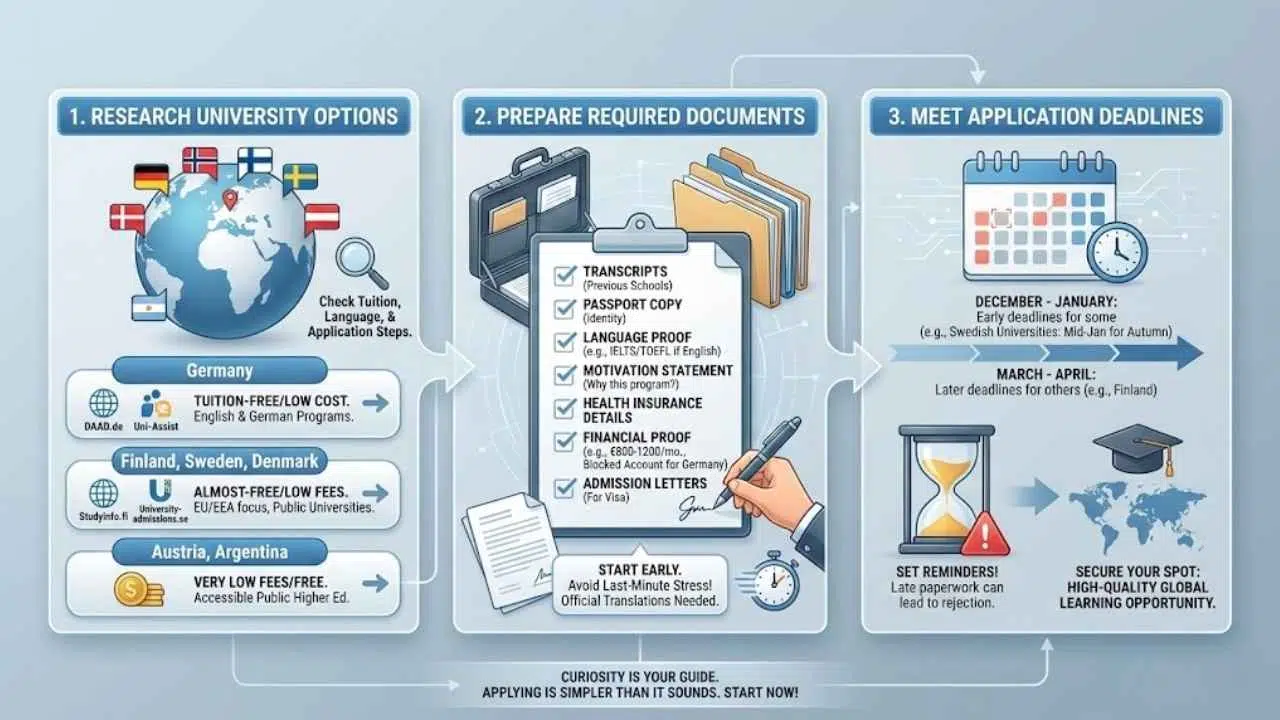
Applying is simpler than it sounds, just start early and check each school’s rules. Get your papers ready, set reminders for dates, and let curiosity be your guide.
Research University Options
Start with Germany, Norway, and Finland. These countries offer free or low-cost public higher education for international students from anywhere in the world. Scan university websites for tuition details, language of instruction, and application steps.
Check if programs are taught in English or require proof of another language. Use centralized portals to make your search easier:
- Germany: Use DAAD.de or Uni-Assist to find programs.
- Finland: Check Studyinfo.fi for all degrees and applications.
- Sweden: Use Universityadmissions.se for a one-stop-shop.
Sweden and Denmark provide almost-free academic opportunities at many public universities too. Austria has very low fees, sometimes just a few hundred euros per semester, for students outside Europe. Make a shortlist based on your field of study, living costs in each city, student visa options, and entry requirements.
Some countries like Argentina also welcome international students into their free college system. Public higher education here opens doors without huge tuition fees hanging over your head.
Prepare Required Documents
Gathering documents early can help you avoid last-minute stress. Universities in Germany, Norway, Finland, Sweden, Denmark, and Austria often ask for transcripts from your previous schools.
You may need a copy of your passport and sometimes proof of language skills if classes are not in English. Many public universities also want a statement explaining why you chose their academic programs.
Some countries or universities request health insurance details, financial statements to show you can pay for living costs (about $800–$1,200 per month), or even letters of recommendation. For Germany, you will likely need to open a Blocked Account (Sperrkonto) to prove you have the cash for your visa.
Student visa applications usually require admission letters and proof that you paid any small fees charged by the university. Keep official translations handy if your papers aren’t in the local language. Double-check with each school since requirements vary widely across higher education institutions offering free tuition for international students.
Meet Application Deadlines
Miss a deadline, and your chance at free tuition might slip right through your fingers. Public universities in Germany, Norway, Finland, Austria, Sweden, and Denmark have strict admission dates for international students.
Some schools may close applications as early as December or January for fall intake. Others cut off applications by March or April. For example, the deadline for most Swedish universities is mid-January for the autumn semester.
Set reminders to check each university’s schedule before you apply. Popular educational programs fill up fast. Decisions come down to the wire with thousands of students eyeing spots in top global universities that offer affordable or zero tuition fees.
Late paperwork can bump you out of consideration even if all other requirements are met! Always review application windows on official university websites so you do not miss the boat on high-quality higher education opportunities abroad.
Final Thoughts
Germany, Norway, Finland, Sweden, Austria, and Denmark all offer free or low-cost higher education for international students who want a smart way to study abroad. These countries make it easy for you to apply and save on tuition fees while giving you access to great universities and global friendships.
Studying in these places means less worry about money and more chances to learn from top teachers in exciting new settings. So why not ask yourself if living in a snowy city or exploring Europe sounds like your next big move?
Get started by checking university websites or speaking with former students; every question brings you closer to packing your bags! Your future may be just one application away, so go after those dreams with both eyes open and heart ready for adventure.