
The global financial landscape of early 2026 has become a graveyard for idealistic economic theories. As the “fentanyl tariffs” tighten their grip on the North American trade corridor, the collateral damage has extended far beyond manufacturing and logistics. Many analysts entered this year predicting that decentralized assets would serve as the ultimate insurance policy against such geopolitical friction. The ongoing economic collapse in Mexico, triggered by aggressive trade pressure and civil unrest, has provided the first real-world stress test for this safe-haven narrative. Instead of acting as a digital bunker, the leading cryptocurrency is behaving like a high-beta tech stock under pressure.
We are witnessing a historic safe-haven narrative collapse as Bitcoin becomes an emergency source of cash rather than a store of value. When traditional markets face a “risk-off” contagion, investors do not flee into digital gold; they flee into the absolute liquidity of the US Dollar. This shift marks the definitive end of the “uncorrelated asset” era. To understand why this occurred, we must examine the hidden mechanics of institutional forced selling and the strategic re-shoring of global capital.
The Surface Illusion vs. The Third-Eye Reality
The front-stage politics of the 2026 trade war focused on the immediate impact of cross-border tariffs and military-led fentanyl interdictions. Retail investors were consistently told that Bitcoin would appreciate as the Mexican Peso devalued and trade tensions rose. This narrative was supported by influential crypto-fund managers who framed decentralized ledger technology as the only escape from centralized economic failures. The general public believed that a borderless asset would naturally thrive when physical borders became chokepoints. However, the reality of the 2026 market has exposed a much more aggressive and centralized liquidity cycle.

The back-stage reality reveals that institutional holders in Latin America are currently facing massive margin calls on their industrial and energy portfolios. To cover these losses, they are selling their most liquid and “portable” assets first. Bitcoin is being liquidated to save legacy businesses from total collapse. This forced selling has turned the supposed safe-haven into a primary source of downward pressure. The following comparison highlights the disconnect between mainstream expectations and the 2026 market reality.
| Market Perception | Third-Eye Reality |
| Bitcoin is digital gold for 2026. | Bitcoin is the emergency ATM for institutions. |
| Decentralization protects against trade wars. | Liquidity needs force sales during crises. |
| Crypto is uncorrelated to traditional stocks. | High correlation during “risk-off” events. |
| Digital assets survive infrastructure failure. | No internet means no access to wealth. |
| Volatility decreases with adoption. | Institutional leverage has magnified price swings. |
The Failure of the Digital Bunker Myth
Established financial media continues to promote the idea that Bitcoin is a hedge against civil unrest and sovereign instability. They point to historical price spikes in 2023 or 2024 as evidence of its resilience. This view ignores the fundamental shift in the 2026 investor profile, where the asset is now held by institutional algorithms. These algorithms are programmed to prioritize dollar liquidity above all else. When the Mexican economy began to buckle under tariff pressure, these automated systems triggered a massive sell-off to protect cash balances.
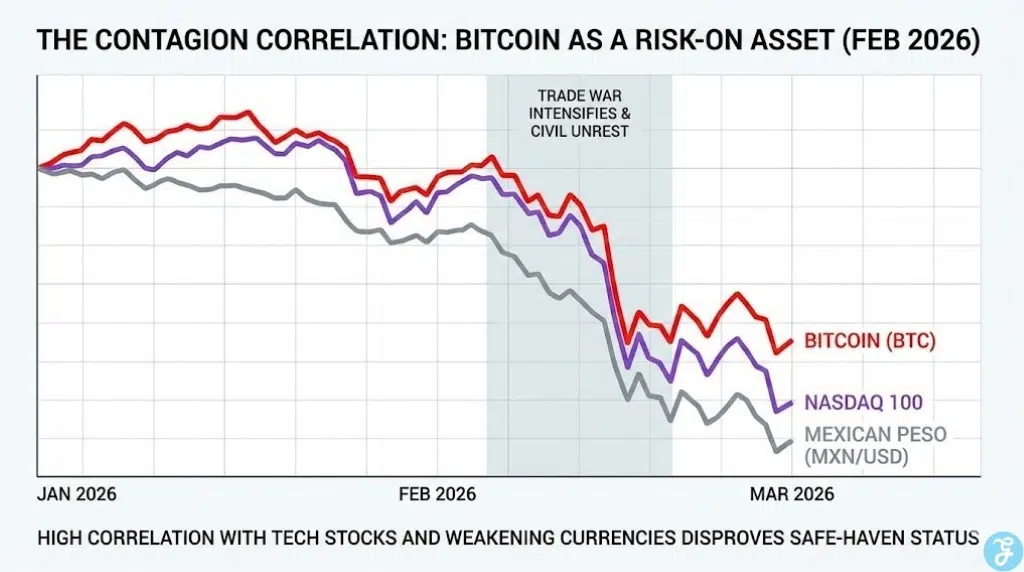
The current crisis proves that digital assets are not immune to the gravitational pull of the dollar. As the trade war intensifies, the demand for greenbacks has reached record levels. Bitcoin cannot buy agricultural equipment or pay off sovereign debt in the middle of a trade blockade. It is a secondary asset that is sacrificed to protect the primary currency of trade. This safe-haven narrative collapse is a direct result of the market realizing that “digital gold” is useless if you cannot exchange it for tangible necessities during a strike or blockade.
| Asset Class | Performance During Mexico Unrest | Liquidity Rating |
| US Dollar (DXY) | +8.4% (Surge in demand) | Extreme |
| Physical Gold | +4.2% (Local premiums hit +15%) | High (Local) |
| Bitcoin (BTC) | -18.6% (Forced liquidation) | Moderate (Network dependent) |
| MXN Sovereign Bonds | -22.1% (Massive sell-off) | Low (Illicid) |
The Hidden Mechanics of the Liquidity Black Hole
Understanding the failure of the safe-haven narrative requires a look at the actual flow of capital across the border. The “Tariff Trap” is not just about taxes on goods moving across the Rio Grande; it is a strategic move to re-shore global liquidity. By creating instability in emerging markets, the U.S. forces capital back into domestic Treasury markets. Bitcoin is simply a casualty in this larger chess game of currency dominance and capital control.
The Security and Intelligence Angle
Intelligence agencies have closely monitored the movement of digital assets during the current Mexican unrest. They have observed that crypto-exchanges are often the first targets of regulatory “gray-zone” attacks during civil strife. Governments can effectively freeze local on-ramps and off-ramps to prevent capital flight and currency collapse. This removes the “exit ramp” that the safe-haven narrative promised to provide for the middle class.
The vertical frontier of digital finance is still tethered to terrestrial regulations and physical infrastructure. During the 2026 strikes, the Mexican government utilized emergency laws to restrict bandwidth to major node providers. This proved that a decentralized asset is only as safe as the centralized network it runs on. Without a stable physical connection, the digital bunker becomes a digital prison. The intelligence community now views Bitcoin as a tracking tool for desperate capital rather than a secret vault.
| Surveillance Factor | Superpower Action | Emerging Nation Impact |
| Exchange Monitoring | Real-time tracking of capital flight. | Forced freeze on local accounts. |
| Network Throttling | Restricting bandwidth to crypto nodes. | Inability to move assets during riots. |
| KYC Enforcement | Demanding data on institutional sellers. | Loss of financial privacy for firms. |
| Power Grid Control | Strategic blackouts in mining regions. | Sudden drop in network hash rate. |
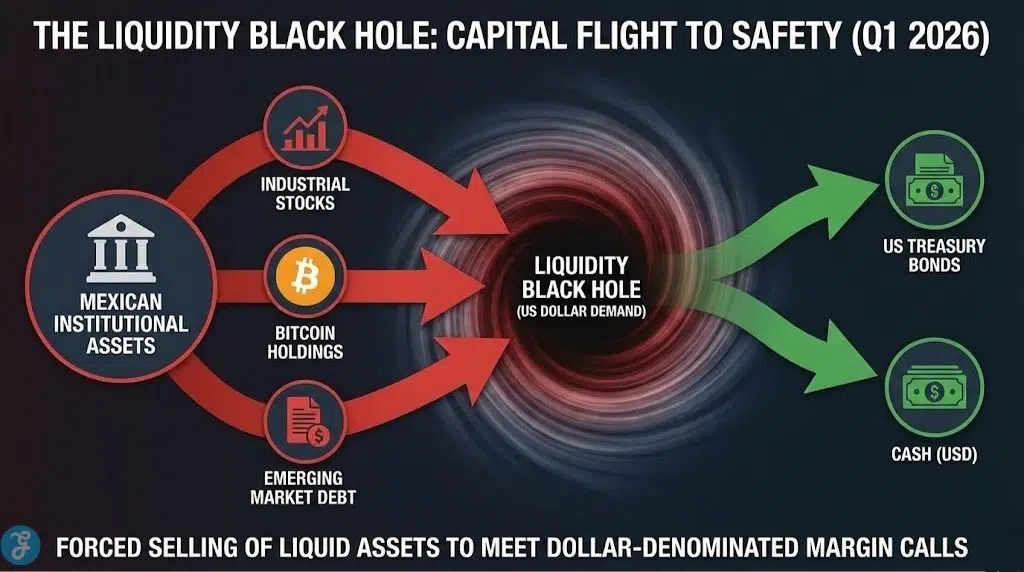
The Economic Undercurrent of Forced Liquidation
The “Liquidity Black Hole” is created when the cost of debt exceeds the value of speculative holdings. As interest rates spiked in response to the trade war, Mexican firms found themselves over-leveraged in dollar-denominated debt. They were forced to dump their Bitcoin holdings to pay down high-interest loans. This selling pressure happened exactly when the safe-haven narrative predicted a price surge. This disconnect has permanently damaged the credibility of crypto as a defensive asset.
This creates a self-reinforcing cycle of devaluation that bypasses traditional hedging strategies. The more Bitcoin drops, the more margin calls are triggered for the next tier of institutional investors. This is the exact opposite behavior of a true safe-haven asset like physical gold or short-term treasuries. In 2026, Bitcoin has become the ultimate “risk-on” barometer. It is the first asset to be sold and the last to be bought back when stability returns.
| Economic Indicator | Correlation with BTC (Feb 2026) | Trend Analysis |
| NASDAQ 100 | 0.94 | Moving in absolute lockstep. |
| MXN/USD Rate | -0.88 | BTC falls as Peso weakens. |
| 10-Year Treasury Yield | -0.62 | Higher yields crush BTC value. |
| VIX (Volatility Index) | -0.75 | BTC crashes as market fear rises. |
The Geopolitical Chessboard and the Dollar Trap
The 2026 trade war is a masterclass in economic re-shoring and monetary dominance. The U.S. is not just taxing fentanyl precursors or Mexican steel; it is using these tariffs to create a “risk-off” environment. This strategy effectively de-monetizes alternatives like Bitcoin by creating a global shortage of cash. The “Third-Eye” view shows that this is a deliberate policy to protect the dollar’s status against the threat of decentralized finance.

The Sovereign Stack Cartel Response
Major central banks are quietly celebrating the failure of the safe-haven narrative during this crisis. They have long feared the rise of a decentralized competitor to their monetary monopoly. The 2026 crisis has given them the perfect case study to discourage further institutional adoption. They frame the safe-haven narrative collapse as proof that only sovereign currencies can provide stability during a global trade shock.
This cartel of central banks is now pushing for more aggressive digital currency regulations. They argue that the volatility of Bitcoin during the Mexico crisis proves it is a danger to financial stability. This regulatory pressure is designed to prevent the next wave of institutional adoption. They want to ensure that when the next trade war hits, investors have nowhere to turn but the state-controlled system. The following matrix shows how global players are leveraging this crisis.
| Global Player | 2026 Safe-Haven Strategy | Desired 2030 Outcome |
| U.S. Federal Reserve | Strengthen the dollar via trade shocks. | Maintain global reserve currency status. |
| Mexican Central Bank | Capital controls to stop digital flight. | Protect the domestic banking system. |
| Institutional Investors | Selling crypto to cover equity losses. | Survival through the liquidity crunch. |
| IMF/World Bank | Promoting CBDCs as “stable” alternatives. | Phasing out decentralized crypto access. |
Strategic Power and Risk Matrices
The trade war test has revealed that the crypto-market remains a subsidiary of the legacy financial system. The numbers do not lie when it comes to the “risk-off” contagion across the North American market. The following matrices highlight the disconnect between what investors were promised and what actually occurred. These risks will define the investment landscape for the remainder of the decade as nations move toward “fortress economies.”
| Perceived Safety Feature | Real-World Performance in 2026 |
| Inflation Hedge | Failed as prices dropped despite CPI spikes. |
| Geopolitical Insurance | Liquidated during the Mexico civil unrest. |
| Digital Gold | Traded like a high-beta leveraged tech stock. |
| Sovereign Exit Ramp | Blocked by regulatory and network hurdles. |
| Peer-to-Peer Stability | Lightning network failed during grid blackouts. |
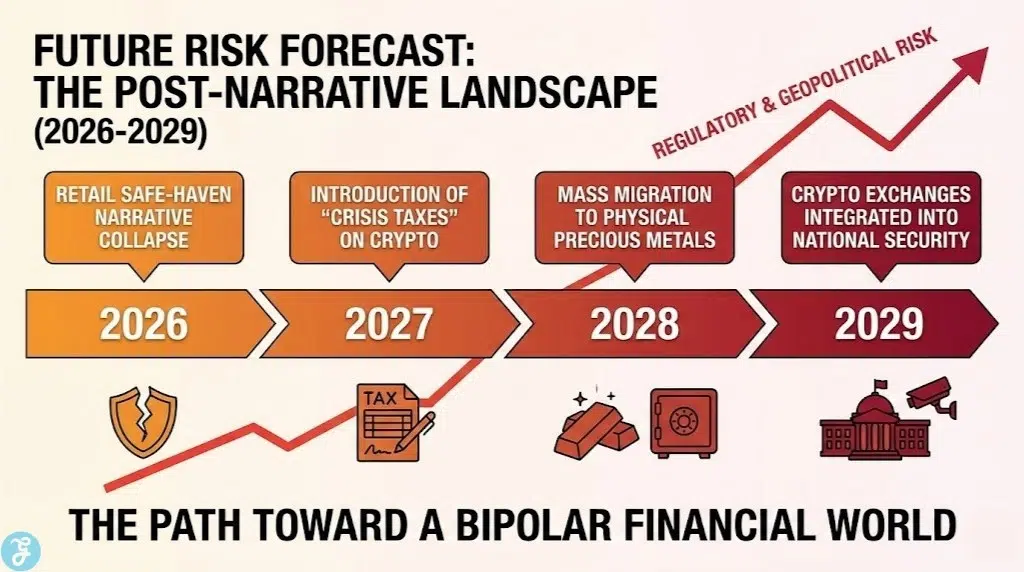
| Timeframe | Projected Security and Economic Risk |
| Q2 2026 | Full collapse of the safe-haven narrative among retail buyers. |
| 2027 | Introduction of “Crisis Taxes” on digital asset transactions. |
| 2028 | Mass migration of capital back into physical precious metals. |
| 2029 | Integration of crypto-exchanges into national security frameworks. |
The “Over the Horizon” Conclusion
The next eighteen months will see a massive restructuring of the digital asset market. As the trade war with Mexico settles into a long-term economic blockade, the myth of the “uncorrelated asset” will vanish. Investors will stop looking for a digital bunker and start looking for tangible resilience in physical assets. We are moving toward a bipolar financial world where you are either inside the dollar system or you are nowhere.
The failure of Bitcoin during this crisis is a warning to every emerging economy. You cannot build a national reserve on an asset that functions as a liquidity tap for foreign hedge funds. The safe-haven narrative collapse is not a temporary dip; it is a fundamental shift in how the world perceives digital value. The sky is not falling for crypto, but the ground is certainly shifting beneath its feet.
Who truly benefits when the “exit ramp” is paved with the very volatility it was supposed to cure? We must decide if we want the speculative freedom of a digital asset or the stability of a physical one. The 2026 trade war has forced that choice upon us with brutal efficiency. The “Third-Eye” sees the truth even when the market is blinded by panic and propaganda.