Choosing between the International Baccalaureate (IB) Vs A-Levels is a huge decision. It feels a bit like standing at a fork in the road, doesn’t it? You might be asking yourself, “Which path actually helps me get into college?” or “Which one fits the way I learn?” I’ve seen plenty of students and parents lose sleep over this exact choice. It’s stressful because you want to get it right.
Here is the short version: The IB asks you to juggle six subjects and a few core projects. A-Levels let you focus intensely on just three or four subjects. That single difference changes everything about your daily schedule, your stress levels, and how universities view your application. In this guide, I’ll walk you through exactly how they compare in 2026. We will look at the workload, the exams, and the real data on university admissions.
Grab a coffee, and let’s figure this out together.
What are A-Levels?
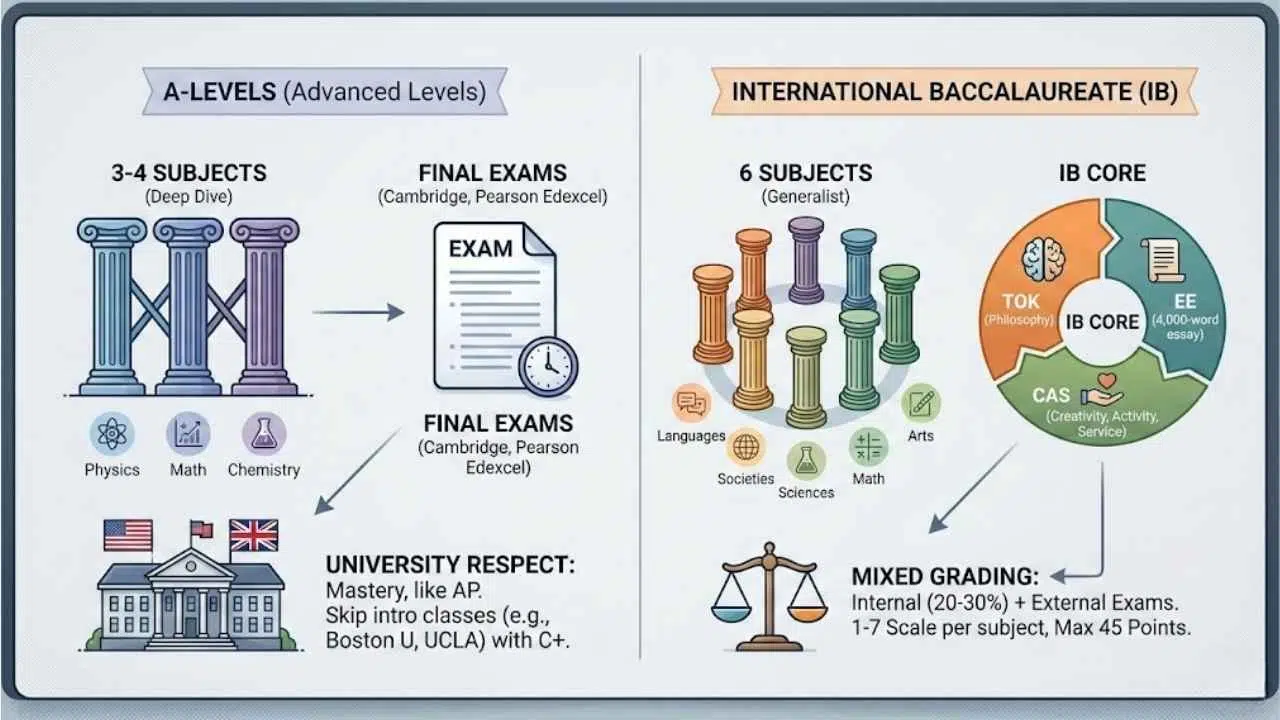
A-Levels (Advanced Levels) are the traditional academic qualification from the UK. You typically choose three or four subjects to study in great detail over two years.
Think of them as a “deep dive.” Instead of skimming the surface of many topics, you become a specialist in a few. If you love Physics, Math, and Chemistry, you can fill your entire schedule with them and never write another history essay.
Most assessment happens at the very end of the two-year course. You sit for big, standardized exams created by boards like Cambridge International or Pearson Edexcel. While some creative subjects like Art have coursework, most grades come down to those final papers.
Universities in the US and UK respect A-Levels because they show you have mastered specific content. In fact, many US colleges treat A-Levels like AP courses. If you score a C or higher, you can often skip introductory classes at schools like Boston University or UCLA.
What is the International Baccalaureate (IB)?
The International Baccalaureate (IB) Diploma Programme takes a completely different approach. It forces you to be a generalist.
You cannot just stick to what you are good at. You must take six subjects from different categories: a first language, a second language, individuals and societies, sciences, mathematics, and the arts.
It doesn’t stop at classes. You also have to complete the “IB Core,” which includes three specific requirements:
- Theory of Knowledge (TOK): A course where you discuss philosophical questions like “How do we know what is true?”
- The Extended Essay (EE): A 4,000-word independent research paper on a topic you choose.
- Creativity, Activity, Service (CAS): A project-based requirement where you might organize a charity event or join a sports team.
Grading is a mix. Teachers grade about 20-30% of your work internally (like oral presentations or lab reports), and the rest comes from external exams in May or November. Students are scored on a scale of 1 to 7 per subject, with a perfect total score being 45 points.
Differences Between A-Levels and IB
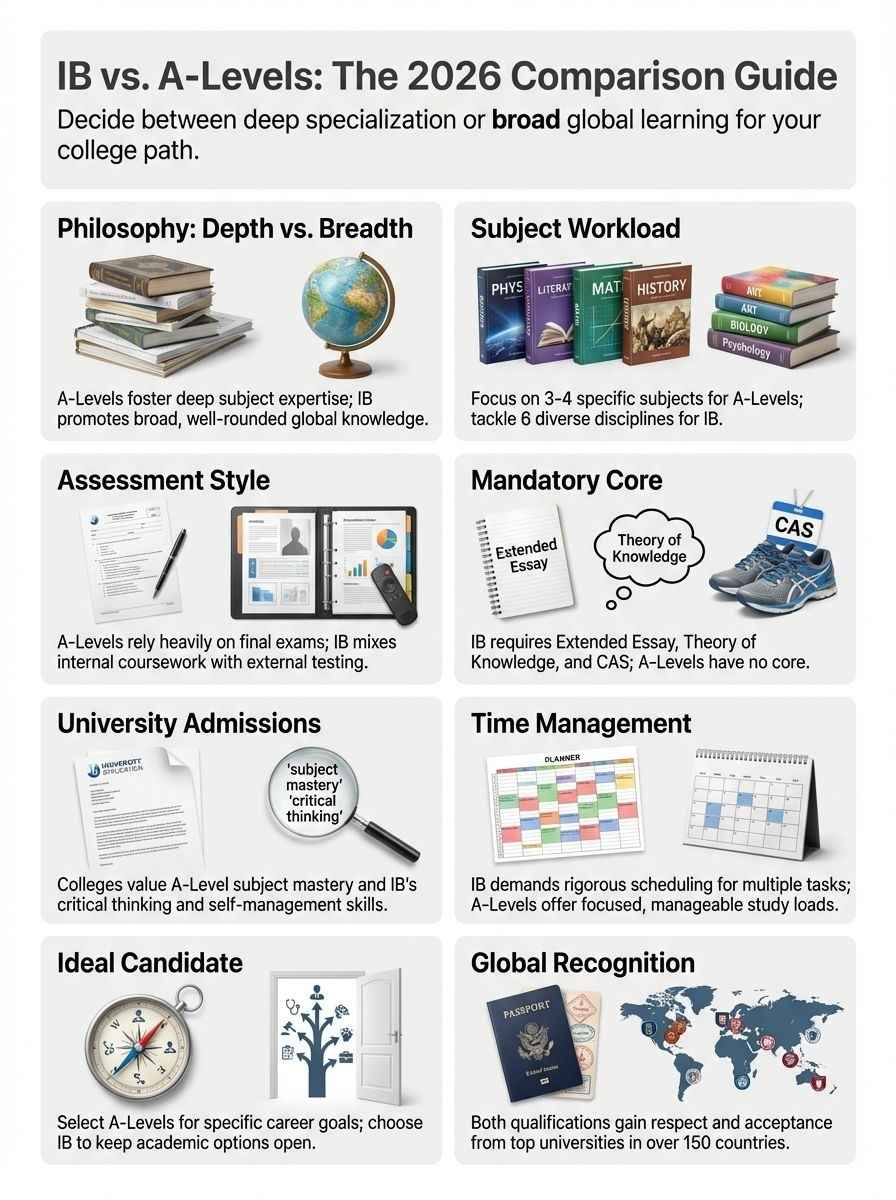
A-Levels are about depth, while the IB is about breadth. That is the headline, but the details are where you make your decision.
Subject specialization vs. breadth
A-Levels allow you to be picky. Most students take three subjects, and they can be anything. You could take Biology, Chemistry, and Psychology to prep for medical school. Or, you could take English, History, and French if you love the humanities.
The IB does not give you that freedom. You have to follow a strict structure. You must choose one subject from each of the six groups (though you can sometimes swap the Arts subject for another Science or Humanities).
This ensures you are well-rounded, but it can be frustrating if you absolutely hate math or dread learning a second language.
Comparing the Structure
To help you visualize it, here is how the two programs stack up side-by-side:
| Feature | A-Levels | IB Diploma |
|---|---|---|
| Number of Subjects | 3 or 4 | 6 (3 Higher Level, 3 Standard Level) |
| Core Requirements | None (usually) | Theory of Knowledge (TOK), Extended Essay, CAS |
| Grading Scale | A* to E | 1 to 7 (45 points max) |
| Exam Timing | Mostly at the end of Year 2 | Mix of internal work and final exams |
Core components and additional requirements
The IB is famous (or infamous) for its workload outside of class. The Extended Essay is a serious academic project. Writing 4,000 words teaches you research skills that most students don’t learn until their second year of college.
A-Levels are much leaner. You go to class, you study the material, and you take the exam. There are no mandatory volunteering hours or philosophy essays unless your specific school adds them.
For a student who plays competitive sports or has a demanding hobby, the “lean” structure of A-Levels often fits better. The IB demands that your “extra” time be spent on school-sanctioned activities like CAS.
Assessment Methods in A-Levels vs IB
How you get your grade is just as important as what you learn. One system favors test-takers; the other rewards consistent grinders.
A-level assessment: Final exams
A-Levels are “linear.” This means nearly 100% of your grade often hangs on the exams you take at the end of the two-year course. It is a high-pressure finish line.
If you have a bad day during exam week, it can tank your grade. However, this system also leaves you with less daily homework stress during the first year. You have time to absorb the material before being tested on it.
This style suits students who are good at memorization and performing under pressure. It is also familiar to US colleges, who see it as similar to a rigorous set of AP exams.
IB assessment: Coursework and exams
The IB spreads the risk. Your final grade is a combination of the big exams in May and “Internal Assessments” (IAs) that you do throughout the year.
For example, in IB English, you might record an oral commentary on a book. In IB Chemistry, you will design and run your own lab experiment. These IAs are graded by your teacher and checked by the IB organization.
This means you can bank points before you ever walk into the exam hall. If you are someone who works hard all year but gets nervous during big tests, this structure can be a lifesaver. However, it also means there is rarely a “down time” where you can relax; there is always a deadline coming up.
Pros and Cons of A-Levels
A-Levels are straightforward and respected, but they can box you in. Let’s look at why they might (or might not) be your best bet.
Advantages of A-Levels
The biggest win here is focus. You get to drop the subjects you dislike.
- Specialization: If you know you want to be an engineer, you can take Math, Physics, and Chemistry. You do not have to waste time on subjects that don’t help your career goals.
- Manageable Workload: With only three subjects, you often have “free periods” during the school day to study. This is rare in the IB.
- University Recognition: Schools like Oxford and Cambridge love A-Levels because they create experts. If you apply for History, they know you have spent two years doing nothing but History.
- Retake Opportunities: If you mess up an exam, it is often easier to retake a single A-Level unit or subject than to redo the entire IB Diploma.
- Accepted in the US: US universities understand A-Levels well. A grade of ‘A’ or ‘B’ is often good for college credit.
Disadvantages of A-Levels
The downside of focusing so early is that you can’t easily change your mind.
- Too Narrow: If you pick three sciences at age 16 and then decide you want to be a lawyer at 17, you might be in trouble. You haven’t practiced essay writing in two years.
- High-Stakes Exams: Putting all your eggs in the “final exam” basket is risky. Illness or anxiety during exam week can have a huge impact.
- Less “Holistic”: You miss out on the soft skills that IB teaches, like public speaking (from the oral presentations) or independent research (from the Extended Essay).
- Inconsistent Global Credit: While UK schools love them, some US schools prefer the “breadth” of the IB because it looks more like a US high school curriculum.
Pros and Cons of the IB
The IB is a gold standard for a reason, but it is also a grind. It produces well-rounded students, but the cost is often sleep and free time.
Advantages of the IB
The IB builds students who are ready for anything. University admissions officers often tell me that IB graduates are the most prepared for college-level writing.
- University Credit: This is a big one. Many US colleges, such as NYU or the University of Michigan, offer significant course credit for Higher Level (HL) scores of 6 or 7. You could start college as a sophomore.
- Data-Backed Admissions Boost: It is not just a feeling.
“Research from Crimson Education and other groups suggests that IB students can have an acceptance rate up to 18% higher at top Ivy League institutions compared to the general applicant pool.”
- Global Mobility: The IB is standardized worldwide. A “40 points” in Singapore means the exact same thing as “40 points” in New York. This makes it easier to apply to universities in different countries.
- Skill Building: The Extended Essay forces you to learn how to cite sources and structure a long argument. A-Level students often don’t learn this until university.
Disadvantages of the IB
The “IB Burnout” is real. It is a marathon that lasts two years.
- Time Management is Brutal: You are juggling six classes plus CAS, TOK, and the Extended Essay. Students often say they feel like they are drowning in deadlines.
- Rigid Structure: You must take a math and a science. If you struggle in those areas, they can drag down your total score, even if you are brilliant at English.
- Score Complexity: The 45-point scale can be confusing for some state universities in the US, which may just look at your GPA instead.
- Jack of All Trades: Because you study six subjects, you might not cover any of them in as much detail as an A-Level student. An A-Level Physics student often covers more complex topics than an IB Physics student.
University Preferences for A-Levels vs. IB
Do colleges actually prefer one over the other? The answer depends heavily on where you are applying.
Global recognition and entry requirements
In the UK, offers are very specific. A university might ask for “AAA” in A-Levels or “38 points” in the IB. They generally treat them as equal qualifications, but the “offer” for IB students can sometimes feel harder to achieve because you can’t slip up in any of your six subjects.
In the US, admissions are “holistic.” Colleges like Harvard and Stanford don’t have a hard preference. They want to see that you took the most challenging courses available to you.
However, the data we discussed earlier shows that IB students often have a slight edge at elite US schools. This is likely because the IB curriculum naturally covers the “soft skills” and extracurricular leadership (through CAS) that US colleges value.
Skills valued by universities
Admissions officers respect the Extended Essay. I have heard interviewers at top colleges ask students specifically about their research topic. It gives you something intellectual to talk about in your interview.
On the other hand, A-Level students are valued for their depth. If you are applying for a specific program like Engineering in the UK, the admissions team might prefer A-Levels because they know you have done advanced math and physics modules that IB students might have missed.
For US admissions, the IB’s “well-rounded” nature is a perfect fit. US colleges want students who are good at everything, which is exactly what the IB produces.
How to Choose Between A-Levels and IB
So, which key unlocks your future? It comes down to your learning style and where you want to study.
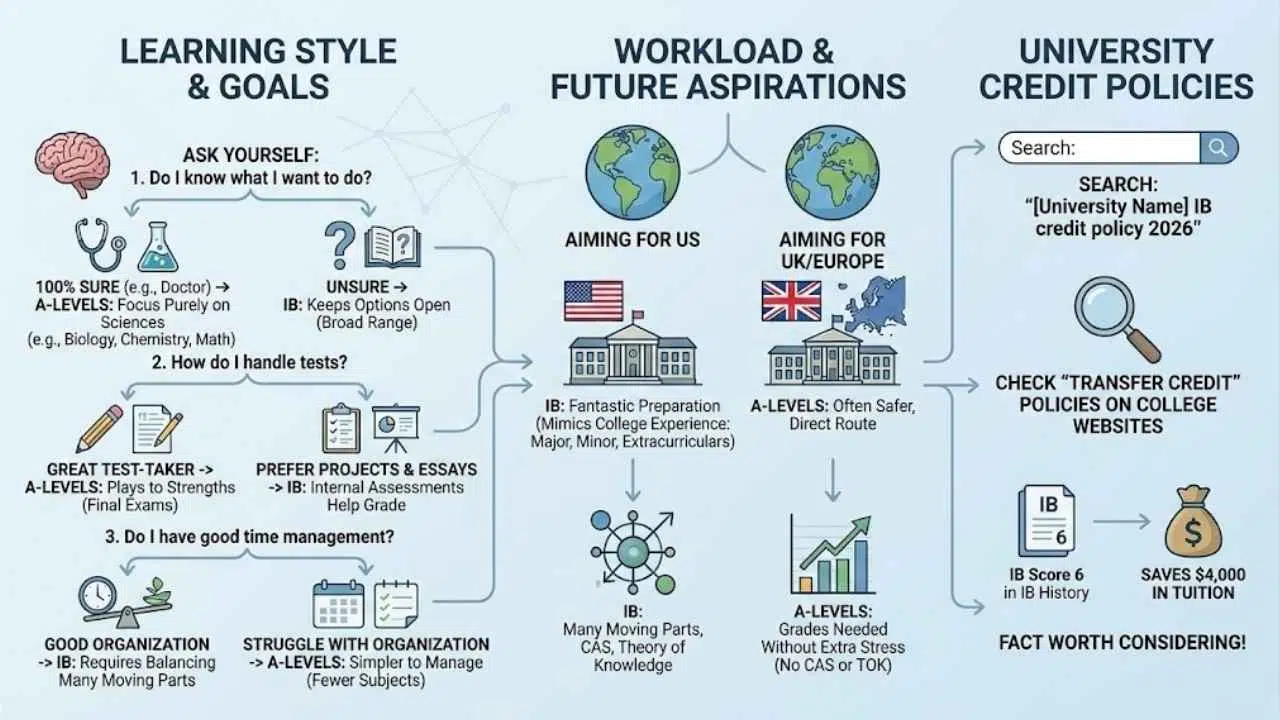
Aligning with learning style and goals
Ask yourself these three questions:
- Do I know what I want to do? If you are 100% sure you want to be a doctor, A-Levels let you focus purely on the sciences. If you are unsure, the IB keeps your options open.
- How do I handle tests? If you are a great test-taker, A-Levels play to your strengths. If you prefer working consistently on projects and essays, the IB’s internal assessments will help your grade.
- Do I have good time management? The IB requires you to balance many moving parts. If you struggle with organization, A-Levels are much simpler to manage.
Considering workload and future aspirations
If you are aiming for the US, the IB is a fantastic preparation. The workload mimics the American college experience of balancing a major, a minor, and extracurricular clubs.
If you are aiming for the UK or Europe, A-Levels are often the safer, more direct route. You get the grades you need without the extra stress of CAS or Theory of Knowledge.
Before you decide, check the “transfer credit” policies on the websites of the colleges you like. Search for “[University Name] IB credit policy 2026.” You might find that a score of 6 in IB History saves you $4,000 in tuition. That is a fact worth considering!
Final Thoughts
Choosing between A-Levels and the IB is like picking between a Swiss Army knife and a scalpel. The Swiss Army knife (IB) prepares you for everything, while the scalpel (A-Levels) is a precise tool for a specific job.
Neither is “better” in a vacuum. The right choice is the one that lets you shine. If you love exploring connections between subjects and want a global qualification, go for the IB. If you have a clear passion and want to dive deep without the distractions, pick A-Levels.
Talk to your teachers, look at the university credit policies, and be honest about how you work best. Once you pick a path, commit to it fully. That is the real secret to success.
If you are still tossing and turning over this, why not reach out to a school counselor or check the official program websites? Getting the facts is the best way to sleep easy tonight!