


Do you have a graveyard of New Year’s resolutions somewhere in the back of your mind? I definitely do. We all want to be more productive, find extra time for ourselves, or just build better routines, but life often gets in the way. Many of us try to change too much at once and end up feeling frustrated. It is a common struggle.
But here is a secret I found that changed everything for me: small changes can lead to big results when you link them to things you already do each day. This method is called Habit Stacking.
In this post, I will walk you through exactly what habit stacking is and how it makes behavior change simpler. You will see steps, real-world examples, and expert tips on how a few tiny tweaks can transform your daily life.
What Is Habit Stacking?
Habit stacking is a simple method where you link a new, small habit to one you already do every single day. The term was popularized by S.J. Scott, but the concept is rooted in decades of psychology.
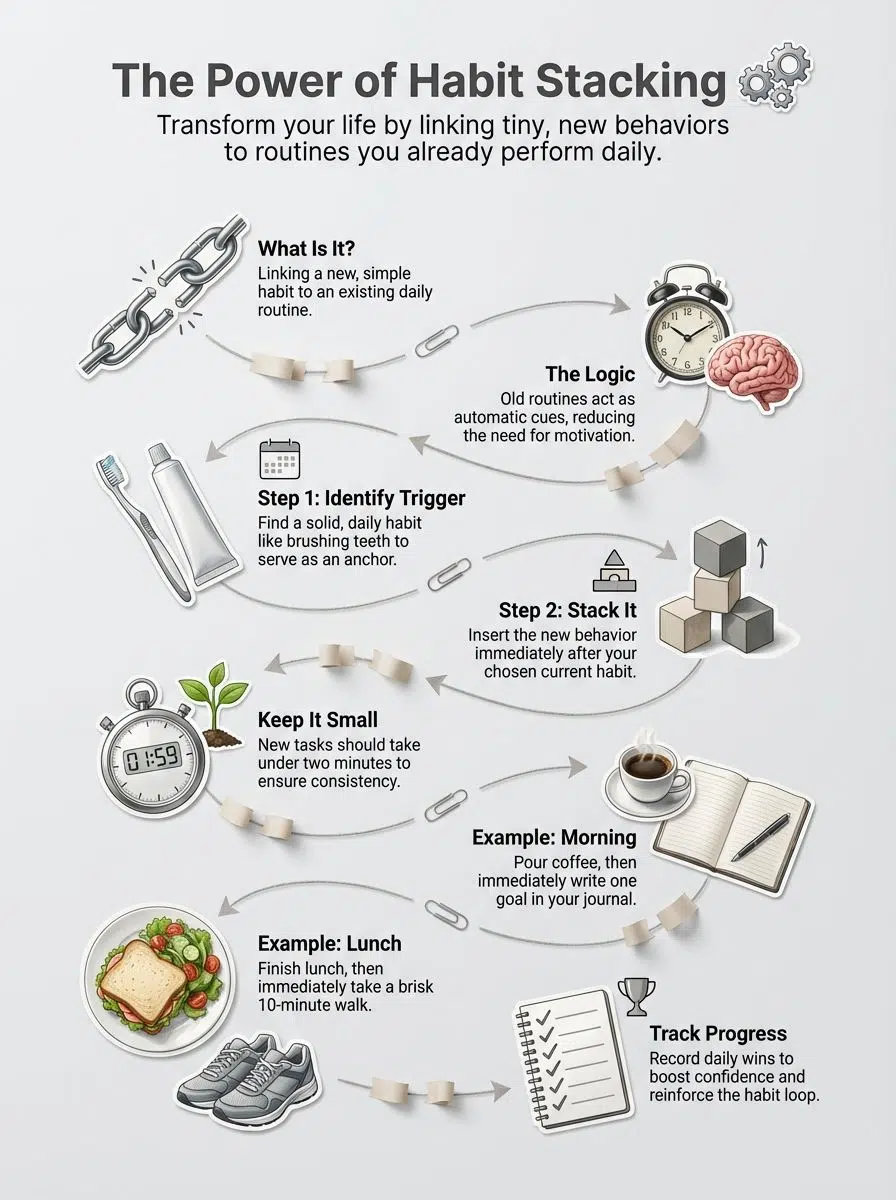
Think of it this way: instead of setting a vague goal like “I will be more grateful,” you say, “After I brush my teeth, I will name one thing I am thankful for.” You use an old routine as a reliable trigger for a new positive change.
This approach works because of a biological process called synaptic pruning. Your brain is efficient; it strengthens connections for behaviors you repeat and prunes away the ones you don’t use.
By stacking a new action on top of a strong, existing neural pathway (like making your morning coffee), you piggyback on a connection your brain has already built. It is like adding a new train car to a locomotive that is already moving at full speed.
How Does Habit Stacking Work?
The mechanics are straightforward. You stack a new habit immediately after a “current habit” that is already hardwired into your day. This takes advantage of what behavioral scientists call Implementation Intentions. You essentially give your brain a specific instruction: “When situation X arises, I will perform response Y.”
For example, you might decide: “After I pour my morning coffee, I will read one page of a book.” This works because it bypasses the need for willpower. When you rely on motivation, you have to make a decision every time. But when you use a stack, the cue triggers the action automatically.
Recent research from 2025 by Georgetown University Medical Center even highlights a brain protein called KCC2, which helps lock these new patterns in place. The study found that specific cues can accelerate how quickly a habit forms.
Over time, your morning coffee doesn’t just wake you up; it signals your brain to read. You stop thinking about it, and it just happens. This shift moves the workload from your prefrontal cortex (the thinking part of your brain) to the basal ganglia (the autopilot part).
Why Is Habit Stacking Effective?
Habit stacking works because it removes the friction of starting. It doesn’t ask you to find more time or energy; it just asks you to change the sequence of what you already do.
Builds on existing routines
Linking a new habit to a daily routine makes it sticky. In her famous study on habit formation, Dr. Phillippa Lally found that consistency is the biggest factor in success. By tying a new action to an established one, you guarantee consistency.
James Clear, author of Atomic Habits, calls this the “Diderot Effect” in action, where one behavior naturally leads to the next. You are not trying to build a new road; you are just placing a new signpost on a path you walk every day.
Chains of habit are too light to be felt until they are too heavy to be broken. – Warren Buffett
Simplifies habit formation
Habit stacking cuts big goals into bite-sized pieces. You only add a new habit to something you already do each day, like brushing your teeth or unlocking your phone.
This reduces Decision Fatigue. We make thousands of choices every day, and our willpower drains with each one. By creating a stack, you make the decision once.
Just five minutes added to a routine can spark real personal growth. This method keeps things easy for anyone who struggles with too many choices or gets tired of tracking lots of habits at once.
Increases consistency
After you make habits simpler, it gets easier to repeat them day after day. Stacking a new task on top of an old one makes sticking with your goal as automatic as putting on your seatbelt. You do not have to think too hard about what comes next; your routine does the heavy lifting.
Each time you perform your stacked habits in order, you strengthen that link in your mind. This pattern keeps behavior change steady, even on tough days. Missed a step? You just catch the next cue, like waiting for the next bus.
Steps to Start Habit Stacking
You can start today with habits you already do. Follow this simple framework to build your first stack.
Identify an existing habit
Spot a routine that happens every day without fail. This is your “anchor.” It could be brushing your teeth, the sound of your morning alarm, or even the act of sitting down at your desk.
To find the best anchors, I recommend creating a Habit Scorecard. Write down everything you do from the moment you wake up until you go to sleep. You will likely find dozens of potential triggers you never noticed, like “turning on the shower” or “hanging up my keys.”
Pick something simple and steady. Change sticks best when it hooks onto what you already do without much thought.
Choose a new habit to stack
After spotting your anchor, pick a new behavior to pair with it. The golden rule here is to use the Two-Minute Rule: your new habit should take less than two minutes to do. If your goal is “read more books,” your stack shouldn’t be “read for 30 minutes.” Instead, try “read one page.”
For example, after I pour my coffee (anchor), I will read one page (new habit). Keep the barrier to entry so low that you cannot say no.
Small changes spark big results if linked to something steady in your life. Aim for achievable goals like filling up a water bottle right after breakfast or taking ten deep breaths just before bed.
Start with small, achievable changes
Stacking works best if you keep it easy at first. Trying to run five miles every morning after brushing your teeth is a recipe for burnout.
Instead, tie a tiny action to your routine. Stanford professor BJ Fogg calls this the “Maui Habit.” He suggests starting with something as small as saying, “It’s going to be a great day” as soon as your feet hit the floor.
These small wins help train the brain for bigger behavior change over time. Tiny steps add up; soon enough, you’ll see real transformation without feeling weighed down.
Be consistent and patient
Habits do not form in a single day. While the old myth says it takes 21 days, Dr. Lally’s research shows the average is actually 66 days, and it can range anywhere from 18 to 254 days depending on the person.
Motivation goes up and down, but routine keeps you on track. Some days will feel easy, while others will be a drag. Stick with it anyway. Celebrate each win, no matter how small. Writing in your journal after coffee or walking every lunch break adds up fast over weeks and months.
Popular Habit Stacking Examples
Curious about how to combine tiny actions for big changes? Here are four powerful stacks you can copy right now.
Drink your morning coffee + write in a journal
Sip your hot morning coffee with your notebook nearby. Jot down simple thoughts or goals as you drink. This small habit blends daily routine with personal development.
Many people use the Five Minute Journal method here: simply list three things you are grateful for and three things that would make today great. The scent of fresh coffee wakes your mind, while writing clears it for the day ahead.
This powerful stack boosts self-reflection and motivation in one go. Consistency comes easily because both actions use the same trigger.
Brush your teeth + practice gratitude
Brush your teeth every morning, then think of one thing that makes you feel thankful. You can do this while brushing or right after rinsing out your mouth.
This isn’t just fluffy advice; it’s science. Data from the Greater Good Science Center at UC Berkeley shows that practicing gratitude regularly can lower blood pressure and improve immune function.
A sticky note on the bathroom mirror can remind you to name something good in your life as part of this new behavior change. This simple stack grows positivity without taking extra time out of your day.
Take a lunch break + go for a 10-minute walk
Take your lunch break and step outside for a 10-minute walk. This simple change boosts your mood and gets blood flowing.
A 2025 study published in Scientific Reports found that walking for just 10 minutes immediately after a meal significantly reduced blood sugar spikes compared to walking later in the day.
You do not need special shoes or a fancy plan; just pick a safe route around the block. Small daily steps like this can improve productivity and support mindfulness.
Prepare dinner + listen to an educational podcast
Cooking dinner does not need to be just a chore. Pop in your headphones, hit play on an educational podcast, and stir up a smarter routine.
According to the Infinite Dial 2025 report by Edison Research, 73% of Americans aged 12 and older have now listened to a podcast. The study also notes that 67% of listening happens at home, making meal prep the perfect time to learn.
Mixing meal prep with learning makes good use of daily routines. You feed your body and mind at the same time, making every minute count toward productivity.
Tips for Successful Habit Stacking
Make each habit change simple so you won’t dread doing it. Little wins stack up fast and make the day feel brighter.
Find the right trigger
A strong trigger helps your new daily habit stick. Think of something you already do without thinking, like brushing your teeth or having morning coffee.
Triggers work best when they are specific. Instead of saying “when I take a break,” say “when I close my laptop for lunch.” Pick a cue rooted in consistency. Simple triggers keep things easy and help habits feel natural instead of forced.
Keep habits simple and actionable
Pick habits that are short and easy. For example, write one line in your journal after breakfast, or put on sneakers right after you wake up.
James Clear calls this the “Minimum Viable Habit.” Your goal is to master the art of showing up. You can optimize the habit later, but you can’t improve a habit that doesn’t exist.
Actions that take less than two minutes pack a punch for behavior change. You do not need to climb a mountain; start by tying your shoes.
Track your progress
Simple actions help habits stick, but tracking progress makes them real. You can use a physical calendar or a digital tool.
| App Name | Best Feature | Why It Helps |
|---|---|---|
| Habitica | Gamification | Turns your life into a role-playing game where completing habits levels up your character. |
| Streaks | Apple Health Integration | Automatically marks habits as complete when you walk or exercise, reducing manual entry. |
| Pattrn | Goal Connection | A newer 2025 favorite that visually links your daily habits to your larger long-term goals. |
Seeing steady improvement builds confidence fast. A chart, sticker calendar, or even tally marks on the fridge show growth over time. Miss a day? No need to worry; just keep going tomorrow.
The Long-Term Benefits of Habit Stacking
Tiny actions, repeated each day, can spark big changes in your life. Here is why this method is worth your time.
Improved productivity
Stacking habits turns daily actions into powerful time savers. You make fewer choices, so your mind works less and gets more done.
This is often called the Compound Effect. Just like interest in a bank account, small productivity gains multiply over time. Imagine pouring coffee while checking your to-do list each morning; that tiny pairing sharpens your focus for the entire day.
By linking a new goal to an old habit, you move closer to better time management without thinking twice. Busy kids or work deadlines? Quick wins like these help anyone fit personal growth into packed routines.
Enhanced well-being
Waking up and following small, healthy routines makes each day smoother. Adding tiny habits like taking three deep breaths after breakfast can lift your mood.
This works because positive habits trigger dopamine, the “feel-good” chemical in your brain. Your brain loves patterns; the more positive steps you stack, the less stress piles up over time.
Studies show that simple actions boost happiness and focus. Layering good choices brings steady personal development and better self-care without feeling forced.
Sustainable lifestyle changes
Small habits, done every day, can make huge waves over months or years. Instead of big leaps, pile up tiny wins.
James Clear describes this as building “Identity-Based Habits.” You stop trying to do a run and start becoming a runner. Drink water after brushing your teeth, stretch while waiting for coffee to brew, or jot down three goals before opening emails.
People who use habit stacking see real transformation without stress or burnout. Research shows that steady daily habits help build focus and boost productivity long term.
Common Mistakes to Avoid in Habit Stacking
Many folks slip up by biting off more than they can chew. Here are the traps to watch out for.
Choosing habits that are too ambitious
Trying to change your routine by picking big goals can backfire fast. This is often called the “False Hope Syndrome.”
If you decide to run five miles every day when you haven’t jogged since last spring, you are setting yourself up to quit. Large changes need motivation that most people do not have every single day. Start tiny. Drink one extra glass of water after brushing your teeth. Once that sticks, you can stack more new habits.
Forgetting to track progress
Skipping progress tracking is a major stumbling block. It is easy to lose sight of small wins if you don’t write them down.
A study by Dr. Gail Matthews at Dominican University found that people who wrote down their goals were 42% more likely to achieve them. Those who sent weekly progress reports to a friend saw that the success rate jumped to 76%.
Missing these quick check-ins means you might not notice your routine slipping away. Just one minute each night to mark what went well can keep you rolling right along.
Lack of patience with the process
Some people get impatient and want fast results. But change takes time. This period of hard work without immediate visible results is what experts call the “Valley of Disappointment.”
Building daily habits is like growing a bamboo tree; you water it every day for years with no sign of growth, and then it shoots up 90 feet in six weeks. Give each new routine enough time before judging success. Stay steady, celebrate tiny wins, and enjoy the journey to personal growth.
Final Words
Small actions can bring big results, and habit stacking proves it every day. Pairing new habits with old routines turns change into a simple step instead of a huge leap.
This approach works quietly but brings powerful changes over weeks and months. You just add one brick at a time to build your daily wall.
For more tips or community support, plenty of books and podcasts dig deeper into habit building. Give yourself the gift of progress and start today with one tiny stack, because small steps set the stage for lasting transformation.





















