

Have you ever stood in the grocery aisle, holding a bottle of cleaner that screams “Earth-Friendly,” and felt a nagging suspicion that it might just be green marketing fluff? You are definitely not the only one feeling this way. In fact, a 2025 survey found that 62% of global consumers now believe companies are greenwashing their products. That is a massive jump in skepticism, and frankly, it is well-earned.
We all want to do our part. We want to buy from brands that protect our forests and oceans. But when 68% of U.S. executives admit their companies have engaged in greenwashing, it becomes exhausting to separate the heroes from the hype.
I’m going to show you exactly how to see through the fake eco-friendly brands. We will look at the red-flag words to ignore, the “ghost” certifications that mean nothing, and the simple tools you can use to check a brand’s reputation in seconds.
What is Corporate Greenwashing?
At its core, greenwashing is a marketing spin. It happens when a company spends more time and money claiming to be green than actually implementing business practices that minimize environmental impact. It is a way to profit from your good intentions without doing the hard work.
Definition and key characteristics
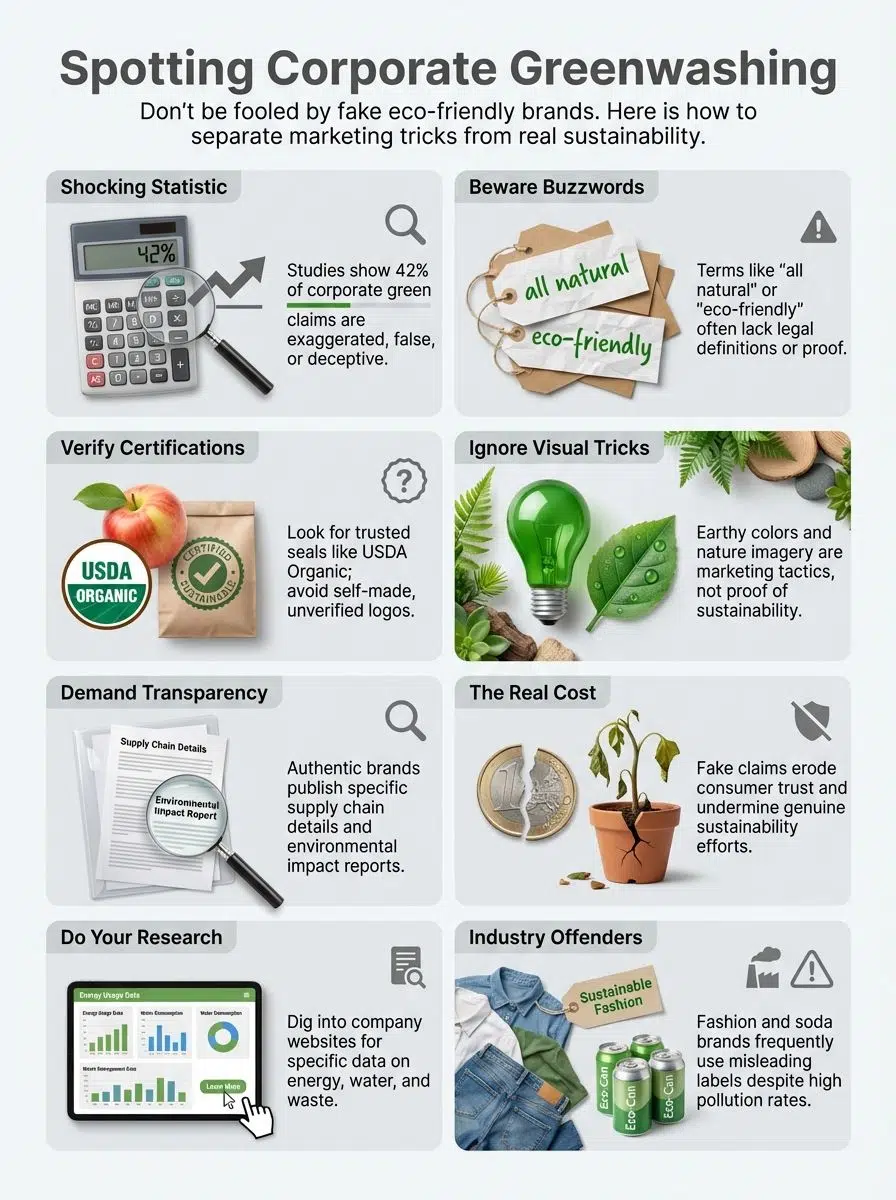
Corporate greenwashing is deceptive. It involves using vague terms, nature-inspired imagery, or even straight-up lies to make a product or company seem sustainable when it isn’t. You might see a “Farm Fresh” sticker on factory-farmed eggs or a “Recyclable” symbol on a plastic pouch that no local facility accepts.
The Federal Trade Commission (FTC) in the U.S. has strict “Green Guides” that tell companies they cannot mislead consumers. Yet, brands often skirt these rules by using puffery, words like “eco-friendly” or “green” that have no legal definition. If a brand talks about “sustainability” but hides its supply chain data, that is a classic sign of greenwashing.
Why greenwashing is a growing concern
The scale of this problem is bigger than just a few bad apples. A recent European Union study shocked many of us when it revealed that 53% of green claims made by companies were vague, misleading, or unfounded. That means coin-flip odds on whether that “planet-safe” label is telling the truth.
This deception hurts everyone. It tricks shoppers into paying extra for products that don’t deliver. It punishes honest companies that invest in real eco-friendly innovations but get lost in the noise. Worst of all, it slows down actual progress against climate change because we think we are making a difference when we aren’t.
Trust is crashing. As Gen Z and Millennial buyers demand more transparency, companies are scrambling. Some are even “greenwashing”, setting ambitious climate targets to get positive press, only to quietly lower them a year later when no one is looking.
Common Tactics Used in Greenwashing
Marketing teams are clever, but they tend to reuse the same playbook. Once you learn these specific tricks, you will spot them on shelves instantly. It pays to be a detective before you buy.
Misleading environmental claims
The most common trick is the “vague promise.” Brands love to slap terms like “All Natural,” “Non-Toxic,” or “Earth Safe” on packaging. Here is the catch: these terms are largely unregulated. A product labeled “natural” can still contain harmful synthetic chemicals because the FDA doesn’t strictly police that word for most goods.
Another tactic is the “irrelevant claim.” For example, you might see a spray bottle proudly claiming to be “CFC-Free.” While that sounds good, chlorofluorocarbons (CFCs) were banned decades ago. They are bragging about following the law. It’s like a car salesman bragging that a vehicle comes with four wheels.
Words are easy, proof is rare.
Vague or unverified certifications
This is where things get tricky. We are trained to trust seals and badges. But did you know companies can just design their own? We call these “Ghost Seals.” A brand might create a green shield logo that says “Certified Earth Choice” and slap it on the box. It looks official, but it’s just a graphic design with no third-party standards behind it.
Real certifications have trails you can follow. If you see a logo you don’t recognize, check the Ecolabel Index, a database that tracks over 450 legitimate environmental labels. If the badge on your package isn’t listed there, or if the brand doesn’t link to a standard on their website, it’s likely a fake.
Use of buzzwords like “natural” or “eco-friendly”
Buzzwords are designed to bypass your critical thinking. A “plant-based” plastic bottle might only be 20% plant material, while the other 80% is standard petroleum plastic that contaminates recycling streams. A fashion brand might call a collection “Conscious” because it uses organic cotton, but then dyes that cotton with toxic heavy metals in a factory that dumps wastewater into rivers.
The “Halo Effect” is powerful. Brands use brown kraft paper packaging and green leaf imagery to make processed, chemical-heavy products feel wholesome. Don’t let the vibe of the packaging distract you from the ingredients list on the back.
Consequences of Greenwashing
When brands get caught faking it, the fallout is real. It’s not just about a few angry tweets; we are talking about lawsuits, millions in fines, and a permanent stain on their reputation.
Eroding consumer trust
People hate being tricked. A 2024 report showed that only 20% of consumers completely trust sustainability claims made by brands. That skepticism is a direct result of being burned by misleading ads. When a shopper finds out their “ocean-bound plastic” shampoo bottle didn’t actually help the ocean, they don’t just stop buying that shampoo; they stop trusting the entire category.
Undermining genuine sustainability efforts
Greenwashing creates a “boy who cried wolf” scenario. It makes it incredibly hard for genuinely responsible companies to stand out. If a fast-fashion giant falsely claims their $5 shirt is sustainable, it makes the honest brand selling a $30 ethically-made shirt look overpriced. This drains revenue from the companies actually investing in fair wages, renewable energy, and circular supply chains.
Legal and financial repercussions for companies
Regulators are finally waking up. In 2022, the FTC fined Kohl’s and Walmart a combined $5.5 million for falsely marketing rayon textile products as “bamboo.” More recently, in 2024 and 2025, the European Union has been cracking down hard with new directives that ban generic claims like “climate neutral” unless they are backed by hard proof.
Investors are watching, too. Companies like DWS Group have faced raids and stock drops after allegations of exaggerating their green investments. The message is becoming clear: if you fake your green credentials, you will pay for it.
How to Spot Greenwashing in Brands
You don’t need a degree in environmental science to spot a fake. You just need to know where to look. Here are three practical ways to vet a brand before you tap your card.

Research the company’s environmental initiatives
Go to the brand’s website and look for the “Sustainability” page. Now, look for numbers, not adjectives. A greenwasher will say, “We love the planet and are working towards a greener future.” A legitimate company will say, “We reduced our water usage by 15% in 2024 and source 80% of our energy from solar.”
Look for transparency reports. Companies like Patagonia and Seventh Generation publish detailed footprints that show exactly where they are succeeding and, crucially, where they are failing. If a brand only shares good news and vague goals for 2050, be suspicious.
Check for third-party certifications
This is your shortcut. Trustworthy certifications are audited by independent outsiders. Look for these gold standards:
- B Corp: The gold standard for overall social and environmental performance.
- USDA Organic: Strictly regulated for food and agricultural ingredients.
- Fair Trade Certified: Ensures fair wages and safe conditions for workers.
- GOTS (Global Organic Textile Standard): The benchmark for real organic fabrics.
- EWG Verified: Checks for harmful chemicals in personal care products.
If you see a logo you don’t know, pull out your phone and Google it. If the search results show it’s a self-made graphic, put the product back.
Look for transparency in supply chains
Can the brand tell you where its stuff is made? Authentic brands are proud of their makers. They might list their factory names or show maps of their supply chain. Everlane and Nudie Jeans are known for breaking down the cost and location of production.
If a company hides its supply chain to “protect trade secrets,” it is often hiding dirty practices. You should be able to trace a product’s journey. If the path is dark, assume there is a reason.
Examples of Corporate Greenwashing
Sometimes the best way to learn is to see who got caught. These major brands tried to paint themselves green and faced serious backlash.
Notable cases from the fashion industry
The fashion world is a minefield. H&M faced a massive class-action lawsuit for its “Conscious Choice” collection, where scorecards allegedly misled customers about the water and fossil fuels used to make garments. In some cases, the data was totally inverted, making dirty products look sustainable.
More recently, in 2025, fast-fashion giant Shein was fined €1 million by Italian authorities. Their “EvoluSHEIN” collection was marketed as eco-friendly, but regulators found the claims about “circularity” and recycled fabrics were vague and misleading, given the brand’s massive volume of disposable clothing.
Greenwashing in food and beverage brands
The food industry loves “farm-washing.” Meat giants like JBS have faced challenges over claims of “net-zero” goals while drastically increasing their greenhouse gas emissions. They promote “climate-friendly” beef without the radical supply chain changes needed to make that a reality.
Coca-Cola is another frequent target. Despite sleek ads about a “World Without Waste” and plant-based bottles, they remain one of the world’s top plastic polluters. Critics point out that sponsoring beach cleanups doesn’t cancel out the billions of single-use plastic bottles pumped into the market every year.
How to Avoid Falling for Greenwashing: Consumers’ Safety
You have more power than you think. By changing how you shop, you force brands to do better. Here is your toolkit for safe, sustainable shopping.
Educate yourself on sustainable practices
Start by learning the “Big Three” of recycling in your area, so you aren’t fooled by “technically recyclable” claims. Just because a package says recyclable doesn’t mean your curbside bin accepts it. Verify local rules.
Use technology to do the heavy lifting. Apps like Yuka (for food and cosmetics) and Good On You (for fashion) let you scan barcodes or search brands to see a simple rating based on real data. They cut through the marketing fluff instantly.
Support genuinely eco-friendly companies
Vote with your wallet. Look for brands that have sustainability baked into their DNA, not just their marketing department. Support B Corps and local businesses that use minimal packaging. When you buy a product that is truly sustainable, you are funding the growth of a better system.
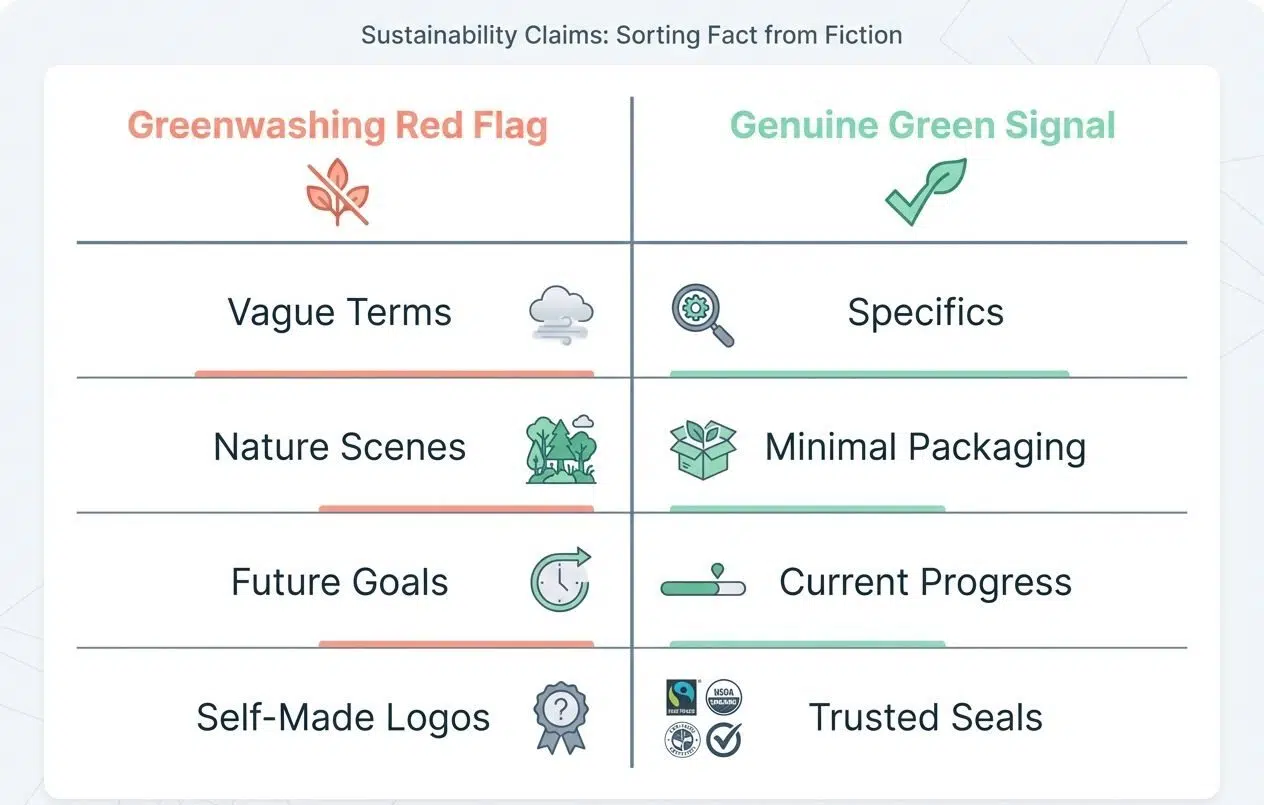
| Greenwashing Red Flag | Genuine Green Signal |
|---|---|
| Vague terms like “Eco-Friendly” or “Green.” | Specifics like “100% Recycled Aluminum.” |
| Nature scenes on plastic packaging | Minimal, compostable, or plastic-free packaging |
| Claims of “Future Goals” (e.g., Net Zero by 2050) | Reports on “Current Progress” (e.g., reduced CO2 by 10% this year) |
| Unrecognized or self-made logos | Trusted seals like USDA Organic, B Corp, Fair Trade |
Demand accountability from brands
If you see something fishy, speak up. Social media is a powerful tool. Tag the brand and ask, “Can you show me the data behind this claim?” or “Where is this factory located?”
You can also report misleading ads to the FTC or consumer watchdog groups like Truth in Advertising (TINA.org). Your report could be the spark that leads to an investigation and protects millions of other shoppers.
Wrapping Up
Navigating the aisles these days can feel like walking through a minefield of marketing tricks. But now you know the secrets. You know that a green leaf logo doesn’t make a product safe, and a vague promise is often a red flag.
The power is in your hands. Every time you check a label, scan a product with an app, or choose a B Corp over a generic brand, you are sending a signal. You are telling companies that honesty matters more than a flashy ad campaign.
So, the next time you see a bottle claiming to save the planet, flip it over. Read the ingredients. Check the certifications. Trust your gut. Real sustainability doesn’t need to hide behind buzzwords.





















