Do you ever feel like you’re shouting into the void with your website? You update your pages. You post fresh content. But the new AI-powered search tools still seem to skip right past you. It is enough to make anyone want to scream into a pillow. Here is the reality check: Today, AI does more than just fetch results. It decides what to show and how people see it.
If you want to be seen in 2026, using schema markup is now as important as brushing your teeth.
I am going to walk you through exactly what works for getting the attention of both algorithms and real people. We will look at the specific tactics that help feed this “AI beast” so your hard work shows up where it matters most.
Ready for some clear answers? Let’s get started.
The Evolution of Schema Markup
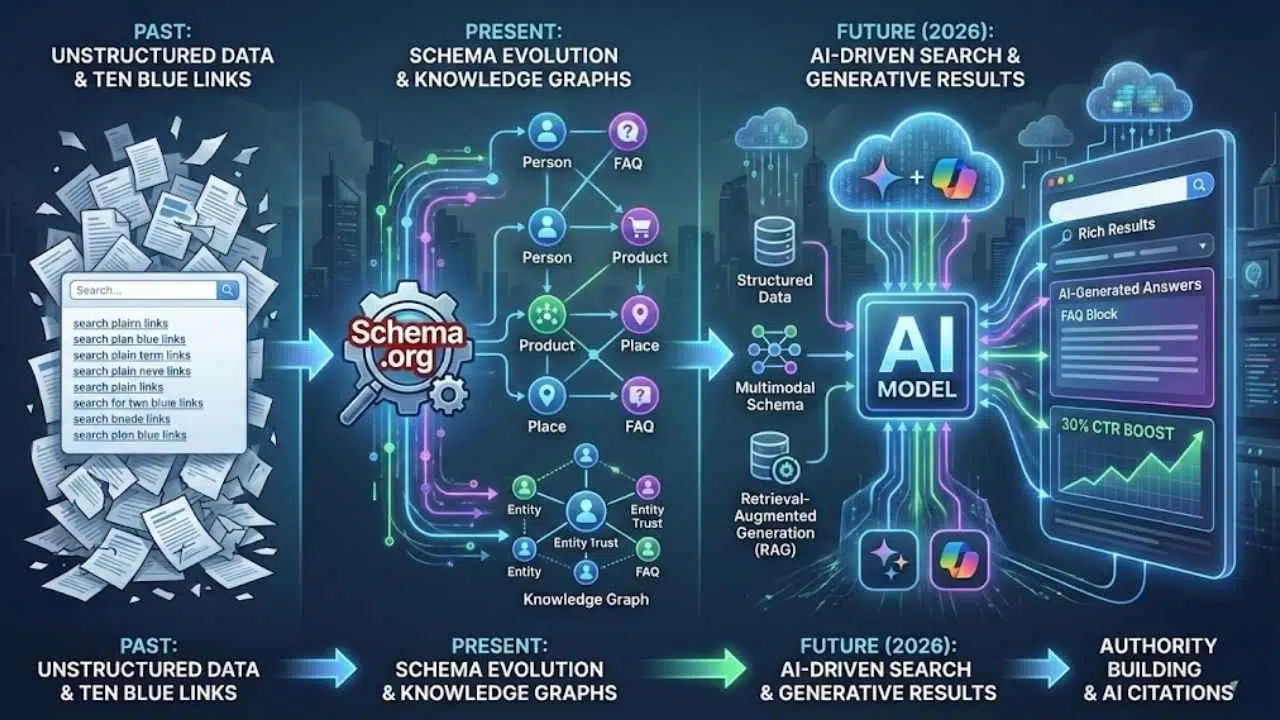
Schema markup started as a simple way to help search engines read web pages better. Today, it is rocket fuel for smarter AI tools and richer online results. Back in the day, we just wanted “ten blue links” on a search page. Now, we are dealing with Schema.org, a collaborative community founded by giants like Google and Microsoft to create a universal language for the web.
Why Schema Markup Matters More in 2026
AI search in 2026 is hungry for structured data. Machines now retrieve information rather than just finding it. Content with strong schema markup rises to the top of AI-driven results and semantic search engines. A recent report from Search Engine Land highlighted that pages with correct schema see a click-through rate boost of nearly 30% compared to those without it.
High-frequency publishing counts. Yet without clear question-answer formats or detailed FAQ blocks using content markup, your articles can vanish into thin air.
SEO looks different from three years ago. Now, authority building uses things like knowledge graphs and entity trust signals. New SEO tactics leverage multimodal schema for AI tools to make websites more visible and citable in artificial intelligence outputs.
“Think of schema as the difference between handing someone a messy pile of papers and handing them a neatly filed report. AI prefers the report every single time.” Companies scramble to feed this growing AI beast. Staying relevant means using schema markup that every major engine expects in 2026.
The Role of Structured Data in AI-Driven Search
Structured data schema markup acts like a special language for search engines and artificial intelligence. In 2026, AI does more than search; it retrieves smart answers from massive pools of information using a process called Retrieval-Augmented Generation (RAG).
Every website is rushing to add clean content markup so their words appear where AI tools look first. The demand for high-frequency publishing feeds both humans and the so-called “AI beast.”
Even something as simple as an FAQ block with crisp question-answer pairs puts your site in a prime position. Search Engine Optimization relies on structured data now more than ever before.
Schema connects facts about people, products, and places to knowledge graphs used by Google’s Gemini or Bing’s Copilot.
If your business wants its content cited by these new digital assistants in 2026, schema makes it possible. Miss out on this detail, and you disappear from important results while competitors snag authority building opportunities across semantic search faster than you can say “structured data.”
AI Search and Schema Markup Integration
AI and schema now work as dance partners. They move in sync to shape search. Sites that tag their content make it easier for AI tools to grab the right facts. This ensures users get quick, smart answers.
How Schema Powers Generative AI Tools
Schema markup acts like a translator for machines. In 2026, structured data feeds generative AI tools clear facts about your content. This helps these systems retrieve and cite information with precision.
We primarily use JSON-LD (JavaScript Object Notation for Linked Data) for this. It is a script that sits quietly in your website’s header and tells the AI exactly what it is looking at without cluttering your page design.
Every search engine and AI assistant depends on this organized layer to pull quick answers and build knowledge graphs. High-frequency publishing boosts presence with both humans and AI engines.
Adding schema markup to FAQs or product info helps the “AI beast” digest details in seconds. SEO tactics from three years ago do not cut it now. Your strategy must revolve around strong content markup using structured data.
Authority building becomes visible as more schema signals connect your brand to accurate citable content across multimodal platforms.
Enhancing AI Citable Content with Schema
Clear schema markup gives AI the green light to pull facts from your site. In 2026, AI no longer just fetches data; it grabs information straight from well-marked sections of your content.
Sites with FAQ blocks and structured question-answer formats make life easy for the “AI beast.” Think of schema as feeding smart snacks to a search engine that wants both speed and credibility.
- Speed: AI models like OpenAI’s ChatGPT prioritize data they can parse instantly.
- Accuracy: Structured tags reduce the chance of the AI “hallucinating” or making up facts about your business.
- Visibility: Well-tagged content often appears in “Zero-Click” summaries at the top of search results.
High-frequency publishing helps your authority soar in digital marketing circles. Factual signals like structured data boost chances for getting cited in AI overviews.
If you want eyes on your work, keeping up with fresh, accurate markup is a must. Even short posts get attention if they serve clear answers using trusted schema elements.
Key Schema Markup Strategies for 2026
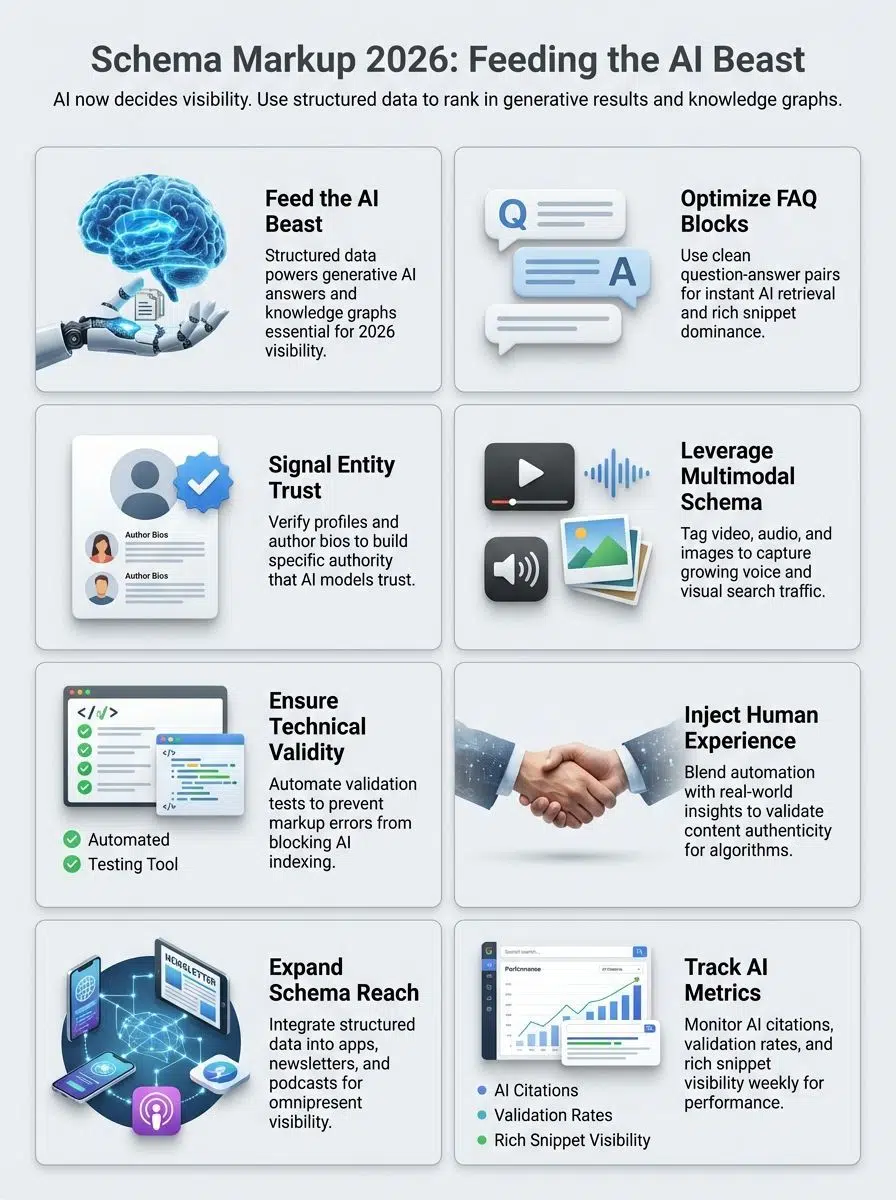
Giving your content the right tags will make search engines smarter in picking it up. Clear signals build digital authority fast. Smart moves now pay off later.
Entity Trust Signals and Their Growing Importance
AI engines in 2026 take trust signals very seriously. Schema markup tells search engines key details about people, places, brands, and websites.
The more signals your entity shows, the more likely AI tools will see you as a reliable source. You should focus on these specific properties:
- sameAs: Use this property to link your website to your verified profiles on LinkedIn, Wikipedia, or Crunchbase.
- founder: Explicitly state who started the company to build historical trust.
- contactPoint: clearly list customer service numbers and options.
Authority building moved from optional to essential for SEO tactics. Google’s multimodal AI now checks not just the words on your site but also who stands behind them.
If your information is backed by structured data and citable content, you are already feeding the AI beast what it wants most: confidence to reference you over others.
Skimp on these trust-building steps, and even frequent publishing cannot save online visibility or ranking power in 2026.
Optimizing FAQ Blocks and Rich Snippets
FAQ blocks and rich snippets stand front and center in search engine optimization for 2026. Smart use of schema markup gives your content a better chance to feed the AI beast and stand out.
Here is how the pros handle this in the US market:
- Schema markup on FAQ blocks makes answers easy for AI tools like Google Gemini to find. This boosts your odds of being cited.
- Search engines show more FAQ-rich snippets. Clear question-and-answer pairs help structure information for fast retrieval by Artificial Intelligence.
- Adding FAQs with structured data supports semantic search. It makes it easier for machines to link user questions with your answers.
- In 2026, strategies push brands to publish hundreds of well-marked words weekly. This chases both human eyes and AI referencing.
- Authority building hinges on high-quality FAQs. Trusted sites get referenced in AI overviews more often because their answers are clearly marked up.
- Multimodal AI engines scan not just text but images and video transcripts. Every content type needs the right schema tags.
- Citable content must be quick to read and fact-filled. Frequently updated FAQ sections signal reliability, which helps boost online visibility.
- Frequent errors occur from missing schema types. Using the latest structured data formats keeps everything compatible with AI-first platforms.
- Rich snippets draw more clicks compared to plain links. They answer questions directly in the search preview, pulling users straight into your site.
- Clear markup makes integration with knowledge graphs smoother. This increases chances of getting featured across various digital assistant platforms in 2026.
Leveraging Multimodal Schema for AI and Search Engines
AI in 2026 consumes data from every source, not just text. Multimodal schema markup acts like a buffet for these hungry AI tools and search engines.
You need to look beyond simple articles. Consider these formats:
| Schema Type | What It Does | Why Use It? |
|---|---|---|
| VideoObject | Tells AI the upload date, duration, and thumbnail URL. | Helps your video appear in video search tabs and AI summaries. |
| ImageObject | Defines the creator, license, and caption of an image. | Crucial for Google Lens and visual search tools. |
| AudioObject | Marks up podcasts or audio clips with transcripts. | Allows voice assistants to “read” your audio content. |
AI-driven platforms use multimodal schema to read, watch, and listen better. Structured data connects images, video, audio, and even interactive elements so AI knows what is important.
Google’s Knowledge Graph uses these connections to pull detailed answers for users who want quick facts. Marketers add alt-text and descriptive tags right in the code.
Search Engine Optimization (SEO) in 2026 relies on rich content types. Routine publishing feeds all parts of this big machine.
Schema markup ties FAQ answers straight to video timestamps or image slideshows so AI can pinpoint answers in seconds. Data integration across platforms lets your product photo match its price tag everywhere online without effort.
Authority building rises fast as structured schema links people to topics through podcasts or web pages. Multimodal tactics mean your site is ready for voice search and smart glasses.
Technical Foundations for Schema Markup Success
Think of schema like wiring in a smart home. Everything must connect well for AI to work fast and correctly. Skip the guesswork. Solid setup now means less hassle later with updates or changes.
Ensuring Compatibility with AI-First Platforms
AI-first platforms in 2026 crave structured data. Schema Markup acts as a digital menu, serving exactly what these systems need to reference your content. Google’s AI Overviews and other multimodal engines rely on clear, machine-readable signals. A simple FAQ block, marked up with schema, can help feed answers straight into search results.
Missing even small markup details is risky. You might vanish from AI-generated summaries overnight. Bulk-publishing alone cannot save you. Every page needs accurate schema for authority building and better online visibility. Treat each piece of content like gold.
Add the right tags. Test for errors using validation tools like Schema.org’s Validator or the Rich Results Test from Google.
Common Pitfalls and How to Avoid Them
AI-driven search engines are hungry for clear, structured data. Tiny mistakes in schema markup can pull your content into a digital black hole.
I have seen these mistakes tank rankings for perfectly good websites:
- Syntax Errors: Missing a single comma or bracket in your JSON-LD code will break the entire script.
- Outdated Types: Using “NewsArticle” for a blog post instead of the more generic “Article” or “BlogPosting” can confuse the system.
- Irrelevant Properties: Stuffing keywords into properties where they do not belong is a quick way to get a manual penalty.
- Missing Fields: Failing to include required fields like “author” or “datePublished” leaves gaps AI cannot fill.
- Neglecting Multimodal: Forgetting to mark up images and videos limits your visibility in visual search.
- Ignoring Reports: You should regularly check the “Enhancements” tab in Google Search Console to catch error reports early.
- No Human Review: Leaving automation to run wild often results in robotic, unhelpful descriptions.
Future-Proofing with Schema Markup
Search keeps changing. Your schema strategy should keep pace. Spread your data far and wide so your content stands out wherever smart tools are hungry for it.
Continuous Monitoring and Updates for AI Adaptation
Keeping up with search engine optimization in 2026 needs eyes wide open. Schema markup updates are no longer a yearly task. They are a constant part of digital strategy.
You need to build a routine around this:
- Monitor structured data performance weekly using tools like Google Rich Results Test to catch errors before AI finds them.
- Adjust schema markup quickly if you spot shifts in how generative AI tools use citable content.
- Use real-time alerts for broken FAQ blocks or missing entity trust signals. Staying ahead can save ranking drops that hurt online visibility.
- Track changes in AI search algorithms from platforms like Bing and Google. Each tweak can mean you need to refresh schema details that feed the beast.
- Set up dashboards in Looker Studio to measure how often your authority building efforts help your site appear as a source.
- Submit updated sitemaps via Google Search Console after every round of content or markup change.
- Publish rich snippets with clear question-and-answer formats at high frequency. AI tools look for this structure first when pulling information.
- Audit older pages monthly for outdated data integration tags since these can confuse machine learning models.
- Review which content pieces get referenced by AI overview features and adjust schema on underperforming pages.
Expanding Beyond Websites: Omnipresent Schema Usage
Schema markup stepped out of its old shoes in 2026. It now lives everywhere, not just on websites. Digital marketing teams feed schema into chatbots, mobile apps, smart speakers, and even email newsletters. AI tools search far beyond webpages for structured data that helps them sort facts.
You will spot schema working over text, images, video files, and yes, even podcasts. Large companies run multimodal schema setups to capture more attention from both humans and machine learning systems. Every digital nook is a chance to drop some semantic breadcrumbs for the hungry AI beast prowling around for answers.
The Human Element in Schema Optimization
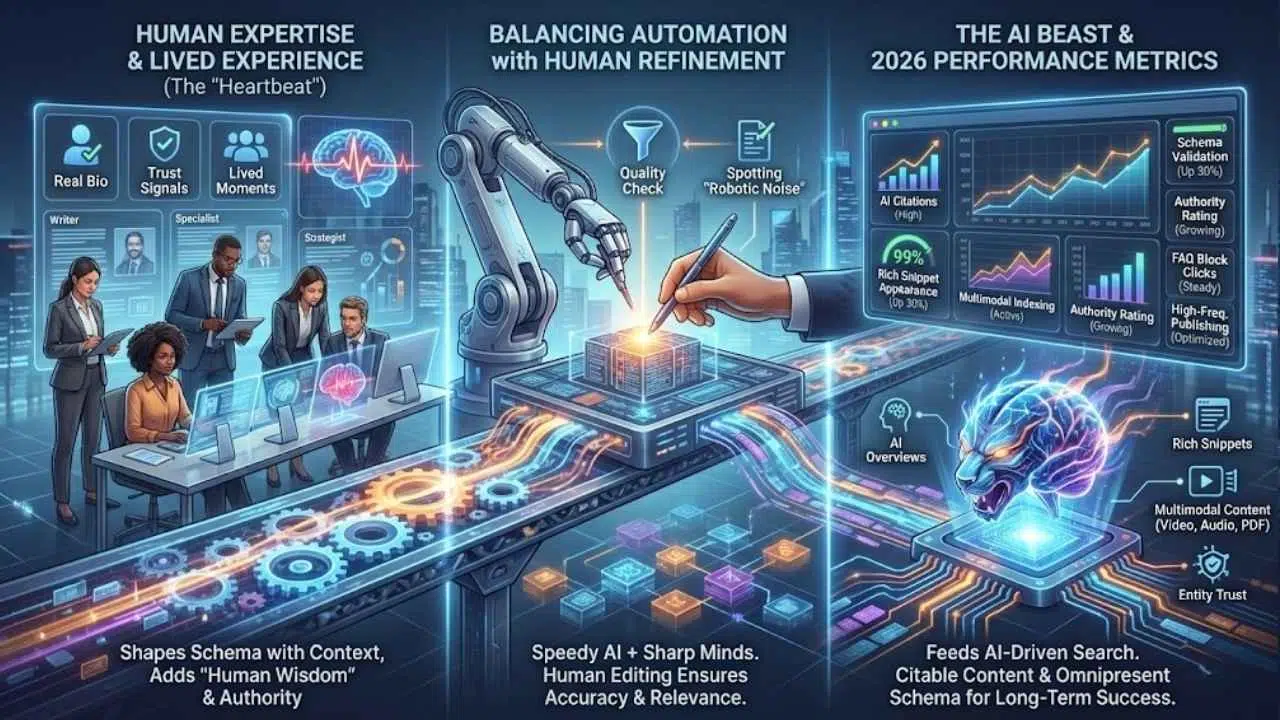
Machines read code, but people spot the story behind it. Experts shape schema. They give your digital facts a heartbeat and help AI speak human.
Balancing Automation with Human Expertise
AI tools can crank out schema markup at lightning speed. Still, skilled humans spot the weird cracks automation leaves behind. A script might fill hundreds of FAQ blocks in minutes. Yet only an expert knows if those answers feel helpful or just robotic noise. In 2026, structured data is everywhere. Digital strategy races to keep up with the AI beast’s hunger for quality content markup.
SEO tactics now rely on both speedy machines and sharp minds. High-frequency publishing feeds search engine optimization needs but risks losing accuracy if left unchecked by real people.
Authority building means more than just boxes ticked. Lived experience adds weight that pure automation cannot fake.
Search engines and AI referencing crave citable content crafted by someone who knows their stuff. No one wants machine-churned facts lined up like dominoes waiting to fall over.
The Importance of Lived Experience in AI Content Creation
Lived experience adds true value to schema markup in 2026. People share stories, opinions, and real problems that AI alone cannot invent. Search engines notice this. They give more weight to content with clear authority building and personal insight.
“Google’s E-E-A-T guidelines emphasize Experience. Use the ‘author’ schema property to link content to a real person with a real bio.”
High-frequency publishing keeps AI engines fed with fresh examples from actual people. Imagine a digital marketing guide or a cooking FAQ.
Users trust advice when it sounds like someone has walked the walk rather than just read the manual. Writers using structured data can lift their schema markup game by placing lived moments into FAQs and rich snippets.
These details give search engine optimization (SEO) efforts an edge since AI referencing rewards content that feels real over generic fluff. In 2026, SEO tactics need human wisdom baked right into citable content for multimodal AI tools.
Measuring the Impact of Schema on AI and SEO
Watch your traffic, rankings, and search features jump or fall as you tweak your schema markup. Smart tracking lets you spot what works for both humans and machines. It guides your next move.
Tracking Performance Metrics in an AI-Driven World
In 2026, tracking how schema markup feeds the AI beast means keeping your finger glued on a much faster pulse. Metrics aren’t just for show.
They are road signs in the blinding fog of AI search and citable content. Here is your cheat sheet, straight from the digital trenches:
| Metric | What To Track | Why It Matters (2026-Style) | Pro Tip |
|---|---|---|---|
| AI Citations | How often AI engines (ChatGPT, Gemini) pull and cite your content | AI overviews now replace standard search. Citable content means more reach. | Create structured FAQs with clean Q&A pairs. AI loves snackable facts. |
| Schema Validation Rates | Number of pages passing schema markup validation tests monthly | Any schema errors, and AI engines might skip you. Flawless markup is table stakes. | Automate checks with Screaming Frog or Sitebulb. |
| Rich Snippet Appearance | Percentage of your URLs showing rich snippets on major engines | Rich snippets mean instant visibility. No snippet, fewer AI-driven clicks. | Double down on product, review, and FAQ schema for more eye-catching snippets. |
| Multimodal Content Indexing | How often your videos, images, audio are picked up in AI search results | AI engines in 2026 crave mixed media. Schema for every format is non-negotiable. | Apply VideoObject and ImageObject schema everywhere content lives. |
| Authority Rating Signals | Third-party trust metrics and mention rate in AI-generated summaries | Authority building changes the citation game. More authority means more AI citations. | Update author and organization schema monthly. Let AI see your digital résumé grow. |
| FAQ Block Clicks | Clicks from FAQ blocks in search results, tracked weekly | Clear, structured Q&A fuels the AI beast. Each click grows your data footprint. | Refresh FAQ answers quarterly with real user data. Keep it fresh. |
| High-Frequency Publishing Stats | Number of schema-optimized articles published per week | Pace yourself. AI engines in 2026 expect steady output. | Batch content updates and deploy schema in sprints. Don’t let your feed gather dust. |
Refining Strategies for Long-Term Success
Smart schema markup keeps you ahead of AI and search engines. Staying sharp means updating your strategy as fast as the digital world spins.
- Use high-frequency publishing so content gets picked up by search engines and AI tools more often.
- Keep FAQ sections clear with question-answer formatting; these feed the AI beast, making your site more citable.
- Monitor structured data performance using SEO metrics like click-through rates and rich snippet visibility.
- Add new entity trust signals regularly to ensure authority building; this makes it easier for AI-driven platforms to reference your expertise.
- Test schema compatibility on AI-first platforms such as Google’s AI Overviews to ensure content displays perfectly.
- Update content markup every quarter using fresh data integration techniques; avoid stale schemas that lose ground.
- Expand beyond websites into omnipresent schema usage; mark up podcasts, videos, and PDFs for seamless multimodal AI access.
- Blend automation with human editing to keep schema both accurate and real; lived experiences add flavor algorithms cannot duplicate.
- Use semantic search queries in your digital strategy to stay relevant as natural language processing grows smarter.
- Document every tweak and result; over time, this log reveals patterns that help refine SEO tactics.
Final Thoughts
Schema markup has become the bread and butter for AI-driven search. It makes your content easier to find and trust. Clearly marked FAQs, rich snippets, and smart entity signals help your pages shine brighter than ever before in 2026. These tools are simple to use if you keep things structured and stay alert for platform changes. They save time while boosting results.
Applying these methods boosts your online visibility and helps build authority with both people and machines alike. So, take the leap now. Small tweaks today could be what sets you apart tomorrow. Sometimes success is simply one schema tag away from landing right in your lap!