

The morning air in Nuuk does not just bite anymore; it burns with the friction of two tectonic plates of power. Outside the Parliament House, the breath of protesters hangs in thick white plumes. They carry signs that read “Vi er ikke til salg” (We are not for sale). It is a hauntingly simple refrain for a crisis that has become the most dangerous geopolitical fissure of 2026. This volatile atmosphere is the defining face of Greenland Geopolitics 2026, where a once-stable Arctic alliance now teeters on the edge of a historic realignment.
Just a few hundred miles north, the silence of the Pituffik Space Base is broken by the low hum of increased American activity. Nearby, elite Danish Frogman Corps units maintain a watchful, weary presence. This is no longer a frozen wilderness; it is a garrison. The Arctic order has thawed, and in its place, a new and aggressive reality has emerged.
Greenland Geopolitics 2026: The Shadow Architecture Beyond the Davos Theatre
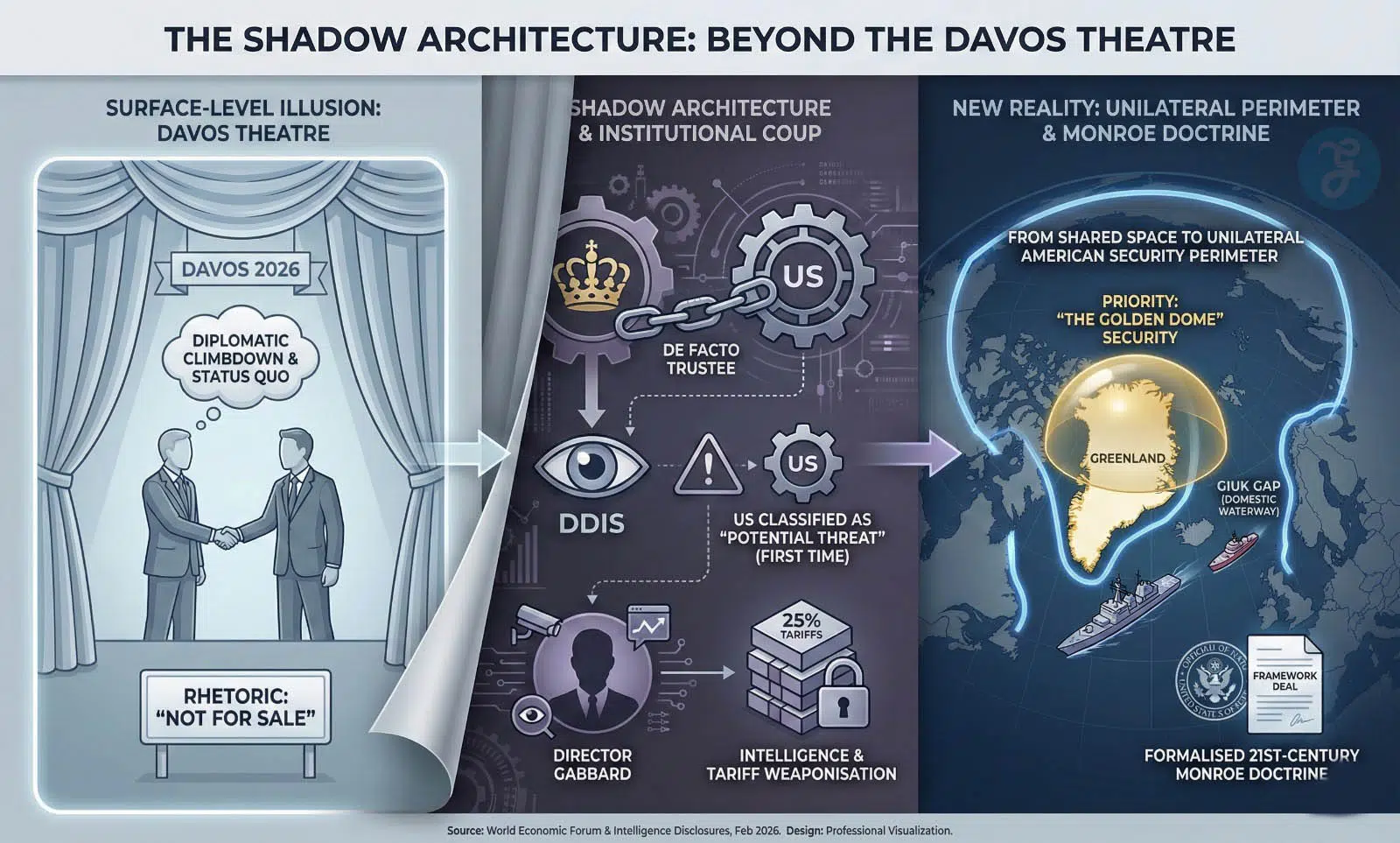
The mainstream narrative suggests that the 21 January framework at Davos was a diplomatic climbdown, a return to the status quo. This is a surface-level illusion. In reality, the 2026 escalation was a high-stakes stress test of the Western alliance, designed to shift the Arctic from a shared space to a unilateral American security perimeter. While the general public focuses on “not for sale” rhetoric, the strategic prism reveals a deeper institutional realignment. Washington has effectively transitioned from being an ally of the Danish Crown to becoming a de facto trustee of the island’s strategic future.
Behind the scenes, the mechanics of this shift are driven by a ruthless institutional realignment. The Danish Defence Intelligence Service (DDIS) was the first to decode this, classifying the United States as a potential threat for the first time in history. This was not a prediction of an invasion, but a reaction to “Back-Stage” reality: the deployment of intelligence assets under Director Tulsi Gabbard to monitor Greenlandic officials and the strategic use of 25% tariff pressure to bypass international law. The Special Relationship appears increasingly strained. It has been replaced by an increasingly hierarchical security relationship where the U.S. treats the GIUK Gap (Greenland-Iceland-UK) as a domestic waterway. By forcing a “framework deal” through NATO Secretary General Mark Rutte, the White House has formalised a 21st-century Monroe Doctrine that prioritises American “The Golden Dome” security over the sovereign rights of an autonomous democracy.
The Original Monroe Doctrine
The original Monroe Doctrine, proclaimed in 1823, served as a foundational warning to European powers against interference in the Western Hemisphere, effectively designating the region as a primary U.S. strategic sphere. Over time, this evolved into a policy of regional primacy, asserting that external actors would not reshape the immediate neighbourhood of the United States. Invoking this doctrine in the Arctic today signals a profound return to perimeter based security thinking. It is a paradigm where geography defines exclusion and strategic control. By reapplying this 19th century logic to the 21st century High North, Washington is essentially declaring the Arctic ice sheet as the new American continental border.
The American Perspective: “The Golden Dome” of Security
Inside the West Wing, the argument for Greenland is no longer whispered as a real estate whim. It is shouted as a defensive imperative. Washington’s obsession is anchored in the “Golden Dome” strategy. This doctrine asserts that North America requires an impenetrable northern shield to counter hypersonic threats in a multipolar age. For the Trump administration, any foreign presence in the Arctic, even that of a loyal ally like Denmark, is a latent vulnerability that the United States can no longer afford to ignore.
The rationale is driven by a perceived besiegement. Throughout 2025, Chinese “research” vessels intensified their presence along the “Polar Silk Road,” a shipping corridor that Beijing views as a shortcut to global trade dominance. To the White House, this is a clear signal of intent. The appointment of Jeff Landry, the Governor of Louisiana, as a Special Envoy in December 2025 was the first overt move to treat the island as a domestic security priority. Landry, a staunch loyalist, carries a mandate to fill the “security vacuum” of the ice sheet with American sensors and steel.
The influence of hawks like Stephen Miller has shifted the narrative further. Miller has publicly argued that “ownership” is the only path to true defence. This has moved the strategy beyond a simple purchase offer. Officials are now floating the idea of a “Compact of Free Association” or, more controversially, outright annexation. The justification is blunt. Washington claims Denmark lacks the deep-water assets to police the warming waters. This approach is unapologetically transactional. It demonstrated that, in the current climate, Washington values its own perimeter more than the cohesion of NATO.
The European Response: “Geopolitical Steeliness”
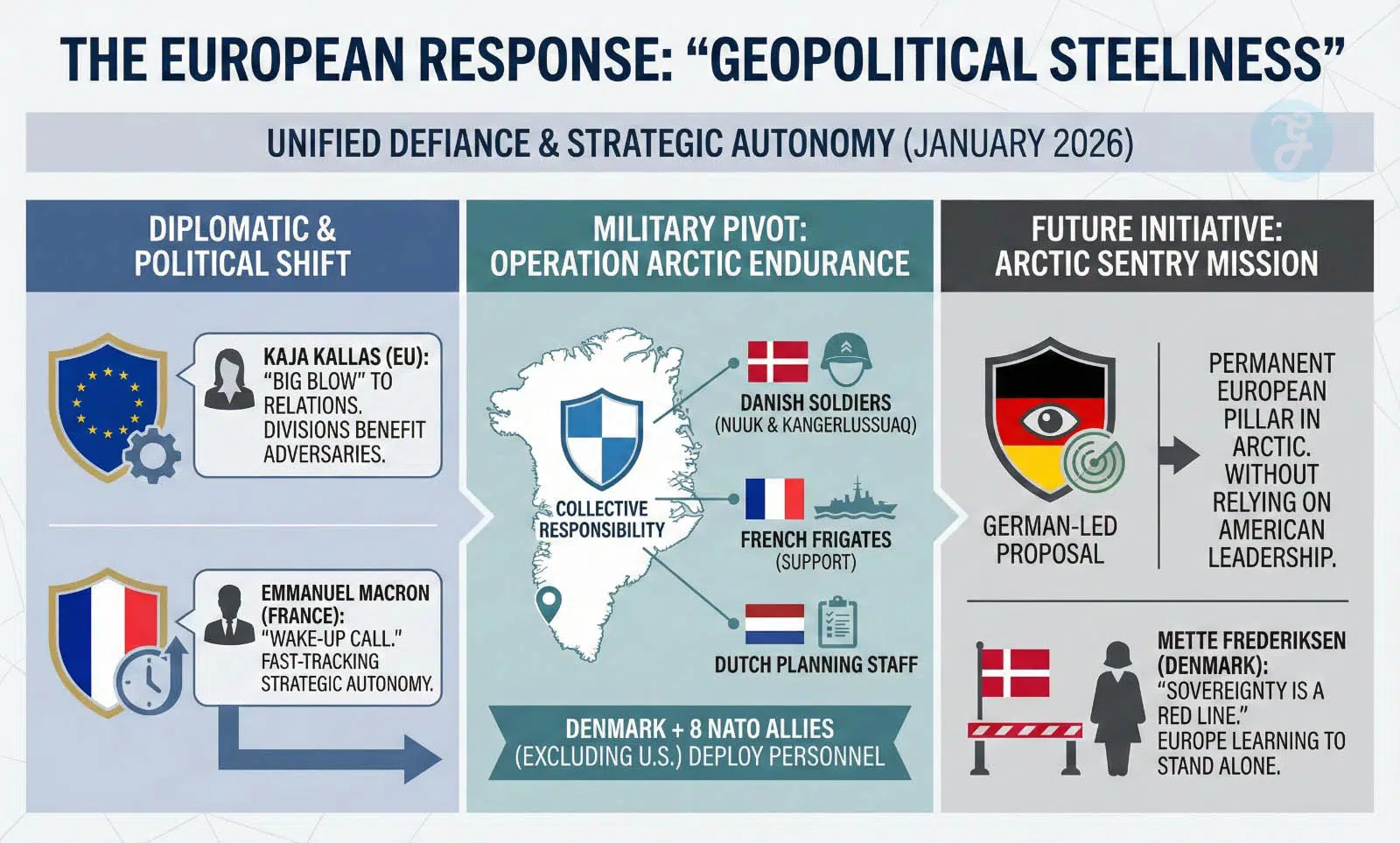 The response from Copenhagen and Brussels has been a rare display of unified defiance. European leaders are now calling for “geopolitical steeliness.” They are moving rapidly to insulate the continent from Washington’s unpredictable demands. Kaja Kallas, the EU’s foreign policy chief, was blunt during an emergency summit in January 2026. She stated that transatlantic relations have taken a “big blow.” She warned that these divisions only benefit global adversaries like Russia and China.
Meanwhile, Emmanuel Macron described the crisis as a “wake-up call.” He is advocating for greater “vigilance” and a fast-tracked path toward European strategic autonomy. This is not just rhetoric; it is a military pivot. Operation Arctic Endurance saw Denmark and eight NATO allies, excluding the U.S., deploy personnel to Greenland. This mission is designed to prove that the island’s defence is a collective European responsibility. Hundreds of elite Danish combat soldiers are now stationed in Nuuk and Kangerlussuaq, supported by French frigates and Dutch planning staff.
The crisis has also accelerated the creation of a permanent “Arctic Sentry” mission. This German-led proposal aims to provide a tangible European pillar within the Arctic without relying on American leadership. Danish Prime Minister Mette Frederiksen remains resolute. She has reiterated that while Denmark seeks dialogue, sovereignty is a red line. As the fracture widens, Europe is learning to stand alone on the ice.
The Mineral War: Neodymium, Uranium, and Power
The real battle for the Arctic is not being fought on the ice, but beneath it. Greenland is currently ranked as the eighth largest holder of Rare Earth Elements (REEs) on the planet. These minerals are the lifeblood of modern technology, powering everything from electric vehicle motors to the guidance systems of F-35 fighter jets. For Washington, this is a matter of national survival. China currently controls roughly 90 per cent of global processing capacity. Breaking this monopoly has become the central pillar of American economic security in 2026.
Two projects at the southern tip of the island tell the story of this fractured West. The first is Kvanefjeld. It is a massive deposit, yet it remains frozen in a legal and political stalemate due to its uranium content. In late 2021, the Greenlandic parliament passed a ban on uranium mining, effectively blocking the project. The second project, Tanbreez, has a very different momentum. It is viewed as the strategic prize of the decade. Unlike its neighbor, Tanbreez is low in radioactivity, making it politically safer.
In early 2026, Critical Metals Corp began construction on a pilot plant in Qaqortoq. The project recently received a 120 million dollar letter of interest from the U.S. Export-Import Bank. Washington sees Tanbreez as a “national security necessity.” It is a direct pipeline to feed processing facilities in the United States, such as the planned facility in Louisiana, and move away from Chinese dependence. Greenlandic leaders, like Prime Minister Múte Bourup Egede, are leveraging this wealth for autonomy, using the phrase “Nothing about us without us” to ensure they are not bypassed by foreign powers.
Hidden Mechanics: The Strategic Lenses
The Security/Intelligence Angle
The internal logic of the Trump administration treats Greenland as the “North American Shield.” While the Davos framework ostensibly removed the threat of force, the Office of the Director of National Intelligence (ODNI) has maintained a surge in resources. This unit was instrumental throughout 2025 in conducting influence operations to monitor Greenlandic sentiment. Concurrently, European intelligence services have responded by treating American signals intelligence as a hostile intrusion. The “tripwire force” of Operation Arctic Endurance now serves as a physical barrier to ensure that “security” remains a multilateral burden.
The Economic Undercurrent
The 2026 crisis has repositioned Greenland as a strategic resource frontier for Western supply security. The U.S. move on Tanbreez is a strategic strike against Chinese dominance. Shenghe Resources remains a shareholder in the stalled Kvanefjeld mine, and Washington is moving to ensure that no future Greenlandic government is tempted to lift the uranium ban in Beijing’s favour. This is about building a “fortress supply chain” where Arctic wealth is funnelled exclusively into North American hubs. This shift in extraction policy and the subsequent diplomatic friction are the direct results of the volatile climate of Greenland Geopolitics 2026.
The Geopolitical Chessboard
NATO is being redrawn. The newly announced Arctic Sentry mission, led by Joint Force Command Norfolk, is an attempt to keep the U.S. inside the tent while asserting European sovereignty. While the U.S. and Europe bicker, Russia and China are the silent beneficiaries, with Moscow militarising the Northern Sea Route. However, the U.S. move is a preemptive strike, signaling to the Kremlin that the High North is no longer a neutral buffer zone, but a tightly controlled U.S. strategic zone.
Strategic Data & Forecasts
The Power Matrix
| Stakeholder | Declared Status | Third-Eye Reality | Actual Winner/Loser |
| United States | Negotiator/Partner | Dominant Security Actor | Winner: Secured de facto mineral oversight and infrastructure veto. |
| Denmark | Sovereign Protector | Defensive Junior Partner | Loser: Intelligence services now forced to treat allies as a threat. |
| European Union | Unified Front | Geopolitical Fragment | Winner: Accelerated independent defence pacts (Arctic Sentry). |
| China | “Near-Arctic” Power | Strategic Outsider | Loser: Effectively blocked from Tanbreez and future southern sites. |
| Inuit Population | Autonomous People | Geopolitical Pawn | Actual Loser: Sovereignty remains secondary to “Security Necessities.” |
3-Year Risk Forecast (2026–2029)
| Risk Category | 12 Months (2026) | 24 Months (2027) | 36 Months (2028) |
| Security Risk | High: Naval “proximity incidents” between U.S. and EU/Danish forces. | Moderate: Permanent Arctic Sentry deployment reduces U.S. mobility. | Low: Normalisation of a “Walled Arctic” with clear spheres of influence. |
| Economic Risk | High: Rare earth processing wars; U.S. sanctions on “hostile” mining. | Moderate: Formation of a “Critical Mineral NATO” excluding China. | Low: Stable production from Tanbreez feeding U.S. military-industrial complex. |
| Political Risk | High: Fall of Danish government over “Davos concessions.” | High: Greenland Independence Referendum triggered by U.S. interference. | Moderate: New “Compact of Free Association” signed under U.S. pressure. |
The Human Cost: Sovereignty and the Inuit Voice
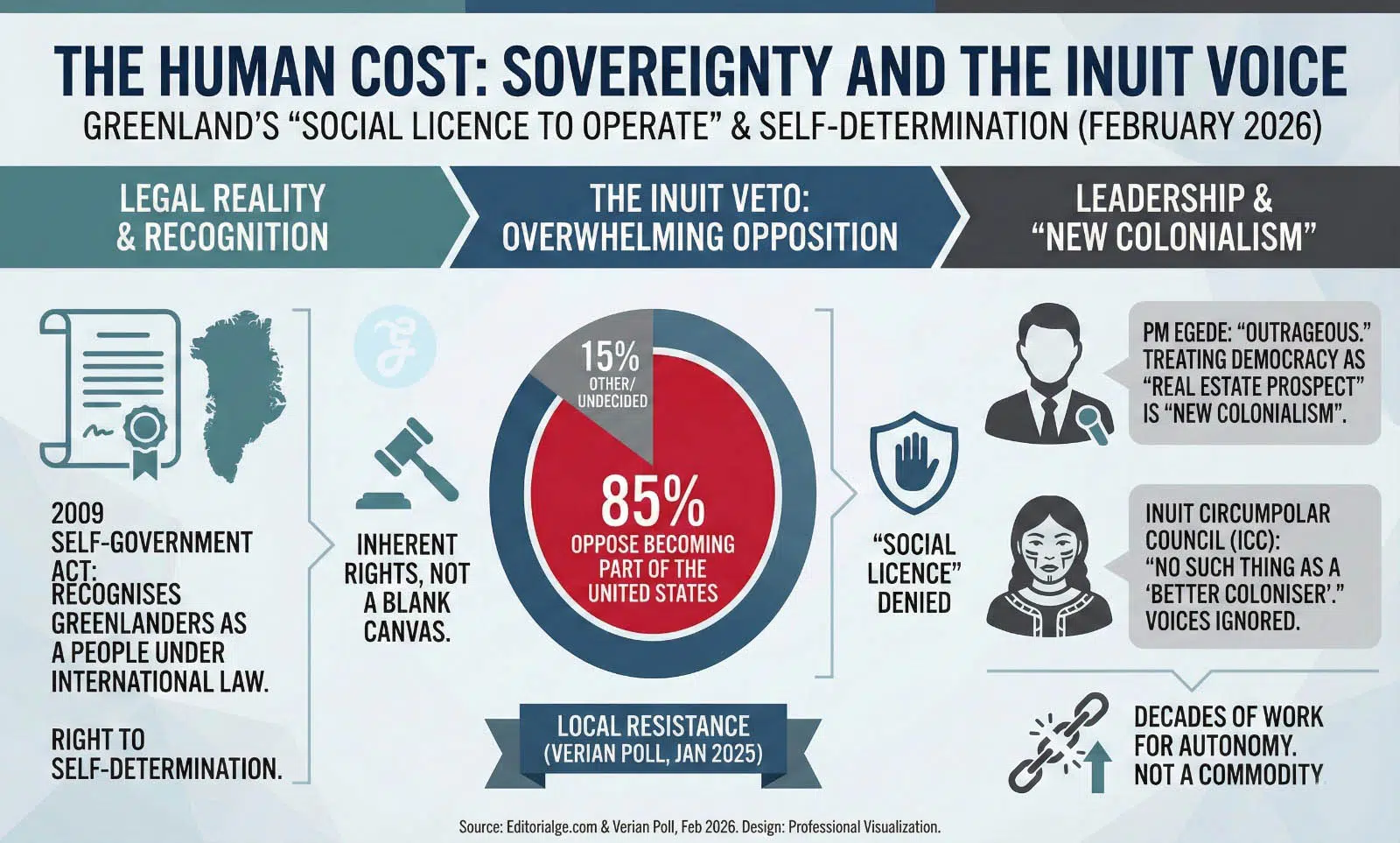
Behind the maps lies a living nation of 56,000 people. Greenland is not a blank canvas. It is a vibrant, modern society with a deep-seated history. The 2009 Self-Government Act fundamentally changed the island’s legal reality, recognising Greenlanders as a people under international law with an inherent right to self-determination. The local resistance to American pressure is overwhelming; polls show roughly 85 per cent of Greenlanders oppose becoming part of the United States.
Prime Minister Egede has noted that it feels “outrageous” for a supposedly close ally to make his people feel unsafe. Treating an autonomous democracy as a 19th-century real estate prospect is a revival of great-power paternalism. It ignores the voices of the Inuit Circumpolar Council, which has warned that there is no such thing as a “better coloniser.” For a population that has worked for decades to shed the shackles of Danish rule, the prospect of being traded like a commodity is deeply offensive.
The NATO Paradox: Defending an Ally or Taking Their Land?
The Greenland crisis has pushed NATO into an existential corner. For seventy-five years, the alliance was built on a sacred promise. Yet in 2026, a founding member found itself defending its territory against the rhetoric of its primary protector. If the United States can challenge Danish sovereignty, the foundation of Article 5 becomes a hollow vessel.
The tension peaked in January 2026 when President Trump suggested he might choose between preserving NATO and securing Greenland. A moment of relief arrived on 21 January at Davos, where Trump and Mark Rutte announced a framework for a future deal. Trump walked back his threats of force, but many in Europe remain skeptical. This atmosphere has left a permanent mark; European capitals are no longer willing to rely solely on the American nuclear umbrella. They are building their own independent defence capabilities, proving that trust has been replaced by a cold pragmatism.
The Coldest War
The crisis in Greenland is the canary in the coal mine for the Western alliance. What began as a startling proposal for a real estate deal has exposed the fragile state of our shared values. The events of 2026 have shown that even the oldest friendships can buckle under the weight of resource scarcity and shifting doctrines.
If the Monroe Doctrine is successfully extended to the High North, the West is not just fractured; it is being redrawn. We may be entering a far more transactional phase of cooperation. In its place, a new and harsher reality is taking shape. The Arctic is no longer a shared global commons. It has become a hardened arena of competing great powers. The Arctic will reveal whether the West remains an alliance of equals, or evolves into something more hierarchical and transactional.





















