
Have you ever felt like traditional schooling is stuck on a tutorial level that never ends? I get it. In my column, I usually analyze game mechanics or the latest hardware drops, but the way we learn is getting a massive patch update in 2026. EdTech Startups are rewriting the rules of the game.
These companies are new technology players working to change how people learn and teach. They use smart tools, apps, and online platforms to make learning easier, faster, or more personal for students around the globe.
In 2026, education is getting a tech boost like never before. Big names such as Coursera Inc., BYJU’S, Chegg Inc., and Google LLC rank among the top players shaping digital classrooms. Smart ideas drive this growth. Companies like Multiverse have raised $419 million to train minds with artificial intelligence. Harmonic pulled in $175 million for its AI math engine.
Synthesis brings tutoring powered by AI straight into homes while Labster lets students run science experiments without leaving their desks. Language apps such as Cambly help connect teachers and students from different countries in real time. Byju’s leads K-12 learning with huge impact across many schools worldwide. Photomath turns tough equations into step-by-step answers on smartphones, no chalk needed.
Working at Editorialge gives me a front-row seat to these waves of change in EdTech Startups, especially where gaming meets classroom tech upgrades. Each company has its own style. Some build better ways to track knowledge (like Golden), others open doors for kids who learn differently (such as Marker Learning).
This surge means more kids get special help, busy workers can upgrade skills after hours, and whole cities experiment with smart schooling through companies like Linker Vision or Articul8 AI.
All these bright sparks matter because they tackle barriers old-school education could not break down alone.
Next up: Meet 10 bold EdTech Startups making noise in early 2026. You will want to keep an eye on them.
EdTech Industry Trends in 2026
Education technology keeps moving fast, like a train that never stops. New ways to learn pop up every month, turning yesterday’s dream into today’s homework.
It reminds me of the rapid iteration cycles we see in software development. The tools just keep getting sharper.
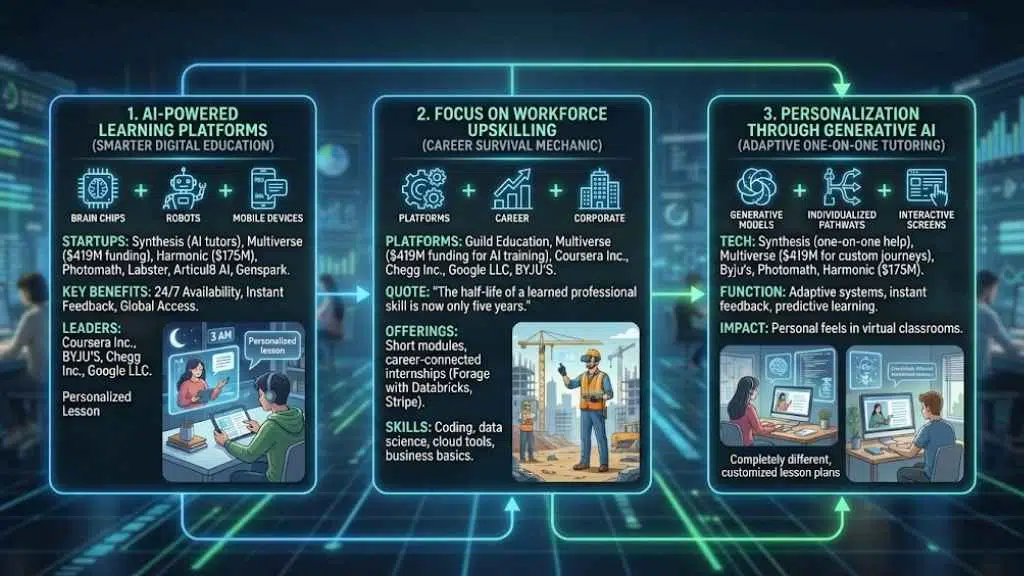
Growth in AI-powered learning platforms
AI-powered learning platforms are spreading fast. Startups like Synthesis use AI tutors to help students learn at their pace. Multiverse, focused on AI training, raised $419 million in funding.
Harmonic, an AI math engine, scored $175 million as well. Big names such as Coursera Inc., BYJU’S, Chegg Inc., and Google LLC lead the charge worldwide.
With tools like Photomath for math problems and Labster for virtual science labs, digital education feels smarter than ever. Articul8 AI and Genspark show how smart systems make lessons easier to understand.
Here is why this shift matters right now:
- 24/7 Availability: Students can get expert help at 3 AM or 3 PM.
- Instant Feedback: No more waiting a week for a graded paper.
- Global Access: A kid in a rural town gets the same quality tutor as a kid in a major city.
This growth makes online education more personal, interactive, and effective for millions around the globe.
Focus on workforce upskilling
Tech giants and EdTech startups see workforce upskilling as a golden ticket for growth. Guild Education stands out in this space, bringing college-level courses and training straight to job sites.
This makes learning easy for employees who need new digital skills or want better jobs. Companies like Multiverse, with $419 million in funding, power AI training that helps workers learn fast and keep up with change.
Big names such as Coursera Inc., Chegg Inc., Google LLC, and BYJU’S are building online education platforms that teach coding, data science, cloud tools, and business basics. These platforms use smart algorithms to check progress quickly so people can improve at their own pace.
“The half-life of a learned professional skill is now only five years. Continuous upskilling isn’t a luxury anymore; it is a survival mechanic for your career.”
Startups create short modules plus career-connected internships, like those from Forage, to match real-life tasks at top tech companies including Databricks or Stripe. This push toward skill development does not just fill gaps; it gives workers hope for future-ready careers while businesses get the talent they need to grow fast in 2026’s race for innovation.
Personalization through Generative AI
Generative AI now acts like a smart tutor for each student. Synthesis uses this tech to offer one-on-one help, giving answers that fit how kids learn best. Multiverse raised $419 million to build custom learning journeys with AI training tools.
Big names like Byju’s and Photomath use these adaptive systems in their education technology platforms. Lessons can change on the spot based on questions or mistakes.
An AI math engine called Harmonic secured $175 million, letting students get instant feedback created just for them. These digital learning solutions do more than just grade work; they read patterns and predict what a learner needs next.
This makes online education feel personal, even in huge virtual classrooms run by companies such as Coursera Inc., Chegg Inc., and Google LLC.
Key Criteria for Selecting Startups to Watch
Picking the right education technology startups takes more than just a quick scan. You want new ideas, strong support, and real change. These signals point to the ones that could shake things up fast.
Innovation in technology
EdTech startups are pushing boundaries with new technology. Multiverse grabbed $419M to grow AI training, while Harmonic used $175M to power its math engine. Synthesis is shaking up tutoring through smart AI.
Platforms like Byju’s and Photomath have made waves in K-12 and math learning across the globe using clever digital tools. Labster opens virtual labs, making science safer and more fun for students anywhere. Linker Vision jumps into smart cities, Articul8 AI takes on enterprise use cases, and Genspark sparks next-level search tech.
These startups are using artificial intelligence for tasks from course design to real-time help, flipping old teaching methods on their head and making learning more personal.
Big names like Coursera Inc., Chegg Inc., Google LLC, Anthropic, Databricks, Stripe, and Figma are part of this race too, proving education technology is blazing forward at full speed.
Funding and investor backing
Big-name investors and large cash rounds make a splash in Education Technology. Multiverse, known for its work with AI training, raised $419 million. Harmonic, an AI math tool, secured $175 million.
Such numbers signal deep belief from backers and speed up new learning solutions. Heavyweight companies like Coursera Inc., BYJU’S, Chegg Inc., and Google LLC also attract large investments as they push digital education forward.
Startups like Labster bring virtual labs to screens with the help of strong financial support. Backing from investors is not just about money; it adds credibility and attracts fresh talent hungry to change how we learn online or in class.
| Criteria | Why It Matters |
|---|---|
| Venture Capital Volume | High dollar amounts (like $100M+) indicate that experts believe the tech is scalable and necessary. |
| Strategic Partnerships | Deals with companies like Google or Walmart prove the product solves a real business problem. |
| User Growth Rate | Fast adoption shows the tool actually works for students and teachers in the real world. |
Impact on education
EdTech startups like Synthesis and Photomath have started changing how students learn. Synthesis uses AI tutoring to support problem-solving, while Photomath helps make math homework less stressful.
Multiverse, with $419 million in funding, boosts workforce training through AI-powered education tools. Harmonic’s $175 million-backed math engine creates new ways for kids to master numbers outside the usual classroom grind.
Virtual labs from Labster allow science learning anywhere, anytime; this brings experiments right into a student’s room or café table. Guild Education targets working adults who want upskilling without hitting pause on their jobs.
Companies such as BYJU’S and Coursera bring digital courses straight to millions of learners worldwide, helping bridge gaps in traditional education. These innovations give students access regardless of where they live or how much money they have for school supplies, a small revolution powered by tech investment and creative minds.
10 EdTech Startups to Watch in Q1 2026
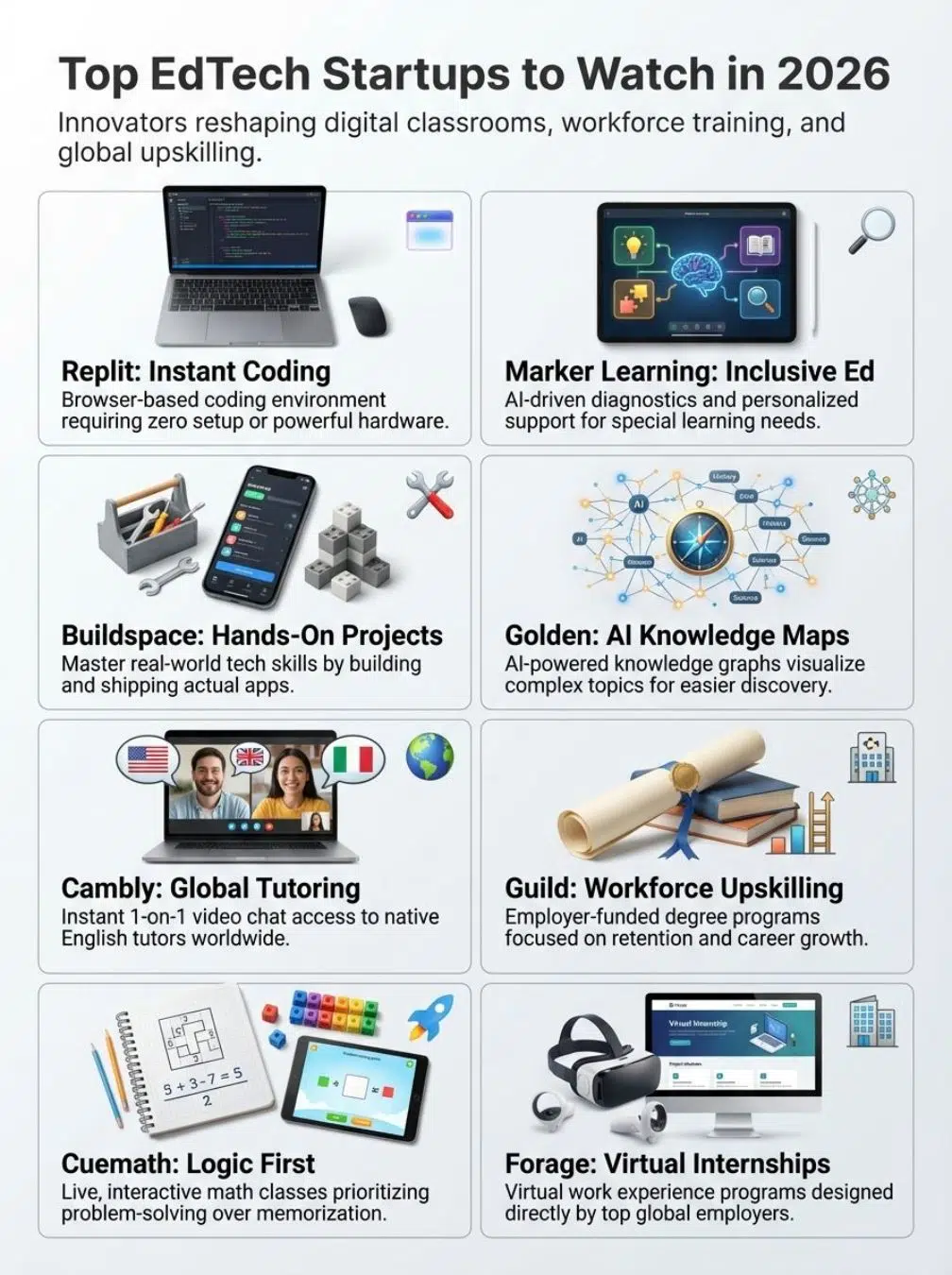
Fresh faces in digital learning are grabbing headlines, and you’ll want to stick around for this list. Each startup is rewriting the script for education technology.
Replit: Browser-based coding education
Replit stands out by offering coding education right in your browser, skipping the setup and fuss. Students build real projects with just an internet connection, turning any laptop or tablet into a digital classroom.
Coders and teachers use Replit to teach Python, JavaScript, C++, you name it, in live sessions or self-paced lessons. Schools lean on Replit for its AI tutoring tools that help explain code bugs gently and quickly.
Key features that make it a game-changer:
- Zero Setup: No spending hours installing compilers; it just runs in Chrome or Edge.
- Multiplayer Mode: You can code in the same file with a friend at the same time, just like Google Docs.
- Ghostwriter AI: An integrated AI helper that suggests code and finds errors instantly.
Many see it as perfect for after-school clubs or entry-level classes since users do not need powerful computers or extra software. Startups like Synthesis often mention how easy platforms like Replit make learning to code part of everyday schoolwork. With online courses growing fast in 2026, browser-based solutions such as this grab attention from big EdTech investments worldwide.
Marker Learning: Special education solutions
Marker Learning changes special education with smart digital learning solutions. It uses AI-powered tools to help students with different needs reach their full potential. Kids get personalized support for skills like reading, writing, and math.
Teachers use Marker’s platform to track progress and adjust plans quickly. Schools save time and resources by switching to these online education tools.
Students feel more confident because the lessons match their pace and style. The company stands out among 10 EdTech Startups To Watch In Q1 2026 by making sure no student is left behind in digital classrooms.
Investors see growth here as schools everywhere need better ways to teach learners who need extra help.
Buildspace: Hands-on project-based learning
Buildspace gives learners real-world skills through hands-on projects. Students build apps, launch websites, and even experiment with AI tools in a low-pressure setting. The platform uses project-based tasks to help users master topics like coding or digital marketing without just reading theory or watching lectures.
Each project includes community support and feedback from professionals, which helps students grow faster. With its focus on workforce and tech upskilling, Buildspace stands out among 10 EdTech Startups To Watch In Q1 2026.
Innovators use the site for modern learning needs such as web3 or practical software engineering exercises. It’s popular because learners see results quickly; building something that works beats endless worksheets any day.
Golden: Knowledge-sharing and mapping platform
Golden uses AI to turn complex information into clear knowledge maps. Teachers and students can search, share, and build topic webs without feeling lost in a sea of data.
Investors have noticed Golden’s drive for smarter digital learning tools, pouring funds into its growth as other EdTech leaders like Coursera Inc., BYJU’S, Photomath, and Labster grab headlines too. Instead of bland lists or dry articles, users see connections pop on screen, kind of like seeing the forest instead of just staring at trees.
This platform boosts curriculum development for schools while powering quick fact-finding for anyone hungry to learn online. With education technology moving fast into 2026, Golden stands out by making vast knowledge networks simple enough for everyone to use, even fifth graders with big questions and busy teachers needing answers now.
Cambly: Language learning for global users
Cambly connects learners with native English tutors, offering real-time conversation practice right on their phones or computers. The platform attracts users worldwide who want to improve their language skills for school, work, or travel.
Cambly’s bite-sized video chat sessions make English less scary and more fun. Any time of day suits a busy schedule. The company keeps things simple but smart.
Learners set goals and pick topics that matter to them most, driving true personalization in every lesson. AI tracks progress and suggests lessons customized for each user’s skill level.
People from over 150 countries have joined Cambly for clear guidance in digital education. This startup stands out as one of the fastest-growing EdTech companies reshaping global learning trends as it breaks down language barriers at scale.
Guild Education: Workforce education and upskilling
Guild Education links big companies with online education and training. Big names like Walmart and Disney use Guild’s platform to help workers learn new skills or earn degrees while working full-time jobs.
The company uses digital learning tools, making it easy for employees to improve their job skills right from home or work. With a strong focus on workforce upskilling and career growth, Guild blends technology, live coaching, and classes into one simple system.
This approach helps businesses keep skilled workers longer by supporting them as they grow in their careers. Many who join these programs get access to college-level courses at little or no cost; some even finish full degrees without going into debt.
In 2026, many investors watch startups like Guild Education because they close the gap between old-school HR training and modern digital education platforms, fueling both employee success and business results.
Cuemath: Math learning platform for children
Cuemath guides kids through math concepts using live online lessons and interactive activities. Its focus is on building strong problem-solving skills, not just memorizing formulas.
Teachers work with each student in small groups, so every child can get help quickly if they feel stuck. Parents across the globe choose Cuemath to build a solid foundation for children from early grades right up to high school.
Backed by EdTech investments and recognized alongside platforms like Byju’s and Photomath, Cuemath stands out for its creative approach to digital learning and curriculum development. The program uses technology to personalize lessons, making tough topics feel less scary for young learners.
With AI tools showing kids new ways to think about numbers, Cuemath draws interest from investors searching for innovation in education technology startups.
Outschool: Live online classes for diverse subjects
Outschool runs live online classes that cover almost everything. Kids can pick from art, chess, coding, math, languages, or even video game design. The platform lets children learn topics that spark curiosity outside a usual school setting.
Teachers create their own courses and teach in small groups over Zoom. For parents craving fresh education options in 2026’s digital learning wave, Outschool feels like striking gold.
The company welcomes young learners worldwide and makes it easy to join with just an internet connection. Outschool fits the trend of online education focused on choice and flexibility, keeping kids engaged while growing real-life skills for tomorrow’s world.
Primer: Personalized learning for homeschoolers
Primer gives homeschool families a simple way to shape education. Through its digital learning platform, kids get courses that fit their pace and style.
Families can pick from many subjects, building plans as flexible as mom’s pancake recipe on Sunday. AI-powered tools help track progress and find gaps in skills, so no topic falls through the cracks.
Many startups praise Primer for innovation in personalized online education. The company stands with giants like Synthesis and BYJU’S by offering hands-on lessons, live classes, and fast feedback using clever technology.
Investors spot big growth here, just like the rush for coding apps or virtual labs such as Labster. Digital education gets smarter and easier at home with Primer’s platform leading the charge into 2026.
Forage: Career-connected learning and internships
Forage links students and job-seekers to virtual internships with real companies. This digital platform lets users try out practical tasks designed by industry leaders like JPMorgan or BCG, all from home.
The process feels close to working in a real office but happens online, making it easy for anyone worldwide to join in. Big firms use Forage’s learning platforms as a way to spot talent early and build skilled teams.
With the global growth of EdTech investments, Forage stands out by focusing on skill development and career pathways rather than just classroom content. Students learn workplace skills fast—think project management, teamwork, and communication—while gaining insights into different professions without leaving their bedroom desk chair.
Forage’s model fits perfectly into today’s demand for digital education that prepares students directly for the workforce.
Why These Startups Stand Out
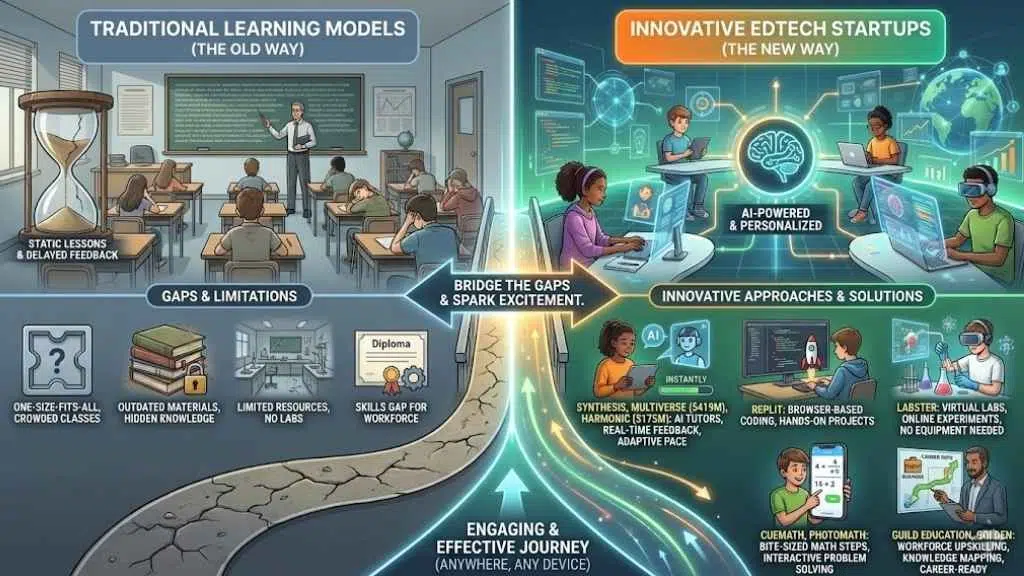
These startups shake up old ways of learning and spark new excitement. They fill gaps most schools leave open, making each student’s journey a little less bumpy.
Innovative approaches to education
AI-powered learning platforms like Multiverse and Synthesis are shaking up digital education. Multiverse snagged $419 million to expand AI training, while Synthesis is climbing the charts as a top startup for 2026.
Students get real-time feedback from AI tutors now, not just static lessons or videos. Virtual labs from Labster help kids run science experiments online.
Replit makes coding simple with hands-on tasks in your browser, ditching boring lectures for actual projects. Companies like Harmonic secured $175 million to turn math into an interactive adventure using smart engines that correct mistakes as they happen.
This approach keeps students engaged and helps them learn at their own pace, no matter where they live or what device they use. Talk about making school less snooze-worthy!
Addressing gaps in traditional learning models
Many EdTech Startups step in where old-school classrooms fall short. Replit teaches coding right from your browser, making computer science easy to access for students who lack strong tech programs at school.
Marker Learning provides special education tools that help all learners move forward, not just those who fit the usual mold. Cuemath and Photomath bring math lessons to screens worldwide, turning tough equations into bite-sized steps.
Synthesis uses AI tutoring to give each student personal feedback, a feature missing from crowded classes. Labster creates virtual labs so kids can practice science even without fancy equipment or supplies.
Golden helps people map out information and share it with others quickly; knowledge stays fresh instead of hidden away in textbooks no one opens anymore. Guild Education partners with businesses for workforce upskilling, closing gaps between what schools teach and jobs demand.
These startups use digital learning platforms so more people get a shot at quality education, no matter their background or zip code.
Final Thoughts
Education technology in 2026 looks bright, full of fresh ideas and smart solutions. The ten EdTech startups we explored today prove that learning online can be personal, hands-on, and open to everyone.
Each uses new tools like AI or project-based lessons to make education fast, simple, and fun for both kids and adults. Readers eager for more can check out their platforms or follow industry news on sites covering digital learning trends. Stay curious; the next big classroom could be only a click away. Sometimes all it takes is one small step to shape your own future.