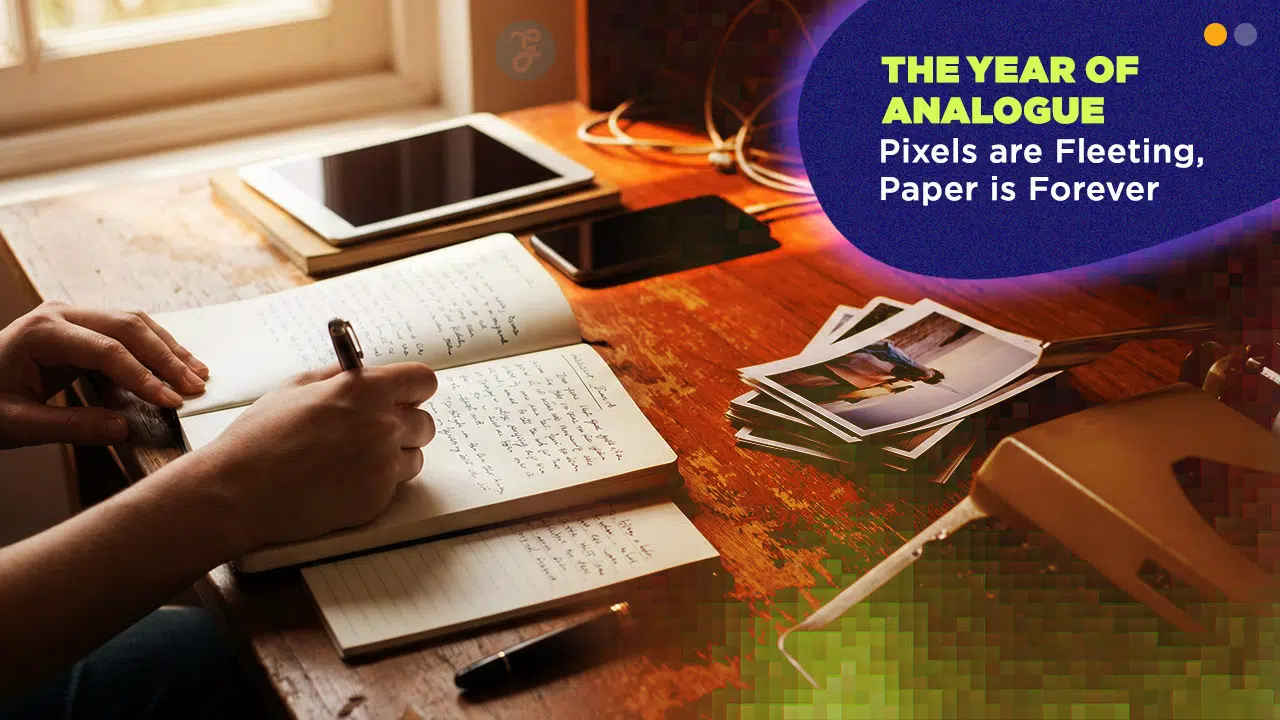
In 2026, the most expensive thing you can own is your own attention. We have spent the last decade building a world of perfect, frictionless glass, where we can summon any image, any answer, and any person with a tap. Yet, as we move through this year, a strange collective shudder is passing through the global population. It is called 2026, The Year of Analogue. It is not a step backward; it is a desperate, beautiful lunging toward the physical.
The Haptic Reset: Defining the Movement
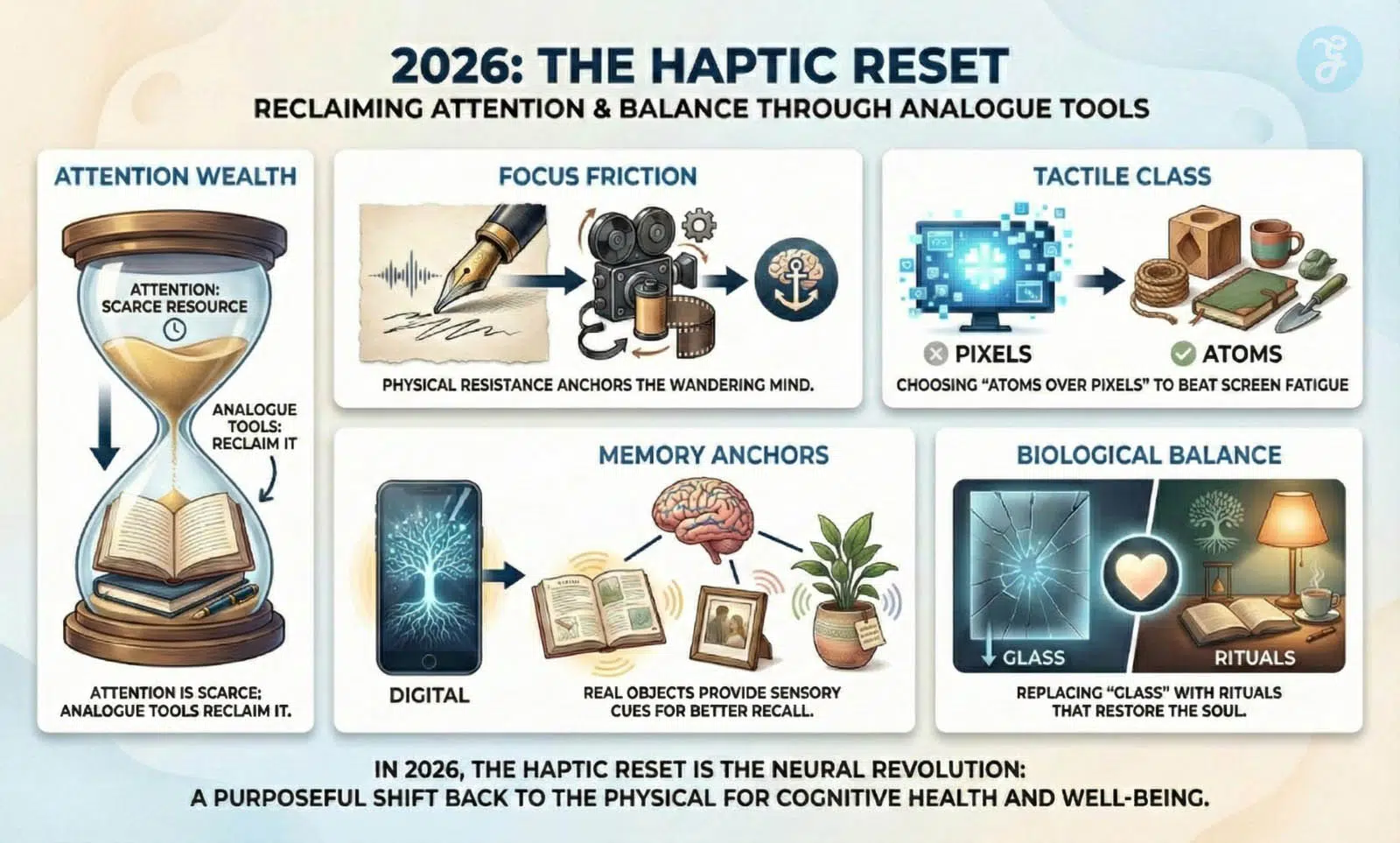
This shift is a global “haptic reset” triggered by years of screen fatigue and the hollow hum of AI-generated content. We are witnessing the rise of the Tactile Class: professionals and students from London to Seoul who are trading high-definition pixels for the weight of heavy paper and the scent of the darkroom.
It is not a rejection of technology, but a search for balance. By returning to paper journals and film cameras, we are reclaiming the physical “anchors” that help us focus and remember. In a world of flickering light, the most luxurious thing you can touch is something real.
The Pillars of the Revolution
The Stationery Surge: Market data shows half of Americans are now intentionally choosing paper planners. Companies like Moleskine are reporting record sales as people like Leo, a developer in London, finds that a paper list is the only thing the “digital noise” cannot delete. He describes the act of physically crossing out a task as a “neurological hit of dopamine” that a haptic buzz on a watch simply cannot replicate.
The Film Boom: Wholesale film sales have jumped 127 percent. Jimin, a student in Seoul, explains that she uses her phone for convenience but her mechanical Leica for memories. She wants the “smell of the darkroom” and the physical weight of a print. To her, a digital photo is a file, but a film photo is a fragment of time captured in silver halide.
The Social Reset: “No-phone” events are no longer niche. They are a status symbol. Luxury in 2026, The Year of Analogue is now defined by the ability to be unreachable. To be “off the grid” is the ultimate sign of wealth because it means you own your time and no algorithm has a mortgage on your focus.
The Breaking Point (The Great Digital Saturation)
The morning light in the metropolis did not come from the sun. It came from the windows. Elara stood in her thirty-second-floor apartment watching the Augmented Reality ads flicker against the glass. A ghostly, thirty-foot-tall bottle of perfume hovered over the street below, casting a synthetic lilac glow across her living room. It was beautiful. It was perfect. It was utterly hollow.
Elara was a high-level digital strategist. Her entire life was a series of optimisations. She moved through her day with swipes and taps. She checked her “Focus Score” on her wrist. She adjusted her “Mood Lighting” with a thought-command. She lived in the “Seamless Era,” where every friction point had been sanded down by AI assistants.
By noon, the Vertigo set in.
It started as a dull throb behind her eyes. Then came the nausea. This was the “Burnout Peak” the news warned about. Her brain was rejecting the non-human content. Every email felt like it was written by a machine for another machine, creating a loop of “I hope this finds you well” generated by Large Language Models talking to other Large Language Models. Every image on her feed was too sharp. Too vibrant. Too fake.
She looked at her hands. She realised with a jolt of horror that she had not felt the texture of anything other than glass, brushed metal, or synthetic fabric in three days. Her fingertips ached for a grain. A snag. An imperfection. She felt like a ghost haunting her own life, a collection of data points moving through a vacuum of light.
Then, the servers flickered.
It was a momentary brownout, a ripple in the city’s massive data cooling systems. The AR ads vanished. The “Smart” lights dimmed. The constant hum of the data centres beneath the city seemed to skip a beat. In that silence, the Cloud felt terrifyingly thin. It was a digital ghost that could vanish at any moment, taking her memories, her work, and her identity with it.
Elara walked to the corner of her room. She pulled a heavy, dust-coated moving box from the back of the closet. Inside, buried under old cables and obsolete chargers, was a small book bound in red fabric.
She picked it up. The weight was substantial. She ran her thumb along the edge of the pages. They were slightly yellowed. They resisted her touch. She opened the first page: January 1984. It was her grandmother’s diary. The ink was uneven. Some words were pressed hard into the paper, creating tiny canyons she could feel with her skin. There was a smudge of dried coffee on the corner of a page, and a pressed wildflower that crumbled into dust as she touched it.
It was a physical footprint. A piece of evidence that a human being had stood in a room, felt a certain way, and left a mark. Elara sat on the floor, ignoring the notifications chiming from her dormant tablet. She let the screen go dark. For the first time in years, she felt grounded. She wasn’t scrolling. She was touching time. This was the personal dawn of 2026, The Year of Analogue.
The Underground Resistance (The Rise of “The Guilds”)
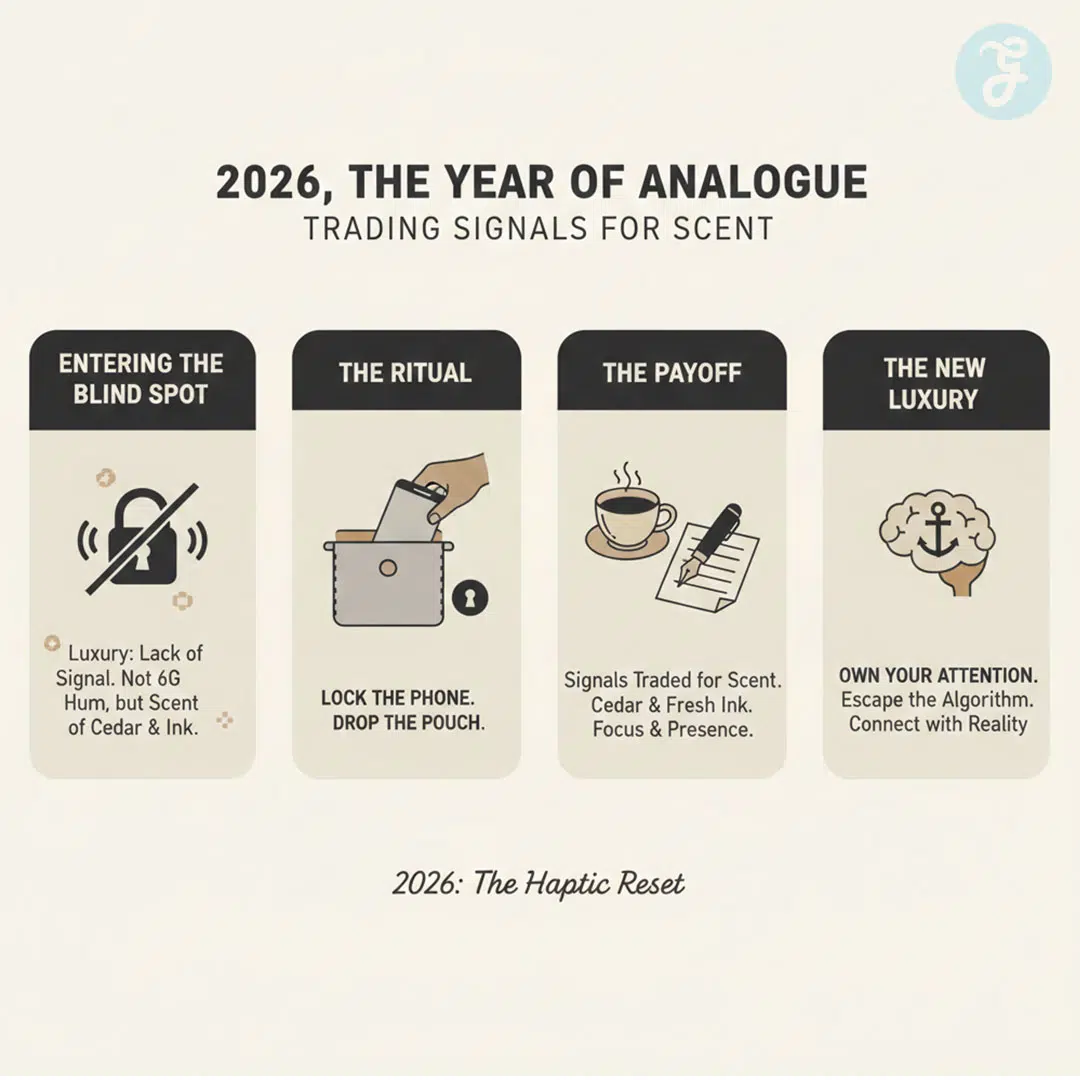
The social map of the city has changed. In 2024, we looked for bars with the fastest Wi-Fi. In 2026, The Year of Analogue, we hunt for the “Dark Cafes.” These venues do not appear on standard maps because their signals are scrubbed from the grid. They exist in the “blind spots” of the city’s 6G network.
At the door, the ritual is always the same. You do not just silence your phone. You place it into a lead-lined pouch that is locked until you leave. The weight of the device vanishes. The phantom vibration in your pocket or the ghost ring finally stops. Inside, the air feels different. It is thick with the scent of roasted beans and something sharper: the metallic tang of fresh ink and the woody musk of cedar-shavings.
The Silicon Crash Effect: Following the “Silicon Crash” of 2025, where several major cloud-hosting giants suffered catastrophic data corruption, the tech-obsessed market pivoted. Digital assets suddenly felt like smoke. Paper felt like gold. People realised that a digital deed could be deleted, but a paper ledger was a physical reality.
The New Retail: Stationery shops have replaced the minimalist tech boutiques. People queue for hours for a specific weight of Japanese vellum or a limited-run fountain pen. These aren’t just stores; they are cathedrals of the tactile.
The Focus Wand: High-end pens are no longer office supplies. They are being marketed by creators like Mohammed on Medium as “focus wands,” the only tools capable of anchoring a human mind in a sea of algorithmic noise. To hold a fountain pen is to accept a contract with the page: there is no backspace. You must think before you ink.
We find Julian in a basement studio in Hackney. He used to write code for a social media giant, optimising the algorithms that keep people scrolling for “one more second.” Now, his fingernails are permanently stained with Carbon Black. He spends his days at a 1950s Heidelberg letterpress. The machine is a beast of cast iron and gears, breathing oil and rhythm. It does not have a “delete” key.
Julian calls his work the “Weight of Thought.” He believes that when you write a letter by hand or press a plate into paper, you are engaging a neural pathway that typing simply cannot touch. “The brain-hand connection is sacred,” he says, his voice competing with the mechanical thud of the press. “When you type, every letter feels the same. A ‘Q’ feels like an ‘A.’ But when you write, your body knows the difference. You are carving your thoughts into the world.”
Science supports him. Recent 2026 studies building on the landmark 2024 findings from the Norwegian University of Science and Technology have confirmed that the physical act of forming letters triggers unique brain connectivity. It creates a “theta-wave” state similar to deep meditation. When Julian presses a plate into a sheet of cotton paper, he isn’t just printing. He is scarring the material. He is leaving a physical dent in the universe.
The studio is a sanctuary of sensory antidotes. Outside, the data centres hum with a relentless, invisible heat. Inside, there is only the scratch of a fountain pen on a toothy page. There is the smell of cedar shavings from a hand-cranked pencil sharpener. There is the mechanical, rhythmic click of a Leica M6 shutter. These sounds are not notifications. They are punctuations of reality.
In 2026, The Year of Analogue, Julian is not a relic of the past. He is a pioneer of the new frontier. He is teaching a generation of “Digital Drifters” how to become “Tactile Architects.” He is showing them that while a pixel is etched in light, a word written in ink is etched in time.
The Education Rebellion (The Pencil-and-Pad Movement)
The most radical spaces in 2026, The Year of Analogue are not high-tech labs. They are classrooms that look suspiciously like the 1950s. At St. Jude’s Academy in London, the morning ritual does not involve logging in. It involves sharpening pencils. Here, “Screen-Free” is not a budget constraint. It is the elite standard. The school has branded its curriculum around “Deep Focus,” a cognitive survival skill for an age of infinite distraction.
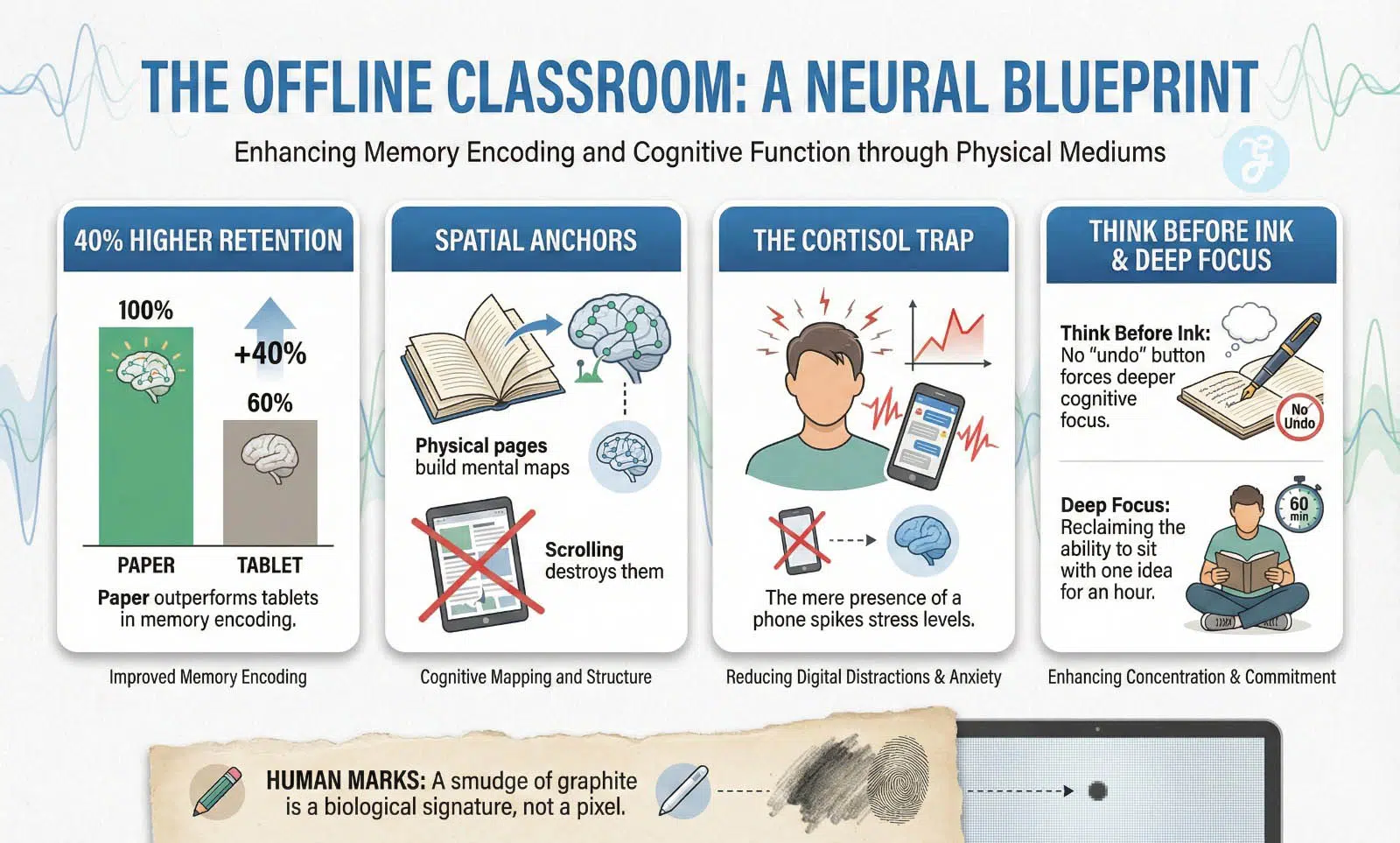
By removing the digital middleman, students are forced to engage with the “materiality” of their education. When a student at St. Jude’s makes a mistake in a physical notebook, they cannot simply hit undo. They must erase, leave a ghost of the error behind, and learn from the friction of the process. This creates a psychological resilience that educators call “The Permanent Mark,” a realization that actions and thoughts have weight and consequences in the real world.
The Retention Gap: Recent findings from the 2026 Global Literacy Initiative confirm what many felt. Students using physical journals show a 40 percent higher information retention rate than those on tablets. The “Spatial Memory” of a book where a student knows a fact was on the bottom left of a specific page is something a scrolling PDF cannot provide.
The Cortisol Factor: A couple of years back in 2024, highlighting the physiological toll of modern connectivity, Dr. Anna Garrett warned that “research indicates that the mere presence of a smartphone can increase cortisol levels, even if it’s not in use.” She described this phenomenon as a digital pressure cooker, where the constant expectation to be available and the habit of scrolling through curated images of “perfect” lives trigger feelings of inadequacy. To combat these micro-stresses and protect her own hormonal balance, Garrett advocates for a strict boundary: “Personally, I’ve turned all my notifications off, and I keep my phone on silent. Always.”
The 2026 Study: “Cortisol Detox in 2026”
Published in early February 2026, research led by Dr. Timothy Allen and contemporary reviews from the National Institute of Mental Health and Neuro Sciences (NIMHANS) have updated the “Digital Pressure Cooker” theory.
- The “Micro-Stress” Loop: The 2026 data emphasizes that it isn’t just one major digital event causing burnout; it’s the constant micro-stressors with no “off switch.” The research shows that 2026 users face a unique “Digital Addiction” where the brain no longer distinguishes between a real threat and a social media notification, keeping the HPA axis (the body’s stress response) in a permanent state of “fight or flight.”
- The 30-2-30 Rule: A new behavioural protocol introduced this year suggests that for every 30 minutes of screen use, a 2-minute “haptic reset” is required to prevent a cortisol spike.
- The “Brain Drain” Meta-Analysis (2025-2026): Recent large-scale experimental studies (including those using the Loomlock device to restrict phone visibility) have confirmed the “Brain Drain Hypothesis.” They found that working memory and attention significantly improve when the device is physically inaccessible, proving that its mere presence… even if silent, consumes “executive resources.”
The Focus Architects: Leading educators like Marcus in Manchester are ditching e-books. He argues that a paper page creates a mental map that a scrolling screen destroys. His students are becoming Analogue Architects, individuals who can sit with a single idea for an hour without an algorithm intervening.
The contrast in the playground is stark. On one side are the “Digital Drifters.” These are the children from districts still pushing the “One Tablet Per Child” mandate. They are often found hunched over glowing rectangles, their eyes darting in the frantic rhythm of the scroll. They are consumers of a world that is being written for them by machines.
On the other side are the Architects. They sit in clusters, passing around physical notebooks filled with sketches and scratched-out sentences. They are learning to value the “Friction of Thinking.” They understand that the resistance of the nib against the page is where the memory is made. To them, a smudge of graphite on a palm is a badge of honour. It is the mark of someone who is building a physical legacy in a world that is increasingly made of light and air.
In these quiet hallways, the revolution is silent. It sounds like the turning of a heavy page. It feels like the weight of a fountain pen. It is the sound of a generation reclaiming the right to think for themselves.
The Haptic Reset: From Mumbai to New York
The shift is deeply personal and globally pervasive. In the bustling heart of Mumbai, Camelia Nandi, a self-employed teacher who spends her days navigating the rigid logic of back-to-back Maths batches, has turned to the spinning wheel of a pottery class to find her equilibrium.
For Camelia, the clay is a silent partner that demands a different kind of presence, one where equations are replaced by the raw, intuitive pull of earth between her fingers. “Online, everything is solved,” she says, her hands coated in wet grey silt. “But the clay challenges me. It has its own will. You can’t ‘command-Z’ a lopsided pot.”
Similarly, Raka Chakrawarti, an entrepreneur based out of Gurugram, used to the high-stakes friction of building a business, has traded her keyboard for a canvas. By picking up a brush, Raka isn’t just painting; she is reclaiming a sense of agency that the digital world often dilutes. These are not just hobbies. They are haptic resets. For the teacher and the entrepreneur alike, the mess of wet clay and the smudge of oil paint are the only things that feel entirely real in a world made of pixels.
In the suburbs of Chicago, “Vinyl Parties” have replaced streaming sessions. It’s no longer about having 50 million songs in your pocket; it’s about having twelve songs on a platter that you have to physically flip halfway through. This “forced intentionality” is the hallmark of 2026, The Year of Analogue. It forces the listener to stay in the room, to hear the album as the artist intended, and to appreciate the pops and hisses that prove the music is being physically played.
The “Film and Fountain” Philosophy
In a world where AI can generate a flawless sunset in seconds, perfection has become cheap. In 2026, The Year of Analogue, “Imperfection” is the new premium. We are seeing a radical shift in what we consider beautiful. A blurry 35mm film photo or a smudged line of ink is no longer a mistake. It is a biological signature. It is the only way to prove a human was actually there.
People are gravitating toward the “honest grain” of physical media because it cannot be faked by an algorithm. An AI can mimic the look of film, but it cannot mimic the chemical reaction of light hitting silver. It cannot mimic the way a fountain pen’s ink feathers into the fibres of a specific batch of paper.
The Grain Revolution: Professional photographers are abandoning digital sensors for the chemical unpredictability of Kodak and Ilford. They want the light leaks, the grit, and the tension of only having 36 frames. This scarcity creates value.
The Ink Anchor: Fountain pen sales are soaring. Users like Siddharth in Delhi describe the “mechanical resistance” of a nib as a mental anchor. “When I use a ballpoint, my hand flies too fast for my brain,” he says. “But a fountain pen requires a specific angle, a specific pressure. It slows me down. It makes me present.”
The Tactile Receipt: Printed photos have returned as the ultimate social currency. Handing someone a physical print is now a deeper act of intimacy than sharing a cloud folder of a thousand files. A print can be framed, touched, and passed down. A file can be lost in a server migration.
The movement reached its climax on June 21, 2026. It was dubbed “Analogue Day.” Across major cities, millions of people took a silent vow. They left their devices at home. They stepped onto the streets with nothing but paper maps, mechanical watches, and film cameras.
The result was an eerie, beautiful silence. For the first time in decades, the blue light was gone. People were looking at the architecture. They were looking at the sky. Most importantly, they were looking at each other. The city felt alive because it was finally being witnessed by human eyes rather than filtered through lenses.
For Elara, the day was a revelation. She sat on a park bench and took out a sheet of heavy cream stationery. She began to write her first letter in years to a friend across the country. She noticed the way her hand cramped at first, the “analogue ache.” Then, the rhythm took over. She felt the “Joy of Anticipation” return, a feeling the instant-gratification era had nearly killed. She knew the letter would take three days to arrive. She knew her friend would have to wait.
That wait was not a burden. It was a gift. It was a space for the relationship to breathe. As Elara licked the envelope and felt the rough texture of the paper, she realised that digital life is about the destination, but analogue life is about the journey. She wasn’t just sending a message. She was sending a piece of her time. And in 2026, The Year of Analogue, time is the only thing we have left that is truly ours.
The Legacy of Paper
The resolution of 2026, The Year of Analogue is not a rejection of progress. It is a refinement of it. We have finally learned that being “Analogue” is not “anti-tech.” It is simply “pro-human.” We use the digital for speed, but we keep the physical for the soul.
The data confirms this cultural pivot is permanent. Current library archives report a 30 percent increase in physical donations of personal letters and journals. People want their history to exist in atoms. They no longer trust the longevity of a subscription-based cloud. They have seen how easily a “permanent” digital archive can be altered or erased.
The science of archival paper supports this choice. High-quality, acid-free paper can survive for over five hundred years without a power source or a software update. In contrast, the average lifespan of a digital file is estimated at less than ten years before format obsolescence or bit rot sets in. We are choosing paper because we want to be remembered by those who haven’t been born yet.
Elara sits in the park as the sun begins to dip. A 35mm camera hangs around her neck. Its weight is a comfort, a physical tether to the world. She is not chasing the perfect shot for an audience of strangers. She is capturing a moment for herself. She opens her journal and begins to write. The ink flows into the fibres. It becomes part of the page. She realises that pixels are merely etched in light. They are brilliant but fleeting. Paper is etched in time. It is slow but enduring.
She looks at her bookshelf later that evening. It is no longer a graveyard of old devices and tangled cables. It is a library of her own life. A row of journals stands there, their spines creased and their pages full. They are a physical footprint. They are evidence of her thoughts, her mistakes, and her growth. They are something that won’t disappear when the power goes out.
In 2026, The Year of Analogue, we have stopped building our lives on the shifting sands of the digital. We have started building them on the enduring foundation of the page. We have traded the infinite for the intimate, and in doing so, we have finally found our way back home.
Note: While the cultural shifts and market data described reflect the global landscape of 2026, The Year of Analogue, the names of specific individuals have been changed to protect their privacy at their request. This does not apply to Camelia Nandi and Raka Chakrawarti, who shared their journeys openly as part of this chronicle of the haptic revolution.