In the rapidly shifting landscape of 2026, the term “security” has evolved far beyond simple two-factor authentication. For the modern consumer, identifying the safest digital banks requires a deep dive into the underlying architecture—specifically how these institutions leverage autonomous AI and decentralized security protocols to stay ahead of sophisticated cyber-adversaries. As traditional banking systems struggle with legacy vulnerabilities, digital-native banks have pioneered “Zero Trust” environments that treat every transaction request as a potential threat until proven otherwise through multi-layered verification.
This review examines the four institutions currently leading the global market in technical resilience and fraud prevention. By focusing on “Agentic AI” (AI that can take proactive defensive actions) and biometric fusion, these banks have set a new gold standard for what it means to keep capital secure in a hyper-connected world.
Here’s a quick overview:
| Bank | Key Security Tech | Best For | Unique Feature |
| Revolut | AI-Powered Fraud Assistant | Global Travelers | Facial Recognition ATMs |
| JPMorgan Chase | Multimodal AI Detection | High-Volume Users | 40% False Positive Reduction |
| Nubank | AI Micro-Personalization | Tech-Savvy Savers | “Financial Twin” Monitoring |
| GXS Bank | Device-Bound Passkeys | Ecosystem Users | Multi-factor Biometric Fusion |
Here Are The 4 Safest Digital Banks of 2026
For users prioritizing technical robustness, these four institutions represent the pinnacle of safest digital banks in 2026. Each has moved beyond simple passwords to embrace a “Zero Trust” architecture powered by advanced AI and decentralized identity management.
1. Revolut: The Proactive AI Defender
Revolut has long been at the forefront of fintech innovation, but its 2026 security stack is its most impressive feat yet. The core of their defense is a sophisticated AI-powered fraud assistant that monitors every transaction in a millisecond. Unlike older systems that rely on static rules, Revolut’s AI uses dynamic behavioral scoring to detect if a transaction matches your unique “financial fingerprint.”
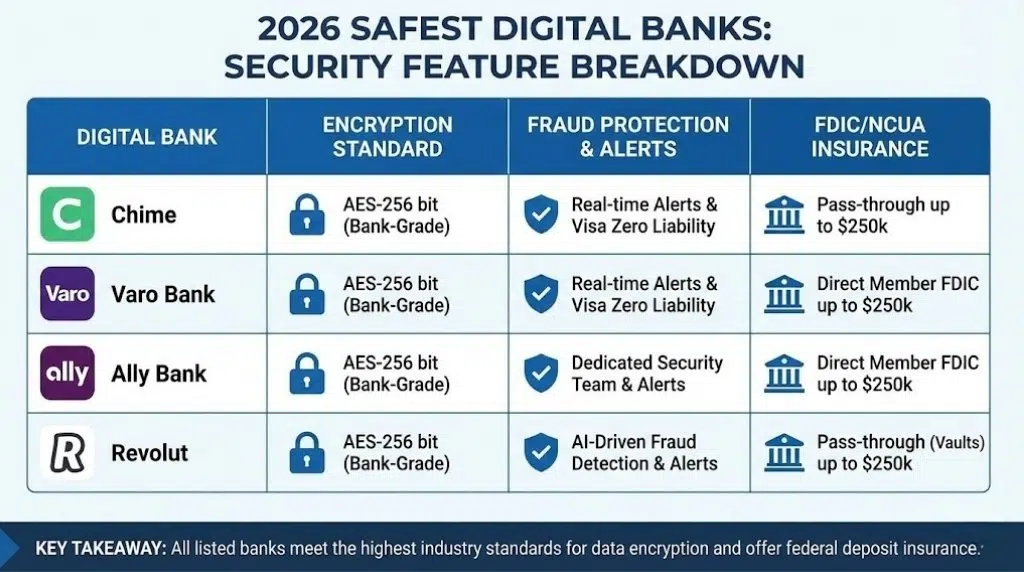
By 2026, Revolut has introduced facial recognition protocols for physical ATM withdrawals in high-risk zones, ensuring that even if a physical card is stolen, the funds remain inaccessible. Furthermore, their implementation of eSIM-bound security ensures that users are protected against SIM-swapping—a common vulnerability where hackers take over a phone number to intercept 2FA codes.
Best For: International travelers and digital nomads who need a bank that understands cross-border spending patterns without triggering unnecessary freezes.
Pros:
- Real-time Behavioral Analysis: Prevents an estimated 25% more fraud losses compared to traditional banking models.
- Dynamic Disposable Cards: Allows users to generate one-time-use virtual cards for online shopping, neutralizing the threat of data breaches at the merchant level.
Cons:
- Tiered Security: Many of the most advanced insurance and protection features are locked behind the Metal or Ultra paid subscriptions.
2. JPMorgan Chase: The AI Fortress
While often viewed as a traditional giant, the Chase digital suite is powered by the COiN platform—one of the most advanced financial AI infrastructures in the world. As one of the safest digital banks, Chase utilizes multimodal AI detection that looks at more than just the “where” and “when” of a purchase. It analyzes the “how”—the specific way a user interacts with the app, the speed of typing, and the device’s unique hardware signatures.
In 2026, Chase integrated “Explainable AI” (XAI). This technology allows the bank’s security team to see exactly why a transaction was flagged, reducing “false positives” by 40%. This means you are less likely to have your card declined at a legitimate grocery store, while sophisticated fraud rings are blocked with surgical precision.
Best For: Users who want the security of a global “too big to fail” institution combined with cutting-edge Silicon Valley tech.
Pros:
- Graph Neural Networks: These detect complex money-laundering and fraud patterns that span across thousands of accounts.
- Massive Recovery Power: Being a global leader, their ability to claw back fraudulent transfers is arguably the best in the industry.
Cons:
- Interface Complexity: Because it offers so many features, the security settings menu can be overwhelming for a casual user.
3. Nubank: The Privacy-Centric Innovator
Nubank has revolutionized the Latin American market and expanded globally by focusing on “Micro-Personalization.” Their standout security feature is the “Financial Twin.” This is an encrypted, AI-generated model of your typical spending habits that lives on the bank’s servers. If a transaction occurs that significantly deviates from the “Twin’s” predicted behavior, the bank initiates a silent verification process that doesn’t disrupt the user unless a threat is confirmed.
What truly makes Nubank one of the safest digital banks is their commitment to federated learning. This allows their AI to learn how to spot new fraud trends by analyzing data across millions of devices without ever actually seeing the private data of the users. Your data stays on your phone, but the bank gets smarter at protecting you.
Best For: Privacy-conscious individuals who want elite security but are wary of how banks handle their personal behavioral data.
Pros:
- 95% Detection Accuracy: Their decentralized training model is incredibly efficient at spotting “zero-day” fraud attempts.
- Intuitive “Silent Watcher”: Behavioral biometrics monitor the angle at which you hold your phone and your scrolling speed to ensure it’s really you.
Cons:
- Regional Focus: While expanding, many of their most innovative features are still rolling out slowly to non-LATAM markets.
4. GXS Bank: The Passwordless Pioneer
GXS Bank has taken the boldest step in 2026 by moving toward a completely passwordless environment. They utilize “Multi-Modal Biometric Fusion,” which requires a combination of two or more biometric markers (such as face and voice, or iris and fingerprint) to authorize high-value movements of money. This eliminates the “single point of failure” inherent in passwords or single-biometric systems.
Furthermore, GXS utilizes device-bound passkeys based on the FIDO2 standard. This means your “key” is a physical piece of encrypted hardware inside your phone’s secure enclave. Because this key never leaves the device, it is virtually impossible to phish or steal remotely. For those looking for the safest digital banks, GXS represents the absolute peak of hardware-level security.
Best For: Tech-savvy users who want to eliminate the hassle and security risk of managing passwords.
Pros:
- Phishing Immunity: Since there is no password to type into a fake website, phishing attacks are effectively neutralized.
- Deepfake Protection: Their “Liveness Intelligence” can distinguish between a real human face and a high-resolution video or deepfake.
Cons:
- Hardware Dependent: You must own a relatively modern smartphone with high-end biometric sensors to take full advantage of their security stack.
How to Choose the Safest Digital Bank
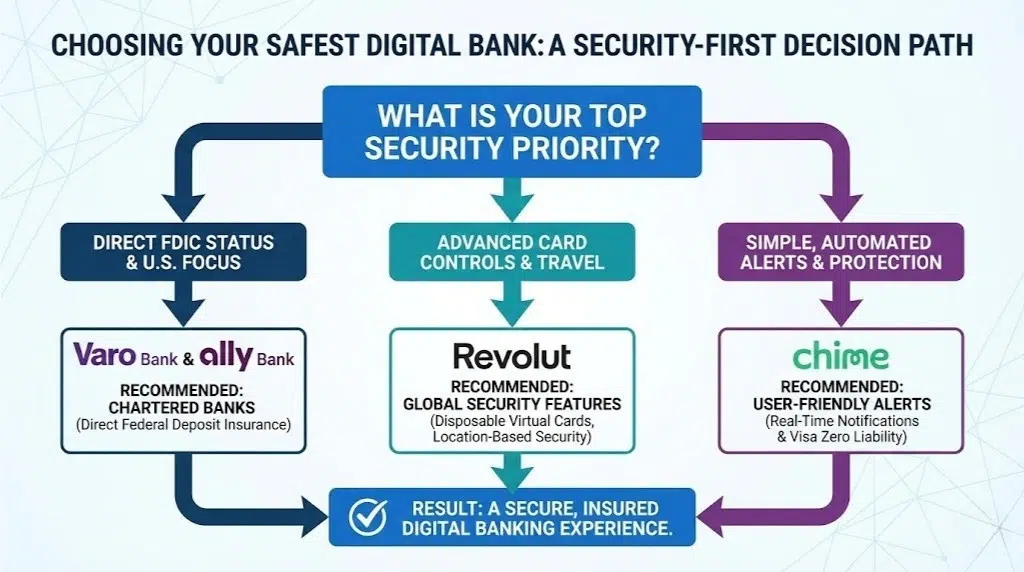
Evaluating a bank’s security requires looking past the marketing and into the technical specifications. The safest option for you depends on your device habits and your tolerance for friction during the login process.
Technical Security Checklist:
-
Passkey Support: Does the bank use FIDO-standard hardware keys?
-
Liveness Detection: Can the biometric system tell the difference between a photo and a live person?
-
Zero-Knowledge Architecture: Does the bank minimize the amount of your personal data stored in a central, hackable cloud?
-
Auto-Freezing: Does the AI have the authority to pause a card instantly based on behavioral anomalies?
| If you value… | Look for… | Key Tech Term |
| Data Privacy | Federated Learning | “Decentralized AI Training” |
| Ease of Use | Passwordless Login | “FIDO2 Passkeys” |
| High Stakes Tech | Biometric Fusion | “Multimodal Authentication” |
| Active Defense | Agentic AI | “Proactive Fraud Assistant” |
Can’t make up your mind?
-
Best Overall Security Tech: JPMorgan Chase (Leverages massive-scale institutional AI for predictive threat modeling)
-
Best for Fraud Prevention: Revolut (Exceptional real-time behavioral analysis for international transactions)
-
Best for Biometric Innovation: GXS Bank (A pioneer in eliminating passwords through multimodal biometric fusion)
-
Best for Personal Privacy: Nubank (Utilizes federated learning to secure data without centralized exposure)
Wrap-Up: Banking with Confidence
As we navigate 2026, the safest digital banks have proven that technology is our greatest ally in the fight against financial crime. By moving away from vulnerable passwords and toward AI-driven, biometric-focused ecosystems, institutions like Revolut, Chase, Nubank, and GXS are redefining trust.
When choosing your next financial home, don’t just look at the interest rates—look at the “Security Tech Stack.” Protecting your digital wealth requires a bank that is as technologically advanced as the threats it faces.