You sit in a big lecture hall with hundreds of other students. The professor stands at the front, talking for an hour while you try to keep your eyes open or scribble notes. Learning feels slow, and it is easy to get distracted. Many students want something better than staring at slides, but do not know where to find it. Did you know that Virtual Reality in Higher Education is changing how college classes work?
More schools use headsets and virtual spaces for lessons, labs, or even group projects. VR makes learning active instead of passive. This blog will show how VR can help you learn more and remember what you study longer. I share facts about how this tech improves focus, lets anyone join from anywhere, and cuts costs on big campus buildings.
Stick around, and I will show you why the classroom you know might soon be history.
The Shift from Traditional Lecture Halls to Virtual Reality
As a technical writer and front-end engineer, I spend my days breaking down complex systems into pieces people can actually understand. I look at education the same way I look at code: if the user experience is clunky and slow, it needs a refactor.
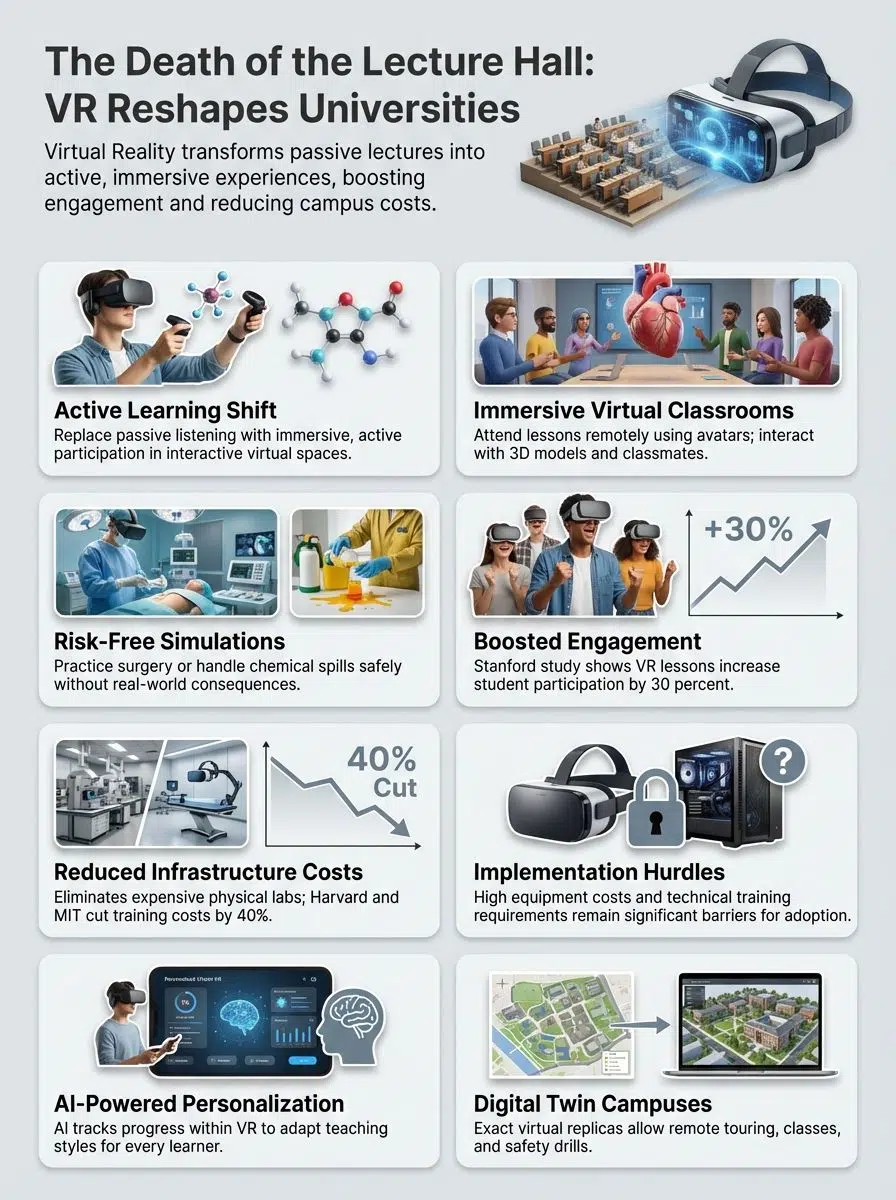
Lecture halls are the old legacy code of universities. They were built for a time when information only flowed one way. Now, learners put on a headset and enter virtual experiences built for interactive lessons. Students can walk through ancient Rome, explore the inside of a cell, or collaborate in real-time, all from their bedrooms.
Suddenly, learning feels like stepping into the story instead of just reading about it.
Major schools are already deploying this “update.” Morehouse College in Atlanta created a full “Metaversity” using the VictoryXR platform. Their students attend class as avatars on a digital twin of their campus. They do not just watch a video about history; they stand on a virtual ship to understand the Middle Passage.
Universities save money on buildings, and students skip long commutes. Virtual Reality is changing where we learn and how we connect and engage with information each day.
Practical Applications of VR in Higher Education
Step into a digital classroom, where professors and students meet without ever leaving home. Imagine learning by doing, exploring worlds once locked inside textbooks.
Virtual classrooms and immersive learning environments
Virtual classrooms let students attend lessons from home, dorms, or even a coffee shop. With Virtual Reality headsets, users feel like they are sitting in the same room as their classmates and teacher.
Interactive whiteboards, 3D models, and digital labs help bring hard topics to life. A chemistry lesson can show atoms swirling around your desk, while history class might transport you to the Colosseum.
Arizona State University successfully replaced standard biology labs with Dreamscape Learn. This VR program places students in an “Alien Zoo” where they must solve problems like a scientist. The results were clear: students in the VR track finished with grades nearly a full letter higher than those in the traditional lab. Teachers find it easier to spot confused faces with real-time avatars instead of rows of blank screens on Zoom calls.
Simulations for complex real-world scenarios
Students can practice surgery, fly a plane, or handle chemical spills in VR. No risk of harm, but all the tension stays real.
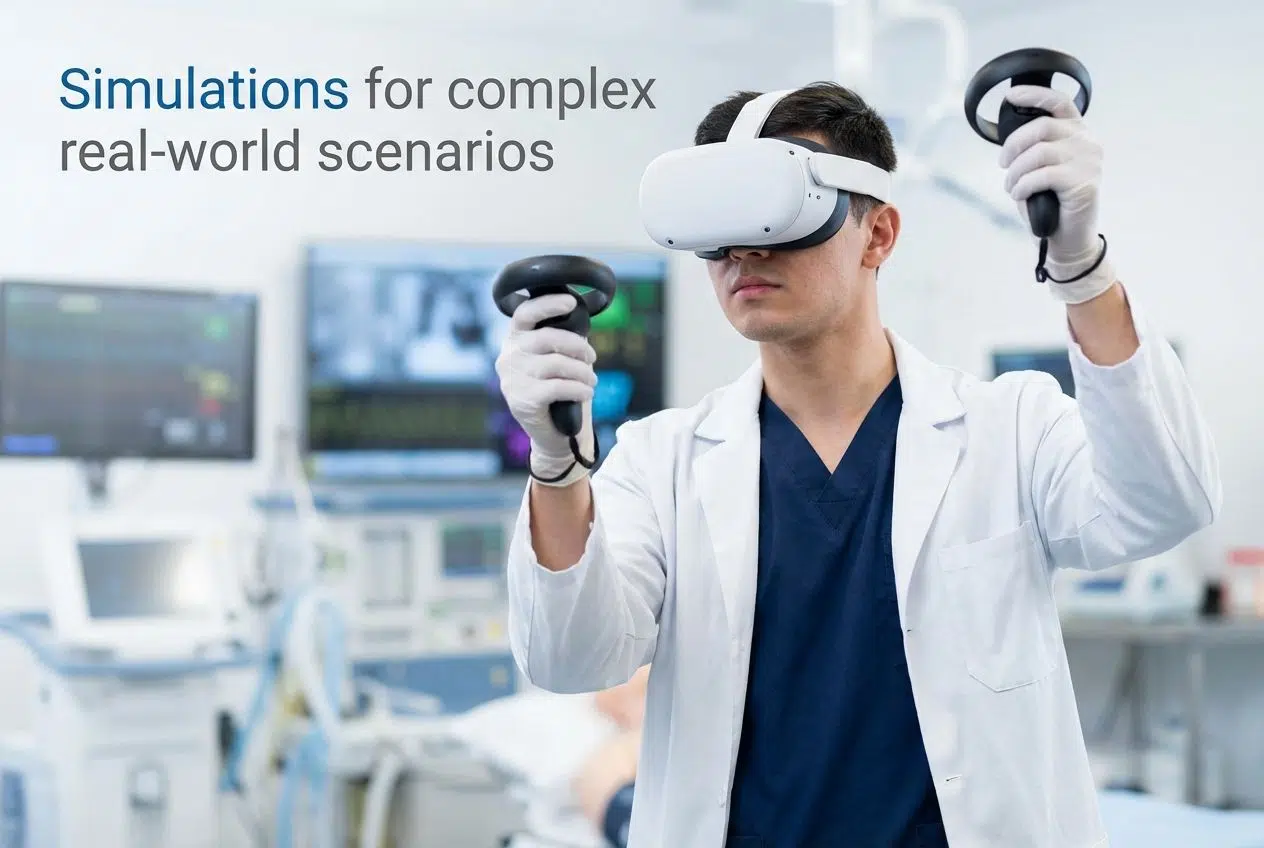
Medical schools are seeing massive benefits here. Fisk University uses VR cadavers instead of real human bodies. A real cadaver costs about $5,000 to $10,000 and requires expensive ventilation and chemicals. A digital cadaver lab costs a fraction of that over time and never degrades.
Business majors learn negotiation skills by acting out deals with virtual partners who never break character. VR lets engineering students test bridges for earthquakes without leaving their dorms. Firefighting cadets train inside simulated burning buildings and feel the heat as they search for survivors. These hands-on lessons build confidence fast and make big ideas stick.
Virtual campus tours and orientation
After exploring simulations for tough real-world challenges, let’s turn to virtual campus tours and orientation. Many colleges now use Virtual Reality to help newcomers find their way before ever setting foot on campus.
Picture a headset sliding over your eyes. Suddenly, you are walking through busy quads, checking out classrooms, or scoping out dorms as if you’re there in person.
The University of Maryland Global Campus (UMGC) took this a step further. They built a “digital twin” of their campus where students can meet admissions counselors and visit the library in a purely digital space.
With digital learning tools like these, students from any city or country get the same chance to explore a university from home. No more maze-like first days! Tools like these save time and help remove stress for both shy freshmen and remote learners.
Collaborative learning through virtual spaces
Students meet up for virtual campus tours and orientation, then move into shared online classrooms. Here, they work together like a team. Platforms like EngageVR and Spatial allow students to upload 3D models and manipulate them together. If you are an engineering student, you can pull apart a jet engine model with a friend who lives three states away.
VR tools let students discuss ideas in real-time using avatars and voice chat. Group work feels less awkward because everyone gets to speak and listen without needing to sit side by side in one room.
Teachers join breakout rooms or supervise while groups solve puzzles together or run science experiments inside VR labs. This makes active learning natural instead of the forced teamwork often found in old lecture halls.
Benefits of VR in Universities
VR brings classrooms to life, grabbing students’ attention like never before. It shapes new paths for learning, making study feel less like a chore and more like a discovery process.
Enhanced student engagement and motivation
Students interact more in virtual classrooms. Virtual Reality makes learning active and fun. They can walk through ancient cities, build molecules, or run science experiments without leaving their rooms.
A 2024 report on the Labster platform highlighted that 90% of students felt more confident in their knowledge after using virtual labs. Even shy students join discussions or group projects since avatars feel less intimidating than big lecture halls.
Gamified tasks in immersive spaces spark friendly competition and curiosity. Scores and badges make achievements clear right away, keeping spirits high and boredom low. Students remember what they learn because they see and do things themselves, instead of just listening to a professor talk for hours straight.
Improved knowledge retention and conceptual understanding
VR makes learning stick. Interactive 3D lessons, like exploring the human heart or a chemical reaction, let people see and touch ideas.
When you “do” something, you remember it better than when you just hear it. A study by PwC found that VR learners were 275% more confident to act on what they learned compared to classroom learners. They also trained four times faster.
| Metric | Traditional Classroom | Virtual Reality (VR) |
|---|---|---|
| Training Speed | Baseline (2 hours) | 4x Faster (30 mins) |
| Confidence to Apply Skills | Baseline | 275% Higher |
| Emotional Connection | Baseline | 3.75x Higher |
Students get instant feedback too, fixing mistakes quickly instead of waiting for grades later. Immersive experiences help students grasp tough concepts that are hard to picture on paper.
Accessibility for remote learners
Students in rural areas, crowded cities, or even other countries can join classes through virtual reality. A student living miles from campus slips on a headset and sits side-by-side with peers in a digital classroom. Learners with disabilities gain new ways to participate using tools that match their needs. VR classrooms break down barriers of distance, busy schedules, and even limited mobility.
Colleges are no longer bound by brick-and-mortar walls or packed lecture halls. With online education powered by virtual reality, each learner gets the chance to engage deeply without leaving home.
Cost-effective alternatives to physical infrastructure
Virtual Reality cuts down the big bills of building and keeping lecture halls. No need for rows of desks, heavy chairs, or high electric costs for bright lights and air conditioning. Consider the cost of a science lab. A single mass spectrometer can cost $50,000. In a VR simulation like Labster, every student gets their own machine for the price of a software license.
Professors create lessons only once in the software. Every new group joins in without extra setup each year. Old buildings need fixes all the time, new roofs, paint jobs, and better Wi-Fi, but a virtual campus skips most of that expense entirely.
Now universities use those savings on scholarships or better online learning tools instead of brick-and-mortar upkeep. Everyone wins: the school saves cash, students spend less on travel and books, and parents breathe easier about college bills getting lighter.
Challenges of Implementing VR in Higher Education
Getting VR into universities throws up big hurdles, so stick around to see what makes this tech such a tricky guest on campus.
High initial costs and resource requirements
Virtual Reality needs strong computers, headsets, cameras, and stable Wi-Fi. These tools can cost thousands of dollars for each student station. A Meta Quest 3 headset costs around $500, while a high-end Apple Vision Pro can run $3,500.
Schools must also update servers and buy special software for better security. This equipment uses a lot of energy and space. Staff need time to learn new systems as well.
Smaller colleges or those in rural areas might struggle more with these demands than bigger schools with large budgets. For many, these high costs make it hard to add Virtual Reality into daily teaching right away.
Need for technical training for faculty and students
Faculty and students must learn to use new VR tools. Many professors grew up teaching in physical rooms, not inside virtual classrooms. Some may feel lost without chalk, a whiteboard, or old lecture slides.
From a technical standpoint, the biggest headache is often Mobile Device Management (MDM). Universities need dedicated IT staff just to make sure 500 headsets are charged, updated, and sanitized between classes. A “dead battery” excuse is the new “dog ate my homework.”
Many universities are now adding tech workshops as part of curriculum redesign. This helps both teachers and learners pick up skills in educational technology at their own pace. A small spark of support can turn nervousness into excitement for active learning online.
Limited access to VR devices in some regions
Some areas still struggle to get Virtual Reality devices. Slow internet, high costs, and weak supply chains make it hard. A school in rural India shared only three VR headsets for all science classes.
Many African universities report fewer than five working devices on campus, even in 2024. Lack of access blocks students from active learning and digital experiences like virtual classrooms or immersive campus tours.
This widens the gap between wealthy schools with advanced educational technology and those stuck using old lecture halls or outdated online education tools.
Future of VR in Universities
VR technology moves fast, leaving professors and students to race just to keep up. New ways of blending AI with digital campuses may soon feel as common as a regular backpack.
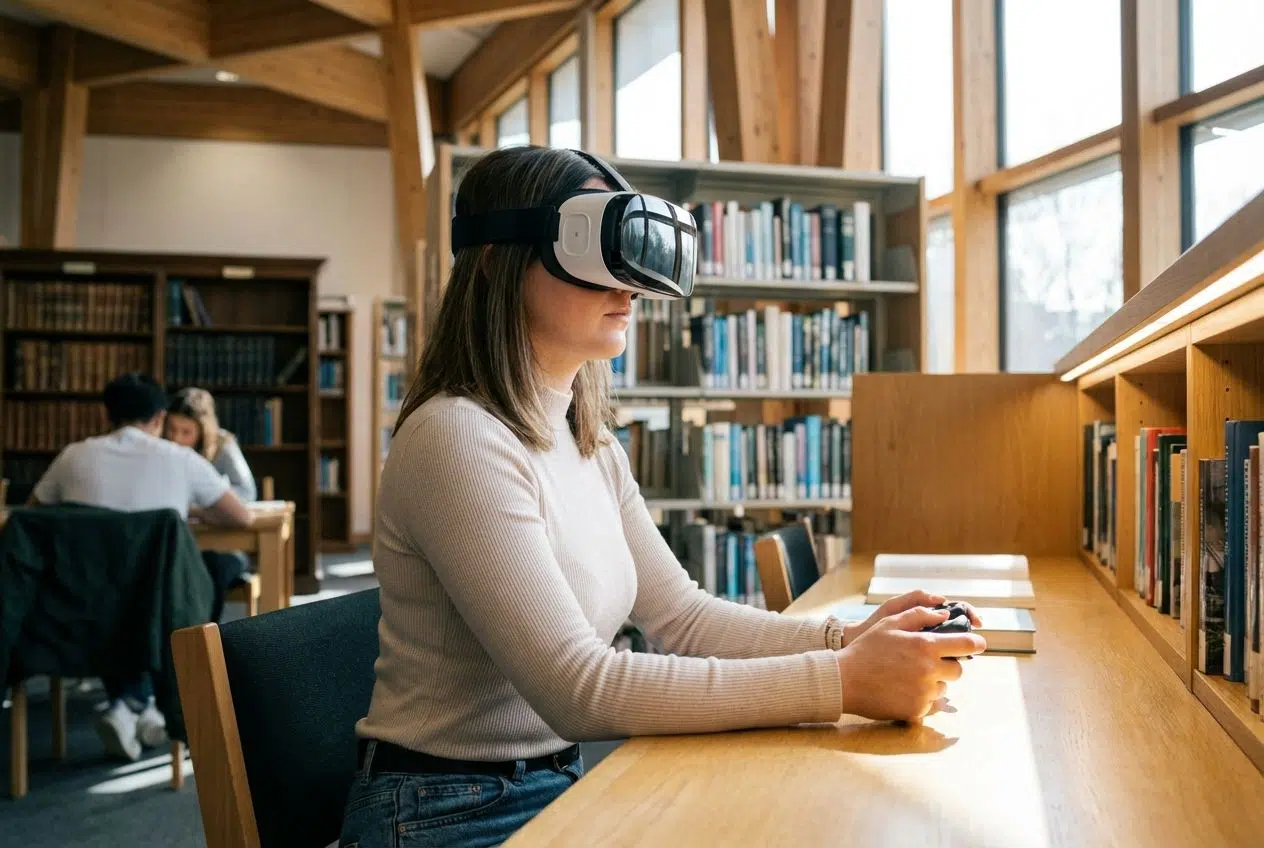
Integration with artificial intelligence and personalized learning
Artificial intelligence makes lessons smarter and faster. AI can track how each student learns in digital classrooms. Some students might need to slow down or get more practice, while others move ahead quickly.
VR combined with AI adapts teaching styles for every learner, almost like a coach whispering tips in your ear. Platforms like Cortex utilize AI to analyze student performance in real-time simulations.
Universities use these tools to give instant feedback on tests or activities. Algorithms check what you grasp and offer new tasks right away. This boosts engagement, keeps learners from feeling stuck, and helps professors spot problems early.
Development of digital twin campuses
Digital twin campuses use detailed virtual models to mirror real universities. Students can log in from home and walk through exact copies of lecture halls, labs, and libraries in Virtual Reality.
Morehouse College and New Mexico State University have both launched digital twin campuses. These aren’t just cartoons; they are accurate replicas where students can attend office hours or social events.
Faculty update virtual spaces fast, no paint or construction needed. In 2024, more major colleges started pilot programs for digital twin learning, with costs dropping each year due to better Educational Technology tools.
Digital twins support remote learners by offering a sense of place no matter where they live; it feels like being on campus while never leaving your room.
Expanding interdisciplinary applications of VR
Medical students use VR to practice surgeries and understand how the human body works. Art majors can explore famous art museums across continents in minutes without leaving their homes. History classes step into ancient cities, examine ruins, and watch real-time recreations of historic events unfold around them. Engineering teams design bridges or test machines together inside a shared virtual workshop.
Professors from different departments now work side by side using VR spaces. They bring chemistry, coding, and even language lessons to life with hands-on activities instead of chalkboard talks.
Learning flows between subjects; students build projects that connect science with storytelling or blend physics with visual design tools. These new methods spark creativity and teamwork everywhere on campus.
The Role of VR in Developing Future Skills
VR hands students new tools for work and life, with quick feedback and real action. They get to try, fail, repeat, then improve in a safe space that feels almost real.
Soft Skills Training through VR Scenarios
Students step into virtual meetings, job interviews, and group projects. In these spaces, they read body language, practice active listening, and learn to handle tough conversations.
Tools like Talespin and Bodyswaps use AI-driven avatars to simulate difficult workplace conversations. A student can practice firing an employee or calming down an angry client.
The 2023 PwC study I mentioned earlier showed VR learners gain confidence up to four times quicker than in-person classroom students during soft skill exercises. Digital learning tools help learners improve leadership, teamwork, and communication much faster than old-school lectures ever could. Mistakes stay private in the headset instead of on a big stage; nobody else sees it but you and the code running your simulation.
Professional Development and Career Preparation
Virtual Reality helps learners practice job skills in safe spaces. It can put people in lifelike environments, such as medical labs or business meetings, letting them make choices and see results right away.
Walmart uses VR to train store managers, and FedEx uses it to train package handlers on safe lifting techniques. Universities are adopting these same enterprise tools to get students ready for day one on the job.
Mock interviews come alive through digital avatars and real-time feedback. Career coaching moves beyond slideshows into hands-on sessions where users build public speaking confidence and teamwork habits inside virtual boardrooms.
Bottom Line: The New Reality of Embracing the “Metaversity”
Universities now face a big shift. Students put on VR headsets and meet in online classes instead of walking into large, cold lecture halls. Professors guide lessons inside immersive experiences, not from a stage with rows of seats. Schools like Morehouse College even teach lab science or history right inside digital worlds.
Hybrid learning means a classroom can reach anyone, anywhere. Blended learning now mixes hands-on practice with interactive technology. This new way builds stronger collaboration and deeper student engagement than chalkboards ever did. Metaversity models break down old walls and support active learning for everyone, whether they are nearby or far away.
Virtual Reality in Higher Education becomes more open, creative, and flexible every day as universities explore this new space called the metaverse campus.