
Do you ever feel like the rules around digital money change every time you blink? You aren’t the only one. For years, trying to keep up with crypto laws felt like watching a game where the referee made up the rules as they went along.
But here we are in 2026, and things look a lot different. Governments have moved past the confusion and started building real safety nets. For the first time, we have clear global standards that protect your wallet without killing the innovation that makes crypto exciting.
In this guide, I’m going to walk you through exactly what these new changes mean for your money. Whether you hold Bitcoin, trade stablecoins, or just want to know if your exchange is safe, I’ll break it down into simple, plain English. Let’s see how the new rules in 2026 are finally making the crypto world a safer place for all of us.
The State of Global Crypto Regulation in 2026
If you remember the “Wild West” days of 2022, you’ll notice a massive shift this year. Rules for digital coins have finally grown up. The goal isn’t just to punish bad behavior anymore; it’s to create a playground where everyone knows the boundaries.
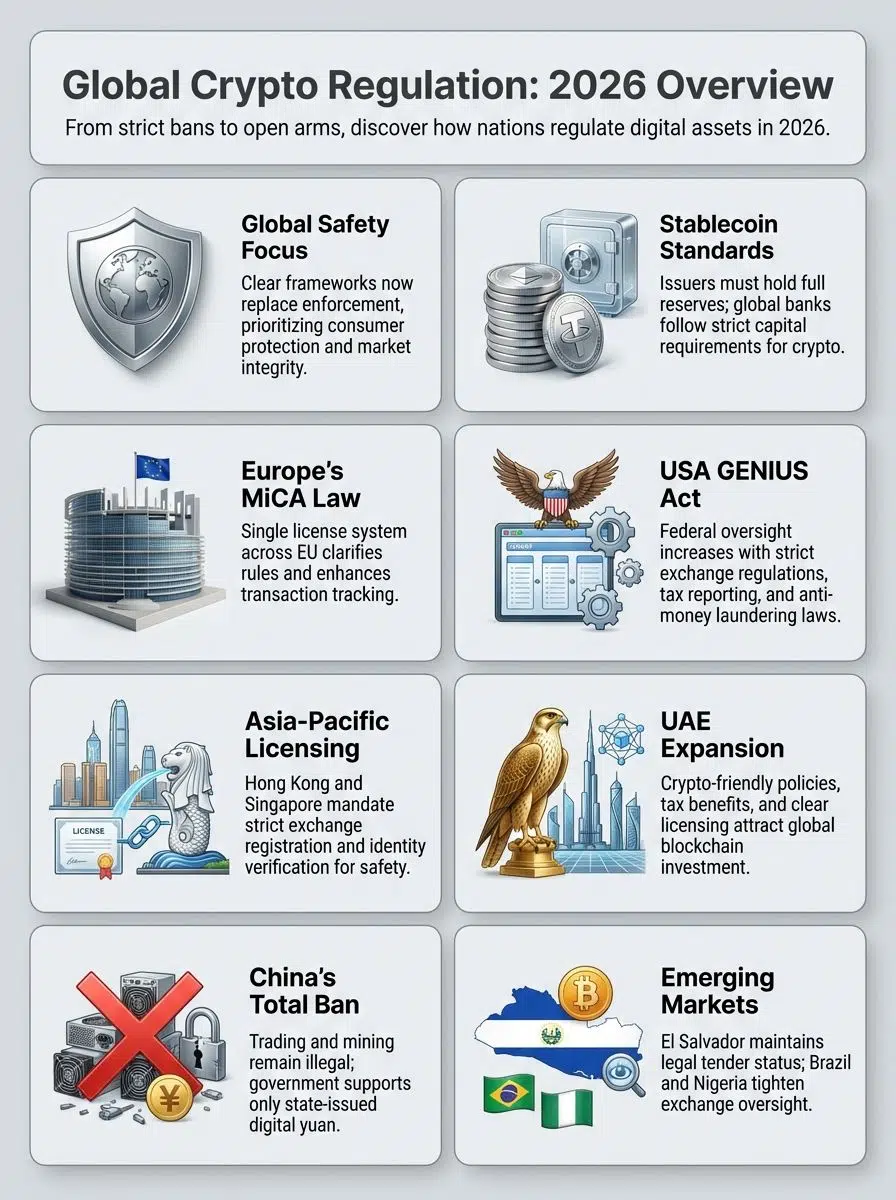
From Whack-a-Mole to Real Frameworks
For a long time, regulators just chased after scams after they happened. It was messy and ineffective. Now, major economies have shifted to comprehensive frameworks that stop problems before they start.
Two massive changes set the stage for where we are today:
- The Basel Committee Standards (Jan 1, 2026): As of New Year’s Day, global banks officially started following strict capital rules for crypto. If a bank wants to hold Bitcoin, they now have to set aside extra capital to cover potential losses. This makes the whole financial system much more stable.
- EU’s MiCA Full Rollout: While the European Union passed MiCA back in 2024, it became fully enforceable across all 27 member states by the end of that year. Today, it stands as the “gold standard” that other regions copy.
Regulators want to prevent fraud but also help blockchain grow safely with global standards in place. Japan, for instance, has refined its licensing system to the point where it’s now one of the hardest markets for hackers to crack.
A solid legal framework doesn’t just catch crooks; it gives honest folks the confidence to build wealth.
Safety First: Protecting Your Wallet
The biggest win for us in 2026 is the focus on consumer protection. Authorities now watch over digital assets with the same intensity they apply to the stock market. Stricter rules demand that companies handle your money with extreme care.
In the United States, the GENIUS Act of 2025 changed the game for how platforms treat user funds. Before this law, if an exchange went bankrupt, your crypto might have been used to pay off its debts. Now, user assets must be kept completely separate from company funds.
Stablecoins also face tighter scrutiny. Under new laws, issuers can’t just promise they have the money; they have to prove it. If you hold a regulated stablecoin today, there is a legal requirement for 1:1 liquid reserves backing it.
Key Trends in Crypto Regulation
New rules now highlight security and trust for everyone, big or small, using digital coins. Watch how these shifts start shaping the way firms work with crypto day by day.
Stablecoin Standards and Reserve Requirements
Stablecoins are the backbone of the crypto market, and in 2026, they are safer than ever. Regulators realized that if stablecoins fail, the whole market crashes. So, they fixed the foundation.
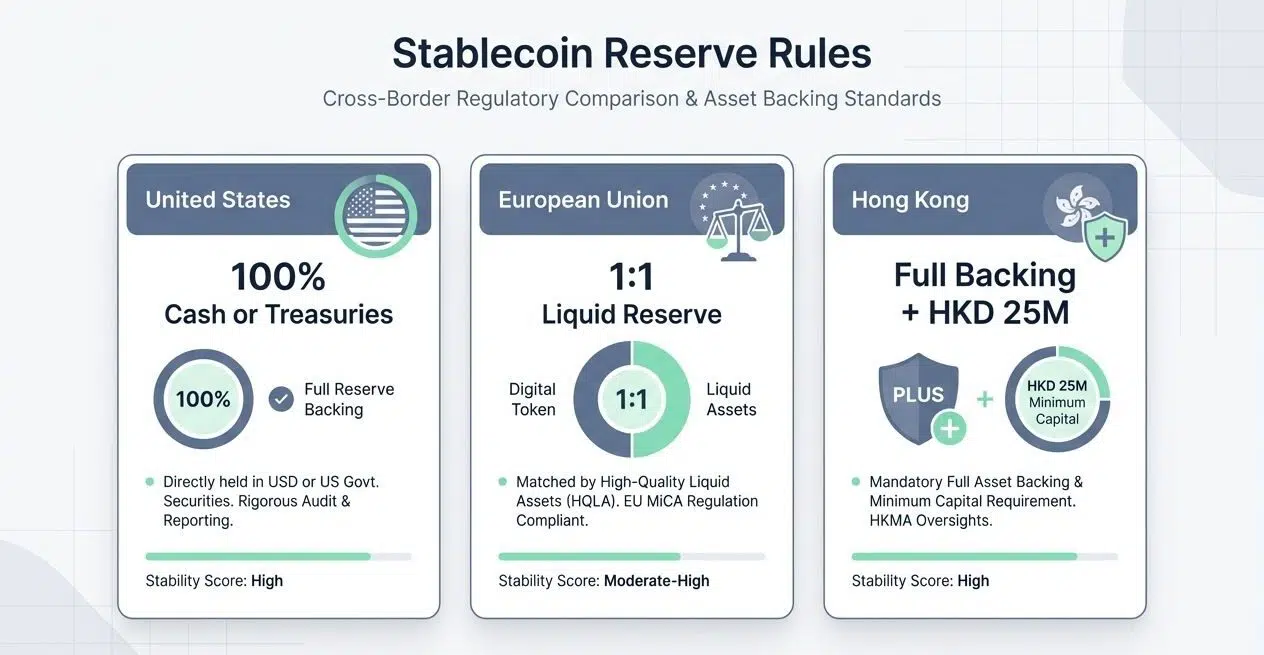
Most major jurisdictions now enforce 100% reserve backing. This means for every $1 digital coin issued, the company must hold $1 in cash or short-term government treasuries. Here is how the top regions compare:
| Region | Key Regulation | Reserve Requirement |
|---|---|---|
| United States | GENIUS Act (2025) | 100% Cash or Treasuries; Monthly Audits |
| European Union | MiCA | 1:1 Liquid Reserve + Bankruptcy Protection |
| Hong Kong | Stablecoin Ordinance | Paid-up capital of HKD 25M + Full Backing |
The United States’ GENIUS Act also added a crucial safety layer: in the event of an issuer’s bankruptcy, stablecoin holders now have priority over other creditors. This stops the “run on the bank” panic we saw in previous years.
Institutional Adoption and Basel Standards
With safer stablecoins, the big players finally felt safe enough to enter the room. In 2026, institutional adoption is no longer just talk; it’s happening at scale.
The Basel Committee’s standards, implemented in January 2026, split crypto into two groups for banks:
- Group 1 (Safe): Tokenized assets and regulated stablecoins. Banks can handle these easily.
- Group 2 (Volatile): Assets like Bitcoin and Ethereum. Banks must hold significant capital to protect against price drops.
Firms like JPMorgan and Goldman Sachs spent all of 2025 updating their systems to meet these rules. The result? You can now see traditional banks offering crypto custody services that are actually regulated and insured.
Cross-Border Regulatory Collaboration
Money moves fast, but crypto moves instantly. Governments realized they couldn’t work in silos anymore. In 2026, international cooperation is the new normal.
Groups like the Financial Stability Board (FSB) and IOSCO have pushed for “same activity, same risk, same regulation.” This means a crypto exchange in London follows nearly the same rules as one in New York or Singapore.
This teamwork has made it much harder for criminals to hide. The “Travel Rule”, which requires exchanges to share sender info for large transfers, is now strictly enforced in the UAE, US, EU, and parts of Asia. If a hacker steals funds, it is now incredibly difficult for them to cash out at a major exchange.
Regional Approaches to Crypto Regulation
While everyone agrees on safety, each region has its own playbook. Some build strict walls, while others open wide doors. Let’s look at the big contrasts.
Europe: The MiCA Standard
Europe was the first mover, and it paid off. The Markets in Crypto-Assets (MiCA) framework is now fully operational. If a crypto firm wants to serve customers in France, Germany, or Italy, they only need one license to operate across the entire EU.
This clarity has attracted businesses. However, it also brought a cleanup. In late 2024, major exchanges like Coinbase had to delist stablecoins that didn’t meet MiCA’s strict EMI (Electronic Money Institution) standards. Today, European users have fewer options, but the ones that remain are highly regulated and transparent.
United States: The GENIUS Act Era
After years of confusion and “regulation by enforcement,” the US finally provided clarity with the passage of the GENIUS Act on July 18, 2025. This law finally defined the roles of the SEC and CFTC.
Key changes you should know:
- Federal Floor: State laws are no longer the only guardrails; there is now a federal standard for payment stablecoins.
- Strict Liability: Issuers face heavy penalties for false marketing. You won’t see ads promising “risk-free 20% returns” anymore.
- Tax Reporting: The IRS rolled out strict reporting rules for crypto brokers in 2026, meaning your transaction history is much more visible to the tax man.
Asia-Pacific: Licensing Hubs
Hong Kong and Singapore are in a friendly race to be the crypto capital of Asia. Their strategy? Strict but clear licensing.
Hong Kong introduced its specific Stablecoin Issuer Ordinance effective August 1, 2025. As of January 2026, the Securities and Futures Commission (SFC) has granted licenses to 11 major Virtual Asset Trading Platforms (VATPs), including big local players like OSL and HashKey. If an exchange isn’t on that list, they cannot legally market to you in Hong Kong.
Singapore continues to focus on institutional use cases. The Monetary Authority of Singapore (MAS) requires strong checks on customer identity and has led the way in testing “purpose-bound money” for government grants.
Middle East: The UAE’s Crypto Oasis
The UAE remains a top destination for crypto businesses. Dubai’s Virtual Assets Regulatory Authority (VARA) released its Rulebook 2.0 in May 2025, which simplified compliance for smaller firms while tightening rules on marketing.
These crypto-friendly policies have worked. Major banks in the region have joined blockchain projects, and the tax benefits continue to attract startups. The clarity from VARA has made Dubai a global entry point for Web3 companies.
Restrictive Markets
Not every country is rolling out the red carpet. Some nations still view crypto as a threat to their financial control and maintain strict bans.
China: The Great Wall of Crypto
China’s stance hasn’t softened. The ban on trading, mining, and exchange services remains firm in 2026. The government supports only the Digital Yuan (e-CNY), which is a central bank digital currency, not a private crypto.
Police actively monitor online platforms for any signs of token promotion. While some tech-savvy users find workarounds, the legal risks are massive. For the average person in China, crypto is effectively off-limits.
Other restrictive nations
China isn’t alone in this approach. Several other nations maintain high barriers:
- India: While not a total ban, the environment is harsh. A 30% flat tax on gains and a 1% “Tax Deducted at Source” (TDS) on every trade make frequent trading very expensive.
- Egypt & Morocco: Both countries continue to ban crypto trading outright, citing financial risk and religious concerns.
- Bolivia: The central bank has kept decentralized currencies off-limits since 2014, focusing instead on modernizing its traditional payment systems.
Emerging Markets and Crypto Adoption
In regions with high inflation or limited banking access, crypto isn’t just an investment; it’s a lifeline. Governments here are moving fast to regulate it so people can use it safely.

Latin America: Brazil Leads the Way
Brazil has become a powerhouse for digital finance. Following the full implementation of Law 14,478, the country saw huge growth. In 2024 alone, Brazil received an estimated $318 billion in crypto value.
The Central Bank of Brazil is also pushing forward with Drex (the digital real), which integrates with regulated crypto platforms. This smart regulation means you can now pay for groceries or services using crypto-backed cards in cities like São Paulo more easily than ever.
El Salvador continues its Bitcoin experiment. By 2026, the focus has shifted from simple adoption to building a “Bitcoin City” economy, offering tax breaks to attract tech talent and miners.
Africa: Licensing and Growth
Africa is seeing some of the most practical uses of crypto for cross-border payments. Governments are catching up to the demand.
South Africa has taken a strong lead. The Financial Sector Conduct Authority (FSCA) mandated that all crypto exchanges get licensed. As of December 2025, they have approved over 300 Crypto Asset Service Provider (CASP) licenses. This stamp of approval has boosted trust significantly.
Nigeria has also pivoted. After years of tension, the SEC introduced the Accelerated Regulatory Incubation Program (ARIP). In late 2025, major local exchanges like Quidax and Busha received official “Approval-in-Principle,” moving the country’s massive crypto market out of the shadows and into the legal light.
The Road Ahead for Crypto Regulation
We have come a long way, but the work isn’t finished. As technology evolves, the rules have to keep up. Here is what experts are watching for the rest of 2026.
The Challenge of Global Alignment
Getting every country to agree is still tough. While the EU and the US have similar standards now, definitions still clash. For example, a token might be considered a utility in Switzerland but a security in the US.
This “taxonomy” problem makes it hard for companies to operate globally without hiring an army of lawyers. Groups like the Basel Committee are trying to fix this, but it’s a slow process.
Smart Compliance and DAOs
The next frontier is Decentralized Finance (DeFi). How do you regulate a computer program that no one controls? New innovations are helping:
- Embedded Supervision: Regulators are testing systems that automatically read blockchain data to check for compliance, removing the need for manual reports.
- DAO Legal Wrappers: New laws in places like Wyoming and the Marshall Islands allow Decentralized Autonomous Organizations (DAOs) to register as legal entities, giving them the right to sign contracts and pay taxes.
Wrapping Up
Crypto regulation in 2026 is all about safety, fairness, and clarity. We have moved past the fear of bans and into an era of clear rulebooks. Europe has MiCA, the US has the GENIUS Act, and Asia has strict licensing regimes that protect your funds.
Whether you are in Brazil using a crypto card or in South Africa trading on a licensed exchange, the environment is safer than it has ever been. The “Wild West” days are over, and a more mature, reliable market has taken their place.
Simple steps, such as checking if your exchange is licensed, can now save you from 90% of the risks that plagued the industry years ago. It’s easier to be smart with your money when the rules are written down in black and white. So, take advantage of these new protections. Do your research, stick to regulated platforms, and you can explore this technology with confidence.